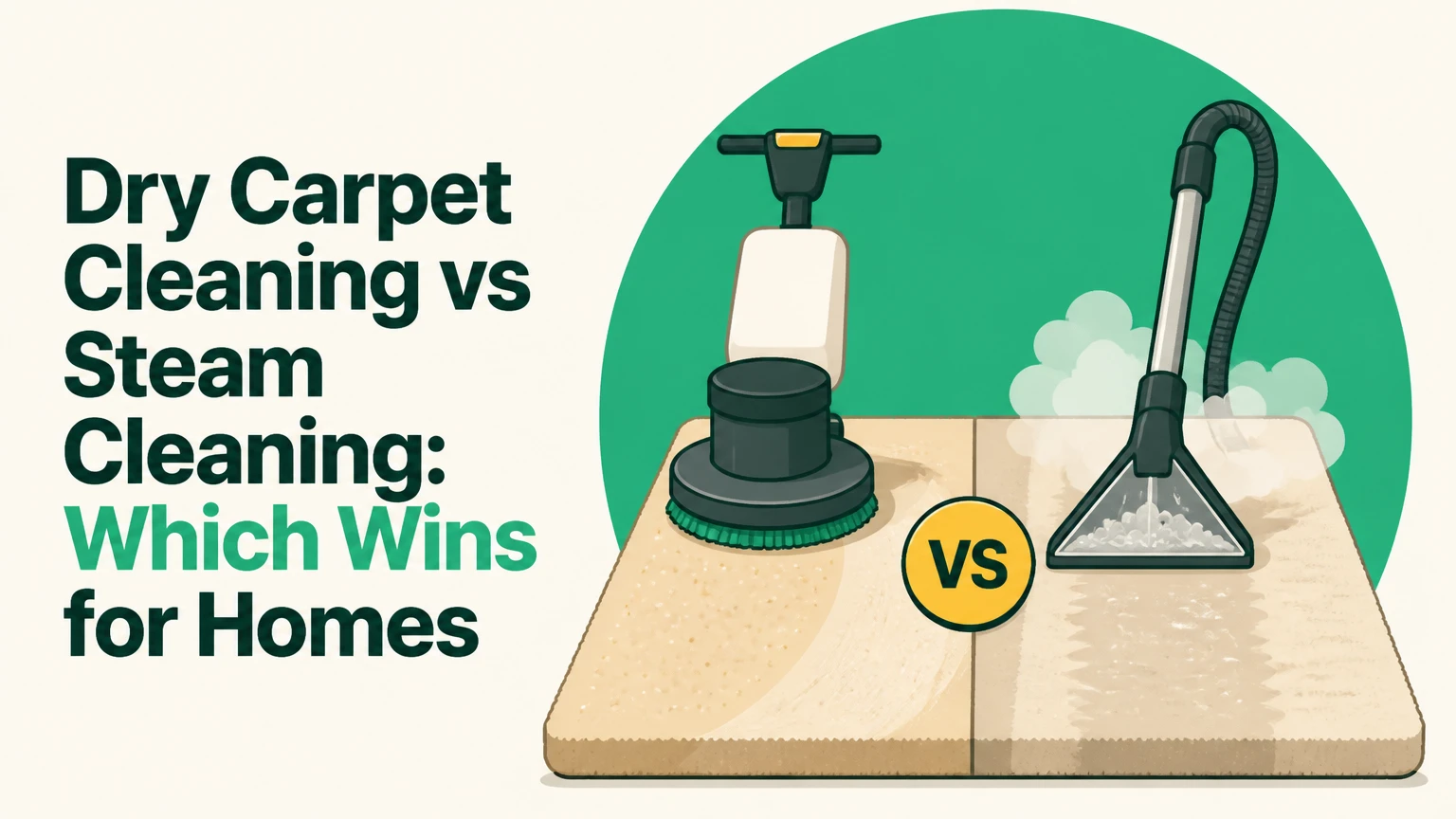
Dry carpet cleaning suits fast maintenance and short drying windows, while steam cleaning, more accurately called hot water extraction, removes more embedded soil from most synthetic carpets. Choose hot water extraction for heavy soil, urine contamination, allergies, or overdue restorative cleaning; choose low-moisture cleaning for light soil, commercial spaces, delicate fibers, or rooms that must reopen quickly.
Key facts at a glance
Hot water extraction reaches deeper into carpet pile and backing than most low-moisture methods.
Dry carpet cleaning usually leaves carpets ready for use within 30 minutes to 2 hours.
Professionally extracted carpet commonly needs 6-12 hours to dry, depending on airflow, humidity, and carpet construction.
Encapsulation is a low-moisture maintenance method, not a complete substitute for restorative extraction in heavily soiled carpet.
“Steam cleaning” is usually a consumer term for hot water extraction; professional equipment primarily sprays hot water and immediately recovers it.
Carpet fiber, backing, contamination type, technician skill, and drying conditions matter more than the method label alone.
What Is the Difference Between Dry Carpet Cleaning and Steam Cleaning?
The central difference is soil transport. Dry carpet cleaning loosens or absorbs soil with limited moisture, then removes the compound through vacuuming or mechanical action; hot water extraction suspends soil in a water-and-detergent solution and removes the slurry with strong vacuum recovery.
“Steam cleaning” creates confusion because many carpet-cleaning machines do not clean with vapor steam. The professional term is hot water extraction, or HWE. A truck-mounted or portable extractor applies a heated solution through a wand and recovers the liquid, dissolved soil, detergent, and suspended particles into a waste tank.
Dry carpet cleaning is an umbrella term for several very-low-moisture methods. Encapsulation applies a polymer detergent that crystallizes around soil as it dries. Absorbent-compound cleaning works a moist powder into the pile and vacuums it out. Bonnet cleaning transfers surface soil to a rotating damp pad. These methods are related, but they do not produce identical results.
The Carpet and Rug Institute’s consumer guidance is commonly summarized by its statement, “There is no one best method for cleaning carpet.” That principle is more useful than claims that one process always wins, because carpet construction and soil load determine the correct cleaning system.
How Do the Two Methods Work?
Hot water extraction uses chemistry, temperature, agitation, time, and recovery. Dry cleaning relies more heavily on chemical separation, brushing, absorbent media, and vacuuming.
How hot water extraction removes soil
A professional HWE visit normally follows this sequence:
- Inspect and identify the fiber. The technician checks fiber type, backing, installation, dye stability, wear, and pre-existing damage.
- Vacuum thoroughly. Dry vacuuming removes loose particulate soil before water turns remaining material into slurry.
- Apply pre-spray. An alkaline or fiber-appropriate detergent breaks bonds between oily soil and yarn.
- Agitate where needed. A CRB machine, brush, or carpet rake distributes chemistry through dense traffic lanes.
- Allow dwell time. Many products need approximately 5-15 minutes, without drying, to work on bonded soil.
- Extract. The wand injects solution and recovers it in overlapping passes. Extra dry passes remove residual moisture.
- Groom and accelerate drying. Pile is reset, furniture tabs are installed, and air movers improve evaporation.
A truck-mounted unit generally provides stronger vacuum recovery and higher sustained heat than a consumer machine. A portable extractor remains useful in apartments, high-rise buildings, and rooms inaccessible to truck hoses, but performance depends heavily on the machine’s lift, airflow, hose length, water temperature, and operator technique.
How low-moisture cleaning removes soil
Encapsulation cleaning sprays a polymer detergent, agitates it through the carpet, and allows the solution to dry into brittle crystals. Routine vacuuming removes those crystals and the soil attached to them. Some commercial systems combine pre-vacuuming, CRB agitation, and post-vacuuming in a single maintenance visit.
Absorbent-compound cleaning distributes a moist, solvent-treated powder through the pile. Counter-rotating brushes contact multiple sides of the yarn, and a commercial vacuum removes the compound after it absorbs soil. The method can produce a clean appearance without saturating backing.
Bonnet cleaning uses a rotary machine and damp absorbent pad. It is fast and useful for appearance maintenance on suitable commercial carpet, but it transfers soil from the upper pile rather than flushing contamination from the backing. Bonnet cleaning is therefore a poor choice for deep pet urine, heavy sand, or neglected residential carpet.
Which Method Cleans Deeper?
Hot water extraction is usually the stronger restorative method because liquid and vacuum recovery move suspended soil out of the pile. Low-moisture cleaning is better classified as maintenance cleaning, although skilled agitation and chemistry can remove substantial surface and mid-pile soil.
The difference becomes obvious with filtration soil, sand, cooking grease, and pet contamination. Dark soil at wall edges, compacted grit in traffic lanes, and urine salts below the visible surface require more than a cosmetic pass. HWE can reach those areas when the technician controls moisture and performs adequate recovery.
Depth does not mean unlimited extraction. Carpet backing, pad, subfloor, and contamination can restrict recovery. A heavily contaminated pad may require pad replacement or localized treatment, because no surface cleaning method can guarantee removal of every odor source.
| Decision factor | Hot water extraction | Encapsulation | Absorbent compound |
|---|---|---|---|
| Typical water load | 4-15 L per 100 sq ft | 0.5-1 L per 100 sq ft | 0.2-1 L per 100 sq ft |
| Primary soil path | Suspended slurry recovered by vacuum | Crystallized soil removed by vacuum | Soil absorbed into compound |
| Typical drying time | 6-24 hours | 30 minutes-2 hours | 30 minutes-2 hours |
| Best cleaning role | Restorative cleaning | Routine commercial maintenance | Low-moisture interim cleaning |
| Deep backing contamination | Strongest option | Limited | Limited |
| Main operator risk | Overwetting and slow drying | Residue or incomplete vacuuming | Powder residue and poor recovery |
Which Method Dries Faster?
Low-moisture cleaning dries faster in nearly every comparable installation. Encapsulation and compound cleaning typically allow careful foot traffic within 30 minutes to 2 hours, while properly performed HWE commonly requires 6-12 hours and can require 24 hours in humid, poorly ventilated conditions.
Drying time depends on more than water volume. Carpet density, pad thickness, indoor humidity, temperature, air movement, extraction passes, furniture placement, and the amount of prespray all change the result. A lightly wetted HWE job with air movers can dry sooner than an overloaded encapsulation job with sticky residue.
A carpet should feel dry at the backing, not merely at the yarn tips. Walking too soon can flatten damp pile, transfer soil from socks, and trap furniture impressions. Place plastic tabs or foil squares beneath furniture legs until the carpet is fully dry, especially when wood stain or metal rust is possible.
What does immediate use actually mean?
“Walk-on ready” does not mean fully dry or fully cleaned. A low-moisture carpet may tolerate light foot traffic, but heavy rolling loads, children’s play, pets, or furniture movement can disturb damp chemistry and redistribute soil.
For an office that must reopen in two hours, encapsulation is often practical. For a bedroom cleaned at 10 a.m. with ventilation and fans, HWE may be fully usable by evening. Scheduling should follow actual drying conditions rather than a fixed promise.
Which Method Removes Stains, Odors, and Allergens Better?
Hot water extraction generally removes more particulate soil, dander, dust, and water-soluble contamination. Neither HWE nor dry cleaning guarantees removal of every stain or odor, because the result depends on the contaminant, dwell time, dye damage, backing, pad, and previous cleaning attempts.
Pet urine illustrates the limitation. Fresh surface urine may respond to targeted treatment and extraction, but aged urine crystals can migrate into pad and subfloor. A cleaner may need ultraviolet inspection, controlled flushing, sub-surface treatment, pad replacement, or odor-sealing work. Dry cleaning can improve appearance while leaving the odor reservoir below the pile.
Oil-based soil is a different case. Low-moisture products containing appropriate solvents can perform well on greasy traffic lanes, especially when the carpet cannot remain wet. HWE also removes oily soil when the prespray, temperature, agitation, and rinse are correctly selected.
Heat alone should not be described as complete sanitization. HWE may reduce microbial and allergen load through detergent action, heat, and physical removal, but temperature, exposure time, and recovery vary across the carpet. Do not treat a normal carpet-cleaning visit as a guaranteed sterilization service.
| Soil or problem | Usually stronger first choice | Reason | Important limitation |
|---|---|---|---|
| Heavy sand and grit | HWE | Water suspends soil for vacuum recovery | Pad may retain contamination |
| Oily traffic lanes | HWE or encapsulation | Alkaline or solvent chemistry breaks oily bonds | Residue causes rapid resoiling |
| Fresh surface spill | Either method | Prompt blotting limits penetration | Dye transfer may be permanent |
| Aged pet urine | HWE with inspection | Better flushing potential | Pad or subfloor may need treatment |
| Dust and dander | HWE | Stronger particulate removal | Vacuuming remains essential |
| Rust or permanent dye | Specialist stain treatment | Cleaning cannot reverse fiber dye damage | Chemical reduction may alter color |
| Wool or plant fiber | Fiber-specific method | Heat and moisture tolerance vary | Manufacturer or rug specialist guidance required |
Is Dry Carpet Cleaning Safer for Wool and Delicate Fibers?
Low-moisture cleaning can reduce shrinkage, browning, dye migration, and slow drying, but “dry” does not automatically mean safe for wool, silk, viscose, sisal, jute, or coir. Fiber identification and testing must precede the method decision.
Wool can tolerate carefully controlled professional wet cleaning in some constructions, while other wool carpets or rugs require low-moisture procedures. Sisal, jute, and coir are especially sensitive to excess water and may brown, distort, or develop edge damage. Viscose and bamboo-derived fibers can show permanent texture and color changes after aggressive moisture or agitation.
A technician should test an inconspicuous area for dye bleeding, browning, texture change, and chemical reaction. Manufacturer care instructions take priority over a generic claim that one method is universally suitable.
How Much Does Each Method Cost?
Typical U.S. residential pricing is approximately $40-$85 per room for HWE and $50-$95 per room for low-moisture cleaning, before minimum charges, stain treatment, stairs, furniture moving, or travel. Per-square-foot pricing commonly falls around $0.20-$0.50 for HWE and $0.25-$0.60 for specialized low-moisture service.
Dry cleaning is not always cheaper. Contractors may charge more for specialized compounds, labor-intensive agitation, commercial equipment, or delicate-fiber procedures. HWE costs can rise when technicians must use portable equipment, perform urine decontamination, move furniture, or install extensive drying equipment.
Prices below are typical planning ranges, not universal market rates. Local labor costs, carpet area, access, and soil severity can change the invoice substantially.
| Pricing item | Hot water extraction | Low-moisture cleaning | Main price variable |
|---|---|---|---|
| Per-room typical range | $40-$85 | $50-$95 | Room size and minimum charge |
| Per-square-foot range | $0.20-$0.50 | $0.25-$0.60 | Carpet condition and method |
| Typical minimum visit | $100-$150 | $120-$170 | Travel and equipment setup |
| Stairs, typical per step | $2-$5 | $2-$6 | Stair shape and soil |
| Pet odor treatment | $50-$250+ | $40-$180+ | Pad and subfloor involvement |
| Drying equipment | Often included or $20-$75 | Usually unnecessary | Humidity and airflow |
What Are the Main Risks?
HWE’s main failure mode is excess moisture. Overwetting can cause prolonged drying, delamination, browning, odor, microbial growth, or damage to wood and laminate beneath the carpet. Wicking occurs when dissolved soil from backing or pad travels upward as the carpet dries, causing a stain to reappear.
Low-moisture cleaning’s main failure mode is incomplete compound removal. Excess polymer can leave a tacky film that attracts soil, while inadequately vacuumed powder can create dust, dullness, or abrasive wear. Bonnet cleaning can create visible swirl marks or damage looped carpet when the pad, pressure, or machine speed is wrong.
Three practitioner rules prevent many failures:
- Measure moisture by recovery, not by appearance. A surface that looks clean can conceal wet pad beneath it.
- Treat recurring spots as possible wicking. Recleaning the visible tip without addressing backing contamination rarely solves recurrence.
- Never select a method before identifying fiber and backing. A low-moisture label cannot compensate for an unsuitable chemical or aggressive brush.
How can a homeowner prevent rapid resoiling?
Ask for the detergent name, dilution, rinse plan, and post-vacuum procedure. Excess detergent is a common cause of rapid resoiling because sticky residue captures new particulate soil.
Vacuum thoroughly before and after cleaning. Keep outdoor grit from entering, use entry mats, and address spills immediately with blotting rather than rubbing. A professional should explain whether the job is maintenance cleaning, restorative cleaning, or specialized contamination treatment.
Which Equipment Produces the Best Result?
Truck-mounted HWE usually offers the strongest combination of heat, airflow, and recovery for accessible residential rooms. Portable extractors remain effective when operated correctly, particularly in high-rise buildings where hoses cannot reach.
Consumer rental machines have smaller recovery systems and may leave carpets wetter. They can improve appearance on moderately soiled synthetic carpet, but poor vacuuming, excessive solution, and slow passes increase drying risk. Consumer machines also lack the inspection and stain-chemistry judgment needed for wool, urine, dye transfer, and delicate construction.
| Equipment option | Typical operating context | Strength | Limitation |
|---|---|---|---|
| Truck-mounted extractor | Detached homes and accessible buildings | High airflow and recovery | Hose access and parking required |
| Portable extractor | Apartments and high-rise rooms | Flexible indoor access | Usually lower sustained capacity |
| Rental carpet machine | DIY residential cleaning | Low upfront rental cost | Greater overwetting and residue risk |
| CRB machine | Encapsulation and compound cleaning | Strong mechanical agitation | Does not replace extraction depth |
| Rotary bonnet machine | Commercial appearance maintenance | Fast surface cleaning | Risk of fiber distortion and soil transfer |
Which Method Should You Choose?
The correct choice depends on soil depth, fiber, drying window, contamination, and warranty instructions. Use HWE for restorative cleaning of compatible synthetic carpet; use low-moisture cleaning for maintenance when rapid use matters or moisture sensitivity limits wet cleaning.
Homes with pets, children, or allergies
Choose professional HWE for heavily soiled synthetic carpet, repeated pet accidents, or long-overdue cleaning. Combine extraction with thorough vacuuming, source control, and targeted urine treatment rather than expecting heat alone to eliminate allergens or odor.
Offices, hotels, and retail spaces
Choose encapsulation or another low-moisture system when rooms must reopen quickly. Schedule periodic restorative extraction when the carpet accumulates embedded grit, because repeated surface maintenance cannot remove every deep soil load.
Wool, sisal, jute, viscose, and silk
Choose the method specified by the manufacturer or a qualified rug and fiber-care professional. Low moisture may reduce risk, but aggressive brushing, unsuitable solvents, or poor testing can still cause permanent damage.
Homes preparing for an event
Choose low-moisture cleaning when appearance and short downtime matter more than maximum soil removal. Use HWE when the carpet is visibly grimy, smells of urine, or has not received restorative cleaning for several years.
Carpet under warranty
Check the warranty document before booking. Some manufacturers specify professional hot water extraction at defined intervals, while others identify approved products, equipment, or procedures; a generic dry-cleaning service may not satisfy those conditions.
How Often Should You Use Each Method?
Vacuum high-traffic residential carpet at least weekly and clean before soil becomes visibly compacted. Many homes benefit from professional cleaning every 12-18 months, while entryways, pets, children, and commercial traffic may justify shorter intervals.
Use low-moisture cleaning between restorative visits when the carpet has light-to-moderate surface soil and the schedule cannot accommodate drying. Use HWE when vacuuming no longer restores pile appearance, traffic lanes remain gray, or embedded contamination is suspected.
Cleaning frequency should follow soil loading rather than a rigid calendar. A lightly used bedroom and a pet-heavy hallway do not need identical treatment.
Questions to Ask a Carpet Cleaner Before Booking
Ask these questions before accepting a quoted price:
- Is the proposed method hot water extraction, encapsulation, absorbent compound, or bonnet cleaning?
- What fiber and backing did you identify?
- What is included in the quoted price per room or square foot?
- How long should the carpet remain unavailable?
- What recovery and air-moving equipment will you use?
- How will you treat pet urine, filtration soil, or recurring stains?
- What detergent and rinse products will you apply?
- Does the method comply with the carpet manufacturer’s warranty?
- Will you protect furniture legs and inspect for dye instability?
- What result is impossible because of permanent dye, wear, or backing damage?
A transparent cleaner explains limitations before starting. Guaranteed removal of every stain, odor, allergen, or microbial contaminant is a warning sign.
FAQ
Can I walk on carpet immediately after steam cleaning?
Wait until the carpet is dry, commonly 6-12 hours after professional HWE and longer in humid conditions. Light walking in clean socks may be acceptable sooner, but children, pets, heavy furniture, and rolling loads should stay off damp carpet to prevent pile distortion and resoiling.
Does dry carpet cleaning remove dust mites?
Low-moisture cleaning can remove some surface soil and allergen-containing particles, but it does not flush the carpet as thoroughly as HWE. Regular vacuuming with effective filtration, humidity control, bedding maintenance, and source reduction remain important for dust-mite management.
Can steam cleaning cause mold?
Improperly performed HWE can contribute to odor or microbial growth when carpet and pad remain wet for too long. Correct solution volume, strong recovery, ventilation, air movers, and moisture-aware scheduling greatly reduce that risk. Existing wetness or subfloor damage requires investigation rather than another cleaning pass.
Is encapsulation better than hot water extraction?
Encapsulation is better for rapid-drying maintenance on suitable carpet, especially in offices and hotels. Hot water extraction is better for deep restorative cleaning, heavy particulate soil, and compatible synthetic carpet with contamination below the surface. Many effective maintenance programs use both methods at different intervals.
Is dry carpet cleaning chemical-free?
No. Encapsulation, absorbent compounds, and bonnet cleaning all use water, detergents, polymers, solvents, or absorbent materials. Ask for product names, safety information, dilution ratios, ventilation requirements, and post-cleaning removal procedures if occupants have chemical sensitivities.
What is the best method for Berber carpet?
The correct method depends on whether the Berber is wool, nylon, polypropylene, or another fiber, plus its loop construction and backing. Low-moisture cleaning may reduce snagging and drying risk, but carefully controlled HWE can suit some synthetic Berber. Avoid aggressive rotary brushing and obtain manufacturer-specific guidance.
The Bottom Line
Dry carpet cleaning vs steam cleaning is not a contest with one universal winner. Hot water extraction is usually the better restorative choice for deep soil, pet contamination, and compatible synthetic carpet; low-moisture cleaning is usually the better maintenance choice when drying time, delicate construction, or continuous occupancy controls the decision.
Select the method after identifying the fiber, backing, soil type, moisture tolerance, warranty requirement, and available drying time. The strongest result comes from appropriate chemistry, mechanical agitation, thorough soil recovery, and honest limits, not from calling one process “best” in every room.