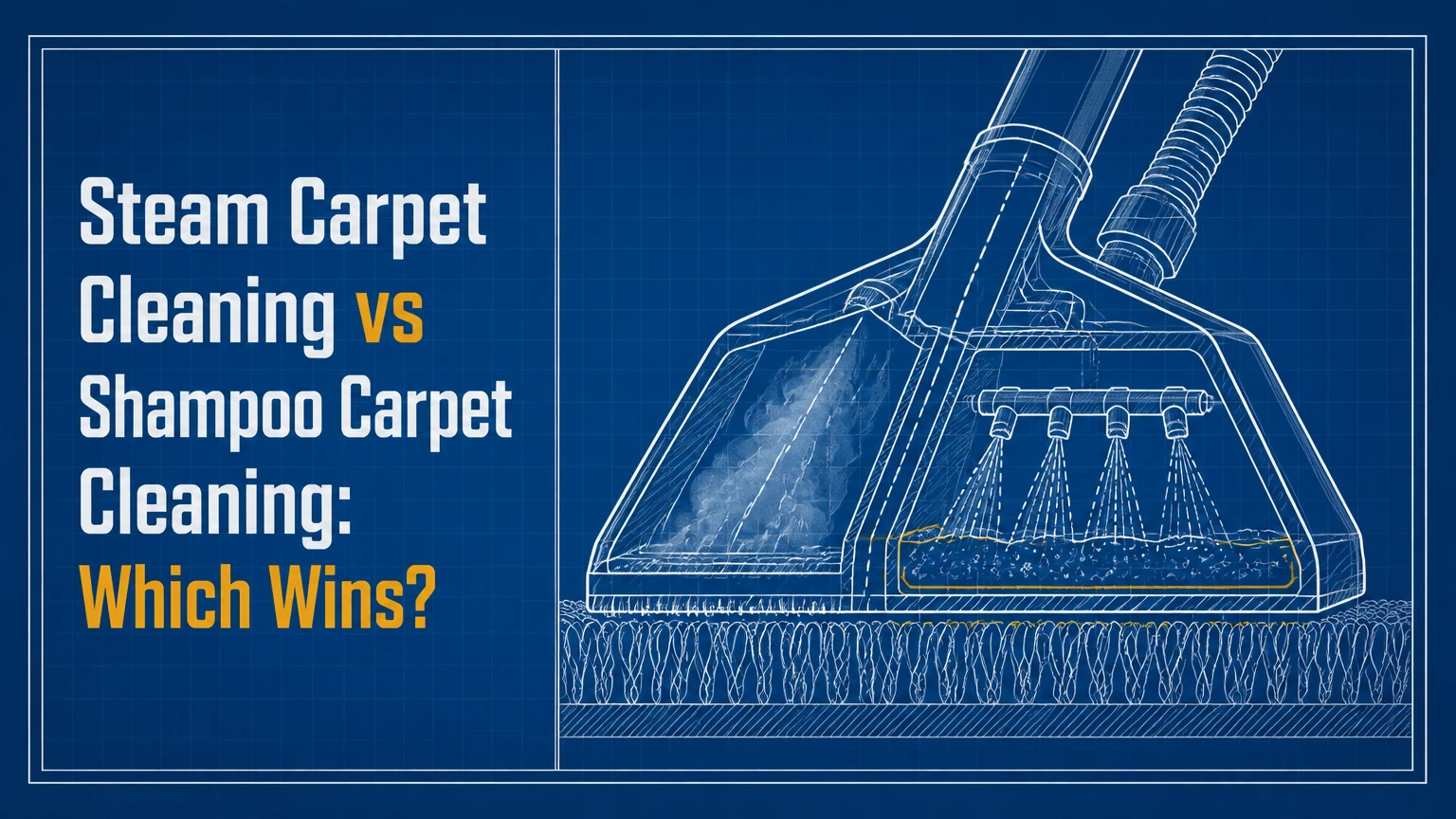
Steam carpet cleaning, usually called hot water extraction, is the better overall choice for removing embedded soil, allergens, and detergent residue when the carpet can tolerate controlled moisture. Shampoo carpet cleaning costs less and can improve heavily soiled surface fibers, but it relies on scrubbing and leaves more chemical residue, so it suits limited situations rather than routine deep cleaning.
Key Facts at a Glance
- Hot water extraction injects cleaning solution into carpet and immediately removes suspended soil with vacuum suction.
- Carpet shampooing applies a detergent solution and uses rotary brushes to scrub surface contamination from the pile.
- Professional hot water extraction typically dries in 6-12 hours; shampooing commonly requires 12-24 hours.
- Steam cleaning does not automatically sanitize carpet because microbial reduction depends on temperature, dwell time, chemical action, and complete extraction.
- Shampoo residue can cause rapid re-soiling when excess detergent remains in the carpet.
- Wool, sisal, jute, glued backings, and damaged carpet require fiber-specific cleaning rather than a generic steam-or-shampoo decision.
What Is the Difference Between Steam and Shampoo Cleaning?
Steam carpet cleaning is generally hot water extraction, while shampoo carpet cleaning is a detergent-and-agitation process. The first method removes soil by suspending it in liquid and recovering that liquid; the second loosens soil through chemical action and brush friction, then depends heavily on drying and post-vacuuming.
The word “steam” creates confusion. True vapor steam cleaners use little liquid, but full-room carpet services commonly use an extractor that sprays heated water through a wand and recovers it through a vacuum hose. The Institute of Inspection Cleaning and Restoration Certification, or IICRC, treats hot water extraction as a major professional carpet-cleaning system, although equipment settings must follow carpet-fiber and manufacturer requirements.
Shampooing also has a terminology problem. Traditional shampoo systems create foam and leave dried detergent behind for later vacuuming. Encapsulation cleaning uses a different polymer chemistry: the polymer surrounds soil and forms brittle crystals that routine vacuuming removes. A low-moisture encapsulation machine should not automatically be classified as traditional shampooing.
How Does Each Method Work?
Hot water extraction follows five practical stages:
- Dry vacuuming removes loose grit before it becomes wet mud.
- A pre-spray dissolves oily soil and traffic-lane contamination.
- Counter-rotating or rotary brushes may agitate the pre-spray.
- Heated solution is injected and immediately recovered through the extraction wand.
- Grooming, airflow, and a final inspection help the carpet dry evenly.
Traditional shampooing uses dry vacuuming, detergent application, rotary scrubbing, drying, and post-vacuuming. The carpet must become sufficiently dry before the residue can be removed effectively, which is why walking on a partially dried shampooed carpet can redistribute soil and flatten the pile.
The cleaning result depends more on soil removal, water recovery, chemical concentration, and technician control than on the machine label. A poorly operated extractor can leave a wetter carpet than a well-operated low-moisture system.
Steam Carpet Cleaning vs Shampoo Carpet Cleaning: Comparison
| Decision factor | Hot water extraction | Traditional shampooing |
|---|---|---|
| Primary soil-removal action | Liquid suspension plus vacuum recovery | Detergent dissolution plus brush friction |
| Typical professional price per room | $80-$180 | $60-$140 |
| Typical whole-home price, 3-5 rooms | $200-$500 | $150-$350 |
| Typical drying period | 6-12 hours | 12-24 hours |
| Typical moisture recovery | 85%-95% with professional equipment | Low to moderate, mostly evaporation |
| Deep-pile soil removal | Reaches lower pile and backing when properly performed | Concentrates on upper and middle pile |
| Residue risk | Low with correct rinsing and extraction | Moderate to high with excess shampoo |
| Main equipment | Truck-mounted or portable extractor | Rotary shampooer and wet-dry or post-vacuum system |
These are typical US residential ranges, not universal prices. Room size, stairs, furniture movement, urine treatment, carpet condition, geographic market, and minimum service charges can change the invoice substantially.
Which Method Cleans More Deeply?
Hot water extraction usually cleans more deeply because vacuum recovery removes suspended soil and cleaning solution from below the visible surface. Shampooing can scrub aggressively, but the machine does not provide equivalent liquid recovery, so contaminated moisture and detergent may remain in the pile or backing.
“Deep cleaning” has a practical limit. Neither method reliably removes soil that has permanently dyed the fiber, damaged the backing, or soaked into a contaminated cushion without specialized treatment or partial replacement. A technician should inspect the carpet rather than promise complete stain removal from a photograph.
Winner: Hot water extraction for embedded dry soil, allergens, and ordinary traffic contamination.
Which Method Leaves Carpet Drier?
Hot water extraction generally leaves carpet drier when the operator uses multiple vacuum passes, correct water flow, and sufficient airflow. Traditional shampooing often dries more slowly because detergent solution remains in the carpet and evaporation does more of the moisture-removal work.
Drying is not determined by temperature alone. A truck-mounted extractor may recover substantially more water than a small rental machine, while poor wand technique can over-wet carpet regardless of equipment type. Typical drying conditions include indoor humidity below 60%, air movement across the pile, functioning HVAC, and no furniture blocking the carpet.
The EPA states, “The key to mold control is moisture control,” in its mold guidance for buildings. That principle applies after carpet cleaning: wet carpet, cushion, and subfloor require rapid drying, not merely a hotter cleaning solution.
Winner: Hot water extraction with strong vacuum lift and professional drying controls.
Which Method Costs Less?
Shampooing usually costs less at the point of service because rotary machines are less expensive and many rental systems use simpler equipment. Hot water extraction costs more when a professional brings a truck-mounted unit, performs pre-treatment, moves furniture, and includes stain or odor treatment.
A low quote can exclude stairs, heavily soiled areas, protector, furniture, or an acidic rinse. Ask whether the price includes pre-vacuuming, pre-spray, agitation, extraction, spot treatment, deodorizer, and taxes before comparing providers.
| Service situation | Hot water extraction typical cost | Shampooing typical cost |
|---|---|---|
| One standard bedroom | $80-$150 | $60-$110 |
| Living room, 200-350 square feet | $100-$180 | $75-$140 |
| Stairs, 12-16 steps | $75-$150 | $60-$120 |
| Three-bedroom home | $250-$500 | $175-$350 |
| Pet urine treatment | $25-$75 per area | $20-$60 per area |
Winner: Shampooing for the lowest initial price, hot water extraction for broader soil removal and lower residue risk.
What Equipment Does Each Method Need?
Truck-mounted extractors typically deliver higher heat and vacuum lift than portable rental machines. Typical commercial specifications include solution temperatures around 180-230°F inside the system, pressure settings from 100-500 PSI, and separate vacuum recovery, although the technician should reduce pressure and heat for sensitive fibers.
Portable extractors are useful in apartments, high-rise buildings, and rooms inaccessible to van hoses. Their lower vacuum capacity often increases drying time, especially when the operator makes too few recovery passes.
| Equipment type | Typical operating detail | Best application | Main limitation |
|---|---|---|---|
| Truck-mounted extractor | 180-230°F system temperature; 100-500 PSI range | Whole homes and deep soil | Requires vehicle access and professional operator |
| Portable extractor | 120-200°F solution range; 50-200 PSI range | Apartments and upper floors | Lower vacuum lift and slower drying |
| Rotary disc shampooer | 13-20 inch disc; 175-300 RPM | Low-pile commercial carpet | Can distort loops or twists |
| Rotary cylinder shampooer | 10-18 inch roller; 200-400 RPM | Commercial cut pile and moderate soil | Less effective on deep residential pile |
| Rental upright extractor | 1-2 gallon tank; consumer vacuum motor | Small DIY areas | Inconsistent heat, flow, and water recovery |
Traditional shampooing is especially sensitive to brush selection. A dense disc brush can fuzz, untwist, or distort cut-pile carpet, while a cylinder machine may be safer on low-profile commercial carpet. A rotary machine is not automatically appropriate because the carpet appears dirty.
Is Shampooing Bad for Carpet?
Shampooing is not inherently harmful, but excessive detergent, aggressive brush pressure, and repeated wet cleaning can shorten carpet appearance life. The greatest recurring problem is residue: sticky surfactants attract new oily soil, making traffic lanes look dirty again within days or weeks.
Shampooing can be reasonable for commercial carpet with a stable construction, heavy surface grease, and a planned post-vacuuming cycle. It is a weaker choice for plush residential carpet, loose twists, shag, wool, and any floor where rapid re-soiling would be difficult to manage.
A counterintuitive practitioner rule is to judge the detergent recovery, not the foam volume. Thick foam can look productive while leaving cleaning chemistry in the pile. More lather does not equal more soil removal.
Winner: Shampooing is acceptable for selected low-pile commercial applications, but hot water extraction is safer for routine residential maintenance.
Which Method Is Better for Allergies, Pets, and Children?
Hot water extraction is generally preferable for households with allergies or pets because it removes particulate soil and detergent solution rather than leaving most cleaning chemistry in place. However, no carpet-cleaning method permanently eliminates all allergens, and heat alone should not be advertised as guaranteed sterilization.
Pet urine requires special caution. Surface extraction can improve appearance and odor, but urine salts may reach the backing or cushion. If contamination penetrates the pad, the technician may need subsurface treatment, pad replacement, or carpet lifting.
| Household situation | Preferred method | Reason | Required precaution |
|---|---|---|---|
| Dust-sensitive occupant | Hot water extraction | Recovers suspended particulate soil | Dry completely before occupancy |
| Fresh pet accident | Hot water extraction | Removes liquid contamination quickly | Blot first; avoid over-wetting |
| Old urine in cushion | Subsurface treatment or replacement | Surface cleaning cannot reach all contamination | Inspect pad and subfloor |
| Greasy commercial entryway | Agitation plus extraction | Breaks oil film, then flushes residue | Use controlled detergent dosage |
| Infant playroom | Low-residue extraction | Reduces chemical film on contact surfaces | Use an approved rinse and ventilate |
Professional cleaning does not replace source control. Frequent vacuuming with a sealed HEPA machine, entry mats, shoe removal, and prompt spot treatment reduce the soil load between cleanings.
How Should Carpet Fiber Affect the Decision?
Carpet fiber, pile construction, dye stability, backing, and cushion condition should determine the cleaning method. Nylon and polyester residential carpets often tolerate controlled hot water extraction, while wool, sisal, jute, viscose, and glued backings require lower moisture, lower agitation, or specialized dry-cleaning procedures.
| Carpet material or construction | Safer general approach | Avoid or modify | Typical concern |
|---|---|---|---|
| Nylon cut pile | Hot water extraction | Excessive heat or alkalinity | Browning, color bleed, over-wetting |
| Polyester cut pile | Controlled extraction | High friction and oily residue | Crushing and slow drying |
| Wool | Wool-approved low-moisture or extraction | High heat and alkaline shampoo | Shrinkage, dye bleed, felting |
| Sisal or jute | Dry compound or specialist cleaning | Saturation | Browning, shrinkage, edge curl |
| Viscose or rayon | Specialist low-moisture cleaning | DIY wet cleaning | Permanent texture and color damage |
| Berber loop pile | Low-pressure extraction | Aggressive rotary discs | Snagging, fuzzing, pulled loops |
Read the carpet manufacturer’s care label and warranty instructions before cleaning. A method that works on nylon can damage wool, and a cleaning company’s “steam clean” guarantee does not override the manufacturer’s specifications.
What Stains Does Each Method Handle Best?
Hot water extraction handles water-soluble soil, particulate contamination, and many ordinary food or beverage residues after correct pre-treatment. Shampooing can loosen greasy surface soil through stronger detergent action, but neither method automatically removes every dye or biological stain.
| Stain or contaminant | More suitable approach | Why | Important limitation |
|---|---|---|---|
| Dry tracked-in soil | Hot water extraction | Suspends and recovers soil | Requires thorough pre-vacuuming |
| Cooking oil or grease | Degreasing pre-spray plus extraction | Breaks oily bonds and flushes them | Excess chemical can leave residue |
| Coffee or tea | Acid-balanced spot treatment plus extraction | Targets tannin discoloration | Heat can set some dyes |
| Pet urine | Enzyme or specialty treatment plus extraction | Addresses organic residue | Pad contamination may remain |
| Wax or gum | Mechanical removal plus solvent | Solid contaminant needs loosening | Solvent requires dye and backing test |
| Permanent marker | Specialist solvent treatment | Ink chemistry differs from soil | Full removal is not guaranteed |
| Rust | Reducing-agent treatment | Rust is not ordinary dirt | Acid products can damage fiber |
A professional should test an inconspicuous area for dye stability before applying alkaline pre-spray, oxidizer, solvent, or acidic treatment. Cleaning can reveal permanent discoloration that was previously hidden by soil, but it cannot restore missing dye.
Can DIY Equipment Match Professional Cleaning?
DIY machines can improve lightly soiled carpet when the user controls solution quantity and makes slow recovery passes. Rental shampooers and extractors rarely match truck-mounted systems because they provide less vacuum lift, inconsistent heat, smaller tanks, and limited tools for corners, stairs, and subsurface pet contamination.
The most common DIY error is over-wetting. The user moves slowly during spraying but fails to make enough dry extraction passes, leaving cushion and backing damp. A second error is adding extra detergent because the carpet looks dirty, which increases residue rather than cleaning power.
Use these controls:
- Vacuum slowly in two directions before wet cleaning.
- Measure detergent according to the machine label.
- Make one controlled wet pass followed by two or three recovery passes.
- Keep doors and windows open when outdoor humidity is lower.
- Place air movers so air crosses the carpet surface.
- Keep furniture on protective tabs until the carpet is fully dry.
You will know the process worked when the pile feels clean rather than tacky, the carpet does not produce a strong detergent odor, and drying continues steadily without cool, damp areas at the edges.
What Causes Re-Soiling, Browning, and Musty Odor?
Rapid re-soiling usually results from detergent residue, incomplete soil recovery, or heavy traffic before drying. Browning and wicking occur when moisture dissolves soil in the backing or cushion and carries it toward the tips as the carpet dries. Musty odor indicates retained moisture, contamination, or both.
How Do You Fix Rapid Re-Soiling?
A professional hot water extraction rinse can reduce removable shampoo residue, but plain water is not always sufficient when the residue is oily or heavily concentrated. The technician should identify the detergent, select a compatible rinse, recover the solution thoroughly, and accelerate drying with air movement.
Do not repeatedly shampoo the same area to correct re-soiling. Repeated detergent application often compounds the original problem.
How Do You Prevent Browning and Wicking?
Use lower moisture, appropriate pH control, immediate extraction, and rapid drying. If a brown mark appears during drying, avoid saturating the spot again; lightly apply a fiber-compatible browning treatment only after testing, then extract or vacuum according to the product directions.
What Should You Do If Carpet Stays Wet?
Run air movers, operate HVAC or a dehumidifier, lift furniture with tabs, and contact a restoration professional if carpet or cushion remains wet after 24 hours. The EPA’s moisture-control principle is the relevant standard here, because odor and microbial growth risk increase when damp materials remain enclosed.
Which Method Should You Choose?
Choose Hot Water Extraction for Most Homes
Choose hot water extraction for routine deep cleaning, children’s rooms, pets, allergy concerns, visible traffic lanes, and carpets that have accumulated soil below the surface. Request pre-vacuuming, targeted pre-treatment, controlled agitation, strong extraction, and a documented drying plan.
Choose Shampooing for Selected Commercial Soil
Choose traditional shampooing only when surface grease is the dominant problem, the carpet construction tolerates rotary agitation, and staff can complete post-vacuuming after the carpet dries. A follow-up extraction or low-residue maintenance program may be more effective than repeated shampooing.
Choose Low-Moisture Cleaning for Sensitive Fibers
Choose a certified specialist for wool, sisal, jute, viscose, antique rugs, loose seams, or moisture-sensitive backing. The correct answer may be dry compound, absorbent powder, controlled low-moisture encapsulation, or no wet cleaning at all.
Should You Hire a Professional?
Hire a professional when the carpet has urine contamination, widespread grease, color bleeding, delicate fibers, water damage, or a warranty requirement. DIY cleaning is more defensible for one or two lightly soiled synthetic rooms when the user can provide ventilation and enough time for complete drying.
How Often Should Carpet Be Cleaned?
Most homes benefit from professional or carefully performed deep cleaning every 12-18 months, while homes with pets, children, allergies, or heavy traffic may need cleaning every 6-12 months. Entryways and traffic lanes often need targeted maintenance sooner than bedrooms.
Vacuuming frequency changes the required interval. High-traffic homes should vacuum at least twice weekly, with entry mats cleaned or replaced before they become saturated with grit. Abrasive sand and soil cut carpet fibers mechanically, so removing dry soil protects appearance more effectively than relying on periodic wet cleaning.
A practical maintenance schedule is:
- Vacuum high-traffic areas two or more times weekly.
- Treat liquid spills immediately with blotting, not rubbing.
- Inspect pet areas monthly with the lights lowered across the pile.
- Deep-clean synthetic residential carpet every 6-18 months.
- Reassess the cushion and backing after any urine or flooding event.
FAQ
Does steam cleaning remove shampoo residue?
Hot water extraction can remove a substantial amount of removable shampoo residue when the technician uses sufficient recovery passes and a compatible rinse. Severe residue may require a specialized detergent-recovery treatment, because plain water can spread oily surfactants without fully dissolving them.
Can shampoo cleaning remove pet urine?
Shampoo cleaning may improve a fresh surface accident, but it cannot reliably remove urine that has reached the backing or cushion. Enzyme treatment, subsurface extraction, pad replacement, or subfloor treatment may be necessary when odor returns after the carpet dries.
Is hot water extraction safe for carpet padding?
Hot water extraction is safe for many synthetic carpet systems when the operator controls moisture and recovers the solution thoroughly. Excess water can saturate cushion, cause delamination, promote odor, and create subfloor damage, so drying performance matters as much as cleaning temperature.
Can I walk on carpet after cleaning?
Light walking is usually acceptable after cleaning if clean socks are worn, but normal traffic should wait until the carpet is fully dry. Typical drying takes 6-12 hours after effective extraction and may take 12-24 hours with lower vacuum lift, high humidity, dense padding, or shampoo residue.
Does steam cleaning kill dust mites?
Hot water extraction can reduce dust mites and remove allergen-containing particles, but ordinary carpet cleaning should not be described as guaranteed mite sterilization. Temperature, exposure time, extraction quality, and recontamination all affect the result, while regular HEPA vacuuming supports longer-term allergen control.
What is the best carpet cleaning method for wool?
Wool usually requires a wool-approved specialist using controlled moisture, moderate temperature, compatible pH, and limited agitation. Traditional shampooing and high-heat extraction can cause dye bleeding, shrinkage, felting, or texture change when the process ignores the carpet manufacturer’s care instructions.
The Bottom Line
For most synthetic residential carpet, hot water extraction is the stronger choice because it reaches deeper soil and removes more moisture and detergent when properly operated. Shampooing remains a lower-cost option for selected low-pile commercial carpets with heavy surface grease. In the decision between steam carpet cleaning vs shampoo carpet cleaning, choose hot water extraction for homes, pets, allergies, and routine deep cleaning, and choose shampoo only when the carpet construction and maintenance plan justify its residue and friction risks.