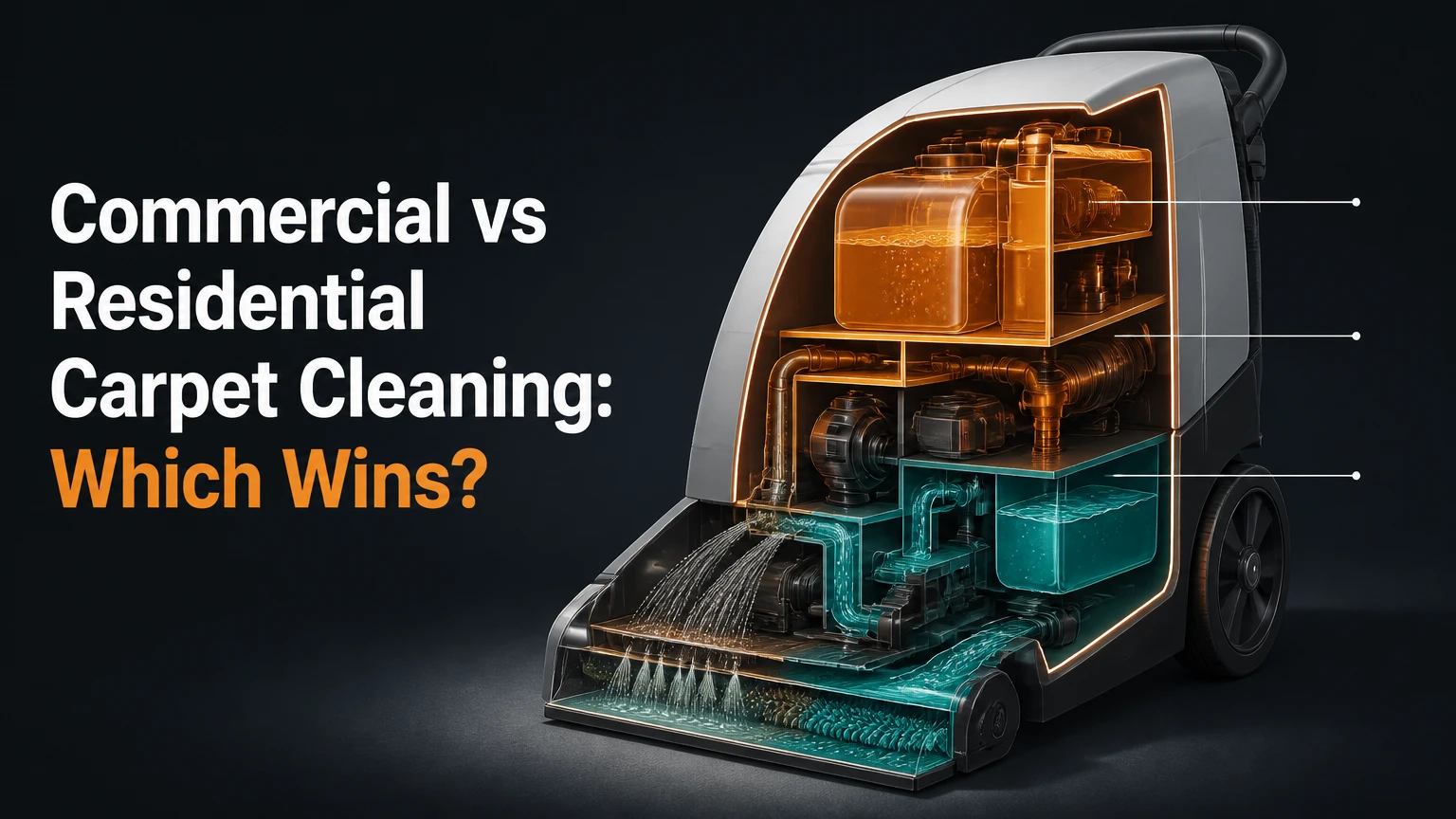
Commercial and residential carpet cleaning are different service strategies, not interchangeable versions of the same job. Residential cleaning prioritizes fiber protection, stain treatment, and indoor comfort, while commercial cleaning prioritizes production speed, traffic-lane control, low disruption, and carpet life. The correct choice depends on carpet construction, soil type, occupancy, and available drying time.
Key Facts at a Glance
- Residential carpet cleaning commonly uses hot water extraction because homes need deep soil removal and detailed spot treatment.
- Commercial carpet cleaning often uses encapsulation or another low-moisture method because offices need rapid drying and minimal interruption.
- Typical residential professional cleaning costs about $0.25-$0.50 per square foot, with minimum charges often around $120-$180.
- Typical commercial carpet cleaning costs about $0.05-$0.25 per square foot, depending on area, access, soil, furniture, and service frequency.
- Residential hot water extraction commonly requires 6-12 hours of drying, while commercial encapsulation may dry in 45-90 minutes.
- Carpet fiber and backing matter more than the building’s label. Wool in an office may need residential-style care, while durable nylon in a home may tolerate commercial methods.
What Is the Difference Between Commercial and Residential Carpet Cleaning?
Commercial carpet cleaning is designed for large, heavily occupied areas where labor efficiency, traffic management, and short drying windows determine the service plan. Residential carpet cleaning is designed for smaller, furnished spaces where technicians must protect varied fibers, treat localized stains, and work around occupants, pets, furniture, and household contents.
The distinction is therefore operational rather than absolute. A school classroom, hotel corridor, medical waiting room, and home bedroom can all contain different carpet constructions and soil profiles. A professional should inspect the fiber, dye stability, backing, adhesive, pile height, and contamination before choosing hot water extraction, encapsulation, bonnet cleaning, or dry compound cleaning.
| Decision factor | Residential carpet | Commercial carpet |
|---|---|---|
| Typical area | 1,000-3,000 square feet | 5,000-100,000+ square feet |
| Common construction | Plush cut pile, patterned cut pile, wool area carpet | Glue-down broadloom, loop pile, carpet tiles |
| Frequent soil | Food, beverages, pet contamination, skin oils | Grit, asphalt residue, grease, toner, tracked moisture |
| Main constraint | Furniture and stain detail | Occupant access and business downtime |
| Common deep-cleaning method | Hot water extraction | Hot water extraction during closure |
| Common interim method | Spot cleaning and vacuuming | Encapsulation, bonnet, or dry compound |
| Typical drying target | Same day, often 6-12 hours | 45-90 minutes for low-moisture work |
| Primary outcome | Clean, comfortable, fiber-safe carpet | Usable, uniform, durable floor covering |
Does the building type determine the cleaning method?
The building type provides context, but carpet specification determines the safe method. Commercial carpet tiles can be damaged by excessive water, while a residential wool carpet can be damaged by aggressive alkaline chemistry or high mechanical agitation. Technicians should follow the carpet manufacturer’s care instructions and test an inconspicuous area before full application.
The Carpet and Rug Institute gives a practical maintenance rule: “The most effective way to keep carpet clean is to vacuum it thoroughly and frequently.” That principle applies to both settings, although a busy office may need daily vacuuming in entrances and a home may need twice-weekly vacuuming in living areas.
How Do Residential and Commercial Cleaning Processes Work?
Residential and commercial carpet cleaning share the same basic sequence: remove dry soil, identify the fiber, apply a compatible cleaning agent, agitate where appropriate, remove suspended soil, and accelerate drying. The difference is the balance between soil removal, moisture control, production rate, and detailed stain work.
Residential hot water extraction process
A typical residential hot water extraction service follows these steps:
- Inspect and identify the carpet. The technician checks fiber type, pile direction, dye stability, backing, stains, and existing damage.
- Remove dry soil. High-filtration vacuuming removes loose grit and particulate matter before moisture is introduced.
- Precondition the carpet. A measured pre-spray loosens oily soil, food residue, and body oils. Wool and sensitive fibers require wool-safe chemistry rather than a generic high-alkaline product.
- Agitate selectively. A soft brush or counter-rotating brush machine distributes the solution without excessive abrasion.
- Rinse and extract. Hot water extraction flushes suspended soil and chemistry from the pile. The technician controls water flow and vacuum passes to avoid overwetting.
- Treat remaining spots. Protein, tannin, oil, rust, and dye stains require different chemistry. A single universal spotter is unsafe.
- Groom and dry. The pile is set, furniture is protected, and air movers improve evaporation.
Typical residential extraction uses roughly 7.5-15 liters of water per average room, although equipment settings and carpet density change that amount. Drying commonly takes 6-12 hours, with humidity, ventilation, pad condition, and subfloor temperature affecting the result.
Commercial low-moisture encapsulation process
Commercial encapsulation uses a polymer detergent that surrounds soil particles as the solution dries. Mechanical agitation distributes the chemistry through the upper carpet fibers, and subsequent vacuuming removes the dried crystals during the next maintenance cycle.
A typical office procedure includes:
- Pre-vacuuming entrances, corridors, and traffic lanes.
- Moving only essential furniture to protect production speed.
- Applying the manufacturer’s dilution through a controlled sprayer.
- Agitating with a cylindrical brush or rotary machine suited to the carpet.
- Allowing the carpet to dry without unnecessary foot traffic.
- Vacuuming thoroughly after crystallization, either immediately when specified or during the next routine cycle.
- Inspecting traffic lanes and repeating spot treatment where necessary.
Commercial encapsulation often dries in 45-90 minutes. Typical production may reach 3,000-5,000 square feet per hour in open areas, but offices with desks, partitions, elevators, and irregular access can reduce that rate substantially.
Which Cleaning Method Fits Each Carpet?
Hot water extraction is the strongest general choice for restorative soil removal, while encapsulation is usually the strongest maintenance choice for occupied commercial areas. Bonnet cleaning provides a fast appearance improvement, and dry compound cleaning minimizes moisture, but neither method should be treated as a universal replacement for extraction.
| Method | Typical water exposure | Typical drying window | Best application | Main limitation |
|---|---|---|---|---|
| Hot water extraction | 7.5-15 liters per residential room; higher equipment-dependent volume commercially | 6-12 hours residential; 4-12 hours commercial | Restorative cleaning and heavy embedded soil | Overwetting, slow access, wicking risk |
| Encapsulation | Less than 1.9 liters per 100 square meters in some VLM systems | 45-90 minutes | Commercial maintenance and frequent traffic lanes | Limited removal of deeply embedded or oily contamination |
| Bonnet cleaning | Low to moderate surface moisture | 30-90 minutes | Cosmetic corridor touch-ups | Primarily surface cleaning; pad can spread soil |
| Dry compound cleaning | Minimal free water | 15-60 minutes after recovery vacuuming | 24/7 facilities and moisture-sensitive areas | Residual compound and deep soil limitations |
Is hot water extraction better than encapsulation?
Hot water extraction is better for periodic restorative cleaning, pet contamination, heavy grease, and soil embedded below the surface. Encapsulation is better for frequent commercial maintenance when the carpet must return to service quickly. Neither method wins in every situation because extraction maximizes flushing while encapsulation minimizes moisture and operational interruption.
The term “steam cleaning” commonly refers to hot water extraction, not cleaning with steam alone. Professional equipment injects heated solution and immediately recovers it with vacuum pressure. Temperature, pressure, chemical concentration, vacuum lift, technician technique, and carpet construction all affect results.
Is bonnet cleaning a deep-cleaning method?
Bonnet cleaning is primarily a surface-maintenance method, not a complete deep-cleaning system. A rotary machine spins an absorbent pad over the carpet, transferring some soil into the pad while improving visible uniformity in high-traffic areas.
Bonnet cleaning can work well in a commercial corridor between restorative extractions. It is riskier on residential cut pile, delicate loop pile, and carpets with loose construction because aggressive rotation can cause fuzzing, blooming, or distortion. A heavily soiled bonnet pad can also redistribute soil rather than remove it.
How Do Carpet Fibers and Backings Change the Decision?
Carpet fiber, pile construction, dye chemistry, and backing determine cleaning risk more reliably than residential or commercial classification. Nylon commonly tolerates professional extraction and routine encapsulation, while wool requires controlled pH, moderate heat, reduced agitation, and careful moisture management.
| Carpet attribute | Typical examples | Preferred approach | Risk to control |
|---|---|---|---|
| Wool fiber | Residential lounge, boutique office | Wool-safe detergent, low agitation, controlled extraction | Shrinkage, dye bleeding, browning |
| Nylon cut pile | Home bedroom, hotel room | Extraction or compatible encapsulation | Overwetting and chemical residue |
| Nylon loop pile | Office broadloom, school | Encapsulation for maintenance; extraction periodically | Snagging and pile distortion |
| Olefin or polypropylene | Commercial tile, basement carpet | Low-moisture cleaning; careful solvent selection | Oil attraction and rapid resoiling |
| Polyester | Residential plush carpet | Moderate extraction and fiber-safe spot treatment | Crushing and oily stain retention |
| Carpet tile backing | Glue-down modular tile | Low-moisture maintenance; controlled extraction | Adhesive failure, curling, delamination |
| Jute or natural backing | Some wool and specialty carpets | Minimal moisture and specialist treatment | Browning, shrinkage, dimensional change |
Carpet tiles deserve special attention because excessive water can migrate into seams, soften adhesive, or remain below the tile. If tiles can be lifted, technicians may replace damaged modules instead of saturating the surrounding floor.
What Are the Typical Costs and Timeframes?
Typical residential carpet cleaning costs about $30-$80 per room or $0.25-$0.50 per square foot, while commercial work commonly costs $0.05-$0.25 per square foot. Large commercial contracts receive lower unit pricing because setup, travel, and equipment costs are distributed across more floor area.
| Service scenario | Typical price | Typical production | Typical access or drying condition |
|---|---|---|---|
| Residential minimum visit | $120-$180 minimum | 2-4 rooms per visit | Furniture and stain work included variably |
| Residential extraction | $0.25-$0.50 per square foot | 375-600 square feet per hour | 6-12 hours drying |
| Small commercial office | $0.15-$0.25 per square foot | 1,000-3,000 square feet per hour | 45-120 minutes with low moisture |
| Large commercial contract | $0.05-$0.15 per square foot | 3,000-5,000 square feet per hour | Night or weekend access often required |
| Commercial restorative extraction | $0.10-$0.30+ per square foot | 1,000-3,000 square feet per hour | Longer closure and drying period |
| Spot, odor, or urine treatment | $25-$150+ per affected area | 1-4 areas per hour | May require subfloor inspection |
A 2,000-square-foot office at $0.10 per square foot would have a typical cleaning charge of about $200 before furniture moving, stairs, heavy soil, or emergency scheduling. A 1,000-square-foot home at $0.35 per square foot would total about $350, subject to the provider’s minimum and room-based pricing.
Prices vary by region, labor costs, travel distance, access, local taxes, and service frequency. Coastal humidity, winter drying conditions, dense furniture layouts, and elevators can increase labor or drying requirements without changing the carpet’s square footage.
Which Option Should You Choose?
The best choice depends on who controls the space, what contaminates the carpet, and how long the area can remain unavailable. Homeowners usually need detailed hot water extraction, while facility managers usually need a scheduled combination of low-moisture maintenance and periodic restorative extraction.
Homeowners with pets or children
Choose professional hot water extraction when pet urine, food spills, tracked soil, or visible staining affects multiple rooms. Ask whether the provider will inspect the pad and subfloor, because surface cleaning cannot fully resolve urine that has penetrated below the carpet.
Use frequent vacuuming between services. CRI guidance supports thorough, frequent vacuuming, and immediate blotting is safer than scrubbing because aggressive rubbing can spread liquid and damage pile tips.
Small offices with 100-500 square meters
Choose quarterly or bi-monthly encapsulation when the office has moderate soil and cannot close for a full day. Schedule extraction during a weekend or holiday shutdown when traffic lanes look gray, sticky, or visibly compressed despite routine maintenance.
Low-moisture cleaning does not remove every embedded contaminant. A maintenance plan should include entry matting, daily vacuuming at entrances, scheduled spot treatment, and periodic extraction based on appearance and soil loading.
Large facilities, schools, and retail sites
Choose a hybrid program for large, high-traffic buildings. Use frequent vacuuming and low-moisture encapsulation for corridors, then schedule hot water extraction during a planned closure when accumulated soil exceeds what interim cleaning can remove.
Facilities should divide the building into zones rather than clean every square foot at the same frequency. Entrances, elevators, reception areas, vending zones, and corridors usually need more frequent service than private offices or low-traffic perimeter areas.
Medical, hospitality, and 24/7 facilities
Choose the method that meets the site’s infection-control, chemical, moisture, and re-entry requirements. Low moisture reduces closure time, but it does not automatically provide the same flushing action as extraction or satisfy every facility-specific hygiene protocol.
Coordinate with the site’s environmental services manager. Document product labels, dilution, equipment, drying verification, and re-entry timing, especially where vulnerable occupants or slip hazards are involved.
How Often Should Residential and Commercial Carpet Be Cleaned?
Residential carpet commonly benefits from professional cleaning every 12-18 months, while commercial carpet may need maintenance weekly, monthly, quarterly, or annually depending on traffic. Frequency should follow soil accumulation and appearance rather than a fixed calendar alone.
| Area type | Vacuuming pattern | Interim cleaning | Restorative extraction |
|---|---|---|---|
| Low-traffic bedroom | 1-2 times weekly | Spot treatment as needed | Every 12-18 months |
| Family living room | 2-4 times weekly | Spot treatment monthly as needed | Every 6-12 months |
| Small office | Daily entrances; 2-5 times weekly elsewhere | Encapsulation every 3-6 months | Every 12 months |
| School corridor | Daily or multiple times daily | Encapsulation monthly or as needed | During major breaks |
| Retail entrance | Daily or more often | Weekly or monthly low moisture | Every 3-6 months |
| 24/7 facility | Zone-based daily vacuuming | Frequent low-moisture cleaning | During approved closure |
Manufacturer warranty instructions may specify a minimum professional cleaning frequency. The Carpet and Rug Institute’s Seal of Approval program evaluates cleaning products and equipment against performance criteria, so facility managers can use approved systems as one screening factor, not as a substitute for carpet inspection.
What Problems Commonly Occur?
The most common failures are overwetting, chemical residue, wicking, fiber distortion, and inadequate dry-soil removal. Each failure has a different mechanism, so repeating the same cleaning method usually cannot solve the underlying problem.
Why do stains reappear after cleaning?
Reappearing stains usually result from wicking, where dissolved soil or stain material in the backing or pad moves upward as the carpet dries. The risk increases when a technician uses excessive solution, leaves residue, or fails to extract deeply enough.
A technician should inspect the spot, identify whether contamination reaches the pad, apply targeted treatment, and use controlled moisture rather than repeatedly soaking the face fiber. A low-moisture encapsulation treatment may improve a mild wicking problem, but severe urine or backing contamination may require pad replacement or localized carpet repair.
Why does carpet become dirty again quickly?
Rapid resoiling commonly results from detergent residue, oily contamination, insufficient rinsing, or a heavily trafficked entry without adequate matting. Sticky residue attracts particulate soil, while olefin fibers can retain oils even when the carpet appears clean immediately after service.
The correction is a measured re-rinse or compatible residue-removal treatment, followed by improved vacuuming and entrance protection. More detergent is not a reliable answer. Chemical concentration must match the product label, fiber, soil, and extraction system.
Can aggressive equipment damage residential carpet?
Aggressive rotary equipment, stiff brushes, excessive heat, and repeated passes can distort residential pile or create blooming. Fiber damage may be permanent, particularly when yarn tips have frayed or loop construction has been pulled.
Professionals should use a pre-inspection, colorfastness test, appropriate brush pressure, and conservative moisture settings. Carpet manufacturers and the IICRC provide technical guidance, but the technician must still adapt the procedure to the specific installation.
What should cleaning not be used for?
Carpet cleaning is not a substitute for flood remediation, mold remediation, asbestos control, or structural moisture repair. Saturated padding, sewage contamination, extensive microbial growth, or persistent subfloor odor requires a qualified restoration assessment rather than an ordinary cleaning visit.
Carpet cleaning also cannot restore permanently crushed fibers, bleach loss, severe dye damage, or missing yarn. A realistic estimate should separate removable soil from permanent physical or chemical damage before work begins.
What Should You Ask a Carpet Cleaning Company?
Ask for the proposed method, equipment type, drying expectation, chemical system, insurance status, and procedure for identifying carpet fiber and backing. A low price is difficult to evaluate when the quote excludes furniture moving, stairs, spot treatment, minimum charges, or odor work.
Use this checklist:
- What fiber and backing did you identify?
- Will you perform a colorfastness and bleeding test?
- Is the price based on rooms, square feet, labor hours, or a minimum charge?
- Does the estimate include furniture moving and stair cleaning?
- Which areas will use hot water extraction or low-moisture cleaning?
- What is the expected drying time under current humidity?
- How will you prevent wicking and chemical residue?
- Is the product compatible with wool, nylon, olefin, or carpet tile adhesive?
- When can occupants safely walk on the carpet?
- What conditions would require a restoration specialist instead?
A professional answer should connect the method to the carpet and the site’s operational needs. “Steam cleaning everything” or “dry cleaning everything” is not an adequate inspection-based recommendation.
FAQ
Can a residential carpet cleaner clean a commercial office?
A residential carpet cleaner can clean a small office if the technician has suitable commercial equipment, insurance, and experience with the installed carpet. Large offices require higher production capacity, scheduling control, commercial vacuum systems, and procedures for furniture, occupants, elevators, and rapid re-entry.
Is commercial carpet harder to clean than residential carpet?
Commercial carpet is not always harder to clean, but commercial spaces usually present more square footage, heavier traffic, embedded grit, and tighter scheduling constraints. Residential carpet often requires more detailed stain treatment, furniture handling, and fiber-sensitive work, particularly with wool, pets, or delicate pile.
Does commercial carpet need steam cleaning?
Commercial carpet does not need hot water extraction at every visit. Encapsulation can maintain moderately soiled carpet with much less moisture, while periodic hot water extraction remains useful for restorative soil removal, grease, heavy traffic lanes, and accumulated residue.
Can I use commercial carpet-cleaning equipment at home?
Commercial equipment can be used in a home only when its pressure, heat, brushes, water flow, and chemistry suit the residential carpet. Oversized equipment or aggressive rotary machines can overwet padding, distort pile, damage delicate fibers, or leave furniture and floors exposed to moisture.
How long should carpet remain unused after cleaning?
After residential hot water extraction, carpet commonly needs 6-12 hours to dry, although airflow and humidity can shorten or extend that period. Commercial encapsulation may allow light traffic after 45-90 minutes when the carpet is dry and adjacent hard floors are safe.
Is low-moisture cleaning safe for carpet tiles?
Low-moisture cleaning is often well suited to carpet tiles because it reduces water reaching seams, adhesive, and backing. The technician must still verify the tile manufacturer’s instructions, control chemical dilution, prevent overspray, and use extraction when deep contamination cannot be removed by surface maintenance.
The Bottom Line
Commercial vs residential carpet cleaning is a decision between operating priorities, not a choice between two universally separate technologies. Residential homes usually favor detailed hot water extraction every 6-18 months, while commercial facilities usually need frequent vacuuming, low-moisture maintenance, and periodic restorative extraction. Choose by fiber, backing, soil, access, and drying tolerance.