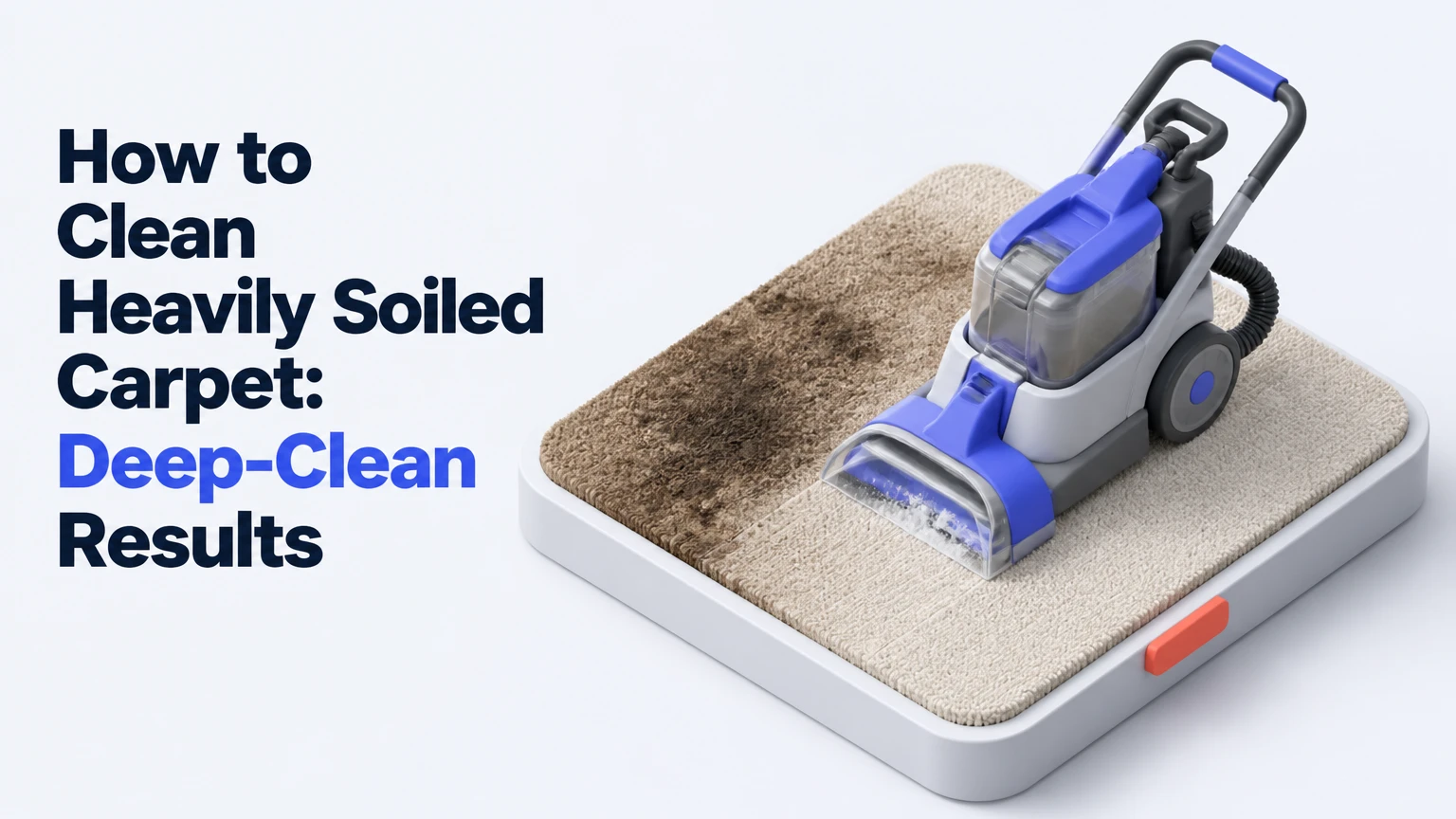
To clean heavily soiled carpet, remove dry soil first, apply a compatible pre-spray, agitate the pile, allow 10-15 minutes of dwell time, then extract with controlled hot water and dry rapidly. The carpet type, soil chemistry, and moisture recovery determine success more than scrubbing force or extra detergent.
Key Facts at a Glance
Dry vacuuming removes loose soil before water turns it into mud.
A heavy-traffic pre-spray needs dwell time and agitation to loosen oily binders.
Hot-water extraction removes suspended soil only when the machine recovers most of its rinse water.
Carpet should dry within 6-12 hours after a thorough extraction; longer wetness raises odor and browning risk.
Wool, viscose, jute-backed, and antique carpets require fiber-specific treatment rather than generic rental-machine detergent.
Pet urine in the backing, delamination, flooding, and mold growth may require professional restoration instead of routine cleaning.
What Counts as Heavily Soiled Carpet?
Heavily soiled carpet has embedded particulate dirt, oily traffic-lane residue, discoloration, or organic contamination that ordinary vacuuming cannot remove. Gray walkways, flattened pile, sticky fibers, persistent odor, and dark soil transferred to a white towel indicate more than surface dust.
Carpet soil usually contains several components at once. Sand and grit abrade fibers, body oils bind particles to nylon or polyester, food residue feeds odor, and moisture can carry contamination into the backing. A dark appearance does not always mean the carpet is permanently stained; traffic lanes often contain soil that a pre-spray and extractor can suspend.
Check the carpet’s construction before applying water. Cut-pile nylon tolerates a broader cleaning process than wool, viscose, or carpet with a weakened latex backing. A professional cleaner should inspect seams, stairs, loose edges, delamination, and previous spot-treatment damage before wet cleaning.
Why the CHAT Principle Works
The CHAT principle combines chemicals, heat, agitation, and time to separate soil from carpet fibers. Chemicals dissolve oily binders, heat accelerates soil suspension, agitation breaks the bond mechanically, and dwell time lets the solution work before extraction.
Chemistry must match both the soil and the fiber. An alkaline traffic-lane pre-spray can work well on synthetic carpet with greasy soil, while high alkalinity can damage wool dyes or leave a harsh residue. Heat helps synthetic carpet cleaning, but excessive temperature can affect dyes, adhesives, and sensitive natural fibers.
Agitation distributes the solution through the pile. Time then allows emulsification and suspension. Extraction removes the suspended material. Removing one element, especially dwell time, often leads users to compensate with excessive detergent or forceful scrubbing, which increases residue and fiber distortion rather than cleaning power.
Before You Start
Plan 2-4 hours for preparation and cleaning, followed by 6-12 hours of drying. A typical DIY cost is $40-$90 for rental equipment and chemicals, while professional residential cleaning commonly ranges from $150-$400 depending on room count, access, furniture, and contamination.
Tools and Materials
| Item | Typical quantity or specification | Purpose |
|---|---|---|
| HEPA or upright vacuum | 2-4 slow passes per direction | Removes dry particulate soil |
| Carpet pre-spray | 1-2 gallons per 500-1,000 square feet, diluted by label | Suspends oily soil |
| Carpet brush or CRB machine | 1 pass in two directions | Works solution into pile |
| Portable extractor | 1.5-2 gallons clean-water capacity | Rinses and recovers soil |
| Acidic fiber rinse | Label dilution, often 2-4 ounces per gallon | Reduces alkaline residue |
| Air movers or box fans | 2-4 units for a room | Speeds evaporation |
| White towels and gloves | 4-8 towels, nitrile gloves | Testing and safe blotting |
Move small furniture, protect wood legs with foil or plastic blocks, and keep children and pets away from wet treatment. Open windows only when outdoor humidity is lower than indoor humidity. Never mix alkaline cleaner, acidic rinse, bleach, ammonia, or disinfectant in the same container.
Test a hidden section for color transfer, texture change, and browning. Follow the product label and the carpet manufacturer’s care instructions. If the carpet is wool, viscose, silk, sisal, or antique, stop after inspection and use a trained cleaner.
How to Clean Heavily Soiled Carpet
The six-step process takes about 45-90 minutes per 100 square feet for a careful DIY operator, excluding furniture movement and drying. The most important factor is controlled moisture recovery: a carpet can look clean while remaining dangerously wet beneath the surface.
Step 1: Vacuum Dry Soil Slowly
Vacuum the carpet in two or three directions, moving at roughly 1 foot every 2-3 seconds. Empty the vacuum when airflow drops, because a full container or clogged filter prevents the agitation needed to lift grit from the pile.
Spend extra time on entryways and traffic lanes. Use a crevice tool around baseboards, where sand and hair accumulate. Do not wet the carpet before dry vacuuming; water binds loose particles into a paste that penetrates deeper.
You will know the step worked when a final vacuum pass collects visibly less grit and the pile begins to stand up. The common mistake is one fast pass, which leaves abrasive soil available to damage fibers during brushing.
Step 2: Apply a Compatible Pre-Spray
Dilute a carpet pre-spray exactly according to its label and apply a light, even coat rather than flooding the carpet. A typical application is 0.5-1.5 gallons of diluted solution per 100 square feet, but porous or heavily soiled carpet may require the product’s higher labeled rate.
Use an alkaline traffic-lane cleaner for greasy soil on synthetic fibers only when the label permits it. Use a wool-safe, near-neutral product for wool. Apply the solution in manageable sections of 25-50 square feet so no area dries before agitation and extraction.
Test colorfastness first with a white towel. The success checkpoint is evenly damp fiber with no liquid pooling at seams or edges. The common mistake is adding concentrated detergent to compensate for poor vacuuming, creating sticky residue that re-attracts soil.
Step 3: Agitate the Pre-Spray
Work the pre-spray into the carpet with a carpet brush, counter-rotating brush machine, or carpet rake. Use moderate pressure and two crossing directions on synthetic cut pile, but use lighter action on loop pile to avoid snagging or fuzzing.
Agitation should reach the contaminated fiber zone without grinding grit into the backing. A brush is useful for stairs and edges, while a CRB machine provides more consistent coverage across large rooms. Never use a hard household scrub brush on delicate fibers.
You will know it worked when the solution becomes visibly gray or the pile releases soil onto a white towel. The common mistake is scrubbing one dark spot aggressively, which can create a lighter, distorted patch even when the stain remains in the backing.
Step 4: Allow 10-15 Minutes of Dwell Time
Keep the pre-spray wet for approximately 10-15 minutes, within the product label’s range, before extraction. Dwell time allows surfactants and solvents to emulsify oily binders so the extractor can remove suspended soil.
Do not allow the treated carpet to dry. If the surface begins drying, lightly mist the section with the same diluted product rather than adding a concentrated dose. Heat, humidity, fiber type, and soil load change the required dwell time.
The success checkpoint is softened traffic-lane soil without dry crusts on the tips. The common mistake is extracting immediately after spraying, which removes the chemical before it has separated the soil bond.
Step 5: Extract With Controlled Hot Water
Fill the extractor with clean hot water at the machine’s recommended temperature. Make one slow wet pass followed by two or three slow vacuum-only passes, overlapping each lane by approximately 1-2 inches.
Portable machines generally produce less vacuum than truck-mounted equipment, so recovery technique matters. Avoid repeated wet passes over the same section. If the recovery tank collects very little water after a wet pass, check the nozzle, hose seal, filter, and machine airflow before continuing.
“Steam cleaning” usually means hot-water extraction, not steam entering the carpet. Typical professional systems may deliver water around 150-200°F at the machine, but the temperature reaching the fiber depends on hose length, pressure, airflow, and equipment design. High pressure alone does not guarantee a better result.
Step 6: Rinse, Groom, and Dry
Use a properly diluted acidic fiber rinse when the cleaning system and carpet label permit it. An acid rinse helps reduce alkaline residue and can lower the chance of crunchy texture, but it is not a universal neutralizer and should never be mixed directly with alkaline pre-spray.
Groom the pile in one direction with a carpet rake, then place air movers so air crosses the carpet rather than blowing straight down into one spot. Run fans and a dehumidifier continuously until the carpet feels dry at the tips and base.
The success checkpoint is a clean, soft surface with no foam, sticky feel, or cool dampness beneath the pile. The common mistake is walking on wet carpet or replacing furniture before drying, which can flatten pile and transfer stains back into the fibers.
Match the Treatment to the Soil
The correct treatment depends on whether the contaminant is particulate, oily, protein-based, acidic, or microbial. Grease needs emulsification, mud needs dry removal first, and urine odor may require treatment below the visible carpet surface.
| Soil or stain | First treatment | Extraction or follow-up | Main risk |
|---|---|---|---|
| Dry mud and sand | Vacuum thoroughly after drying | Hot-water extraction after pre-spray | Turning grit into wet abrasive slurry |
| Greasy traffic lanes | Synthetic-safe alkaline pre-spray | Agitation, hot-water rinse, extra vacuum passes | Sticky detergent residue |
| Coffee or tannin | Blot, then approved acidic or tannin treatment | Controlled rinse and drying | Browning or permanent dye change |
| Pet urine | Absorb liquid, identify contamination depth | Enzyme or restoration treatment as labeled | Odor remaining in pad or subfloor |
| Vomit, milk, or food | Remove solids, use labeled protein treatment | Extract and dry rapidly | Organic odor and bacterial growth |
| Salt or winter residue | Mild acidic rinse or fiber-safe salt treatment | Thorough extraction | White residue returning after drying |
Pet urine requires special caution. If odor returns when humidity rises, the contamination may extend into the carpet backing, pad, or subfloor. Surface shampoo cannot reliably remove a source that lies below the face fibers.
When Carpet Type Changes the Process
Carpet fiber determines the safe pH, temperature, agitation level, and drying method. Nylon and polyester generally tolerate professional hot-water extraction, while wool, viscose, jute, and silk need lower-moisture or specialist procedures.
| Carpet type | Common property | Safer cleaning approach | Avoid |
|---|---|---|---|
| Nylon | Durable, often solution-dyed or acid-dyed | Fiber-compatible pre-spray and extraction | Excessive heat on unstable dyes |
| Polyester | Hydrophobic, stain-resistant | Moderate pre-spray and thorough rinsing | Expecting easy removal of oily soil |
| Olefin | Low moisture absorption, weak abrasion resistance | Low-moisture cleaning or gentle extraction | Aggressive brushing and heat |
| Wool | Protein fiber, moisture and pH sensitive | Wool-approved products and trained technician | High-alkaline detergent and over-wetting |
| Viscose or rayon | Weak when wet, prone to browning | Specialist low-moisture treatment | DIY wet extraction |
| Berber or loop pile | Loops can snag or unravel | Gentle grooming and low agitation | Rotary brush machines without testing |
Carpet labels, manufacturer specifications, and a fiber test take priority over generic internet advice. A rental machine that is acceptable for synthetic wall-to-wall carpet can permanently distort viscose or cause color bleeding in wool.
Which Cleaning Method Should You Use?
Hot-water extraction is the strongest general choice for heavily soiled synthetic residential carpet when equipment can recover water effectively. Encapsulation suits routine commercial maintenance and faster drying, while bonnet cleaning is a surface-maintenance method that cannot replace deep soil extraction.
| Method | Typical cost | Typical drying time | Best use | Main limitation |
|---|---|---|---|---|
| Hot-water extraction | $0.20-$0.40 per square foot | 6-12 hours | Embedded soil and allergens | Overwetting with poor technique |
| Encapsulation | $0.15-$0.30 per square foot | 1-2 hours | Commercial maintenance | Limited on thick grease and deep urine |
| Bonnet cleaning | $0.10-$0.20 per square foot | 1-3 hours | Light surface appearance work | Does not clean pad or backing |
| Dry compound cleaning | $0.20-$0.50 per square foot | 1-4 hours | Moisture-sensitive settings | Lower performance on oily soil |
| Truck-mounted extraction | $0.25-$0.60 per square foot | 4-10 hours | Large or heavily soiled homes | Requires professional access and scheduling |
Encapsulation polymers crystallize around soil and depend on later vacuuming. That makes the method useful for offices with frequent maintenance, but it does not solve a saturated traffic lane in one application.
Bonnet cleaning can improve appearance quickly on commercial cut pile, yet repeated use may move soil sideways or downward. It is a maintenance step, not a substitute for restorative extraction.
Dry the Carpet Safely
Carpet should normally dry within 6-12 hours after thorough extraction, although humidity, pile density, pad thickness, and ventilation can extend that period. Rapid drying reduces browning, musty odor, wick-back, microbial growth, and backing damage.
Use at least one air mover per 100-200 square feet when possible. A dehumidifier is especially useful in closed rooms, basements, and humid climates. Keep indoor relative humidity near or below 50-60% during drying if practical.
Check the carpet at the edges and in dense traffic lanes, not only at the surface. If the backing remains cool or damp after 12 hours, increase airflow and extraction rather than applying more chemicals. The U.S. Environmental Protection Agency states, “The best way to control mold growth is to control moisture.” That principle applies to carpet drying as well as building materials.
Common Mistakes and How to Fix Them
| Mistake | Observable symptom | Corrective action | Prevention |
|---|---|---|---|
| Skipping dry vacuuming | Muddy recovery water and gray pile | Let dry, vacuum, then re-clean lightly | Vacuum slowly in several directions |
| Overwetting | Wet backing after 12 hours | Extract with vacuum-only passes and increase airflow | Use section control and limited wet passes |
| Too much detergent | Crunchy or sticky fibers | Rinse with clean water and recover thoroughly | Measure dilution, never free-pour |
| Wrong pH on wool | Color shift or rough texture | Stop, blot, and call a fiber specialist | Use wool-approved products only |
| Scrubbing aggressively | Fuzzing, shading, or pulled loops | Stop brushing and groom gently | Match agitation to pile construction |
| Furniture returned early | Brown marks or flattened lanes | Lift furniture and re-dry the area | Use blocks until fully dry |
A recurring brown stain is often wick-back, where dissolved soil or stain rises from the backing during evaporation. Lightly misting an approved acidic treatment, blotting, and drying quickly may help, but repeated browning can indicate contaminated backing or overwetting.
Crunchy carpet usually means dried detergent or mineral residue. A controlled rinse can correct mild residue, but repeated rinsing without strong recovery compounds the moisture problem.
DIY or Professional Cleaning?
DIY extraction is reasonable for moderately to heavily soiled synthetic carpet when the carpet is colorfast, the backing is intact, and the operator can dry it within the same day. Professional cleaning is the safer choice for wool, viscose, extensive urine, flooding, mold, delicate dyes, or carpet that has already been over-wet.
| Situation | DIY suitability | Typical DIY cost | Professional need |
|---|---|---|---|
| Two dirty synthetic rooms | Suitable with rental extractor | $40-$90 | Optional |
| Whole home with gray traffic lanes | Possible with strong equipment | $70-$150 | Recommended for consistent recovery |
| Pet urine odor in multiple rooms | Limited | $50-$120 | Often required |
| Wool or viscose carpet | Not recommended | $30-$80 for testing supplies | Specialist recommended |
| Flooded or mold-affected carpet | Unsafe to attempt casually | Variable | Restoration contractor required |
Ask a professional cleaner what equipment they will use, whether pricing includes pre-treatment and rinse, how long drying should take, and whether urine contamination includes the pad. A low quote that omits soil treatment, furniture movement, or odor remediation may not represent the same service.
When Cleaning Is the Wrong Solution
Cleaning cannot restore carpet with delaminated backing, melted fibers, severe permanent dye loss, or contamination that has damaged the pad and subfloor. Replacement or restoration becomes more likely when the backing bubbles, seams separate, the carpet remains contaminated after specialist treatment, or the pile has worn away.
Water damage needs a different decision process. Carpet exposed to sewage, floodwater, or prolonged saturation may contain pathogens and hidden moisture; professional assessment should occur before routine extraction.
A practical replacement test is visual and structural, not simply color-based. If the carpet fibers remain intact, the backing is stable, and the discoloration lightens during a controlled test, cleaning may be worthwhile. If the carpet is brittle, unraveling, permanently flattened, or repeatedly smells after drying, further detergent may waste money and increase damage.
How Much Time and Money Does It Take?
A typical DIY deep clean costs $40-$150 and takes 2-4 hours of active work for several rooms, followed by 6-12 hours of drying. Professional residential cleaning commonly costs $150-$400 for a home, while severe urine treatment, stairs, furniture movement, or restoration can increase the total.
| Project scope | DIY active time | Professional time | Typical price range |
|---|---|---|---|
| One 100-square-foot room | 45-90 minutes | 30-60 minutes | $40-$100 |
| Three carpeted rooms | 2-4 hours | 1-3 hours | $100-$250 |
| Whole 1,500-square-foot home | 4-7 hours | 2-4 hours | $200-$500 |
| Pet urine treatment | 2-5 hours | 2-6 hours | $150-$600 |
| Flood or backing damage | Not suitable | 1-3 inspection hours | $300-$2,000+ |
Prices vary by region, carpet accessibility, furniture, minimum service charges, and contamination severity. Square-foot pricing is useful for comparison, but a fixed room minimum may make a small project cost more than a simple area calculation suggests.
Troubleshooting After Cleaning
Why Did the Stain Return?
A returning stain usually comes from wick-back, residue, or contamination below the carpet surface. Blot the area, avoid adding detergent, apply only a compatible treatment, and dry it rapidly; persistent return indicates that the backing or pad needs evaluation.
Why Does the Carpet Smell Musty?
Musty odor usually means the carpet, pad, or subfloor remained damp too long. Increase air exchange, run a dehumidifier, inspect the backing, and avoid masking odor with fragrance because fragrance does not remove microbial growth or moisture.
Why Is the Carpet Crunchy?
Crunchy texture usually results from dried detergent, mineral deposits, or incomplete soil suspension. A clean-water rinse with strong vacuum recovery can correct mild residue, but multiple failed rinses suggest poor equipment recovery or a backing problem.
Why Are Traffic Lanes Still Dark?
Persistent dark lanes may contain oily soil, irreversible fiber wear, dye loss, or compressed pile. Reapply a compatible pre-spray only after checking the first cleaning result; worn or permanently shaded fibers will not become new through repeated extraction.
FAQ
Can I use laundry detergent to clean heavily soiled carpet?
Laundry detergent is a poor substitute for carpet extraction detergent because it can foam excessively and leave surfactant residue. Excess foam reduces machine recovery and residue attracts new soil. Use a product labeled for carpet and follow its dilution rate, especially with rental machines.
How often should high-traffic carpet be deep-cleaned?
Most homes benefit from professional or thorough extraction every 6-18 months, depending on occupants, pets, soil load, and ventilation. Vacuuming high-traffic lanes several times weekly and treating spills immediately reduces the amount of restorative cleaning required.
Does hot water kill bacteria in carpet?
Hot-water extraction can remove suspended soil and some microorganisms, but ordinary carpet cleaning should not be described as sterilization. Disinfection requires an appropriate registered product, correct concentration, and contact time, and those chemicals may not be compatible with every carpet fiber.
Should I vacuum after encapsulation dries?
Yes. Encapsulation depends on polymer crystals and later vacuuming to remove the captured soil. Vacuum after the carpet has dried according to the product instructions, then repeat slow passes over busy lanes where dry soil remains.
Can baking soda remove deep carpet odor?
Baking soda may absorb a small amount of surface odor, but it cannot remove urine in the pad, moisture in the backing, or contamination beneath the carpet. Vacuuming fine powder can also challenge household filters. Identify and treat the odor source instead.
The Bottom Line
How to clean heavily soiled carpet successfully depends on soil removal, compatible chemistry, controlled agitation, complete extraction, and fast drying. Vacuum before wetting, allow 10-15 minutes of dwell time, use fewer wet passes and more vacuum-only passes, and choose professional restoration for delicate fibers, flooding, mold, or contamination below the carpet surface.