
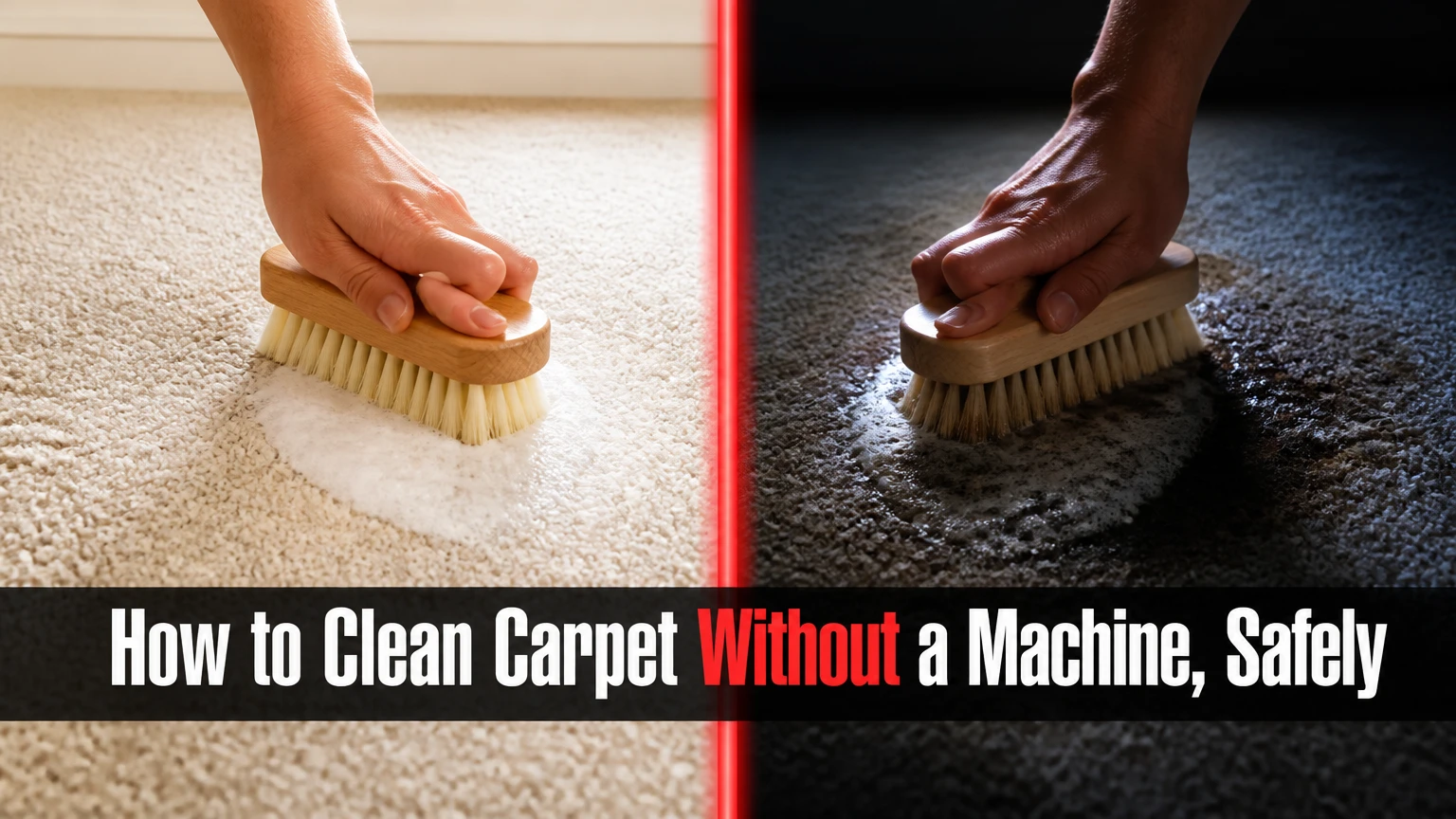
To clean carpet without a machine, remove dry soil, treat stains with a small amount of diluted cleaner, agitate gently, extract moisture with white towels, and dry the carpet quickly. A typical 10-by-12-foot room takes 2-4 hours of work and drying time, with low moisture and thorough towel extraction determining the result.
Key Facts at a Glance
Use approximately 2-3 drops of clear dish soap in 1 liter of warm water for light surface soil.
Apply liquid with a damp cloth or fine mist, not by pouring it onto the carpet.
Press white towels into the pile to extract moisture; rubbing can distort carpet yarn.
Baking soda absorbs some odors, but it does not remove embedded soil without vacuuming.
Never mix vinegar with chlorine bleach, ammonia, hydrogen peroxide, or commercial cleaners.
Carpet should feel dry within 12-24 hours; persistent dampness increases odor and microbial risk.
What Does Manual Carpet Cleaning Remove?
Manual carpet cleaning removes loose grit, surface dust, food residue, light oil, and some fresh stains without powered water extraction. Hand cleaning does not usually remove deeply embedded soil from the backing or padding as effectively as hot-water extraction, because towels cannot recover as much dirty solution as a machine.
Carpet soil has several components. Dry particles respond to brushing and vacuuming, oily particles need a surfactant, and water-based spills respond best to immediate blotting. Pet urine, milk, vomit, and floodwater require more caution because liquid can travel beneath the visible stain.
The Carpet and Rug Institute recommends prompt blotting and following the carpet manufacturer’s care instructions. That guidance matters because nylon, polyester, wool, cotton, jute, and rayon respond differently to water, pH, heat, and agitation.
How Does Hand Cleaning Work?
Hand cleaning combines dry-soil removal, chemical loosening, mechanical agitation, absorbent extraction, and evaporation. A diluted surfactant separates greasy soil from fibers, while towels transfer loosened liquid and debris away from the carpet pile.
Capillary action pulls liquid into an absorbent towel when the towel contacts damp carpet under pressure. The towel must be replaced as it becomes wet, because a saturated cloth can move soil around instead of removing it. Gentle agitation loosens soil, but aggressive scrubbing can fray yarn, spread stains, and create a fuzzy patch.
Manual cleaning is therefore a low-moisture maintenance method, not a complete substitute for professional extraction after flooding, years of neglected soil, or widespread pet contamination.
Which No-Machine Cleaning Method Should You Choose?
Choose diluted dish soap for light general soil, a dry compound for odor and moisture-sensitive surfaces, and a labeled foam product for small isolated stains. Use baking soda alone for a mild odor, but do not rely on the baking soda-and-vinegar fizzing method as deep cleaning.
The reaction between sodium bicarbonate and acetic acid produces carbon dioxide, water, and sodium acetate. The bubbles may disturb loose particles, but the reaction also neutralizes much of the acidity and alkalinity. It does not replace surfactant cleaning or extraction, and a powdery residue can remain in the pile.
| Method | Mixture or product | Typical dwell time | Best use | Main limitation |
|---|---|---|---|---|
| Diluted dish soap | 2-3 drops per 1 liter warm water | 2-5 minutes | Light soil and grease | Soap residue if overapplied |
| Baking soda | Dry layer, 1-2 tablespoons per square meter | 30-60 minutes | Mild odor | Requires thorough vacuuming |
| Commercial dry compound | Label-directed powder | 15-60 minutes | Low-moisture refresh | Needs strong vacuum removal |
| Carpet foam spray | Label-directed aerosol or pump spray | 10-30 minutes | Small stained areas | Can leave stiff residue |
| Diluted white vinegar | 1 part vinegar to 3 parts water | Immediate blotting | Selected odor or mineral residue | Not suitable for every fiber or stain |
What Tools and Materials Do You Need?
A basic hand-cleaning kit needs a vacuum or broom, white microfiber towels, a bucket, a soft or medium nylon brush, clear dish soap, and airflow. A 10-by-12-foot room typically needs 2 liters of cleaning solution, 6-10 towels, and 30-60 minutes of active work.
| Item | Typical quantity | Function | Acceptable substitute |
|---|---|---|---|
| Clear dish soap | 2-6 drops | Emulsifies light oily soil | Labeled carpet spot cleaner |
| Warm water | 1-2 liters | Carries diluted cleaner | Cool water for protein stains |
| White microfiber towels | 6-10 | Blotting and extraction | White cotton towels |
| Nylon brush | 1, 2-4 inch head | Controlled agitation | Clean soft toothbrush for spots |
| Vacuum cleaner | 1 machine | Removes dry soil and powder | Stiff broom and dustpan |
| Box fan | 1-2 fans | Speeds evaporation | Open windows and ceiling fan |
Do not use a colored towel, rough wire brush, abrasive sponge, or large amount of laundry detergent. Colored textiles can transfer dye, and laundry products often foam excessively or leave optical brighteners behind.
Before You Start: Test the Carpet
Read the carpet or rug care label, then test every liquid in a hidden area for color transfer, texture change, and browning. Wait until the test patch dries before treating the visible carpet, because some damage appears only after evaporation.
Identify the fiber when possible. Synthetic nylon and polyester carpet generally tolerate controlled spot cleaning better than wool or plant fibers, while jute, sisal, seagrass, silk, and viscose can stain, shrink, brown, or distort with water.
Move lightweight furniture, place plastic or foil under remaining legs, and clean one small section first. A 30-by-30-centimeter test patch provides enough evidence to stop before a problem spreads across the room.
Fiber Compatibility Guide
| Carpet or rug material | Water tolerance | Recommended method | Avoid |
|---|---|---|---|
| Nylon | Moderate to high | Low-moisture dish-soap solution | Excessive heat and overwetting |
| Polyester | Moderate | Blotting and labeled spot cleaner | Strong solvents and heavy agitation |
| Olefin | Moderate | Mild detergent for oily soil | Hot water and persistent rubbing |
| Wool | Low to moderate | Dry method or wool-approved cleaner | Alkaline soap, vinegar experiments, soaking |
| Jute or sisal | Low | Dry vacuuming and professional care | Water saturation and steam |
| Viscose or rayon | Low | Professional rug cleaning | DIY wet cleaning and brushing |
How Do You Clean Carpet Without a Machine?
Clean carpet without a machine in six controlled stages: remove dry soil, pretest and treat spots, apply diluted cleaner sparingly, agitate gently, extract with towels, and dry with moving air. For a 10-by-12-foot synthetic-carpet room, plan on 30-60 minutes of labor, 1-2 liters of water, and 12-24 hours for complete drying.
Step 1: Remove Dry Soil
Vacuum slowly in two directions, giving high-traffic lanes two passes each. If no vacuum is available, sweep with a clean stiff-bristled broom, collect the debris, and take a removable rug outdoors for gentle beating only if its backing and construction permit it.
Dry soil becomes muddy when liquid reaches it. Removing grit first also reduces the need for aggressive brushing, which protects twisted carpet yarn and reduces pile distortion.
You will know this step worked when the dustpan or vacuum canister collects little visible grit on a second pass. The common mistake is wet-cleaning before removing sand and hair.
Step 2: Treat Stains by Blotting
Place a folded white towel beneath or around a small removable rug stain when possible. Apply cleaning solution to a white cloth, then press from the outside of the stain toward its center.
Use 1 teaspoon of diluted solution at a time for a spot no larger than 10 centimeters across. Wait 2-5 minutes, blot, and repeat rather than flooding the area. Scraping dried mud is safer after it has fully dried; liquid mud spreads through the pile.
You will know this step worked when color transfers to the towel without the stain expanding. The common mistake is rubbing back and forth, which drives particles deeper and roughens the fibers.
Step 3: Mix a Low-Suds Cleaning Solution
Add 2-3 drops of clear dish soap to 1 liter of warm, not hot, water. Swirl gently, then use the foam or dampen a cloth rather than creating a bucket of suds on the carpet.
For a 10-by-12-foot synthetic room, begin with 1 liter and prepare a second liter only if necessary. More solution does not mean cleaner carpet; it increases the volume that must be removed from the backing.
You will know the mixture is suitable when it feels slippery but produces limited foam. The common mistake is substituting concentrated detergent, bleach, ammonia, or laundry powder.
Step 4: Clean Small Sections
Work in 60-by-60-centimeter sections. Dip the brush or cloth, wring it thoroughly, and work in the direction of the pile with light pressure, using short overlapping strokes rather than circular scrubbing.
A lightly damp surface is the target. The backing should not feel wet through the carpet, and no liquid should pool at seams, edges, or furniture marks. For broad soil, overlap each section by about 5 centimeters to avoid visible boundaries.
You will know this step worked when the pile looks evenly damp and the towel picks up gray or brown soil. The common mistake is cleaning the entire room before extracting the first section, which lets dirty solution migrate and dry unevenly.
Step 5: Extract Moisture With Towels
Lay two or three white towels over the damp section and press firmly with your hands or body weight. Replace towels when they become wet, then repeat until the towel feels only slightly damp.
Do not twist the carpet or drag the towel. For a small rug, place a waterproof layer beneath the rug and press from above; for fitted carpet, use a dry towel and controlled foot pressure without walking on exposed wet fibers.
You will know this step worked when the carpet feels cool but not wet and the towel no longer darkens significantly. The common mistake is stopping after one towel, leaving detergent and dirty water inside the pile.
Step 6: Rinse Lightly, Groom, and Dry
If soap was used, mist the cleaned area with a small amount of plain water, then repeat towel extraction immediately. Groom the pile in one direction with a clean brush and run a fan across the surface with windows open when outdoor humidity is low.
Aim for surface dryness within 6-12 hours and complete drying within 24 hours. Do not replace furniture until the carpet is dry, and use foil or plastic under legs if furniture must return sooner.
You will know the process is complete when the carpet feels dry at the surface and base, has no soapy stiffness, and smells neutral after 24 hours. The common mistake is closing windows and turning off airflow while the carpet remains damp.
How Should You Treat Different Stains?
Fresh stains require blotting first, while grease needs a surfactant and pet urine needs odor-focused treatment rather than perfume. Unknown, old, or chemically altered stains should receive the mildest tested treatment because repeated products can permanently set color or create rings.
| Stain type | First action | Hand-cleaning treatment | Do not use |
|---|---|---|---|
| Coffee or tea | Blot with cool water | Mild dish-soap solution, then rinse | Hot water and vigorous rubbing |
| Grease or cooking oil | Lift solids with a spoon | Minimal dish-soap solution on cloth | Pouring detergent directly |
| Wet mud | Remove excess, let residue dry | Vacuum or brush, then spot clean | Scrubbing wet mud |
| Red wine | Blot immediately | Small amounts of cool water and approved cleaner | Salt piles and repeated soaking |
| Pet urine | Blot liquid deeply | Enzyme cleaner labeled for carpet | Vinegar over fresh urine |
| Milk or vomit | Remove solids, blot | Cool water and enzyme product | Hot water, which can set proteins |
| Ink or dye | Blot edges carefully | Professional or labeled solvent treatment | Bleach and broad-area wetting |
How Do You Remove Pet Odor Without a Machine?
Blot fresh pet urine with layered towels, apply a carpet-labeled enzymatic cleaner according to its label, and allow the stated dwell time before extracting with towels. Baking soda can reduce a mild residual smell after the area dries, but it cannot neutralize urine absorbed into padding.
Urine odor often returns because the visible surface stain is smaller than the liquid’s spread below it. If odor persists after one careful treatment, stop adding household chemicals. A professional may need to inspect the pad, subfloor, and affected tack-strip area.
Can Baking Soda and Vinegar Deep-Clean Carpet?
Baking soda and vinegar do not provide reliable deep cleaning when mixed together. Baking soda is a dry odor absorber, while diluted vinegar may help with selected mineral or alkaline residues, but the two substances largely neutralize each other and can leave moisture and powder in the carpet.
For odor maintenance, sprinkle a thin layer of baking soda, leave it for 30-60 minutes, and vacuum slowly in multiple directions. Do not leave a heavy layer overnight on a carpet that cannot be vacuumed thoroughly, because powder can remain at the backing.
Use vinegar only after a hidden-patch test and never combine it with bleach, ammonia, hydrogen peroxide, or commercial products. The absence of visible fizz does not prove that chemical residues are safe together.
How Does Hand Cleaning Compare With Other Options?
Hand cleaning costs the least and gives the most control over moisture, but professional hot-water extraction removes more embedded soil from large areas. Dry compounds reduce drying risk, while foam sprays work best as targeted maintenance rather than whole-room restoration.
| Option | Typical cost | Active time | Drying target | Soil removal | Best situation |
|---|---|---|---|---|---|
| Hand cleaning | $2-$10 in supplies | 30-60 minutes per room | 6-24 hours | Surface to moderate | Small synthetic rooms |
| Commercial dry compound | $10-$30 per package | 15-30 minutes | 1-2 hours | Surface soil and odor | Moisture-sensitive rugs |
| Foam spray | $5-$15 per canister | 10-25 minutes | 2-6 hours | Isolated spots | Entryways and fresh marks |
| Rental extractor | $30-$80 per day | 1-3 hours | 8-24 hours | Moderate to deep | Several carpeted rooms |
| Professional extraction | $100-$300 typical visit | 1-3 hours onsite | 6-24 hours | Deep soil and residues | Large, heavily soiled areas |
Costs vary by country, room size, product brand, travel, and local labor. The practical threshold is area, not merely dirt: hand cleaning becomes inefficient when a room needs repeated kneeling, multiple liters of dirty water, or more than one day to dry.
Is Hand Cleaning as Effective as Steam Cleaning?
Hand cleaning is effective for surface soil and small fresh stains, but it is usually less effective than powered extraction for embedded grit, saturated pet urine, and large high-traffic areas. Machine performance also depends on equipment condition, solution choice, operator technique, and the number of extraction passes.
“Steam cleaning” commonly refers to hot-water extraction in carpet care, although many rental machines do not produce true steam. The relevant difference is recovery: a powered vacuum can remove more liquid and suspended soil than towels can.
Manual cleaning remains the safer choice for a small spill when a machine would introduce unnecessary water. It is not a sound substitute for water-damage remediation or badly contaminated padding.
What Drying Problems Can Occur?
The main drying problems are musty odor, detergent residue, browning, stain wicking, and backing damage. These problems usually follow excessive water, insufficient towel extraction, poor airflow, or incompatible chemicals rather than insufficient scrubbing.
Common Mistakes and Repairs
| Failure mode | Likely cause | Recovery action | Prevention |
|---|---|---|---|
| Crunchy or stiff pile | Dried soap residue | Light water mist and towel extraction | Measure soap precisely |
| Musty smell | Carpet stayed damp | Increase airflow and reassess pad | Extract until towels stay nearly dry |
| Brown edges | Natural fiber browning or overwetting | Stop wet treatment; seek rug specialist | Use dry method on jute or wool |
| Stain returns | Wicking from backing | Blot, extract, and dry again | Treat with less liquid |
| Fuzzy texture | Aggressive brushing | Stop agitation; groom lightly | Use pile-direction strokes |
| White powder | Incomplete vacuuming | Brush gently and vacuum slowly | Use a thin baking-soda layer |
A counterintuitive practitioner rule is that a second towel-extraction cycle often improves results more than a second scrubbing cycle. Once soil is suspended, recovery determines whether it leaves the carpet or dries back into it.
Another rule is to clean from the least soiled area toward the dirtiest area. That sequence reduces cross-contamination on the brush and preserves clean towels for the final sections.
When Should You Avoid DIY Carpet Cleaning?
Avoid DIY wet cleaning for flooding, sewage, widespread pet urine, mold growth, valuable rugs, color-unstable dyes, and fibers such as viscose or silk. Professional assessment is also appropriate when the carpet remains damp for more than 24 hours or odor returns after drying.
Contact a qualified carpet or rug cleaner when:
- Water has reached the pad or wooden subfloor.
- A stain covers more than roughly 1 square meter.
- The carpet label requires professional cleaning.
- Dye transfers during the patch test.
- The rug has hand-knotted construction, fringe, silk, viscose, or antique value.
- Someone in the home has severe respiratory sensitivity and the source of contamination is unknown.
The Environmental Protection Agency advises controlling indoor moisture and drying wet materials promptly because prolonged dampness supports mold growth. Cleaning cannot make a contaminated pad hygienic if the underlying material remains wet or biologically soiled.
How Often Should You Clean Carpet by Hand?
Spot-clean spills immediately, dry-refresh odor-prone areas every 2-4 weeks, and hand-clean small traffic zones when visible soil appears. Vacuuming remains the primary maintenance step because dry soil causes abrasion when it stays in carpet fibers.
| Household condition | Vacuuming frequency | Hand spot treatment | Deeper cleaning |
|---|---|---|---|
| One or two adults, no pets | 1-2 times weekly | As spills occur | Every 12-18 months |
| Children or indoor pets | 3-5 times weekly | Same day | Every 6-12 months |
| Allergy-sensitive household | Daily high-traffic passes | Low-moisture only | Professional assessment as needed |
| Entryway or commercial traffic | Daily | Daily marks | Every 3-6 months |
| Wool or delicate rug | Low-suction scheduled care | Dry or approved product | Specialist interval |
The Carpet and Rug Institute’s Seal of Approval program identifies tested cleaning products and equipment, but a certification does not override a carpet manufacturer’s warranty instructions. Product labels and fiber-specific care requirements remain the controlling guidance.
FAQ
Can I Clean Carpet With Only Water?
Water alone can remove some fresh, water-soluble spills when applied sparingly and blotted immediately. Water will not dissolve most greasy soil, and repeated wetting can spread stains or damage backing, so use a tested carpet cleaner for oily or established marks.
What Can I Use Instead of a Carpet Cleaning Machine?
Use a vacuum or broom, white towels, a bucket, a nylon brush, diluted clear dish soap, and a fan. Commercial dry compound or labeled foam spray can replace liquid cleaning when the carpet backing is moisture-sensitive or the room must return to use quickly.
How Much Water Should I Use on Carpet?
Use enough solution to dampen the pile without wetting the backing, typically 1-2 liters for a 10-by-12-foot synthetic room. Apply approximately 1 teaspoon at a time to a small stain, then extract immediately with dry towels.
Will Baking Soda Ruin Carpet?
Baking soda usually does not harm colorfast synthetic carpet when used as a thin, dry layer and removed thoroughly. It can create residue in deep pile, overload a weak vacuum, or affect delicate fibers, so patch-test and avoid heavy application on wool, jute, viscose, and antique rugs.
How Long Does Carpet Take to Dry After Hand Cleaning?
A lightly damp synthetic carpet commonly dries in 6-12 hours with airflow and can take up to 24 hours in cool or humid conditions. Thick rugs, wet padding, closed rooms, and poor towel extraction extend drying time and increase musty-odor risk.
How Do I Clean Carpet Without a Vacuum?
Sweep loose soil with a clean stiff broom, lift remaining debris with a dustpan, and use dry white towels for controlled blotting. Avoid baking soda or dry compound unless you have a reliable way to remove all powder from the pile.
The Bottom Line
To clean carpet without a machine, vacuum or sweep first, test the fiber, use a measured low-suds solution, treat small sections, and extract aggressively with clean white towels. Keep liquid away from the backing, dry the carpet within 24 hours, and reserve DIY methods for manageable surface soil and fresh stains. For a large, saturated, delicate, or contaminated carpet, professional extraction or rug cleaning is the safer choice.