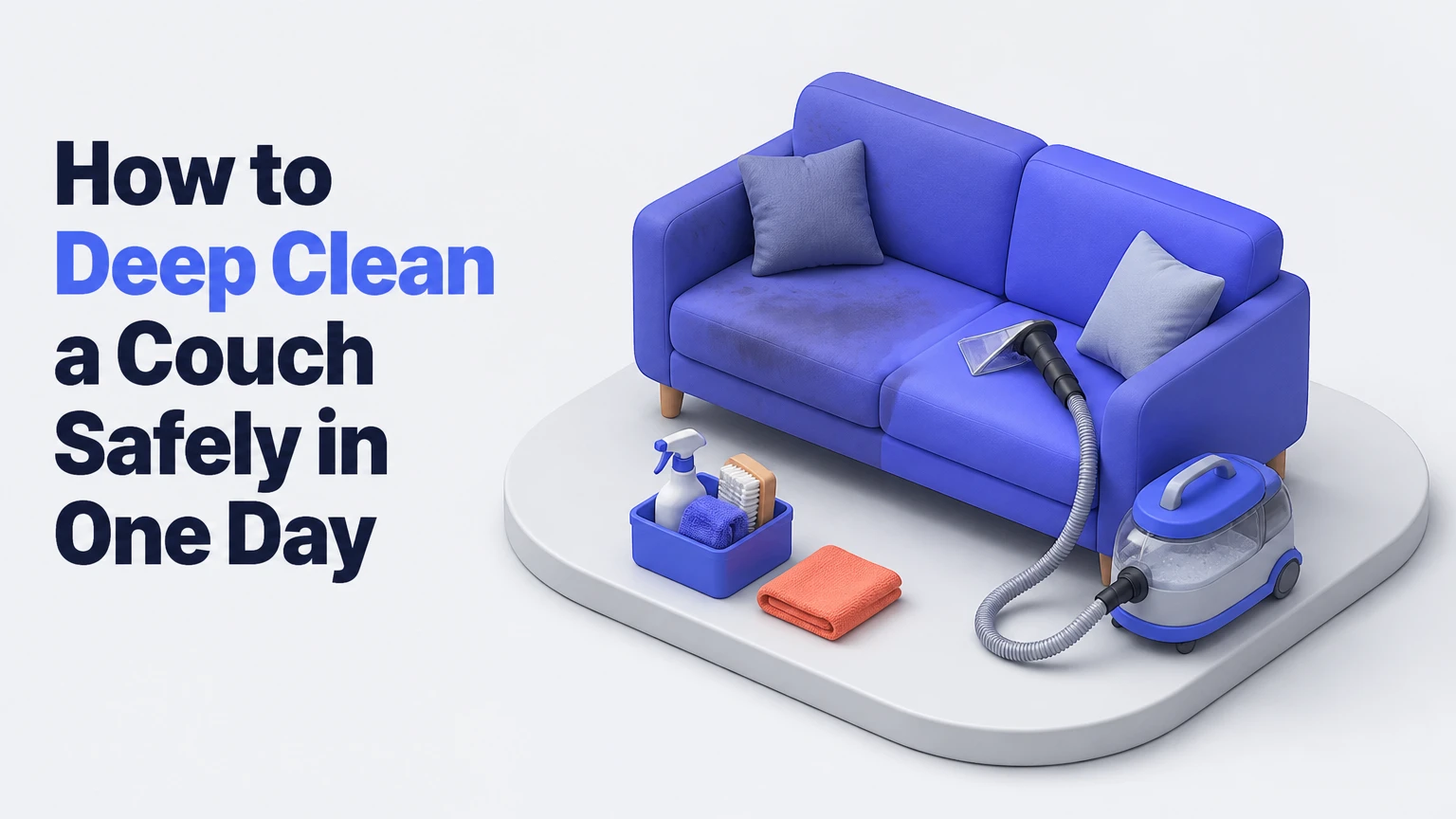
To deep clean a couch, identify its upholstery care code, vacuum every surface, pre-treat compatible stains, apply minimal cleaning solution, agitate gently, extract or blot moisture, and dry the couch rapidly with airflow. The complete process usually takes 1-3 active hours and 4-24 hours to dry, depending mainly on fabric, cushion thickness, humidity, and water volume.
Key Facts
A W or WS couch can usually tolerate a controlled water-based cleaning, but the manufacturer’s care instructions take priority over the code.
An S-coded couch requires an upholstery-safe solvent; water can cause dye bleeding, shrinkage, or permanent rings.
An X-coded couch should receive vacuum-only maintenance at home, with liquid cleaning left to a qualified upholstery professional.
The safest extraction method uses the least solution that removes soil, followed by several dry suction passes.
Typical DIY costs range from $20-$75, while professional upholstery cleaning commonly costs $120-$300 or more.
A couch is ready for use only when the fabric, seams, and cushion interiors feel completely dry and no musty odor remains.
What Does Deep Cleaning a Couch Remove?
Deep cleaning removes embedded dust, body oils, food residue, pet dander, hair, allergens attached to soil, and many ordinary stains from upholstery fibers and accessible cushion surfaces. Deep cleaning does not reliably sterilize foam, remove every permanent dye alteration, or repair fabric that has already faded, torn, or chemically damaged.
Routine vacuuming removes loose particles from the surface and seams. Deep cleaning adds a compatible solution, controlled agitation, and moisture removal so bonded soil can detach from fibers. The process resembles carpet cleaning, but couch upholstery is more vulnerable because fabric may be thinner, foam may retain water, and dyes can bleed under friction or heat.
Deep cleaning also has limits. A urine odor inside thick foam, smoke contamination throughout the frame, or mold growth beneath upholstery may require cushion replacement, structural disassembly, or professional remediation rather than another surface treatment.
How does upholstery cleaning work?
Upholstery cleaning has three functional stages: chemistry loosens soil, agitation transfers soil toward the surface, and extraction or blotting removes the suspended residue. Surfactants in a suitable upholstery cleaner reduce the bond between oily soil and fibers, while extraction removes both cleaner and detached particles.
“Steam cleaning” is often used as a household term for hot-water extraction, but steam vapor and a heated extraction machine are different processes. A portable extractor sprays liquid and immediately recovers much of it; a steam cleaner may deliver vapor with little or no recovery function. Couch suitability depends on the fabric label and manufacturer, not the machine name.
What Should You Check Before Cleaning?
Before deep cleaning a couch, confirm the care code, inspect the fabric for damage, test the cleaner in a hidden area, and prepare enough airflow to dry the upholstery. Skip liquid cleaning when the label is missing and the material is delicate, unstable, antique, or visibly weakened.
Care-code meanings
| Code | Permitted home method | Main risk | Safer decision |
|---|---|---|---|
| W | Water-based upholstery cleaner; controlled extraction | Water rings, shrinkage, dye transfer | Test first and use low moisture |
| S | Upholstery-safe dry solvent | Solvent marks, fumes, flammability | Follow the solvent label exactly |
| WS or SW | Water-based cleaner or solvent | Damage from unsuitable chemistry | Choose the gentler tested method |
| X | Vacuuming only at home | Permanent liquid or solvent damage | Hire a qualified upholstery cleaner |
| No label | No assumed method | Hidden fiber and dye instability | Contact the maker or use a professional |
Care codes are practical screening instructions, not a guarantee that every product is safe. A W label does not mean a couch can be soaked, and an S label does not mean every household solvent is appropriate. Check the original furniture manual when available.
What tools and quantities are needed?
For one standard three-seat couch, prepare a vacuum with an upholstery attachment, a crevice tool, 6-10 clean white microfiber towels, a soft upholstery brush, a measuring cup, a spray bottle, a compatible cleaner, and two or more fans. A portable extractor is optional for W or WS upholstery.
Use the cleaner at the dilution printed on its label. Do not invent a stronger mixture to compensate for heavy soil. Stronger chemistry increases residue, color loss, and fiber damage without guaranteeing better extraction.
Protect unfinished wood, metal hardware, electrical controls, and flooring. Remove decorative pillows and loose covers before starting. Keep pets and children away until the couch is dry and cleaning-product residue has been removed.
How to Deep Clean a Couch Step by Step
The following process is designed for W and WS fabric upholstery, with solvent and leather variations provided later. Complete one cushion or hidden section first, because a small test can reveal dye transfer, texture change, or water-ring formation before the entire couch is wet.
Step 1: Read the label and inspect the upholstery
Locate the manufacturer’s tag beneath a cushion, along the platform, or under the couch frame. Record the code and material, then inspect seams, piping, backing cloth, loose threads, sun-faded areas, and previous repair sites.
Do not clean over a torn seam or exposed foam. Vacuum-only maintenance is safer until weakened upholstery is repaired.
You’ll know it worked when: the cleaning method, material, and product all match the label and no fragile area is overlooked.
Common mistake: assuming a removable cover and the fixed couch base share the same care instructions. Check both.
Step 2: Remove cushions and vacuum every surface
Take off loose cushions and vacuum the top, underside, sides, platform, back, arms, seams, and crevices. Use the crevice tool around piping and the upholstery tool on broad fabric. A HEPA-filter vacuum is useful for retaining fine dust, but suction technique matters more than the filter for visible soil.
Vacuum slowly. Spend roughly 30-60 seconds on each cushion face and repeat on heavily used seating areas. Shake loose crumbs into a bin rather than brushing them deeper into the foam.
You’ll know it worked when: the vacuum stops collecting visible crumbs and the seams no longer contain hair, grit, or loose dander.
Common mistake: wetting the couch before dry soil removal. Water turns dust into difficult-to-remove mud.
Step 3: Test the cleaner in a hidden area
Dilute the product exactly as directed, apply a small amount behind the couch or beneath a cushion, and wait until the test patch dries. Press a white towel onto the area to check for color transfer, then compare texture and sheen with an untreated section.
Allow at least 15 minutes for a basic color-transfer check and longer when the test patch dries slowly. Stop if the fabric becomes sticky, lighter, rougher, distorted, or visibly darker around the edges.
You’ll know it worked when: the dry test patch has no bleeding, tide mark, stiff residue, or altered nap.
Common mistake: testing only whether the fabric changes color while ignoring stiffness or pile distortion.
Step 4: Pre-treat stains according to their type
Blot fresh liquid with a dry white towel, working from the outside toward the center. Apply a small amount of compatible spot cleaner to the towel or stain rather than flooding the cushion. Let the product dwell for the label’s stated time, commonly 5-10 minutes.
| Stain | First action on W or WS fabric | Avoid |
|---|---|---|
| Coffee or tea | Blot, then use neutral upholstery cleaner | Hot water before testing dye stability |
| Grease or body oil | Use a fabric-safe detergent or solvent approved for the code | Dish soap applied heavily |
| Pet urine | Blot, then use an enzyme product labeled for upholstery | Fragrance-only sprays |
| Ink | Professional treatment is safest; test solvent carefully | Rubbing alcohol without a hidden test |
| Mud | Let dry, vacuum, then clean remaining mark | Scrubbing wet grit into fibers |
| Red wine | Blot immediately and use tested upholstery chemistry | Chlorine bleach or aggressive peroxide |
Do not mix cleaners. Combining acids, solvents, oxidizers, and detergents can create irritating vapors or an unstable product.
You’ll know it worked when: the stain lightens without spreading, and the towel collects soil rather than transferring dye.
Common mistake: rubbing a stain in circles. Friction pushes contamination outward and can roughen the nap.
Step 5: Apply a light, even cleaning solution
For W or WS upholstery, mist a manageable section, such as one cushion or half an arm, until the surface is evenly damp. Do not pour solution onto the fabric or saturate the foam. Heavy soil may require a second controlled pass after the first has dried.
Use a spray pattern that overlaps slightly, and keep the nozzle close enough to control overspray. Begin with vertical passes and then work across the section, rather than repeatedly spraying one spot.
You’ll know it worked when: the fabric is damp to the touch but no liquid pools in seams, the cushion remains structurally firm, and the backing is not wet.
Common mistake: treating “more chemical” as equivalent to “more cleaning.” Residue left in upholstery attracts fresh soil and can create a crunchy texture.
Step 6: Agitate gently with the correct tool
Use a soft upholstery brush or a clean microfiber towel, applying light pressure in the direction recommended for the fabric. Short, overlapping strokes loosen soil; aggressive circular scrubbing can fray fibers, flatten velvet, or create a visible halo.
On microfiber, clean small sections and brush the pile back into a consistent direction after extraction. On chenille, use minimal pressure because raised yarns can snag or shift.
You’ll know it worked when: suspended soil appears on the towel or in the extractor recovery tank, while the fabric retains its original nap and color.
Common mistake: using a stiff household brush. Hard bristles can permanently change the surface even when the chemistry is correct.
Step 7: Extract or blot until little moisture remains
For a W or WS couch, use a portable upholstery extractor with a clean tank and the manufacturer’s upholstery nozzle. Make one controlled spray-extraction pass, then make two or three slow suction-only passes. The recovery tank should collect visibly dirty water during the first pass and progressively clearer water afterward.
If no extractor is available, press clean white towels firmly onto the damp section and replace them as they become wet. Do not twist or wring the fabric. Manual blotting removes surface moisture but cannot match the recovery from a strong extractor, especially inside thick cushions.
You’ll know it worked when: the fabric feels only slightly damp, the recovery water becomes clearer, and a towel pressed into the surface is not soaked.
Common mistake: moving the machine quickly. Fast passes leave water behind and reduce soil recovery.
Step 8: Dry the couch completely
Stand loose cushions on their edges with space between them, but do not distort their shape. Aim two fans across the upholstery rather than directly into one wet spot, open windows when outdoor humidity is lower, and use a dehumidifier in a closed room when necessary.
The U.S. Environmental Protection Agency recommends indoor relative humidity below 60%, ideally 30%-50%, to limit moisture-related mold growth. A couch that feels dry on top may still hold moisture near the zipper, welt cord, or foam center, so inspect those areas before use.
You’ll know it worked when: seams and cushion edges feel dry, the couch has no cool dampness, and no musty smell develops after several hours.
Common mistake: covering or stacking cushions during drying. Restricted airflow can keep the foam damp long after the surface appears dry.
Which Couch Cleaning Method Should You Use?
The best method depends on the care code, fiber sensitivity, soil depth, available extraction power, and drying conditions. Water-based extraction is efficient for many synthetic W or WS couches, while solvent cleaning suits S-coded upholstery and professional treatment is safer for unstable, valuable, or heavily contaminated furniture.
| Method | Suitable material | Typical active time | Typical cost | Main limitation |
|---|---|---|---|---|
| Manual low-moisture cleaning | W or WS polyester, nylon | 1-2 hours | $20-$40 | Limited foam extraction |
| Portable extraction machine | W or WS synthetic fabric | 1-3 hours | $40-$75 rental or owned unit | Over-wetting risk |
| Encapsulation foam | Tested synthetic upholstery | 1-2 hours | $25-$60 | Weak against heavy grease |
| Dry solvent cleaning | S-coded fabric, selected blends | 1-2 hours | $30-$80 DIY materials | Fumes and solvent-mark risk |
| Professional upholstery service | Delicate, stained, valuable, or X-coded furniture | 1-3 hours | $120-$300+ | Scheduling and regional pricing |
| Leather cleaner and conditioner | Finished leather, with product approval | 45-90 minutes | $20-$60 | Wrong product can darken leather |
Is hot-water extraction the same as steam cleaning?
Hot-water extraction uses a spray-and-recover system; steam cleaning uses heated vapor or a machine marketed around steam. Hot-water extraction is generally the more relevant comparison for fabric couches because recovery removes dissolved soil and moisture, while vapor alone does not remove suspended dirt.
Use the temperature and solution settings specified by the machine and furniture manufacturer. High heat can shrink natural fibers, set certain stains, soften adhesives, or alter finishes. An extractor is not automatically safe merely because it is sold for carpets.
When is low-moisture or solvent cleaning better?
Low-moisture cleaning is preferable when a synthetic couch needs surface maintenance but cannot tolerate long drying. Solvent cleaning is appropriate only for an S-coded couch and only with a product labeled for upholstery, adequate ventilation, and strict fire-safety precautions.
Neither method is a universal substitute for extraction. Encapsulation can leave embedded grease or pet urine untreated, and solvent cleaning cannot remove water-soluble soil in the same way as a carefully extracted water-based cleaner.
How Do You Clean Leather, Microfiber, Velvet, or Removable Covers?
Material-specific cleaning changes the procedure because fiber structure, finish, and backing determine how much moisture and friction the couch can tolerate. Never transfer a fabric-couch formula to leather, velvet, suede, or an untested removable cover.
| Material | Preferred approach | Drying or finishing step | Avoid |
|---|---|---|---|
| Finished leather | Damp microfiber cloth plus leather cleaner | Apply compatible conditioner sparingly | Household disinfectant, alcohol, soaking |
| Faux leather | Mild cleaner after hidden test | Wipe dry completely | Abrasive pads and petroleum solvents |
| Microfiber | Code-approved low-moisture cleaner | Brush pile uniformly after drying | Saturation and random directional strokes |
| Velvet | Vacuum and professional low-moisture treatment | Restore pile with suitable brush | Steam, hard scrubbing, excess water |
| Removable cotton cover | Follow sewn-in label, test shrinkage | Dry as directed before refitting | Hot drying without approval |
| Suede or aniline leather | Specialist cleaning | Product-specific restoration | Water-based DIY cleaning |
How should leather be deep cleaned?
Vacuum leather with a soft brush, wipe a small area with a barely damp microfiber cloth, apply a leather cleaner approved for that finish, and remove residue with a second cloth. Condition only after the surface is clean and dry, using a thin coat rather than saturating the hide.
Finished, aniline, nubuck, and suede leather behave differently. A product safe for finished leather may stain aniline leather or damage a suede nap. If the leather absorbs water immediately, has worn color, or shows cracking, use a leather specialist instead of adding conditioner blindly.
How should microfiber be cleaned?
Check the care code first, then clean microfiber in small sections with minimal liquid and gentle agitation. After drying, restore the pile with a soft brush in one consistent direction; uneven brushing can leave visible dark and light patches.
Some microfiber fabrics are S-coded and should receive solvent rather than water. Water can produce rings or stiff patches even when the fabric feels synthetic. Rubbing alcohol is sometimes recommended for specific S-coded microfiber, but the manufacturer’s instructions and a hidden test must control the decision.
What Common Problems Occur After Cleaning?
Most post-cleaning problems result from excessive moisture, incomplete extraction, incompatible chemistry, or uneven treatment. Correct the cause rather than adding another product, because repeated wetting often spreads the original problem.
| Problem | Likely cause | First recovery action | When to stop DIY |
|---|---|---|---|
| Water ring | Uneven wetting or drying | Reclean the entire panel seam to seam with minimal moisture | Ring remains after full drying |
| Musty odor | Foam or seams stayed damp | Increase airflow, dehumidify, inspect cushion interior | Odor persists for 24-48 hours |
| Crunchy texture | Detergent residue | Extract or blot with clean water only if code permits | Texture remains after drying |
| Dye transfer | Unstable dye or wrong chemistry | Stop, blot, and keep the area cool and ventilated | Color loss is visible |
| Flattened nap | Excess pressure or wrong brush | Let dry, then brush gently in one direction | Velvet or chenille remains distorted |
| Brown or yellow edges | Soil wicking from backing or foam | Professional rinse and drying assessment | Stain returns after drying |
Do not spray vinegar, rubbing alcohol, bleach, or disinfectant over a problem without checking the care code. Household formulas can damage finishes, create odor, or spread a ring.
What should you do about a musty couch?
A musty couch should be separated from other furniture, dried with fans and dehumidification, and inspected at seams, cushion zippers, and the underside. If the odor persists after 24-48 hours of thorough drying, the foam or backing may contain contamination that surface cleaning cannot remove.
Do not seal a damp cushion in a plastic bag. Do not mask the smell with fragrance. Persistent odor after a wet-cleaning attempt is a reason to obtain a professional moisture and upholstery assessment.
How Much Does Couch Cleaning Cost and How Long Does It Take?
Typical DIY couch cleaning costs $20-$60 for solution and basic supplies, or $40-$75 for a daily extractor rental. Professional upholstery cleaning commonly costs $120-$300 or more, while active work takes about 1-3 hours and drying usually takes 4-12 hours for lightly damp synthetic fabric or up to 24 hours for thick, humid, or heavily wet upholstery.
| Couch situation | Active cleaning time | Typical drying time | Typical DIY cost |
|---|---|---|---|
| Two-seat synthetic loveseat | 45-90 minutes | 4-8 hours | $20-$45 |
| Three-seat fabric couch | 1.5-3 hours | 6-12 hours | $30-$75 |
| Thick removable cushions | 2-3 hours | 12-24 hours | $40-$75 |
| Leather couch | 45-90 minutes | 1-3 hours | $20-$60 |
| Velvet or delicate upholstery | 1-3 hours professional time | 8-24 hours | $120-$300+ professional |
| Pet-urine affected foam | 2-4 hours assessment and treatment | 12-48 hours | $100-$350+ |
Drying time increases with cushion thickness, room humidity, low airflow, dark fabric, and the amount of water used. A warm room alone is not enough if humid air cannot leave the space.
When Should You Hire a Professional?
Hire a professional upholstery cleaner when the couch is S or X coded, antique, silk, velvet, aniline leather, severely stained, smoke-contaminated, or wet deep inside the foam. Professional service is also the safer choice when the furniture has high replacement value and a failed experiment would cost more than the cleaning fee.
Ask the cleaner which method, chemical family, drying plan, and inspection standard will be used. An IICRC-trained technician may follow upholstery-cleaning practices from the Institute of Inspection Cleaning and Restoration Certification, but certification does not replace checking the manufacturer’s fabric requirements.
DIY cleaning is a poor choice for mold, extensive pet urine, sewage, unknown antique textiles, or upholstery with structural damage. Surface deodorizer cannot solve contamination inside foam, and a second wet treatment can worsen the condition.
How Often Should You Deep Clean a Couch?
Most households should vacuum a couch weekly, clean spills immediately, and deep clean fabric upholstery every 6-12 months when the material permits it. Homes with pets, smokers, allergies, young children, or heavy daily use may need targeted cleaning more often, while delicate upholstery may require less frequent professional treatment.
A schedule should follow soil load rather than a rigid date. Clean high-contact arms and seat fronts when they become visibly dark or oily, but avoid repeatedly wetting the same cushion before it has fully dried.
FAQ
Can I deep clean a couch without a machine?
Yes, a W or WS couch can be cleaned manually with a tested upholstery solution, a soft brush, and absorbent white towels. Manual blotting removes surface moisture and soil, but it does not extract contamination from thick foam as effectively as an upholstery extractor, so use very little liquid and allow extra drying time.
Can I use laundry detergent on couch upholstery?
Laundry detergent is usually a poor first choice because it may contain brighteners, fragrances, enzymes, or a concentration that leaves difficult residue. Use a product labeled for the couch’s care code and dilute it exactly according to the manufacturer’s instructions.
How do I clean couch cushions that cannot be removed?
Vacuum fixed cushions through seams and around piping, clean one section at a time, and keep liquid away from the cushion’s interior and frame. Use extraction or towel blotting immediately, then place fans so air crosses the cushion surface and reaches the lower seams.
Does deep cleaning disinfect a couch?
Deep cleaning removes soil and may reduce microorganisms carried in that soil, but ordinary upholstery cleaning is not the same as disinfection. A disinfectant is appropriate only when its label specifically permits use on the upholstery material and requires no damaging dwell time or rinse.
How do I prevent a couch from getting dirty quickly?
Remove dry soil weekly, treat spills immediately, avoid oily skin products on seating areas, rotate reversible cushions, and use washable covers where the manufacturer permits them. The most effective prevention is frequent low-moisture maintenance, because heavy buildup requires stronger chemistry and creates longer drying times.
The Bottom Line
To deep clean a couch safely, follow the care code, remove dry soil first, test every product, use controlled moisture, extract thoroughly, and dry every cushion completely. W and WS synthetic upholstery is usually the most manageable DIY category; S, X, velvet, suede, aniline leather, antique fabric, and contaminated foam deserve professional assessment. The correct method matters more than the strongest cleaner.