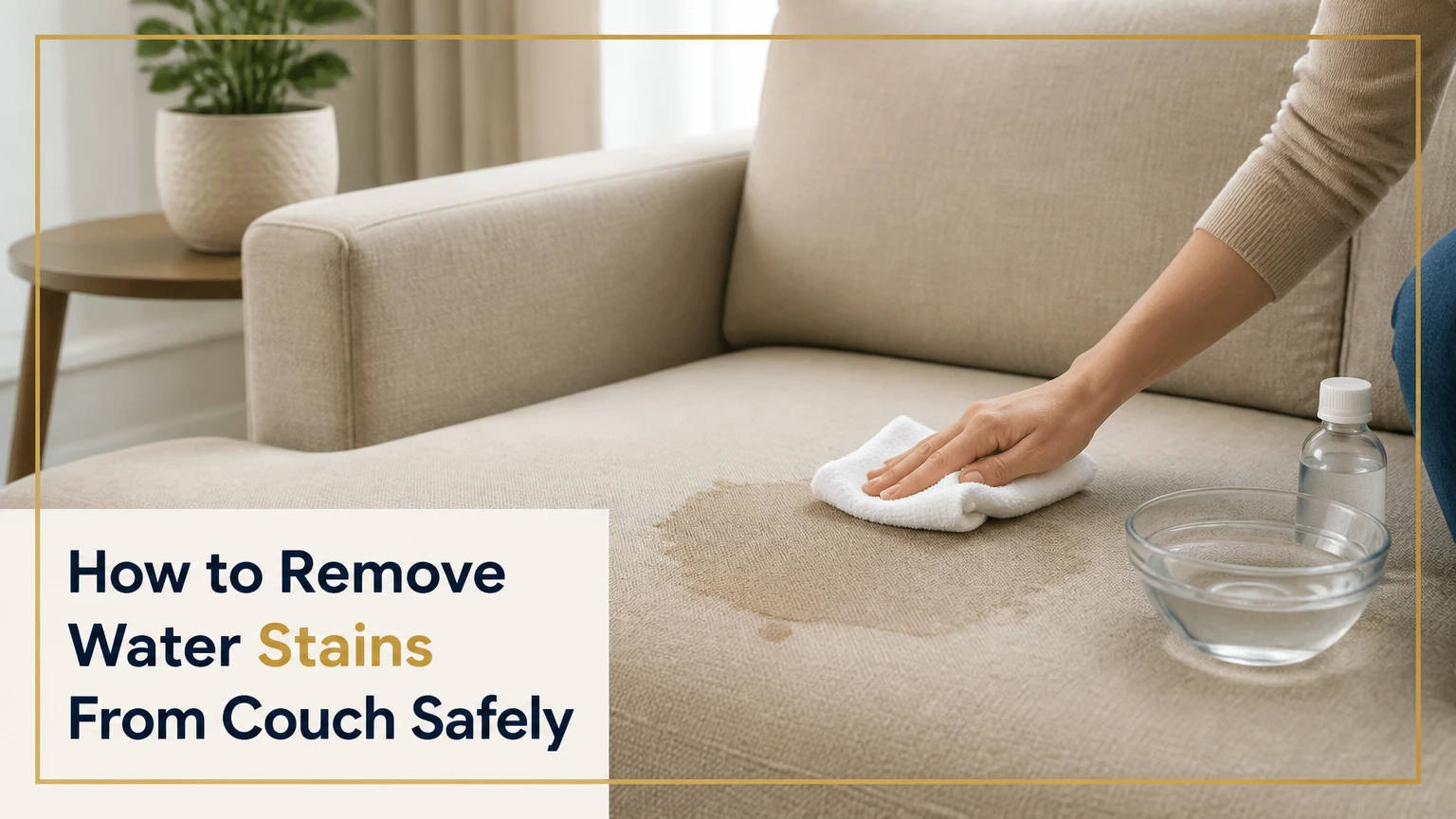
To remove water stains from a couch, first read the upholstery care code, then use the lowest-moisture method approved for that fabric. W and W/S upholstery can often be treated with distilled water and careful extraction, while S fabrics require water-free solvent and X fabrics should be vacuumed or professionally cleaned. Dry the area quickly with cool airflow.
Key Facts
A couch water ring usually forms when dissolved minerals, soil, or cleaner residue move to the drying edge of a wet area.
Distilled water is safer than tap water for W and W/S upholstery because it adds fewer minerals.
An S care code means water can damage the fabric, so use only a labeled upholstery solvent after a hidden-area test.
An X care code prohibits consumer liquid cleaning; vacuuming and professional assessment are the safer options.
The safest drying method is strong airflow at room temperature or cool air, not an iron, radiator, or hot hair dryer.
Treating only the visible circle can create another boundary; broad, controlled cleaning often produces a more even result.
Why Do Water Rings Appear on Couch Fabric?
Water rings appear when moisture dissolves minerals, dust, detergent, sizing, or spill residue inside upholstery and carries those substances toward the drying perimeter. The visible circle is therefore often a drying pattern rather than a deposit located only at the center.
A clear spill can also expose soil that was already present. When the wet area dries, the pile may lie in a different direction, creating a darker or lighter halo even when minerals are not the main cause. Colored drinks, pet accidents, and cleaning products add separate contamination that plain water cannot remove.
The ring may be on the surface, inside the cushion cover, or at the foam boundary. A stain that returns after repeated cleaning often indicates residue or moisture in the cushion core, not a failure of blotting technique.
Identify the residue before choosing a cleaner
| Visible condition | Likely cause | Best first response | Do not assume |
|---|---|---|---|
| Pale circular edge | Tap-water minerals | Distilled-water rebalancing on W or W/S fabric | The ring is only surface dirt |
| Brown or gray halo | Soil moved by moisture | Upholstery-safe detergent or professional extraction | Vinegar alone will remove soil |
| Sticky or crunchy patch | Dried soap or cleaner | Controlled rinsing with approved solution | More soap will improve it |
| Yellow or orange edge | Tannin, dye, or aged residue | Professional assessment for delicate fabrics | The mark is a mineral ring |
| Flattened or shiny patch | Pile distortion or heat | Gentle brushing after complete drying | More liquid will restore texture |
Which Couch Care Code Should You Follow?
The care code determines whether water, solvent, or neither belongs on the upholstery. Find the tag under a seat cushion, beneath the sofa, on the platform, or inside a removable cover, and check the furniture manufacturer’s cleaning instructions before testing any remedy.
| Code | Approved cleaning category | Typical DIY action | Main risk |
|---|---|---|---|
| W | Water-based products | Distilled water or upholstery cleaner | Tide lines, over-wetting, dye bleed |
| S | Water-free solvent | Upholstery dry-cleaning solvent | Solvent marks, fumes, flammability |
| W/S | Water or solvent | Use the gentlest tested option | Damage from either incompatible product |
| X | Vacuum only | Vacuum upholstery and call a professional | Permanent water or solvent damage |
| No code | Unknown | Contact manufacturer or cleaner | Irreversible fiber, dye, or backing damage |
A W label does not mean the cushion can be soaked. It means a compatible water-based product may be used with controlled moisture. Similarly, W/S does not guarantee that every household cleaner is safe.
If the tag says X, do not use distilled water, vinegar, steam, carpet shampoo, or an extraction machine at home. Vacuuming may remove loose soil, but an X-coded fabric may require a professional who can identify its fiber, backing, and construction.
What Should You Gather Before Cleaning?
Prepare distilled water, white microfiber cloths, a vacuum with an upholstery attachment, absorbent towels, a fan, and a white cotton swab for testing. Add a labeled upholstery cleaner or water-free solvent only when the care code permits it.
Before-you-start checklist
| Requirement | Typical specification | Why it matters |
|---|---|---|
| Distilled water | 250-500 milliliters for one cushion | Reduces new mineral deposits |
| White microfiber cloths | 4-6 cloths, 30 x 30 centimeters | Reveals dye transfer and controls moisture |
| Absorbent towels | 2-4 bath or terry towels | Extracts liquid without rubbing |
| Vacuum | Upholstery nozzle, low suction if adjustable | Removes grit before wet work |
| Fan | Box or pedestal fan, 40-60 centimeters away | Speeds evaporation without heat |
| Cleaner or solvent | Manufacturer-labeled upholstery product | Matches the W, S, or W/S code |
| Test area | 5 x 5 centimeters beneath cushion | Exposes bleeding, rings, and texture changes |
Remove jewelry with sharp edges and photograph the stain before treatment. If the cushion cover has a zipper, check whether the manufacturer permits machine washing; do not assume a removable cover is washable.
How Do You Remove a Fresh Water Stain?
Fresh water stains on W or W/S upholstery usually respond best to controlled blotting followed by even drying. The process takes about 20-45 minutes of active work, plus 4-12 hours of drying, and success depends more on moisture control than on chemical strength.
Step 1: Read the label and test the fabric
Vacuum a hidden section, then apply one teaspoon of the planned solution to a white cloth. Press the cloth against the test area for 10 seconds and inspect it for dye transfer, texture change, stickiness, or a new ring.
Wait until the test area is fully dry before judging the result. Some fibers look darker while wet, and velvet or microfiber can temporarily change direction.
You will know the test passed when: the white cloth remains clean, the color stays stable, and the dry pile matches the surrounding fabric.
Common mistake: testing on the most visible part of the stain, where a failed experiment becomes permanent damage.
Step 2: Vacuum the dry upholstery
Use the upholstery attachment to remove dust, hair, crumbs, and grit from the cushion surface and seams. Vacuum in the direction of the pile on velvet, chenille, and microfiber rather than dragging the nozzle aggressively across the fibers.
Dry soil can become mud when moisture is introduced. Removing it first also lets you distinguish a genuine ring from a patch of compressed or dirty pile.
You will know the step worked when: the fabric feels dry and loose, with no visible crumbs along the seam.
Common mistake: skipping vacuuming because the stain looks clean. Invisible soil is often what creates the brown edge.
Step 3: Rebalance a light ring with distilled water
Dampen a white microfiber cloth with distilled water and wring it until no drops fall. For a small ring, lightly blot from the outer edge toward the center; for a broad tide mark, treat the entire cushion panel from seam to seam so one wet boundary does not replace another.
Do not pour water onto the couch. Work in sections of approximately 15 x 15 centimeters, transferring moisture from the cloth rather than flooding the foam. Immediately press a dry towel over each section for 10-15 seconds.
You will know it worked when: the visible boundary softens while wet and the towel removes moisture without soaking through the cushion.
Common mistake: treating only the dark circle with a wet spot. A partial patch often dries with a second, larger outline.
Step 4: Extract and dry the cushion
Place a folded dry towel over the treated area and press with the flat palm. Replace the towel when it feels damp. Set a fan 40-60 centimeters away and use cool air, or use a hair dryer on its lowest cool setting while keeping it at least 20 centimeters from the fabric.
Rotate or stand the cushion on its edge only if the manufacturer permits it and the cushion remains stable. Keep pets and children away until the upholstery is completely dry.
You will know the step worked when: the fabric no longer feels cool or damp, the ring has not expanded, and the pile can be brushed back into place.
Common mistake: applying heat to accelerate drying. High heat can set residues, shrink natural fibers, soften adhesives, or distort synthetic pile.
Can Vinegar Remove a Couch Water Ring?
Diluted white vinegar can help dissolve some alkaline mineral residue on W or W/S upholstery, but vinegar is not universally safe and does not reliably remove soil, dye, oil, or old drink residue. Use it only after a hidden-area test and never on S, X, silk, rayon, or uncertain vintage upholstery.
A safer starting mixture is one part white vinegar to three parts distilled water, rather than an automatic 1:1 mixture. Apply the solution to a cloth, not directly to the cushion, and use the smallest amount that wets the surface evenly.
Blot the area, then remove residue with a second cloth dampened with distilled water. Vinegar odor commonly fades as the fabric dries, but persistent odor indicates trapped moisture or residue inside the cushion.
Practitioner rule: vinegar is a mineral-residue treatment, not a general upholstery disinfectant. The phrase “sanitizes the couch” overstates what a weak household vinegar solution can establish on porous fabric.
How Do You Clean an S-Code Couch?
Clean an S-code couch with a labeled water-free upholstery solvent, applied sparingly to a white cloth after ventilation and a hidden-area test. Never substitute water, vinegar, steam, or a water-based carpet product because moisture can cause rings, shrinkage, dye bleed, or backing separation.
Read the solvent label for compatible fibers, ventilation requirements, and disposal instructions. Open windows, keep the product away from flames and pilot lights, wear suitable gloves, and do not use a hair dryer while solvent vapors remain.
Apply approximately one teaspoon of solvent to a cloth, not the fabric. Blot from the outer edge toward the center, move to a clean part of the cloth, and allow the area to evaporate naturally.
You will know it worked when: the mark fades without a darker perimeter, the fabric remains level, and the solvent odor diminishes during ventilation.
Common mistake: saturating the cushion because the solvent evaporates quickly. The cover may dry while the foam or backing retains solvent.
Can You Use a Steam Cleaner or Extraction Machine?
A steam cleaner or hot-water extractor is suitable only when the manufacturer permits water-based deep cleaning and the fabric has passed a test. Extraction can help large, soil-loaded areas, but steam is not a universal treatment for water rings and is inappropriate for S or X upholstery.
Portable extractors spray solution and recover it through suction. Use the upholstery tool, the manufacturer’s formula, the lowest practical spray volume, and several slow suction-only passes. Avoid hot tap water unless the equipment and fabric instructions specifically allow it; temperature does not compensate for excess moisture.
| Situation | Recommended method | Typical active time | Drying time |
|---|---|---|---|
| One fresh ring, W fabric | Distilled-water cloth method | 20-45 minutes | 4-8 hours |
| One stubborn mineral ring, W fabric | Diluted vinegar test and blot | 30-60 minutes | 4-12 hours |
| S-code localized mark | Water-free upholstery solvent | 15-30 minutes | 1-3 hours |
| Large W-coded cushion area | Low-moisture extractor | 45-120 minutes | 8-24 hours |
| X-coded or antique upholstery | Professional assessment | 1-3 hours | 4-24 hours |
The machine must recover more liquid than it introduces. A cushion that remains damp after 24 hours needs more airflow and professional evaluation, especially if it smells sour or musty.
How Do You Remove an Old or Set-In Water Stain?
Old couch water stains require diagnosis before treatment because the ring may contain mineral scale, soil, cleaner residue, dye migration, or permanent fiber distortion. On W and W/S upholstery, clean the affected panel evenly with an approved low-moisture method; on S, X, antique, or delicate fabrics, use a professional.
Start by vacuuming and inspecting the dry texture under natural light. If the area is crunchy, sticky, or gray, residue is likely present. If the color differs but the fabric feels normal, dye change or sun fading may be permanent.
Do not repeat vinegar applications indefinitely. Repeated acidity can affect dyes, finishes, and some natural fibers while leaving embedded soil untouched.
Professional cleaning is usually the better choice when the stain covers more than one cushion, returns after two controlled attempts, reaches the foam, or came from urine, milk, wine, or another contaminated liquid.
Which Method Fits Your Couch?
The best method depends on the care code, stain size, residue type, and value of the furniture. Distilled-water rebalancing is the lowest-cost option for a light W or W/S ring, while solvent or professional cleaning becomes safer when the fabric is delicate or the construction is unknown.
| Method | Suitable code | Typical cost | Best use | Main limitation |
|---|---|---|---|---|
| Distilled-water blot | W, W/S | $1-$4 | Small fresh ring | Does not remove grease |
| Diluted vinegar treatment | Tested W, W/S | $2-$6 | Mineral residue | Can affect dyes and odor |
| Water-free solvent | S, some W/S | $8-$25 | Localized solvent-safe mark | Fumes and flammability |
| Portable extractor rental | Approved W | $20-$50 per day | Multiple cushions | Over-wetting risk |
| Professional upholstery cleaning | Any after assessment | $100-$300 typical | Delicate, large, recurring stains | Higher upfront cost |
What about microfiber?
Microfiber may carry W, S, or W/S instructions, so the fiber name alone does not determine the method. Some microfiber develops a darker ring from water even when the underlying material is washable; use the label, distilled water, minimal moisture, and gentle pile brushing.
What about velvet, chenille, linen, and rayon?
Velvet and chenille can show permanent pile direction changes after rubbing or uneven drying. Linen may shrink or crease when wet, while rayon and viscose can weaken, distort, or develop irreversible water marks. Professional cleaning is the prudent choice for rayon, viscose, silk, antique velvet, and high-value upholstery.
What if the cushion cover is removable?
A removable cover can still have a nonwashable finish, backing, zipper, or fiber blend. Follow the sewn-in label exactly, wash only when the manufacturer permits it, close the zipper, avoid hot water, and air-dry flat if instructed.
Common Mistakes and How Can You Fix Them?
Most failed couch-stain treatments result from incompatible chemistry, uneven moisture, or slow drying rather than from insufficient scrubbing. Stop adding product when the stain worsens, let the area dry enough to evaluate it, and match the recovery method to the failure.
| Failure mode | Likely reason | Recovery action |
|---|---|---|
| Ring becomes larger | Partial wetting and slow edge drying | Rebalance the full cushion panel with approved moisture |
| Fabric turns crunchy | Dried cleaner, vinegar, or minerals | Rinse lightly with approved solution, extract, and dry |
| Color transfers to cloth | Dye instability | Stop immediately and contact a professional |
| Cushion smells musty | Foam remains damp | Increase airflow and seek assessment after 24-48 hours |
| Pile looks shiny | Rubbing or heat damage | Stop brushing; have textured upholstery evaluated |
| Stain returns | Contamination inside foam | Professional extraction or cushion replacement assessment |
Do not scrub in circles with a stiff brush. Agitation can break fibers, raise fuzz, flatten nap, and spread dissolved soil beyond the original boundary.
Do not mix vinegar with bleach, ammonia, or commercial cleaners. Chemical combinations can release irritating vapors, and the resulting pH may damage upholstery.
Do not use baking soda as a substitute for stain extraction. Baking soda may absorb a surface odor, but it cannot pull a mineral ring from deep foam and can leave powder in seams and mechanisms.
When Should You Hire a Professional?
Hire a professional upholstery cleaner when the couch has an X code, silk, rayon, viscose, antique velvet, unstable dye, extensive saturation, or a stain that returns after two careful treatments. Professional help is also appropriate when the cushion foam remains damp beyond 24-48 hours.
Ask the cleaner which process matches the fabric code, whether they test for dye bleed, how they control moisture, and whether they provide a written limitation for permanent discoloration. A professional cannot always reverse sun fading, chemical bleaching, or pile damage, so ask whether the mark is removable before authorizing treatment.
The cost is typically higher than DIY supplies, but the risk calculation changes for furniture valued at several hundred or several thousand dollars. A failed home experiment can permanently alter color, texture, backing, or cushion shape.
How Can You Prevent New Water Rings?
Prevent new water rings by using coasters, blotting spills immediately, cleaning whole cushion panels instead of isolated circles, and keeping upholstery moisture low. After any approved wet cleaning, provide continuous airflow until the cover and cushion core are fully dry.
Use distilled water for small W or W/S touch-ups when the manufacturer permits it. Vacuum weekly in high-use homes, address body-oil soil before it becomes embedded, and wash or replace protective covers according to the furniture maker’s instructions.
Keep a record of the care code and approved product inside a household cleaning file. That small step prevents a common emergency mistake: using a water-based spray on an S-coded couch because the label was forgotten.
FAQ
Will tap water remove a water stain from a couch?
Tap water may redistribute a light ring, but it can also add calcium, magnesium, iron, or chlorine residue as it dries. For W or W/S upholstery, distilled water is the safer choice because it contains fewer dissolved minerals. Tap water is not appropriate for S or X fabrics regardless of hardness.
Can I use a hair dryer on a wet couch?
Use a hair dryer only on the cool setting, at least 20 centimeters from the fabric, while moving it continuously. Hot air can shrink natural fibers, soften adhesives, set residues, or distort synthetic pile. A box fan positioned 40-60 centimeters away usually provides safer, more even drying.
How many times can I treat the same water ring?
Attempt no more than two careful treatments at home before seeking professional advice, especially on textured or delicate upholstery. Repeated wetting increases the chance of dye migration, backing damage, foam saturation, and permanent pile change. A recurring ring often indicates contamination below the cover.
Is a water ring on a leather couch cleaned the same way?
No. Leather requires a leather-specific cleaner and conditioner, not vinegar, distilled-water saturation, or fabric upholstery solvent. Blot fresh moisture with a dry cloth, follow the leather manufacturer’s instructions, and seek professional help for dyed, aniline, nubuck, or suede leather.
Why does my couch still smell after the water stain dries?
A lingering smell usually indicates trapped moisture, organic contamination, detergent residue, or foam exposure rather than a simple mineral ring. Improve ventilation and inspect the cushion underside and seams. If the odor remains after 24-48 hours or resembles mildew, stop home cleaning and contact an upholstery professional.
The Bottom Line
To remove water stains from a couch, identify the care code first, test a hidden area, use distilled water only on approved W or W/S upholstery, and extract moisture before it reaches the foam. Use water-free solvent for tested S fabric, never liquid-clean X fabric, and choose professional cleaning for delicate, valuable, contaminated, or recurring stains. The safest solution to how to remove water stains from couch is controlled moisture followed by rapid, cool drying.