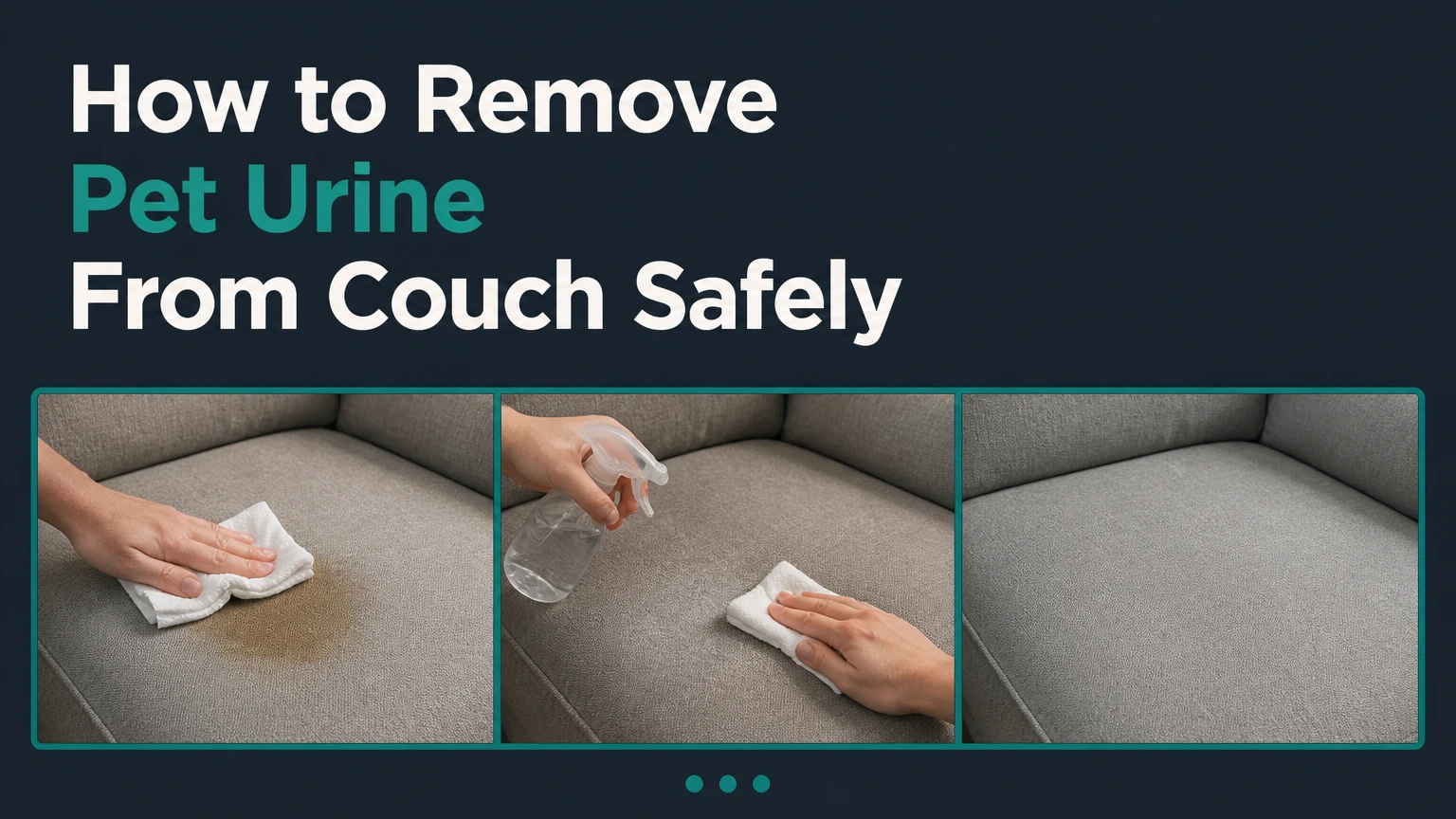
To remove pet urine from a couch, blot as much liquid as possible, verify the upholstery care code, then apply a compatible enzymatic urine cleaner deeply enough to reach the contaminated padding. Keep the area damp for the product’s stated dwell time, extract excess moisture, and air-dry fully for 24-48 hours before judging the odor.
Key Facts at a Glance
- Enzymatic upholstery cleaner is usually the best home option for urine that has reached fabric, batting, or foam.
- Vinegar and baking soda can reduce surface odor, but they do not reliably remove every urine residue from cushion foam.
- Upholstery code W or S/W permits carefully controlled water-based cleaning; code S requires a solvent-safe method.
- Code X upholstery should not be wet-cleaned at home, because water can cause rings, dye transfer, shrinkage, or backing damage.
- A dry surface does not prove the couch is clean, because odor can return when humidity rehydrates residue.
- Heat, ammonia, chlorine bleach, and uncontrolled soaking can make the stain or odor harder to correct.
Why Does Pet Urine Keep Smelling After Cleaning?
Pet urine keeps smelling after ordinary cleaning because dissolved salts and organic residues can remain below the visible surface, especially inside cushion foam. As the residue dries and later absorbs humidity, odor molecules become detectable again even when the fabric looks clean.
Fresh urine is mostly water, with urea, salts, pigments, proteins, and other organic compounds. Microorganisms break down some of those compounds during drying, producing stronger-smelling by-products. Cat urine often seems more persistent because cats may produce concentrated urine and may return to the same location repeatedly.
The common explanation that urine contains permanent, water-insoluble “crystals” is too simple. Uric-acid salts can dry into deposits that ordinary wiping does not remove, but their behavior depends on pH, humidity, the upholstery fiber, and how deeply the liquid traveled. A cleaner must therefore reach the contaminated layer, not merely cover the smell on the surface.
Enzyme products also need realistic expectations. They do not instantly destroy every odor molecule, and they are not interchangeable with disinfectants. Their effectiveness depends on the product’s formulation, temperature, moisture, contact time, and whether the cleaner can reach the same depth as the urine.
What Should You Do Before Cleaning?
Before cleaning, identify the upholstery code, remove loose cushions, locate the full wet area, and gather absorbent towels, gloves, a measuring container, and a compatible urine cleaner. A typical single-cushion treatment takes 30-60 minutes of active work and 24-48 hours of drying.
Before-You-Start Checklist
| Requirement | Typical specification | Why it matters |
|---|---|---|
| Active treatment time | 30-60 minutes | Allows blotting, testing, and application |
| Drying time | 24-48 hours | Prevents premature odor judgment |
| Enzyme cleaner | 500-1,000 milliliters per cushion | Provides enough liquid for moderate contamination |
| Absorbent towels | 6-12 white towels | White fabric reveals transfer and reduces dye risk |
| Ventilation | 18-24°C room, fan nearby | Speeds evaporation without applying heat |
| Protection | Nitrile gloves and washable clothing | Limits contact with urine and cleaning chemicals |
Read the manufacturer’s care label before applying water, vinegar, peroxide, or solvent. The label may be under the seat, beneath a removable cushion, or attached to the sofa frame.
If the urine reached the floor, rug, skirt, or underside of the cushion, treat those surfaces as part of the same contamination zone. Cleaning only the visible top often leaves an odor reservoir beneath the cushion.
How to Remove Fresh Pet Urine From a Fabric Couch
Fresh pet urine should be removed with pressure blotting first, followed by a tested, upholstery-compatible enzyme cleaner. The first hour matters because liquid urine can migrate into batting and foam, where surface wiping cannot reach it.
Step 1: Remove the Pet and Absorb the Liquid
Put on gloves and keep the pet away from the couch until the area is dry. Place several layers of white paper towel or a clean white microfiber towel over the wet spot, then press vertically with your hands or body weight.
Replace saturated towels repeatedly. Do not scrub, because lateral rubbing spreads liquid across fibers and can push it through the cushion cover. Do not use colored towels, since dye can transfer into damp upholstery.
You will know Step 1 worked when: a fresh towel picks up little or no visible liquid after firm pressure.
Common mistake: lifting the first towel too quickly. A damp cushion may require 5-15 minutes of repeated pressing before surface extraction is adequate.
Step 2: Expose the Contaminated Cushion
Unzip or remove the cushion cover if the manufacturer permits it, and inspect the foam, batting, zipper area, seams, and underside. If urine passed through the cover, blot the foam with towels before applying cleaner.
Do not automatically put a urine-soaked cover in the washing machine. Check the care label, close zippers, use a cold or warm cycle allowed by the label, and avoid drying the cover until the odor is gone. Dryer heat can make remaining discoloration or odor more difficult to remove.
You will know Step 2 worked when: you have identified whether contamination is limited to the cover or has reached foam and the underside.
Common mistake: treating only the circular stain. Urine often travels beyond the visible edge through seams and absorbent batting.
Step 3: Test the Cleaner
Apply a small amount of the chosen product to a hidden area, such as the rear skirt or the underside of a removable cushion. Wait at least 10 minutes, then check for dye transfer, fading, stiffness, water rings, pile change, or a sticky residue.
A hidden test is not a complete guarantee. A product may behave differently when used at a larger volume, but testing can identify obvious incompatibility before the main treatment.
You will know Step 3 worked when: the test area has no visible color change, texture change, or dye transfer after drying.
Common mistake: assuming “natural” means fabric-safe. Vinegar, essential oils, peroxide, and concentrated detergents can all damage particular fibers or finishes.
Step 4: Choose a Urine-Compatible Cleaner
For W or S/W upholstery, choose a product specifically labeled for pet urine and upholstery. Look for instructions that identify fabric compatibility, required dwell time, ventilation, and whether the product is intended for use on foam.
Do not select a cleaner only because it has a strong fragrance. Fragrance masks odor temporarily and can make it harder to determine whether the urine residue remains.
For S upholstery, use only a solvent-compatible product or an upholstery professional. For X upholstery, vacuuming is generally the homeowner limit unless the manufacturer provides a specific approved procedure.
You will know Step 4 worked when: the product instructions match the care code and the cleaner can be used on the contaminated layer.
Common mistake: using a carpet product on a couch without checking the label. Upholstery backing, dyes, and foam can respond differently from carpet.
Step 5: Apply Enough Cleaner to Reach the Urine
Apply the enzyme cleaner evenly across the stain and a surrounding margin of approximately 2-5 centimeters. Use enough liquid to reach the depth of contamination, but do not flood a fixed frame, wooden arm, electrical component, or non-washable lining.
A practical starting quantity for a moderate fresh accident is 250-500 milliliters on a removable seat cushion, followed by additional product only if the urine reached the foam. A large accident or cat-marking event may require 500-1,000 milliliters or professional extraction.
The product must remain in contact with the residue. Spraying a few pumps on the surface cannot treat urine that soaked several centimeters into foam.
You will know Step 5 worked when: the affected fabric is evenly damp through the contaminated zone, without liquid running into the frame.
Common mistake: using too little cleaner because the surface looks wet. Surface dampness does not confirm penetration into the cushion core.
Step 6: Observe the Labelled Dwell Time
Leave the product undisturbed for the time specified on its label, commonly 15-60 minutes for a fresh spot and longer for dried contamination. Some formulations require several hours, so the product label overrides a generic timetable.
A loose plastic sheet or clean damp towel can slow evaporation on compatible, water-safe fabric. Do not tightly seal a large wet cushion for many hours, because restricted drying can encourage mildew and leave the foam wet internally.
You will know Step 6 worked when: the treatment zone remains damp for the stated contact period and the odor begins to change rather than simply becoming perfumed.
Common mistake: blotting immediately after spraying. Removing the cleaner before its required contact time reduces its access to the residue.
Step 7: Extract and Dry the Cushion
Blot with clean towels, or use a small upholstery extractor if the care code and product instructions permit it. Make several slow extraction passes, emptying the machine when the recovered liquid becomes substantial.
Stand the cushion on its edge in a ventilated room, place a fan several feet away, and expose both sides to moving air. Avoid hair dryers, heaters, irons, and direct high heat.
You will know Step 7 worked when: the cushion feels dry through its thickest section, not merely dry on the cover, and no odor returns after overnight humidity exposure.
Common mistake: reinstalling the cushion while the foam is damp. Trapped moisture can produce mildew odor and makes it difficult to distinguish mildew from urine.
Which Method Works Best for Pet Urine?
For most water-safe fabric couches, a labelled enzymatic urine cleaner offers the best balance of odor treatment, accessibility, and cost. Professional extraction becomes the better choice when urine has saturated thick foam, multiple accidents overlap, or two correctly performed home treatments fail.
| Method | Typical cost | Working time and drying | Best use | Main limitation |
|---|---|---|---|---|
| Enzymatic upholstery cleaner | $10-$30 per 32 oz | 30-120 minutes, 24-48 hours drying | Fresh or moderate urine on W or S/W fabric | Needs correct depth and dwell time |
| Diluted white vinegar | $1-$4 | 15-30 minutes, 8-24 hours drying | Temporary surface odor reduction on compatible fabric | Does not reliably remove deep urine residue |
| Baking soda | $1-$5 | 4-12 hours before vacuuming | Surface moisture and mild odor | Does not extract contaminated foam |
| Portable extractor rental | $30-$80 per day | 1-3 hours, 12-36 hours drying | Larger water-safe areas | Poor technique can over-wet cushions |
| Professional upholstery cleaning | $100-$300 typical | 1-4 hours, 6-24 hours drying | Deep contamination or several cushions | Cost and variable treatment quality |
Is Vinegar and Baking Soda Safe?
Vinegar and baking soda can help with a light, surface-level accident on compatible water-safe fabric, but the combination is not a dependable substitute for urine-specific enzymatic treatment. Vinegar is acidic, while baking soda is alkaline; mixing them produces carbon dioxide and a mostly neutral solution, reducing the useful effect of each ingredient.
If using vinegar as a fallback, dilute ordinary 5% white vinegar with an equal volume of water, test it, apply sparingly, and blot rather than saturate. Do not combine vinegar with bleach, peroxide, ammonia, or commercial cleaners.
Baking soda can absorb some surface moisture and odor after the fabric has been treated and partially dried. Vacuum it thoroughly when dry. Baking soda cannot reach or extract urine that remains inside foam.
Should You Use Hydrogen Peroxide?
Hydrogen peroxide is not the default treatment for a urine-marked couch because it can lighten dyes, weaken some fibers, and alter upholstery finishes. Peroxide may help with discoloration on selected synthetic, colorfast fabrics, but only after a hidden test and only at the concentration and contact time approved for that material.
Never mix hydrogen peroxide with vinegar or chlorine bleach. Chemical mixtures can release irritating gases or create uncontrolled oxidation. A urine-specific product with explicit upholstery instructions is the safer first choice.
How Do Upholstery Codes Change the Procedure?
Upholstery care codes determine whether water, solvent, or only vacuuming is appropriate. The code does not identify the fiber by itself, so a code-based treatment still requires a hidden test and compliance with the couch manufacturer’s instructions.
| Upholstery code | Permitted approach | Typical materials or situation | Home urine treatment |
|---|---|---|---|
| W | Water-based cleaning | Many treated synthetics and cotton blends | Tested enzyme cleaner, controlled extraction |
| S | Water-free solvent cleaning | Some delicate or solvent-sensitive upholstery | Solvent-safe professional or labelled product |
| W/S | Water or solvent | Mixed upholstery constructions | Test both options, use lower moisture |
| X | Vacuum only | Delicate, unstable, or manufacturer-restricted fabric | Professional assessment for urine contamination |
| No readable code | Unknown | Older or custom furniture | Treat as high-risk until identified |
How Should You Clean Microfiber?
Microfiber should be cleaned according to its W, S, or W/S label rather than by appearance alone. Water can create rings on some microfiber, while excessive rubbing can flatten the nap and produce a shiny patch.
For W microfiber, blot first, test a small amount of enzyme cleaner, use minimal even moisture, and brush the dried nap gently with a soft upholstery brush. For S microfiber, use the approved solvent method and avoid water-based vinegar mixtures.
How Do You Clean Leather or Suede Couches?
Leather should be wiped immediately with a barely damp cloth, then treated only with a manufacturer-approved leather cleaner; suede and nubuck require specialized low-moisture products or professional restoration. Neither material should be saturated with ordinary fabric enzyme spray.
For finished leather, remove urine from seams and perforations without forcing liquid into the hide. Dry the area naturally, then apply a compatible leather conditioner only if the leather-care instructions permit it. Conditioner will not remove a urine odor trapped beneath leather upholstery.
Suede and nubuck absorb liquid quickly and develop tide marks, stiff patches, or color changes. Blot without rubbing, photograph the damage, and contact a leather or suede specialist when urine entered the cushion or seam.
How Should You Treat Dried or Old Urine?
Dried urine requires source mapping, controlled rehydration with a compatible cleaner, and extraction from every affected layer. A visible ring that has existed for days may represent only the outer edge of a larger contaminated area.
Use a UV-A flashlight in a dark room to inspect the cushion, seams, underside, nearby rug, and floor. A UV glow is not proof of urine, because detergents and other substances can fluoresce, but it helps identify areas that need closer inspection.
For a small dried spot on W upholstery, apply the tested enzyme product across the entire suspected zone, allow the full label dwell time, and extract. Repeat once after complete drying if the odor clearly returns. If the cushion remains strongly odorous after two complete treatments, stop adding liquid.
Professional treatment is appropriate when urine reached thick foam, the couch has multiple marking sites, the cushion cover cannot be removed, or the smell returns whenever indoor humidity rises.
What Are the Costs and Drying Times?
Typical home treatment costs $10-$30 for a ready-to-use enzyme product, while professional upholstery treatment commonly costs $100-$300 for a couch, depending on region, size, access, fabric, and the number of contaminated cushions. Deep foam replacement can cost more than cleaning when urine has repeatedly soaked the interior.
| Situation | Home material cost | Professional range | Typical drying time |
|---|---|---|---|
| Fresh surface spot, one cushion | $5-$20 | $100-$175 | 12-24 hours |
| Fresh urine in cushion foam | $15-$40 | $150-$250 | 24-48 hours |
| Dried cat urine, one cushion | $20-$60 | $175-$350 | 24-72 hours |
| Several cushions or repeated marking | $40-$100 | $250-$600 | 24-72 hours |
| Foam replacement after saturation | $50-$250 per cushion | $150-$500 installed | 24-48 hours |
These are typical consumer ranges, not fixed prices. A technician may charge more for stairs, parking restrictions, delicate textiles, odor inspection, or disassembly.
Why Does the Couch Still Smell After Treatment?
A couch can still smell after treatment because the urine reached foam, the cleaner did not reach the full contamination map, the cushion was judged before drying, or another nearby surface remains contaminated. Odor that returns only during humid weather strongly suggests retained residue rather than a purely surface stain.
Common Mistakes and Recovery Steps
| Mistake | Result | Recovery |
|---|---|---|
| Scrubbing a wet stain | Spreads urine and roughens fibers | Stop rubbing, blot outward to inward |
| Using ammonia cleaner | May resemble urine odor to the animal | Rinse only if code permits, then use compatible treatment |
| Applying bleach | Dye damage and hazardous chemical reaction | Ventilate, do not add another chemical, seek advice |
| Using heat | Sets discoloration or dries residue into fibers | Cool naturally, then test a compatible cleaner |
| Flooding fixed upholstery | Wet foam, frame damage, mildew risk | Extract promptly and increase airflow |
| Spraying fragrance only | Masks odor without removing source | Map and treat the contaminated layer |
| Replacing the cover too soon | Traps moisture inside foam | Dry on edge until the core is fully dry |
A counterintuitive practitioner rule is that stronger odor during the first wet treatment does not necessarily mean failure. Moisture can temporarily release volatile compounds, but the odor should decline after complete drying; persistent intensity signals incomplete source removal.
Another useful rule is to treat the cushion underside as seriously as the top. Urine follows gravity, so the lowest seam or bottom fabric may contain more residue than the original visible spot.
Do not use a wet vacuum on code S or X upholstery simply because extraction seems efficient. Machine power cannot correct an incompatible solvent-water decision.
How Can You Prevent Repeat Urination on the Couch?
Prevent repeat urination by removing the odor source, blocking couch access until treatment is complete, and investigating medical or behavioral causes. A pet may return because the location still smells familiar, because the couch is an attractive soft substrate, or because pain, anxiety, marking, or litter-box problems remain unresolved.
Wash or treat nearby blankets, rugs, pet beds, and flooring. Use a waterproof furniture cover during the drying period, but do not place the pet back on the couch until the cover and cushion are completely dry.
For cats, consult a veterinarian when house-soiling is sudden, frequent, painful, or accompanied by straining, blood, vocalization, or unusual thirst. Urinary disease can require prompt attention, and cleaning alone cannot solve a medical trigger.
For dogs, review toilet access, schedule changes, separation distress, and age-related incontinence. A properly cleaned couch reduces scent cues, but behavior modification and veterinary advice may still be necessary.
When Should You Hire a Professional?
Hire a professional upholstery cleaner when urine has penetrated fixed foam, affected several cushions, produced a persistent odor after two complete treatments, or damaged leather, suede, silk, rayon, or an unknown fabric. Professional cleaning is also safer when the couch has expensive construction or an irreplaceable finish.
Ask the technician four specific questions:
- Will the technician inspect the care code and test for dye transfer?
- Will the process treat the cushion cover, batting, foam, underside, and frame separately?
- Does the quoted price include odor treatment or only surface cleaning?
- What drying time and moisture-extraction method will be used?
Hot-water extraction can remove contaminated liquid effectively from compatible water-safe upholstery when performed with appropriate chemistry and strong recovery equipment. Steam alone is not a urine-neutralizing treatment, and excessive heat or moisture can spread odor through foam.
FAQ
Can I use dish soap to remove pet urine from a couch?
Dish soap can remove surface oils and some fresh residue, but it is not designed to break down the full odor profile of pet urine inside upholstery. Use only a tiny, well-diluted amount on compatible fabric, rinse or extract carefully, and choose a urine-specific enzyme cleaner when odor or foam contamination is present.
How long should I leave baking soda on a couch?
Leave baking soda on fully or nearly dry compatible upholstery for approximately 4-12 hours, then vacuum it thoroughly. Baking soda can help with surface moisture and mild odor, but leaving it longer will not extract urine from cushion foam and may leave powder in seams or under the cover.
Does cat urine require a different cleaner from dog urine?
Cat urine does not always require a different chemical category, but concentrated or repeated cat urine often requires more product, longer dwell time, and deeper extraction. Choose a cleaner labelled for pet urine, inspect the underside and nearby surfaces, and escalate sooner when a cat repeatedly marks the same cushion.
Can I put a couch cushion cover in the dryer?
Only use a dryer when the cover label explicitly permits it and the urine odor has been removed. Air-drying is safer after treatment because dryer heat can set remaining discoloration, shrink the cover, distort backing, or make residual odor harder to evaluate.
Will a UV flashlight find every urine stain?
A UV flashlight can reveal some dried urine residues in a dark room, but it cannot identify every urine deposit or distinguish urine perfectly from detergent and other fluorescent substances. Use UV inspection as a locating aid, then confirm suspected areas by odor, texture, and the contamination path.
Should I replace a urine-soaked couch cushion?
Replace the foam when repeated urine contamination has produced persistent odor, the foam cannot be adequately extracted, or the material has begun to deteriorate. A single fresh accident usually does not require replacement if the cover and foam can be treated, extracted, and dried completely.
The Bottom Line
The reliable way to remove pet urine from a couch is to blot immediately, identify the upholstery code, treat the full contamination depth with a compatible urine cleaner, extract excess moisture, and dry the cushion completely. For a water-safe couch, an enzymatic product is usually the strongest home option; for old, repeated, or foam-deep contamination, professional extraction or foam replacement is more dependable. Use this process whenever you need to know how to remove pet urine from couch upholstery without spreading the stain or trapping moisture.