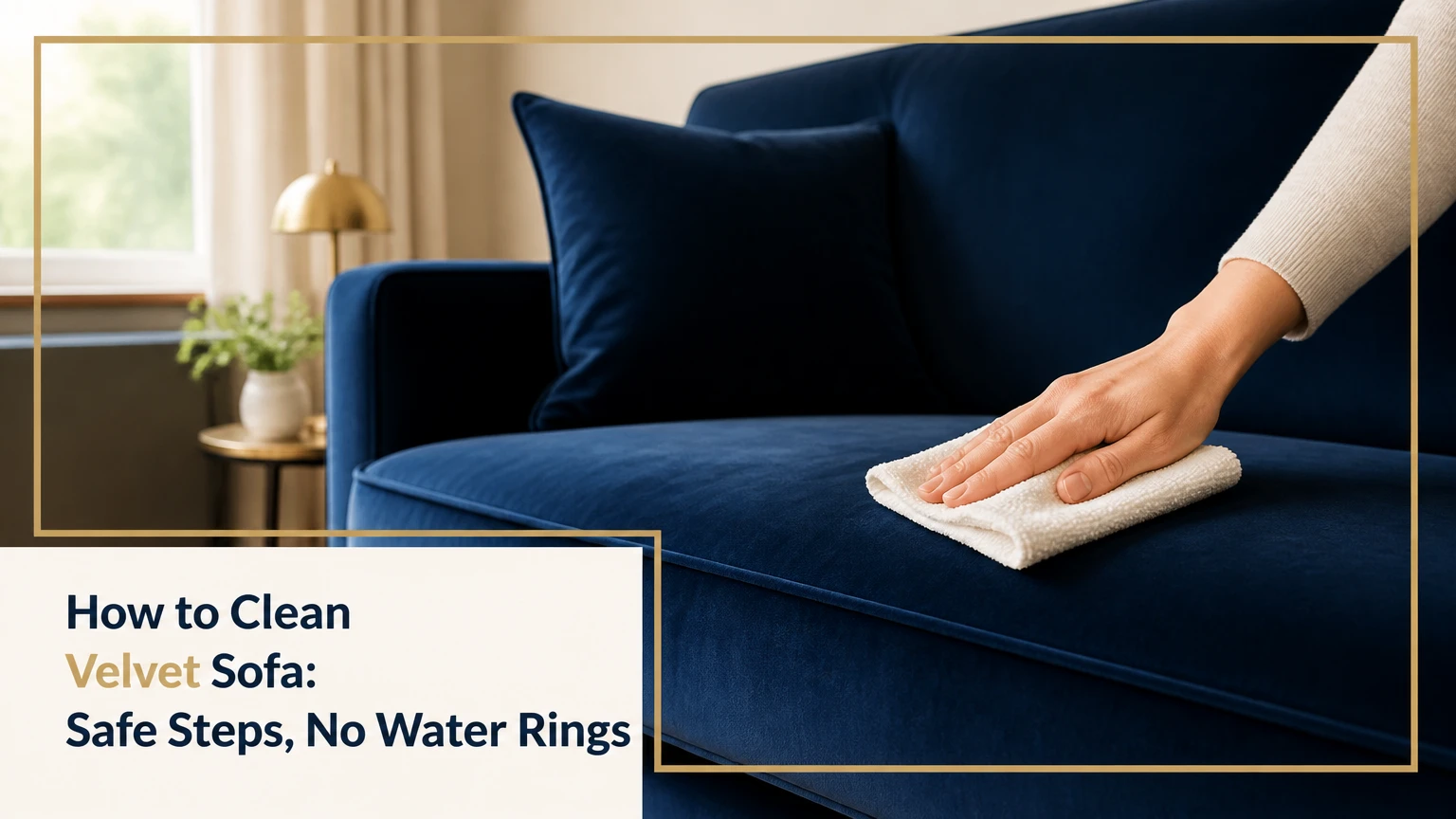
To clean a velvet sofa safely, first identify its upholstery cleaning code, then vacuum the pile and use the least-moisture method approved by the manufacturer. Code W or WS velvet can usually be cleaned with controlled foam, while code S, X, silk, viscose, and valuable antique velvet require solvent-specific or professional care.
Key Facts at a Glance
The upholstery cleaning code, not the word “velvet,” determines whether water is permitted.
Vacuum velvet with a soft upholstery brush in the direction of the nap.
Foam cleaning uses suds rather than a saturated cloth or wet extraction machine.
Always test colorfastness, texture, and shrinkage on a hidden area before cleaning.
A damp velvet panel must dry evenly, because slow drying can create rings, odor, or backing damage.
Steam can lift crushed pile, but heat and moisture can also set dye, shrink natural fibers, or loosen adhesive.
Why Velvet Changes Shade When You Clean It
Velvet is a pile fabric made by cutting raised yarns that create a dense, directional surface. The nap is the direction in which those fibers lie, so brushing, sitting pressure, moisture, and reflected light can make one area appear lighter or darker without changing the dye.
The pile gives velvet its softness and color depth, but it also creates cleaning constraints. A rotating brush, rough sponge, or concentrated suction can bend or pull fibers, leaving a permanently flattened or “bald” patch. Velvet upholstery also shows directional marks more readily than flat-weave linen or canvas.
Velvet is not one fiber. Polyester, nylon, cotton, silk, rayon, viscose, and blended velvet can have very different reactions to water, heat, solvents, and abrasion. The fiber label helps, but the manufacturer’s care code remains the controlling instruction.
| Velvet characteristic | What it means | Cleaning consequence |
|---|---|---|
| Cut pile | Raised fibers catch light | Brush with the nap after drying |
| Directional nap | Fibers lie in one orientation | Clean complete panels evenly |
| Dense surface | Dust hides between fibers | Vacuum slowly with a soft brush |
| Absorbent backing | Moisture can travel below fabric | Avoid soaking cushions |
| Sensitive texture | Pressure changes fiber position | Do not scrub or use stiff bristles |
Which Upholstery Cleaning Code Applies?
The correct cleaning code determines the safest chemistry: W permits water-based products, S permits solvent-based products, WS permits either approved method, and X permits vacuuming or light brushing only. If no code appears, contact the sofa manufacturer before applying liquid, solvent, or steam.
Look beneath removable cushions, along the platform under the seat, behind the sofa, or under a manufacturer label. Some tags use “W,” “S,” “W-S,” “WS,” or “X”; others provide a written care instruction instead.
Do not infer the code from color, price, softness, or fiber content. A polyester velvet sofa may be code S because of its backing or dye, while a cotton-blend sofa may carry a W or WS instruction. The construction matters.
| Code | Permitted method | Typical homeowner action | Main restriction |
|---|---|---|---|
| W | Water-based upholstery cleaner | Controlled foam or low-moisture product | Do not saturate fabric |
| S | Water-free solvent | Label-approved solvent spot treatment | Ventilate and avoid open flames |
| WS | Water-based or solvent | Use the gentler tested option | Test both chemistry and color |
| X | Vacuum or brushing only | Remove dry soil mechanically | No liquid, solvent, or steam |
Code X deserves special attention. A professional may have a specialized process, but a household upholstery machine is not automatically safe. If the tag says X, restrict home care to dry soil removal and consult the maker for stains.
What Should You Prepare Before Cleaning?
A typical velvet sofa cleaning session takes 60-120 minutes of active work and 4-12 hours of drying, depending on the method, cushion thickness, room humidity, and amount of moisture used. Prepare a soft upholstery-brush vacuum head, white microfiber cloths, distilled water for approved W products, a pH-neutral upholstery cleaner, and a soft clothes brush.
Before mixing anything, remove throws, toys, and loose cushions. Photograph the sofa’s nap direction and inspect seams, piping, buttons, zipper areas, and existing marks. Cleaning can make old wear more visible even when the process is correct.
Before-You-Start Checklist
| Requirement | Typical specification | Why it matters |
|---|---|---|
| Vacuum head | Soft upholstery brush, 25-35 mm bristles | Reduces pile pulling |
| Cloths | 4-6 white microfiber cloths | Reveals dye transfer |
| Foam solution | 250-500 ml prepared solution | Limits over-wetting |
| Drying setup | Fan, open window, 18-24°C room | Reduces drying time |
| Test time | 10-15 minutes observation | Detects bleeding and rings |
| Cleaning cost | $5-$25 DIY supplies | Excludes equipment purchase |
Patch-test every product on an underside, rear corner, or removable cushion edge. Apply the smallest practical amount, wait until dry, then compare color, sheen, stiffness, and pile direction under natural light.
How to Clean a Velvet Sofa Safely
The safest process has seven stages: inspect the code, vacuum dry soil, prepare the approved cleaner, test a hidden area, clean one panel with minimal moisture, remove residue, and dry while restoring the nap. Work slowly because velvet can look uneven while damp and may reveal the final result only after complete drying.
Step 1: Identify the Fabric and Map the Nap
Read the care label and run clean fingertips lightly across a hidden section to determine the direction of the nap. Photograph the surface before cleaning, noting crushed areas, water marks, discoloration, and stains.
Separate removable cushion covers only if the manufacturer specifically permits removal and washing. A zipper does not prove that a cover is machine-washable; shrinkage can prevent the cover from fitting the cushion again.
Success checkpoint: You know the code, fiber if available, nap direction, and pre-existing damage.
Common mistake: Treating an unlabeled velvet sofa as water-safe because the fabric feels synthetic.
Step 2: Vacuum the Sofa Without Pulling the Pile
Set the vacuum to its lowest effective suction and use a soft upholstery attachment. Vacuum cushions, crevices, piping, the seat deck, and the back in slow overlapping passes, moving with the nap rather than against it.
Do not use a bare hose nozzle directly on velvet. The concentrated airflow can catch loose pile, and repeated passes over one spot can create a visible directional change.
Success checkpoint: No loose crumbs, pet hair, or gritty particles remain before liquid treatment.
Common mistake: Cleaning a stain while dry grit remains, which turns wiping into fine abrasion.
Step 3: Test the Approved Cleaner
For code W or WS velvet, test a pH-neutral upholstery cleaner or a small amount of dry foam. For code S, use only a solvent expressly labeled for upholstery and compatible with the manufacturer’s instructions; for code X, stop after vacuuming unless the maker approves another process.
Use a white cloth or cotton swab and test color transfer, ring formation, texture change, and drying behavior. Wait at least 10 minutes, and preferably until the test area is fully dry, before treating a visible panel.
Success checkpoint: The test area has no dye on the cloth, tide line, shrinkage, stickiness, or altered sheen.
Common mistake: Testing only for color bleeding and ignoring a stiff or glossy change in the pile.
Step 4: Make Controlled Foam for Code W or WS
Mix one teaspoon of pH-neutral upholstery detergent with 250 ml of distilled water, unless the product label specifies a different dilution. Whisk the mixture until a stable layer of foam forms, then use the foam rather than pouring liquid onto the sofa.
Commercial products vary, so the label takes priority over a homemade ratio. Dish soap can leave surfactant residue and should be a last-resort substitute, not a universal velvet cleaner.
Dip a white microfiber cloth into the foam, wring it nearly dry, and collect suds with the cloth. Treat a 30 x 30 cm area first.
Success checkpoint: The fabric feels only lightly damp, with no wet cushion edge or liquid running into a seam.
Common mistake: Applying the watery solution beneath the foam and soaking the upholstery backing.
Step 5: Clean One Complete Panel
Wipe gently in straight, overlapping strokes that follow the nap. Complete one cushion face, arm panel, or back panel at a time instead of cleaning isolated circles, because partial cleaning can create visible changes in sheen.
Use minimal pressure. If the cloth becomes gray or transfers soil, replace it rather than pressing harder. For a greasy mark, allow the approved foam to sit for 30-60 seconds before lifting it with a fresh cloth.
For code S, place a small amount of approved solvent on a white cloth, never directly on velvet, and blot the affected area. Solvent vapor requires ventilation, and solvent products must remain away from flames, cigarettes, heaters, and energized electrical equipment.
Success checkpoint: Soil transfers to the cloth while the pile remains aligned and the panel has no spreading moisture.
Common mistake: Rubbing across the nap, which can create a shiny patch even when the stain disappears.
Step 6: Remove Residue Without Rinsing the Sofa
For a code W or WS product, use a second white microfiber cloth barely dampened with distilled water only when the cleaner label calls for rinsing. Blot or wipe lightly over the treated area, then stop; repeated rinsing increases the chance of a water ring.
Never pour rinse water onto the fabric or use a household carpet extractor unless the sofa manufacturer specifically permits extraction. Upholstery foam, batting, wood frames, and adhesives can retain water below the visible surface.
Success checkpoint: The panel has no slippery residue, visible suds, or saturated seam.
Common mistake: Continuing to rinse until the cloth comes away perfectly clean, thereby pushing moisture deeper into the cushion.
Step 7: Dry and Reset the Velvet Pile
Stand cushions upright if their construction allows it, separate them from wet frame areas, and use a fan to move air across the sofa. Keep the room ventilated, but avoid directing a high-heat hair dryer at the pile.
When the velvet is damp rather than wet, use a clean, soft clothes brush to align the nap in one direction. Do not brush aggressively while the fibers are swollen.
Success checkpoint: The fabric is fully dry, smells neutral, and has a consistent sheen when viewed from several angles.
Common mistake: Replacing cushions or sitting on the sofa before the interior has dried.
How Should You Treat Common Velvet Sofa Stains?
Stain treatment depends on the substance, cleaning code, and time since the spill. Remove solids first, blot liquid from the outside toward the center, and test the approved chemistry before attempting a visible repair.
| Stain | First action | Code W or WS option | Avoid |
|---|---|---|---|
| Coffee or tea | Blot within 5 minutes | Tested upholstery foam | Hot water and scrubbing |
| Red wine | Lift liquid with white cloth | Small tested foam application | Salt piles and flooding |
| Grease or butter | Lift solids with card | Foam after dry absorption | Rubbing oil outward |
| Ink | Isolate the mark | Professional treatment preferred | Alcohol without a test |
| Pet urine | Blot and ventilate | Enzyme product only if code allows | Saturating cushion foam |
| Dried food | Loosen dry residue | Foam after vacuuming | Knife scraping the pile |
Coffee, Wine, and Water-Based Drinks
Blot fresh liquid with folded white towels, applying vertical pressure rather than wiping sideways. Replace the towel as it absorbs moisture, then use the code-approved method on a small section.
A red-wine stain may leave dye even after the liquid is removed. Home treatment becomes less predictable when the stain has dried, the velvet is pale, or the cushion contains natural fiber.
Grease and Oil
Lift excess grease with a blunt card and place an absorbent powder only if the manufacturer permits it and the powder can be fully removed without abrasion. Vacuum the residue carefully, then use tested upholstery foam on code W or WS velvet.
Solvent treatment may be more appropriate for code S fabric, but solvents can also dissolve finishes or move dye. A professional is safer when the grease has reached the backing.
Pet Accidents and Odor
Blot urine or vomit immediately, keeping moisture away from cushion seams and foam. Enzyme cleaners require manufacturer approval because biological products formulated for carpets may discolor upholstery or remain active inside a cushion.
Persistent odor after surface cleaning usually means contamination below the fabric. Repeatedly adding liquid makes that problem worse.
Can You Steam-Clean a Velvet Sofa?
Steam cleaning is safe only when the sofa manufacturer approves steam for that exact fabric and construction. Low-pressure steam can relax crushed synthetic pile, but heat and moisture may shrink cotton or silk, mobilize dye, damage adhesives, or create deep cushion moisture.
Use a handheld steamer at the manufacturer’s specified distance, never pressing the nozzle against velvet. Test first, keep the steam moving, and brush the nap lightly while the pile is warm. Do not use steam to remove an unknown stain from antique, viscose, rayon, silk, or code X velvet.
Steam is often confused with cleaning. Steam may refresh texture or reduce some odors, but it does not automatically extract dissolved soil from the cushion. A professional technician should assess valuable or structurally delicate furniture before using heat.
Can You Wash Velvet Sofa Covers in a Machine?
Machine-washing a velvet sofa cover is safe only when the care label explicitly permits it. Removable construction, a zipper, or a polyester fiber label does not establish washability because shrinkage, backing distortion, dye transfer, and pile crushing can prevent refitting.
If washing is approved, follow the label’s temperature, cycle, detergent, and drying instructions exactly. Close zippers, wash the cover alone, avoid chlorine bleach, and do not tumble-dry unless the manufacturer allows it. Air-drying a fitted cover can also create dimensional changes if the fabric dries in a stretched position.
| Cover instruction | Safe assumption | Appropriate action |
|---|---|---|
| Machine wash, cold | Water permitted | Use labeled cold cycle |
| Hand wash only | Low agitation required | Wash separately and gently |
| Dry clean only | Water prohibited | Use an upholstery or garment specialist |
| Do not remove cover | Cover is not user-washable | Clean upholstery in place |
| No instruction | Risk is unknown | Ask the manufacturer first |
How Do You Fix Common Cleaning Problems?
Most velvet cleaning problems result from excessive moisture, residue, pressure, heat, or uneven panel treatment. Stop adding product when the fabric looks worse, allow the area to dry completely, and diagnose the texture before attempting another method.
| Problem | Likely cause | Safer correction |
|---|---|---|
| Stiff surface | Detergent residue | Professional rinse or carefully tested low-moisture treatment |
| Dark ring | Uneven drying or water edge | Do not add water blindly; consult a technician |
| Flattened pile | Pressure or heat | Nap brushing; approved low steam only |
| White residue | Cleaner or powder deposits | Vacuum dry residue, then follow product label |
| Musty odor | Moisture retained in foam | Stop wet cleaning and dry professionally |
| Dye transfer | Unstable color or excess moisture | Stop immediately and preserve the fabric |
A stiff surface may improve after complete drying and gentle brushing, but repeated water application can worsen residue. A dark ring is not automatically fixed by misting the entire panel; that approach can enlarge the mark and damage code S, X, or water-sensitive velvet.
Professional upholstery cleaners may be able to blend a panel or extract residue, but no technician can guarantee removal of a set dye stain or a permanently crushed pile.
When Should You Hire a Professional?
Hire an upholstery professional for antique velvet, silk, viscose, rayon, mohair, code X fabric, extensive pet contamination, large water rings, dye bleeding, or stains that have reached the cushion interior. Professional cleaning is also the safer choice when the sofa has sentimental or replacement value.
Ask the technician which process matches the sofa’s code, whether they have cleaned velvet before, how they will control moisture, and whether they will test a hidden area. Request an itemized price and confirm drying requirements.
The Institute of Inspection Cleaning and Restoration Certification, or IICRC, publishes professional cleaning standards, but certification alone does not guarantee experience with delicate velvet. Ask for relevant upholstery examples rather than relying only on a logo or general carpet-cleaning experience.
| Situation | DIY suitability | Typical professional price |
|---|---|---|
| Vacuum maintenance | Suitable | $0 service cost |
| One small code W spill | Often suitable after testing | $75-$150 minimum visit |
| Full standard sofa clean | Possible for experienced users | $150-$450 typical range |
| Antique or silk velvet | Not recommended | $250-$700 typical range |
| Odor inside cushion foam | Limited | $200-$600 depending on damage |
| Dye bleed or large water ring | Poor candidate | Inspection required first |
Prices vary by location, sofa dimensions, access, fabric risk, and whether cushions are removable. A technician may charge a minimum service fee even for one chair or one small stain.
How Often Should Velvet Upholstery Be Cleaned?
Vacuum velvet every one to two weeks in homes with pets, children, or heavy use, and every two to four weeks in lighter-use rooms. Spot-clean spills immediately, inspect the nap monthly, and schedule a professional assessment when soil has migrated below the surface or odors persist.
Routine vacuuming prevents grit from cutting at the pile during use. Rotate reversible cushions every one to two weeks when the manufacturer permits it, and change seating positions to reduce one-sided crushing.
Fabric protectors can reduce absorption, but they do not make velvet stain-proof. Apply only a protector approved for the fabric code, use ventilation, and test for changes in sheen before treating the entire sofa.
The Bottom Line
The safest answer to how to clean velvet sofa is to follow the upholstery code, remove dry soil first, use minimal moisture, test every product, and dry each panel evenly. Code W and WS synthetic velvet is the most practical candidate for controlled foam cleaning, while code S, X, silk, viscose, rayon, antique, and badly stained velvet generally justify professional care.
Velvet rewards gentle maintenance rather than aggressive restoration. Vacuum regularly, blot spills immediately, avoid unapproved steam and household chemicals, and stop when a test patch shows bleeding, rings, stiffness, or altered sheen.
Frequently Asked Questions
Does Velvet Need Special Upholstery Cleaner?
Velvet needs a cleaner compatible with its upholstery code and fiber construction, not a product marketed merely as “velvet cleaner.” Code W and WS fabric may accept a low-moisture upholstery foam, while code S requires an approved solvent and code X permits dry cleaning methods only. Test before use.
What Is the Best Brush for Velvet Furniture?
The best brush is a clean, soft clothes brush with flexible bristles that do not catch the pile. Use it lightly in the nap direction after vacuuming or controlled cleaning. Stiff garment brushes, abrasive sponges, and rotating vacuum heads can bend, pull, or polish velvet fibers.
How Long Does a Velvet Sofa Take to Dry?
A lightly foam-cleaned panel typically dries in 4-8 hours in a ventilated room, while cushions treated with more moisture can require 12-24 hours. Temperature, humidity, fabric density, and foam construction change the result. Do not use the sofa until the surface and cushion edges feel completely dry.
Can Rubbing Alcohol Remove Ink From Velvet?
Rubbing alcohol can dissolve some inks, but it can also strip finish, mobilize dye, or create a lighter patch. Use it only when the manufacturer or a professional approves it for the fabric code, and perform a hidden test first. Ink on silk, viscose, antique, or valuable velvet should receive professional treatment.
Why Does Velvet Look Different After Vacuuming?
Vacuuming can change the apparent shade because the pile points in a different direction and reflects light differently. Brush the surface gently with the nap after vacuuming. If the area remains glossy, flattened, or lighter after the nap is aligned, pressure or heat may have altered the fibers.
Should You Clean the Whole Sofa or Only the Stain?
Clean the entire visible panel when the product and code permit it, because isolated spot treatment can leave a difference in sheen or soil level. For code S, X, antique, or water-sensitive velvet, do not expand a stain treatment across the panel without professional guidance; additional solvent or moisture can enlarge the damage.