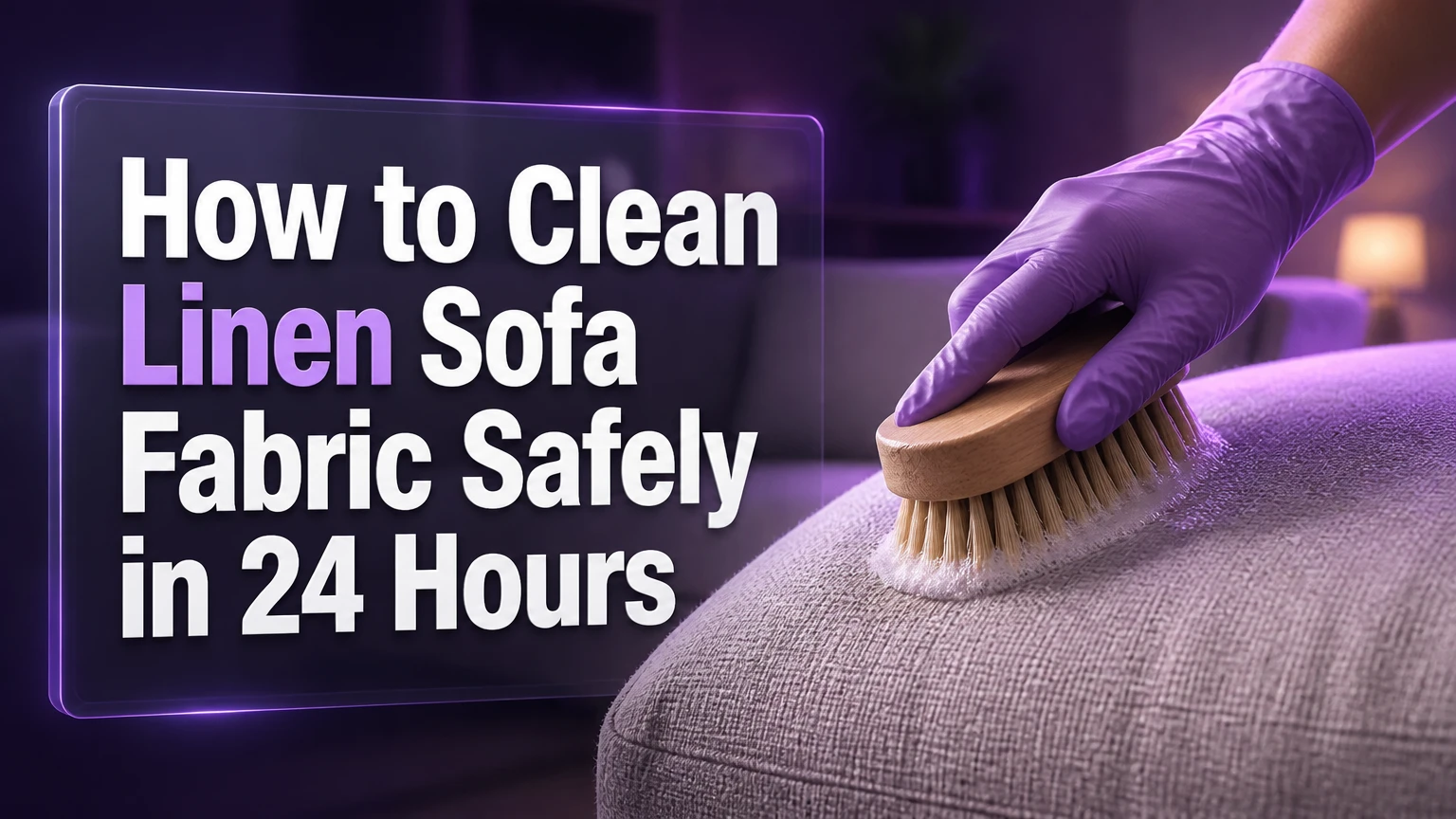
To clean a linen sofa safely, first read its upholstery care code, vacuum away dry grit, test a hidden area, and use the smallest approved amount of water or solvent. Blot rather than scrub, clean in small sections, and dry the fabric rapidly with airflow. The care label determines the correct method.
Key Facts at a Glance
- Linen sofa upholstery can shrink, brown, bleed dye or develop water rings when it becomes excessively wet.
- A W code permits water-based upholstery cleaning; S permits solvent-based cleaning; WS permits either; X means vacuum-only maintenance.
- Distilled water reduces mineral deposits, but distilled water does not make an unsafe cleaning method safe.
- A linen sofa should remain unused until the upholstery and inner cushion edges are completely dry.
- Typical DIY spot cleaning takes 10-20 minutes; a cautious whole-sofa cleaning usually takes 2-4 hours plus drying.
- Removable linen covers should be washed only when the furniture manufacturer explicitly permits washing.
Why Linen Upholstery Needs Controlled Moisture
Linen is a cellulose fiber made from flax. Flax yarn absorbs moisture and has less elastic recovery than many synthetic upholstery fibers, so uneven wetting can produce shrinkage, rippling, tidelines or distortion around seams.
The upholstery cover is only one part of the risk. Linen sofas may also contain cotton, viscose, polyester, foam, batting, adhesive, a backing cloth or a stain-resistant finish. Water can migrate through the face fabric into the backing and cushion, where slow evaporation encourages odor and browning.
A clean-looking spot can still be a failed repair if the surrounding soil is pushed to the perimeter. Professional upholstery cleaning therefore controls three variables: the chemistry, the moisture volume and the drying rate. The practical rule is simple: remove dry soil first, apply cleaner to a cloth or controlled tool, and never saturate the cushion.
What changes the cleaning result?
| Variable | Typical value or condition | Main consequence |
|---|---|---|
| Linen content | 100% flax, 50-60% blend or linen-look synthetic | Determines shrinkage and dye-transfer risk |
| Cleaner pH | Approximately 6.0-7.5 for cautious upholstery work | Lower risk of alkaline browning than strong alkaline products |
| Working section | 30-60 cm wide | Limits moisture migration and visible tidelines |
| Spot dwell time | 30-120 seconds | Allows soil suspension without prolonged wetting |
| Drying period | 6-24 hours, depending on moisture and airflow | Determines when the sofa can be used |
These figures are practical working ranges, not guarantees. A manufacturer’s care instructions override general linen-care advice, particularly for upholstery with a backing, printed pattern or protective finish.
How Do You Read a Linen Sofa Care Label?
A linen sofa care label normally uses W, S, WS or X to specify the approved cleaning category. Find the tag beneath a seat cushion, on the platform, under the sofa frame or inside a removable cover, then follow the furniture maker’s instructions rather than identifying the method from the word “linen” alone.
| Code | Permitted approach | Do not assume |
|---|---|---|
| W | Water-based upholstery cleaner | That soaking or machine extraction is safe |
| S | Water-free upholstery solvent | That ordinary laundry detergent is acceptable |
| WS or SW | Water-based or solvent-based cleaner | That both methods should be combined |
| X | Vacuuming and limited brushing | That DIY wet or solvent cleaning is approved |
Care codes describe the upholstery covering, not always the complete sofa construction. A W label may allow controlled upholstery moisture while the cushion manufacturer still prohibits removing and washing the cover. A code can also be absent, faded or located in an unexpected place; when no reliable code exists, stop at vacuuming and contact the manufacturer or an upholstery professional.
Which Cleaning Method Matches the Care Code?
The correct method depends on the care code, fiber blend, dye stability, stain type and cushion construction. Solvent cleaning limits water exposure, while low-moisture water cleaning handles many food and beverage residues more effectively; neither method is universally safest.
| Method | Suitable code | Best soil or situation | Typical DIY risk | Typical professional price |
|---|---|---|---|---|
| Vacuum and dry brush | X, or all codes for maintenance | Dust, crumbs and loose grit | Low if the brush is soft | $0 maintenance |
| Solvent spot cleaning | S or WS | Oil, makeup and greasy marks | Solvent halo, odor or dye loss | $150-$350 whole sofa |
| Low-moisture foam | W or WS | Mud, sugary residue and general soil | Overwetting and residue | $150-$350 whole sofa |
| Hot-water extraction | Explicit manufacturer approval only | Deep soil in water-safe blends | Shrinkage, browning and wet foam | $150-$400 typical |
| Professional dry or encapsulation cleaning | S, WS or uncertain fabric | Luxury linen and large sofas | Low homeowner risk | $150-$450 typical |
The table uses typical United States residential ranges; local labor, sectional size, access and fabric testing can change the price. Hot-water extraction is not automatically a deeper or better choice because linen can react badly to heat, pressure and prolonged moisture.
When is solvent cleaning safer?
Solvent cleaning is generally safer for upholstery labeled S, especially when the fabric water-spots easily or the sofa contains a sensitive backing. Use only a product labeled for upholstery, provide ventilation, avoid open flames and follow the product’s safety sheet.
Solvent is less effective against some water-soluble stains, including many sugary drinks and protein residues. A professional can select a solvent and extraction strategy after testing the dye, but a homeowner should not improvise with paint thinner, acetone, lighter fluid or household dry-cleaning chemicals.
When can you use a water-based cleaner?
Use a water-based upholstery cleaner only on W or WS fabric after a hidden-area test. Choose a low-residue product intended for upholstery, dilute it exactly as directed, apply minimal liquid, and extract or blot residue before the fabric dries.
A clear, mild detergent solution can work for a small emergency spot when the label permits water. A practical test mixture is 250 milliliters of distilled water with one or two drops of clear, dye-free dish detergent. The mixture is not a universal linen cleaner, and excessive detergent is difficult to remove from fabric.
Before You Start: Tools, Time and Safety
Prepare the sofa before opening a bottle of cleaner. You need a vacuum with a clean upholstery attachment, white microfiber cloths, a soft upholstery brush, distilled water if the code permits water, the approved cleaner, white paper towels, gloves and two fans.
| Requirement | Practical specification | Why it matters |
|---|---|---|
| Time | 30 minutes preparation, 60-150 minutes cleaning | Prevents rushed overwetting |
| Drying | 6-24 hours with airflow | Protects cushion interiors |
| Distilled water | 500 mL-2 L for spot work | Limits mineral residue |
| Cloths | 4-8 white, lint-free cloths | Reveals dye transfer and prevents color transfer |
| Air movement | 1-2 fans plus open ventilation | Shortens surface drying |
| Cost | $10-$35 for basic supplies | Excludes a vacuum or professional service |
Do not clean a whole linen sofa when the fabric is visibly sun-faded, torn, delaminating, strongly odor-soaked or covered in unknown chemicals. Photograph the upholstery before testing, remove jewelry that can snag the weave, and keep children and pets away from wet solvent or detergent.
Step 1: Vacuum the Linen Sofa Completely
Vacuum the entire linen sofa with a clean upholstery tool, using overlapping passes across cushions, arms, back panels, piping and the underside of removable cushions. Use a crevice tool at seams, but keep suction controlled so the attachment does not pull loose threads or distort the weave.
Dry soil behaves like abrasive grit. If you wet the fabric first, that grit can turn into a paste and spread through the yarn. Vacuuming also exposes the true stain boundaries, which are often smaller than the surrounding area that only appears darker.
You’ll know it worked when the fabric feels free of crumbs and the vacuum collects little new debris from a second pass. A common mistake is using a rotating carpet brush, which can raise fuzz and create a visibly lighter patch.
Step 2: Test the Cleaner in a Hidden Area
Apply one small drop or a 2-centimeter patch of the approved cleaner to an inconspicuous area, such as the rear skirt or the underside of a cushion. Cover the test with a white paper towel, press for 30 seconds, then inspect the towel and fabric after the area dries.
Check for dye transfer, yellowing, texture change, shrinkage, rippling, stiffness and a visible tide mark. A wet test that looks acceptable can still fail during drying, so wait until the test area is fully dry before continuing.
You’ll know the test passed when the white towel remains clean, the fabric lies flat and the dried patch matches the surrounding color. A common mistake is testing only the cleaner and not the complete process, including brushing, blotting and drying.
Step 3: Blot and Treat Individual Stains
Blot a fresh spill immediately with a dry white cloth, working from the outside edge toward the center. Do not rub, press aggressively or use a colored towel, because friction can fuzz linen and colored dyes can transfer into absorbent upholstery.
For a W or WS sofa, dampen the cloth with the approved solution rather than pouring cleaner onto the fabric. For an S sofa, use the labeled upholstery solvent in a well-ventilated room. Apply several light blotting passes instead of one wet application.
Which cleaner suits common linen sofa stains?
| Stain | First action | Permitted treatment | Avoid |
|---|---|---|---|
| Coffee or tea | Blot within 5 minutes | W-code upholstery cleaner, lightly applied | Hot water and scrubbing |
| Grease or butter | Lift solids with a dull card | S-code solvent or professional treatment | Water-only spreading |
| Red wine | Blot, then isolate the area | Manufacturer-approved W treatment | Salt, bleach and rubbing |
| Ink | Dab the outer edge carefully | Professional solvent treatment | Alcohol without testing |
| Pet urine | Blot and ventilate | Professional enzyme assessment | Saturating foam cushions |
| Mud | Let dry, then vacuum | Small W-code treatment if needed | Wetting gritty mud |
The stain’s chemistry matters more than the fabric’s color. Protein and biological odors can penetrate cushion foam, while a surface cleaner may remove the visible mark without removing the source.
Step 4: Clean Small Sections With Minimal Product
Divide a water-safe sofa into sections of roughly 30-60 centimeters. Whip a diluted upholstery solution into foam if the product permits it, then apply mostly suds with a soft brush or cloth; avoid pushing liquid into the cushion.
Use light strokes in the direction of the weave, then blot residue with a clean cloth that is barely damp. Replace the cloth when it becomes gray, and keep the transition between cleaned and dry areas feathered rather than creating a hard wet boundary.
You’ll know the section is controlled when the fabric is evenly damp rather than visibly wet, no liquid collects at seams, and the cloth removes soil without leaving foam. A common mistake is repeatedly adding detergent because the first pass lifts more dirt; excess detergent often creates stiffness and rapid resoiling.
For S-code upholstery, do not substitute this step with water. Solvent methods require the product’s stated application, ventilation and recovery procedure, and large-area solvent cleaning is usually better handled by a trained technician.
Step 5: Dry the Sofa Before Use
Position fans to move air across the sofa, open suitable ventilation and run a dehumidifier when indoor humidity is high. Stand cushions on their edges only if the manufacturer permits it and the cushions remain stable; do not fold wet linen or stack damp covers.
A surface may feel dry while the cushion seam and backing remain damp. Check the piping, seat creases and underside every few hours. Do not sit on the sofa, replace damp cushions or cover the upholstery until those areas are dry.
How long should linen upholstery dry?
A lightly blotted spot may dry in 1-3 hours, while controlled whole-sofa cleaning commonly requires 6-24 hours. High humidity, dense foam, cool rooms and heavy moisture extend the drying period, so a 12-hour estimate is not a safe deadline.
| Cleaning situation | Typical surface time | Safer use point |
|---|---|---|
| Dry vacuuming only | 0 hours | Immediately |
| Small blotted spot | 1-3 hours | When color and feel match |
| Low-moisture sectional | 6-12 hours | After seams are dry |
| Dense cushion cleaning | 12-24 hours | After underside inspection |
| Odor or biological contamination | 24-48 hours or professional service | Only after source treatment |
The success checkpoint is a dry, neutral-smelling cushion with no cool or damp seams. A common mistake is using a hair dryer on high heat, which can concentrate moisture, stress finishes and create uneven drying.
Can You Steam-Clean Linen Upholstery?
Steam cleaning is appropriate only when the manufacturer explicitly approves heat and moisture for that upholstery. Steam can over-wet linen, drive moisture into foam, loosen adhesives and increase the risk of shrinkage or browning, especially on older or unlined fabric.
A handheld steamer is not a safer substitute for a controlled upholstery extractor. If steam is approved, keep the nozzle moving, use the lowest effective output and follow the furniture maker’s distance and temperature instructions. Never steam an X-code sofa or an untested antique linen cover.
Common Mistakes and How to Fix Them
A water ring appeared
A water ring usually forms when moisture dries unevenly and soil migrates to the edge of the wet zone. Do not repeatedly soak the mark. On W or WS fabric, lightly feather the surrounding area with distilled water and blot outward, then dry the complete section evenly; call a professional if the ring remains after one controlled attempt.
The fabric turned yellow or brown
Brown or yellow discoloration can result from cellulosic browning, slow drying, alkaline residue, oxidation or an underlying stain. Do not apply vinegar, bleach or a stronger alkaline cleaner as a blind correction. Stop, dry the sofa fully and seek an upholstery technician who can identify the cause before applying a neutralizing rinse.
The sofa feels stiff
Stiffness usually indicates dried detergent, disturbed fibers or a finish affected by moisture. Once fully dry, gently vacuum and brush with a clean, soft upholstery brush. If the stiffness is localized or accompanied by a crust, professional low-moisture rinsing may be required.
The color bled
Color bleeding means the dye has migrated into the moisture or solvent. Stop cleaning immediately, keep the area from spreading and use white towels to absorb remaining product. Dye transfer can become permanent after heat or additional water, so a professional should handle valuable or dark linen upholstery.
The cushion smells musty
A musty odor indicates slow drying or moisture retained in the cushion assembly. Increase airflow and inspect the underside, seams and foam. If the smell persists after 24-48 hours, cleaning the face fabric again may worsen the problem; professional cushion inspection is more appropriate.
The cover shrank or rippled
Shrinkage can occur when linen fibers relax and contract during wetting and drying, particularly at seams. Do not force a shrunken cover over foam or iron it aggressively. A furniture upholsterer may be able to refit or replace the cover, but the original dimensions may not be recoverable.
Can You Wash Removable Linen Sofa Covers?
Wash removable linen sofa covers only when the sofa manufacturer gives explicit washing instructions for that cover. A zipper does not prove that the fabric is washable, preshrunk or safe to separate from the cushion.
If washing is approved, record the cover orientation, close zippers, use the specified water temperature and detergent, avoid bleach unless the manufacturer permits it, and follow the stated drying method. Never mix covers from different cushions without labeling them, because small dimensional differences can prevent proper refitting.
When Should You Hire a Professional?
Hire a professional when the sofa has an X code, no verifiable code, extensive staining, pet contamination, dye transfer, persistent odor, antique construction, silk or viscose content, or a high-value 100% linen cover. Professional upholstery cleaning is also safer when the fabric needs whole-sofa treatment rather than a small isolated spot.
Ask the cleaner what method they recommend, how they will test colorfastness, how they will protect the frame and how they will dry the cushions. Look for upholstery experience or IICRC training, but treat certification as one qualification rather than a guarantee. A competent cleaner should explain the risk of shrinkage and refuse to promise a perfect result for a pre-damaged fabric.
Typical United States pricing is $150-$350 for a standard sofa and $250-$450 for a sectional, with higher prices for access problems, stain correction, solvent work or cushion disassembly. Obtain a written estimate that states whether deodorizing, protectant and stain treatment are separate charges.
How Should You Maintain Linen Upholstery?
Vacuum a frequently used linen sofa weekly and address spills immediately. Keep the sofa away from strong direct sunlight when possible, rotate reversible cushions according to the manufacturer’s instructions, and avoid sitting on one edge that receives concentrated wear.
A fabric protectant can reduce the speed at which some liquids penetrate, but it cannot make linen stain-proof or eliminate the need for testing. Use only a protectant approved for the exact upholstery and ask whether it changes texture, color or future cleaning requirements.
For households with pets or young children, washable throws and removable arm covers usually provide more reliable protection than repeated chemical treatments. Linen remains vulnerable to abrasion, grease and dye transfer even when a fluoropolymer or similar finish is applied.
FAQ
Can I clean a linen sofa with dish soap?
Use a tiny amount of clear dish soap only on W or WS upholstery, and only for a small tested spot. Mix approximately one or two drops into 250 milliliters of distilled water, apply the foam or solution to a cloth, blot lightly and remove residue. Dish soap is not suitable for S or X fabrics.
Is white vinegar safe for linen upholstery?
White vinegar is not automatically safe for linen upholstery. Vinegar can affect dyes, finishes and neighboring fibers, while a vinegar mixture cannot reverse shrinkage or remove all browning. Use it only when the furniture manufacturer or a qualified upholstery technician specifically recommends it after testing the complete fabric assembly.
How often should I deep-clean a linen sofa?
Many homes need professional or careful whole-sofa cleaning every 12-24 months, while high-use homes may need it sooner. Weekly vacuuming and immediate blotting reduce the need for wet cleaning. The correct interval depends on traffic, pets, cooking residue, sunlight exposure and whether the sofa has a protective finish.
Can baking soda remove odor from a linen sofa?
Baking soda may absorb a small amount of surface odor when left dry and vacuumed thoroughly, but it cannot treat urine, mildew or moisture inside cushion foam. Avoid leaving powder in seams or using it as a substitute for source removal. Persistent odor requires inspection and possibly professional cushion treatment.
How do I clean a cream linen sofa without making it patchy?
Clean the entire visibly connected panel or cushion face rather than treating scattered dots, because cream fabric reveals tidelines easily. Vacuum first, test in a hidden area, use the least moisture allowed by the care code and dry the section evenly. For widespread discoloration, professional cleaning usually produces a more uniform result.
The Bottom Line
How to clean linen sofa upholstery safely comes down to four decisions: read the care code, remove dry grit, match the cleaner to the code and control moisture during drying. Blot fresh stains, avoid scrubbing and never machine-wash a removable cover without written manufacturer approval. For valuable, unlabeled, contaminated or visibly damaged linen, professional upholstery cleaning is the lower-risk option.