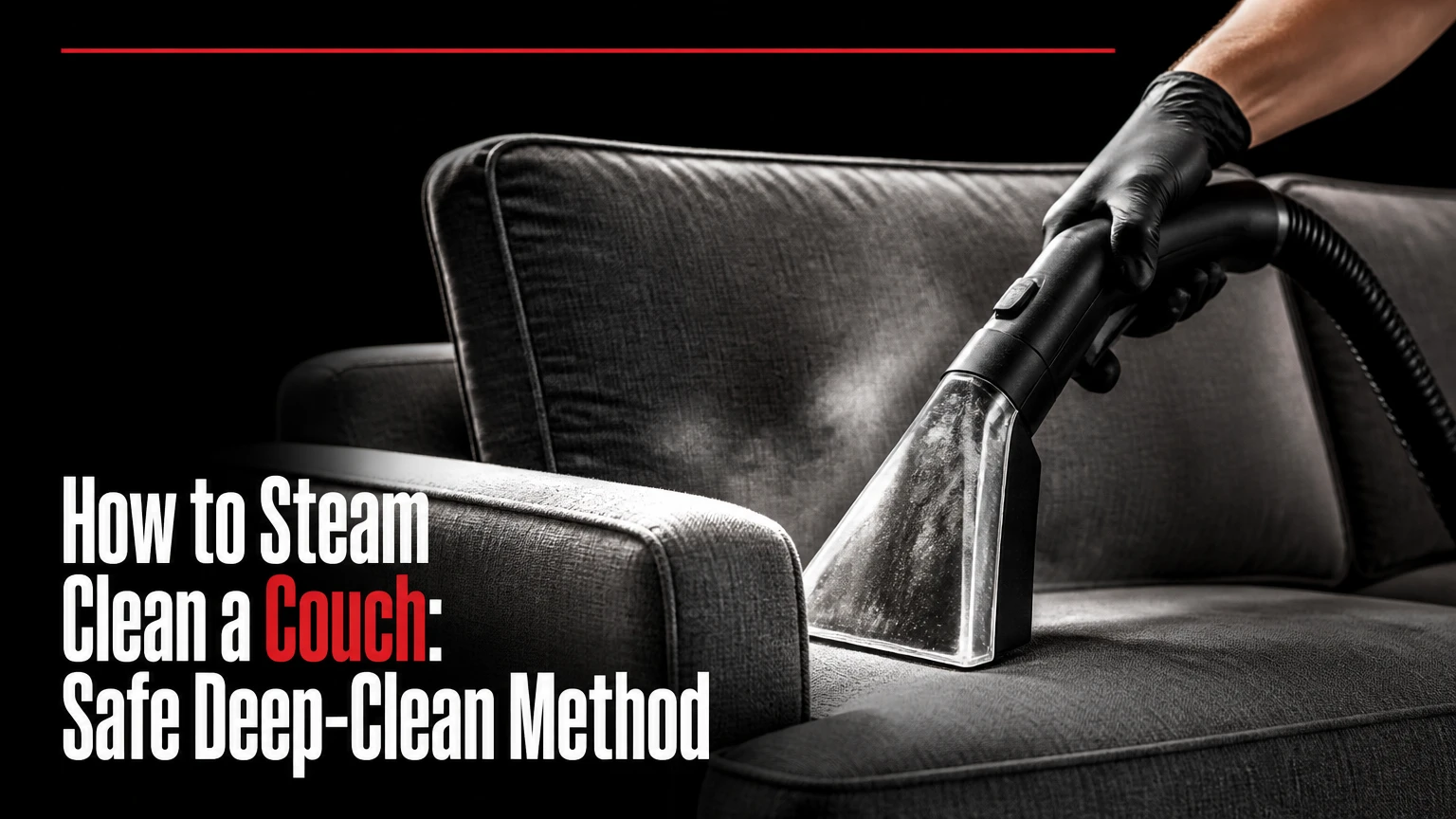
To steam clean a couch safely, confirm the upholstery care code, vacuum dry soil, test an inconspicuous area, use short low-moisture passes, extract excess water, and dry the couch quickly with strong airflow. The complete process usually takes 1-2 hours of hands-on work, but drying can take 4-12 hours.
Key Facts at a Glance
A W or WS/SW upholstery code permits water-based cleaning, but the machine manufacturer must also approve upholstery use.
An S code requires a solvent-based method, while an X code permits vacuuming only.
Steam vapor and hot-water extraction are different processes: extraction injects water and immediately removes it with a vacuum.
A couch should feel dry at the surface and inside accessible cushion seams before anyone sits on it.
Typical DIY upholstery cleaning costs $25-$60 for a rental or $100-$400 for a consumer machine.
Drying slows sharply in humid rooms, thick foam cushions, and couches placed tightly against walls.
Can You Steam Clean Every Couch?
You cannot safely steam clean every couch. Steam or water-based upholstery cleaning is generally limited to fabrics marked W or WS/SW, while S fabrics require a solvent and X fabrics should receive vacuum-only care; manufacturers may impose stricter limits.
The care label is commonly sewn beneath a seat cushion, attached to the platform, or fixed under the sofa frame. A W code means the material can tolerate a water-based cleaning product, not that high heat, pressure, or prolonged moisture is automatically harmless. A WS or SW code permits either water-based or solvent-based cleaning, but colorfastness testing remains necessary.
Do not proceed with a home steam machine when the label is missing and the fabric is expensive, antique, loosely woven, heavily dyed, or visibly damaged. A professional upholstery cleaner can identify fiber, backing, dye, and construction risks that a household user cannot reliably assess.
What Do the Upholstery Codes Mean?
| Code | Permitted method | Steam-cleaning decision | Main risk |
|---|---|---|---|
| W | Water-based cleaner | Usually possible after testing | Water rings, dye transfer, shrinkage |
| S | Solvent-based cleaner | Do not steam clean | Permanent staining or fabric distortion |
| WS/SW | Water or solvent | Possible with testing | Heat, moisture, and colorfastness damage |
| X | Vacuum only | Do not apply water or steam | Marks, shrinkage, backing failure |
Leather, suede, silk, rayon, wool blends, and some viscose upholstery require special caution. Leather is not cleaned like woven fabric, and a steam nozzle can strip finish, drive moisture into seams, or create a visible texture change. Velvet may flatten or develop directional shading when exposed to heat and pressure.
What Is the Difference Between Steam and Hot-Water Extraction?
A steam cleaner produces heated vapor, while a hot-water extraction machine sprays liquid cleaning solution into upholstery and removes the mixture with a vacuum. Many consumer products marketed as steam cleaners are actually carpet or upholstery extractors, so the label on the machine matters more than the marketing name.
True low-moisture vapor steam contains relatively little liquid water and relies on heat and agitation. It may loosen surface oils, but a steam-only unit cannot remove dissolved soil unless a separate towel or extraction vacuum lifts it away. Hot-water extraction uses a spray-and-suction cycle, which is often better for fabric couches when the care code permits water and the cushion can dry fully.
The useful question is not “How hot is the machine?” It is “How much moisture enters the upholstery, and how effectively does the machine remove it?” Excess heat can damage fibers, while excess water can remain inside foam and create odor.
Which Machine Should You Use?
| Machine type | Typical use | Moisture behavior | Best couch application |
|---|---|---|---|
| Handheld vapor steamer | Spots and seams | Low liquid output, limited extraction | Small marks on tested W fabrics |
| Portable extractor | Cushions and sofas | Injects water, vacuums it back | Most washable fabric couches |
| Canister vapor cleaner | Surface soil and crevices | Low-moisture vapor, separate towel needed | Light maintenance on durable upholstery |
| Professional extractor | Full sofas and sectionals | Strong vacuum recovery | Thick cushions, large jobs, delicate-risk assessment |
Choose an upholstery attachment rather than a floor head. The attachment should have a narrow fabric opening, controlled spray or steam delivery, and enough suction to remove moisture. A steam mop is a poor choice because its broad head distributes heat and water unevenly, while many hard-floor attachments lack upholstery extraction.
What Should You Prepare Before Cleaning?
Prepare the couch, room, machine, and drying setup before applying moisture. The minimum kit includes a vacuum with an upholstery brush and crevice tool, an approved upholstery machine, clean water, white towels, a soft brush, protective gloves, and two fans or one fan plus a dehumidifier.
Before You Start
Hands-on time: 60-120 minutes for a three-seat couch
Drying time: Typically 4-12 hours
Difficulty: Moderate
Typical DIY cost: $25-$60 to rent, or $100-$400 to buy
Water: Use the quantity specified by the machine manual
Cleaning solution: Use only the approved upholstery formula
Prerequisite: Confirm W or WS/SW code and complete a hidden-area test
Room setup: Move the couch 10-15 centimeters from the wall where possible
Remove throws, pet beds, toys, and removable cushions. Open a window if outdoor humidity is lower than indoor humidity, but do not rely on an open window alone during wet weather. Place fans so air crosses the upholstery rather than blowing directly into one small patch.
Step 1: Read the Care Label and Inspect the Couch
Read the care code and inspect seams, piping, backing, zippers, loose threads, fading, and previous water marks before applying any product. Photograph existing damage so a later change is not mistaken for a cleaning defect.
Look underneath cushions and along the rear skirt for hidden labels. Check whether cushion covers are removable and machine-washable, because a removable cover may require a different method from the fixed sofa body. Look for manufacturer warnings about heat, solvent, stain-resistant coatings, or professional cleaning.
Success checkpoint: You have identified a W or WS/SW code and found no warning against water or heat.
Common mistake: Treating a removable cover’s washing instructions as permission to steam clean the non-removable upholstery.
Step 2: Vacuum Every Upholstery Surface
Vacuum the couch slowly with an upholstery brush, then use a crevice tool around seams, under cushions, and between the back and arms. Make at least two passes over high-use areas because dry crumbs, grit, pet hair, and skin flakes can become muddy when wetted.
Vacuum the underside of loose cushions and the platform beneath them. Use a rubber pet-hair tool if hair resists the brush, but avoid aggressive scraping that can pull loops from woven fabric.
Success checkpoint: The vacuum canister contains visible dry soil, and no loose grit remains in seams.
Common mistake: Steam cleaning first. Wetting unremoved grit can spread soil and make later extraction less effective.
Step 3: Treat Stains According to Their Chemistry
Blot fresh liquid spills with a white towel, then apply a compatible upholstery pre-treater only when the label and machine instructions permit it. Allow the product to dwell for the label’s stated time, commonly 5-10 minutes, without letting it dry on the fabric.
Do not scrub wine, blood, urine, or oily marks with random household chemicals. Vinegar, bleach, ammonia, dish soap, and laundry detergent can react with dyes, leave residue, or damage a protective finish. Ink often needs solvent treatment, while protein stains such as blood respond to different chemistry from grease.
For pet urine, remove the cushion cover if permitted and treat the foam separately only with a product designed for the material. Steam alone does not reliably neutralize urine salts inside thick foam.
Success checkpoint: The stain has lightened or softened without spreading beyond the original edge.
Common mistake: Applying a large amount of cleaner. More liquid increases drying time and can create a tide mark.
Step 4: Fill and Configure the Machine
Fill the clean-water tank with the water volume specified in the manual, and use distilled water if the manufacturer permits it and local tap water is hard. Add upholstery solution only at the stated dilution; never pour detergent into a tank that is designed for water only.
Preheat a steam machine according to its instructions. Set an extractor to its upholstery tool or lowest suitable spray setting. Keep the vacuum tank empty and clean so recovered water does not foam excessively or contaminate the fabric.
Success checkpoint: The correct attachment is fitted, the solution dilution is known, and the dirty-water tank is ready to receive extracted moisture.
Common mistake: Using carpet detergent or laundry soap in an upholstery machine. Excess surfactant can leave fabric stiff, sticky, or rapidly re-soiled.
Step 5: Test a Hidden Area and Wait
Test the exact process on a hidden section, such as the back lower edge or underside of a cushion, using the same heat, solution, agitation, and suction planned for the visible upholstery. Check the test area immediately and again after it dries, ideally over 24 hours.
Look for dye transfer on a white towel, shrinkage, bubbling, texture change, watermarking, bleeding, or a darker halo. A five-minute check can miss delayed shrinkage and slow color migration, particularly on cotton, rayon, and blended fabrics.
Success checkpoint: The dried test area matches the surrounding fabric in color, texture, and dimensions.
Common mistake: Testing with plain water but cleaning the couch with hot solution. The test must reproduce the real procedure.
Step 6: Clean the Couch in Small Sections
Clean one section at a time, using overlapping passes of approximately 30-60 centimeters. Apply the minimum moisture that loosens soil, then make two or three slow suction-only passes before moving to the next section.
For an extractor, keep the tool moving while spraying and avoid stopping with the trigger held down. For a vapor steamer, release short bursts into the fabric or towel-covered tool, then wipe or extract the loosened soil immediately. Do not hold a hot nozzle against one location.
Work from the cleanest areas toward the dirtiest, usually from the upper back and outside arms toward seat fronts and armrests. Clean each cushion consistently from seam to seam to reduce visible shading.
Success checkpoint: The fabric looks evenly damp rather than saturated, and the suction pass removes less water each time.
Common mistake: Making repeated wet passes because a stain remains. Stop when the fabric is approaching saturation and allow it to dry before deciding whether another treatment is safe.
How Should You Clean Cushions and Seams?
Clean loose cushions separately, one face at a time, and stand them on edge only after the surface is no longer dripping. Avoid flooding zippers, buttons, tufting, wood trim, and the gap between fabric and foam because these areas dry slowly and can corrode or retain odor.
Use the crevice attachment after cleaning to remove pooled water from seams. Do not steam directly into cushion interiors, because heat and moisture can deform foam, loosen adhesive, and create an odor that surface drying cannot resolve.
Step 7: Dry the Upholstery Completely
Dry the couch immediately with cross-ventilation, fans, and a dehumidifier when room humidity is high. Typical surface drying takes 4-12 hours, but thick foam, dense fabric, cool temperatures, and humidity above roughly 60% can extend the period considerably.
Open cushions away from the frame where the construction allows it. Keep airflow moving across both sides, and rotate cushions after several hours if the manufacturer permits. Do not cover the couch with blankets or return it tightly against a wall while damp.
Success checkpoint: The fabric feels dry at seams and cushion edges, has no cool damp spots, and produces no musty odor when pressed.
Common mistake: Sitting on the couch when the surface feels dry but the foam remains wet. Body pressure can force hidden moisture outward and transfer clothing oils into damp fibers.
How Long Does a Steamed Couch Take to Dry?
A fabric couch typically takes 4-12 hours to dry after controlled water-based cleaning, although thick foam cushions may require 24 hours. Drying time depends on extracted moisture, fabric density, room temperature, airflow, humidity, and whether cushions can be separated.
Use a clean, dry towel to press seams and cushion centers. If the towel feels cool or damp, continue drying. A moisture meter can provide a useful comparison between the cleaned couch and an untouched area, although household meters are not calibrated equally for every textile.
If the couch still feels damp after 12 hours, increase airflow and reduce humidity rather than adding heat alone. High heat can set some stains, shrink natural fibers, or damage synthetic finishes.
What Are the Most Common Steam-Cleaning Mistakes?
The most damaging errors are ignoring the code, applying too much water, using the wrong chemical, skipping vacuuming, and stopping the drying process too early. Each error has a different remedy, and additional cleaning often makes the original problem worse.
- Cleaning an S or X fabric with water: Stop immediately and contact the manufacturer or an upholstery professional. Solvent-only and vacuum-only fabrics are not safe candidates for home steam.
- Overwetting the foam: Stop wet passes, perform slow extraction-only passes, and separate cushions for airflow. A persistent odor after 24-48 hours warrants professional assessment.
- Leaving detergent residue: After the fabric is fully compatible with water, use a light clean-water rinse and thorough extraction, following the machine manual. Do not repeatedly soak the couch.
- Creating water rings: Avoid cleaning only the center of a visible panel. Clean the complete panel or cushion evenly, then extract consistently from edge to edge.
- Using heat to force drying: Replace excessive heat with moving air and dehumidification. Heat can accelerate evaporation, but it cannot remove moisture trapped deep in foam without airflow.
A practitioner rule of thumb is to measure success by water recovery, not by the amount of visible steam. A cooler, well-extracted upholstery pass is safer than a hotter pass that leaves the cushion saturated.
How Do You Fix Water Spots, Stiff Fabric, or Odor?
Water spots usually result from uneven wetting, soil migration, hard-water minerals, or incomplete extraction. Stiff fabric commonly indicates dried detergent residue, while a musty smell usually indicates slow drying or moisture retained inside foam.
| Problem | Likely cause | Safer first response | Escalation point |
|---|---|---|---|
| Brown or dark ring | Soil migration or uneven drying | Re-clean the whole panel lightly, then extract evenly | Ring remains after complete drying |
| White mineral mark | Hard water residue | Use approved distilled-water rinse | Mark persists on tested fabric |
| Crunchy texture | Excess detergent | Follow a manufacturer-approved rinse procedure | Fabric remains stiff after drying |
| Musty odor | Wet foam or slow airflow | Fans plus dehumidifier for 24 hours | Odor persists or worsens |
| Dye on white towel | Color bleeding | Stop water cleaning immediately | Professional color correction |
Do not hide an odor with fragrance. Perfume can combine with damp organic soil and make diagnosis more difficult. If foam remains wet, surface wiping will not solve the underlying problem.
When Is Professional Upholstery Cleaning Better?
Professional cleaning is better for S or X fabrics, valuable natural fibers, severe urine contamination, antique construction, large sectionals, or any couch that cannot dry quickly. Professionals may use solvent cleaning, low-moisture systems, high-recovery extraction, or fiber-specific products that household machines do not provide.
DIY cleaning is reasonable for a durable W-coded polyester or microfiber couch with light-to-moderate soil, removable cushions, and reliable airflow. Hire a professional when the couch is expensive enough that a replacement or repair would exceed the cleaning fee.
| Situation | DIY suitability | Typical US cost | Preferred method |
|---|---|---|---|
| Three-seat polyester sofa | High | $25-$60 rental | Upholstery extraction |
| Large sectional | Moderate | $100-$300 service | Professional extraction |
| Wool or silk blend | Low | $150-$400 service | Fiber-specific professional care |
| Pet urine in foam | Low | $150-$500 service | Extraction and odor treatment |
| S-code microfiber | Low | $100-$300 service | Approved solvent cleaning |
Typical professional upholstery cleaning costs vary by region, access, fabric, number of cushions, and contamination. A quote should identify the cleaning method, drying expectations, stain limitations, and whether odor treatment costs extra.
What Changes for Velvet, Wool, Leather, and Microfiber?
Velvet, wool, silk blends, rayon, and leather need material-specific care rather than a generic steam cycle. Durable synthetic microfiber is often more tolerant, but the care code and manufacturer instructions still control the decision.
- Microfiber: Use the care code, low moisture, and gentle agitation. Water can create rings on some microfiber finishes, so clean the full panel rather than one isolated spot.
- Velvet: Avoid household steam unless the manufacturer explicitly permits it. Heat and pressure can crush pile or produce permanent shading.
- Wool: Use low moisture and controlled temperature only with confirmed approval. Wool can shrink, felt, or develop texture changes.
- Rayon or viscose: Treat as high risk because water can cause browning, distortion, and texture change. Professional cleaning is usually the safer choice.
- Leather: Do not use a fabric extractor or general steam cycle. Use the leather manufacturer’s cleaner and conditioner, and keep moisture away from seams and perforations.
How Often Should You Steam Clean a Couch?
Most water-safe couches need deep cleaning every 6-12 months, while homes with pets, children, smoking, or allergy concerns may need cleaning every 3-6 months. Vacuuming weekly and treating spills promptly reduces the need for frequent wet cleaning.
A routine schedule should not override visible condition. Clean sooner when armrests feel oily, cushions smell after vacuuming, or dry soil remains embedded despite regular maintenance. Clean less aggressively when the fabric is delicate or drying conditions are poor.
Steam cleaning does not permanently eliminate allergens, bacteria, or dust mites from an entire couch. Heat exposure, contact time, and penetration vary by machine and fabric, while allergens can remain inside foam and surrounding dust can quickly resettle.
FAQ
Can I steam clean a couch without a machine?
A garment steamer can loosen light surface soil on some water-safe fabrics, but it does not extract dissolved dirt or moisture. Use a clean white towel to lift loosened soil, keep the nozzle moving, and avoid treating cushions deeply. A proper upholstery extractor is more suitable for substantial soil.
Can I use tap water in a couch steam cleaner?
Use the water specified by the machine manufacturer. Distilled water can reduce mineral deposits in some steam appliances, but certain extractors are designed for ordinary tap water and may not perform correctly with additives. Never add vinegar, bleach, or unapproved detergent to the tank.
Can steam remove old couch stains?
Steam may soften some oil-based or water-soluble soil, but old stains can be chemically set, oxidized, or discolored below the surface. Test first, identify the stain type, and avoid repeated wet passes. Pet urine, ink, and dye transfer often require professional treatment rather than more steam.
Can I steam clean a couch with removable covers?
Only clean removable covers according to their care label and manufacturer instructions. A washable cover may tolerate machine washing but still shrink under steam or high heat. Clean the insert and fixed frame separately, and do not reinstall a cover until both the cover and cushion are fully dry.
Is steam cleaning better than dry upholstery cleaning?
Neither method is universally better. Water-based extraction suits many W-coded synthetic fabrics because it removes suspended soil with suction, while solvent or low-moisture cleaning may suit S-coded, delicate, or moisture-sensitive upholstery. The care code, fiber, soil type, and drying conditions determine the safer choice.
The Bottom Line
To steam clean a couch successfully, verify the care code, vacuum thoroughly, test the exact process, use short low-moisture passes, extract repeatedly, and dry every cushion with moving air. W and WS/SW fabrics may be suitable, but S, X, delicate, and valuable upholstery should use the approved alternative or a qualified professional.