
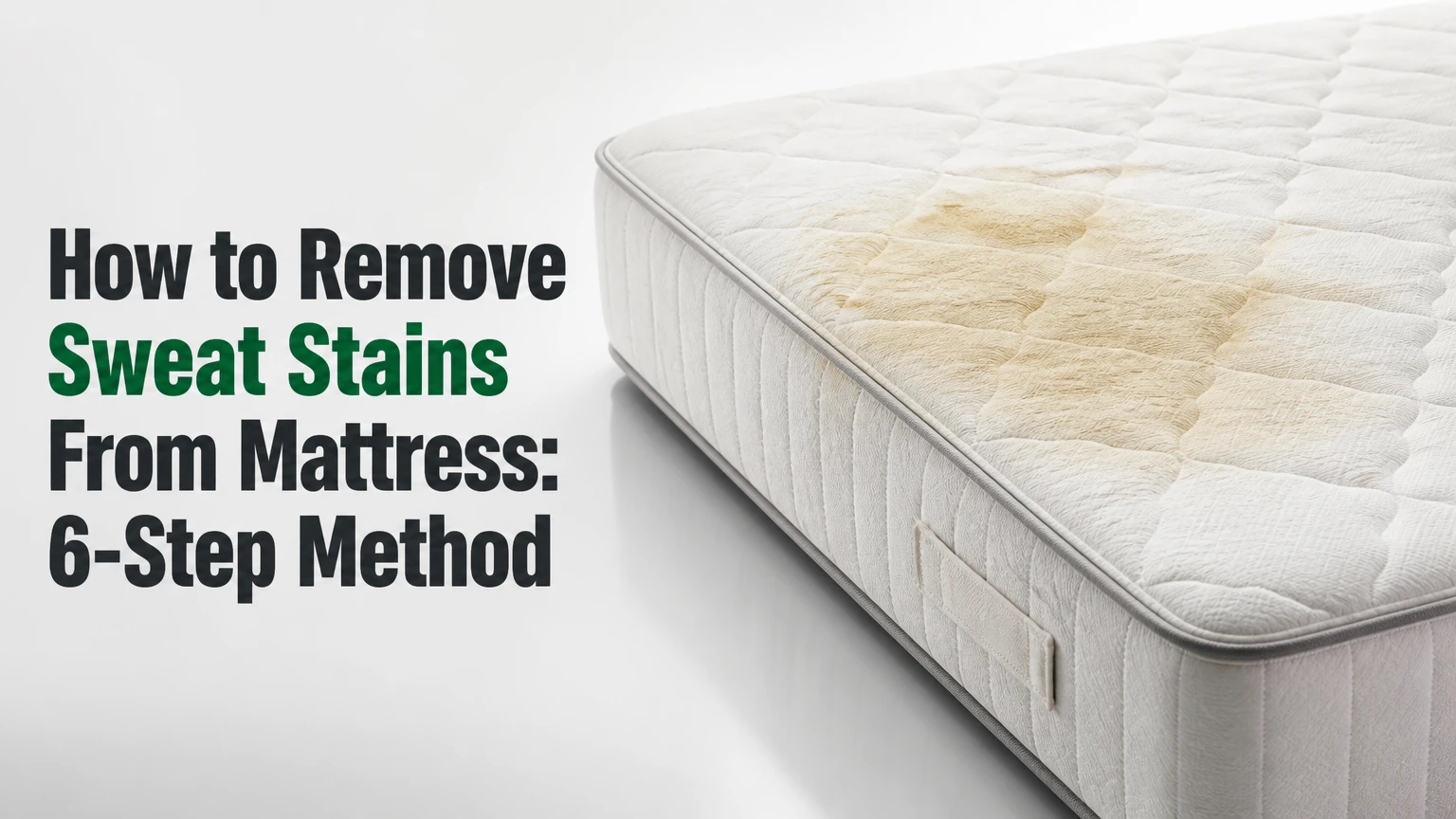
To remove sweat stains from a mattress, vacuum the surface, blot fresh moisture, spot-test a mild cleaner, apply only enough liquid to dampen the fabric, blot thoroughly, and dry the mattress completely with strong airflow. Use diluted 3% hydrogen peroxide for light discoloration or a labeled enzyme upholstery cleaner for older organic residue.
Key Facts at a Glance
- Sweat stains usually combine salts, urea, skin oils, and fabric discoloration caused by repeated moisture and oxidation.
- A mattress cover should feel damp after cleaning, never wet enough to saturate foam or padding.
- A typical spot-cleaning job takes 30-45 minutes of work and 8-12 hours of drying.
- Hydrogen peroxide can lighten colored or dark mattress fabric, so patch testing is mandatory.
- Enzyme cleaners require the product’s stated dwell time and are not automatically safe for latex, wool, silk, or untreated covers.
- EPA moisture-control guidance treats rapid drying as the central mold-prevention measure, not baking soda or fragrance.
Why Do Mattress Sweat Stains Turn Yellow?
Mattress sweat stains turn yellow because repeated body moisture leaves salts, urea, skin oils, and other residues in the cover, while oxygen and heat gradually alter the residue and surrounding fibers. A yellow mark can therefore remain after the original sweat has dried, especially on white cotton quilting.
Sweat itself is mostly water and electrolytes, including sodium and chloride. Body oils add lipids, and normal skin shedding contributes small amounts of protein and cellular material. Those substances bind to textile fibers differently, so one cleaner rarely removes every component equally well.
A fresh translucent ring usually needs blotting and mild detergent. An old yellow patch may need oxidation or an upholstery-safe enzyme product, but neither treatment can reliably restore fabric that has permanently changed color from age, heat, or bleaching.
Is a yellow mattress stain always sweat?
No. Yellow discoloration can also come from urine, spilled drinks, skin oils, cleaning residue, foam oxidation, or dye migration from bedding. Sweat is more likely when the marks appear in shoulder, torso, hip, or leg zones and have a faint salty or sour odor rather than a sharp urine smell.
Do not use the sweat method for blood, vomit, urine, or visible mold. Those contaminants require different products, protective measures, and sometimes professional remediation.
What Should You Do Before Cleaning the Mattress?
Before cleaning a mattress, remove all bedding, inspect the care label, vacuum both sides of the cover if accessible, and identify the cover fiber and mattress core. Prepare ventilation before applying liquid because drying speed determines whether spot cleaning succeeds.
Before You Start
| Requirement | Typical specification | Why it matters |
|---|---|---|
| Working time | 30-45 minutes | Covers vacuuming, treatment, blotting |
| Drying time | 8-12 hours | Foam and humid rooms may need longer |
| Hydrogen peroxide | 3%, 120-240 mL | Stronger concentrations increase discoloration risk |
| Baking soda | 30-45 g | Useful for surface odor after drying |
| Dish soap | 1-2 drops | Excess soap leaves a sticky residue |
| Tools | White towels, spray bottle, vacuum, fan | White fabric reveals transferred soil |
Open a window, remove the mattress protector, and place the mattress where air can reach at least one broad side. Check the manufacturer’s instructions first. Some removable covers are machine-washable, while others contain wool, cooling treatments, flame-resistant fibers, or adhesives that should not be exposed to peroxide or steam.
Wear nitrile gloves if your skin is sensitive. Never mix hydrogen peroxide with chlorine bleach, ammonia, vinegar, or other cleaning chemicals.
How to Remove Sweat Stains From Mattress in 6 Steps
The safest mattress stain-removal process uses the least liquid that can do the job, followed by physical extraction and rapid drying. Treat a small section first, because a successful patch test predicts color safety but cannot guarantee that every mattress cover will respond identically.
Step 1: Strip and Vacuum the Mattress
Remove sheets, blankets, and the protector, then vacuum the entire upper surface with an upholstery attachment. Make slow overlapping passes across seams, quilting, and the stain perimeter, where dry salts and skin flakes often collect.
Do not start with water. Dry vacuuming removes loose residue before liquid turns it into a paste and spreads it into the quilting.
You will know this step worked when the surface looks free of powder and lint, and the stain boundary is easier to see. A common mistake is vacuuming only the visible yellow center, leaving a larger ring that later becomes a tide mark.
Step 2: Blot Fresh Sweat Moisture
Press a dry white towel onto a fresh damp area for 10-15 seconds, lift it, and repeat with a dry section until transfer decreases. Do not rub, because rubbing spreads salts across a wider area and pushes residue below the cover.
For a recent spill or heavily damp patch, use several towels and body weight through your hands rather than kneeling on the mattress. Replace wet towels promptly.
You will know this step worked when the towel feels less damp after each press. A common mistake is applying cleaner before removing free moisture, which increases the amount of liquid the mattress must later release.
Step 3: Patch-Test the Cleaning Solution
Choose an inconspicuous seam or underside edge. Apply one or two drops of the planned solution, wait 10 minutes, blot with a white towel, and inspect the dry area for bleaching, dye transfer, roughness, or a sticky film.
For a mild soap test, mix 250 mL of cool water with one or two drops of clear, fragrance-free dish soap. For peroxide, use fresh 3% hydrogen peroxide without increasing its concentration.
You will know the test passed when the fabric’s color and texture remain unchanged after drying. A common mistake is treating a prominent stain first because the visual result feels more important than avoiding permanent discoloration.
Step 4: Treat Light or Fresh Discoloration
For a light sweat ring on a white or colorfast cover, mix 240 mL of 3% hydrogen peroxide, 30 g of baking soda, and one or two drops of liquid dish soap. Apply the mixture to a white cloth or spray it sparingly onto the stain, keeping the treated zone smaller than the stain’s outer edge.
Leave the solution for 10-15 minutes, then blot with a clean damp cloth to remove loosened residue. Use no more liquid than needed to dampen the cover’s surface. Never pour the mixture directly onto the mattress.
Hydrogen peroxide oxidizes some colored organic residues, but it can also lighten dyes and weaken some fibers with repeated use. Baking soda helps with surface odor and mild residue; it does not reliably pull moisture from the center of dense memory foam through a dry powder.
You will know the treatment worked when the ring lightens without a spreading wet border. A common mistake is leaving peroxide overnight, which increases discoloration without guaranteeing deeper cleaning.
Step 5: Use an Enzyme Upholstery Cleaner for Older Stains
For an old yellow patch with organic odor, select an enzyme cleaner labeled for upholstery or fabric mattresses. Apply the label-directed amount as a fine mist, usually enough to dampen the cover rather than saturate the padding, and allow the stated dwell time, commonly 15-30 minutes.
Enzymes work only under suitable conditions. A product may contain protease, amylase, lipase, or a blend, and the label may specify a pH range, temperature, or prohibition against use on wool and natural latex.
After the dwell period, press a dry white towel firmly over the area for 10-20 seconds at a time. Repeat with clean towel sections until transfer decreases, then leave the mattress exposed to airflow.
You will know the process worked when the odor decreases after drying and the towel stops picking up yellow residue. A common mistake is adding peroxide over an enzyme cleaner, which can deactivate the biological ingredients or create an untested chemical mixture.
Step 6: Dry, Inspect, and Vacuum
Stand the mattress on its side only if the manufacturer permits it and the mattress can be supported safely. Otherwise, keep it flat and direct a fan across the treated surface, with a second fan or open window improving air exchange.
Allow at least 8-12 hours in a dry, ventilated room. Dense memory foam, cool weather, high humidity, or a large treatment area can extend drying beyond 24 hours.
Press a clean, dry hand towel against the area after several hours. If the towel feels cool or damp, continue drying. Do not remake the bed or use a protector until the cover and nearby seams are completely dry.
You will know drying is complete when the treated area matches the surrounding temperature, has no cool dampness, and produces no musty smell. A common mistake is using a hair dryer on hot air, which can damage foam, adhesives, or fabric; use room-temperature airflow instead.
Which Mattress Stain Method Is Best?
The best method depends on stain age, cover color, mattress material, and available drying conditions. Peroxide is economical for small, colorfast surface marks, while an enzyme upholstery cleaner is more suitable for persistent organic odor, provided the product is compatible with the cover.
| Method | Typical cost | Contact time | Drying estimate | Best use |
|---|---|---|---|---|
| Mild soap solution | $1-3 household supply | 5-10 minutes | 4-8 hours | Fresh, light residue |
| 3% peroxide mixture | $2-6 per treatment | 10-15 minutes | 6-12 hours | White or colorfast yellowing |
| Enzyme upholstery spray | $6-20 per bottle | 15-30 minutes | 8-24 hours | Older organic odor |
| Professional extraction | $80-250 typical service | 1-3 hours onsite | 6-24 hours | Large or repeated contamination |
Professional prices vary by region, mattress size, access, and whether transportation is included. The figures above are typical consumer ranges, not universal rates.
Can baking soda remove sweat stains?
Baking soda can reduce surface odor and absorb limited surface moisture, but baking soda alone rarely removes an established yellow sweat stain. Vacuum it only after the mattress is completely dry, because damp powder can cake inside quilting and leave alkaline residue.
Use 30-45 g over a fully dry treated area and leave it for 4-12 hours, rather than assuming a thicker layer cleans deeper foam. Baking soda is a deodorizing finishing step, not an extraction system.
Is steam cleaning safe for a mattress?
Steam cleaning is safe only when the mattress manufacturer permits it and the operator can extract and dry the moisture quickly. Steam may soften adhesives, distort quilting, or leave water inside foam, especially when a consumer steamer is held in one place.
Steam also does not automatically sanitize a mattress or eradicate dust mites throughout its core. Heat exposure, dwell time, penetration, and post-cleaning drying all determine the result. For extensive staining, ask a professional about low-moisture upholstery cleaning or water-extraction equipment rather than requesting steam by name.
How Do Mattress Materials Change the Cleaning Method?
Mattress material changes the acceptable liquid volume, agitation level, and drying risk. Innerspring covers generally tolerate slightly more surface moisture than dense foam, but every material still requires a patch test and complete drying.
| Mattress type | Liquid tolerance | Preferred treatment | Avoid |
|---|---|---|---|
| Memory foam | Low, surface mist only | Mild soap or compatible enzyme spray | Pouring liquid, soaking, hot steam |
| Latex foam | Low to moderate | Manufacturer-approved mild cleaner | Peroxide without testing, prolonged wetness |
| Innerspring | Moderate at cover surface | Blotting, mild soap, limited peroxide | Saturating quilt and coil border |
| Hybrid | Low to moderate | Treat according to foam comfort layer | Assuming coils make soaking safe |
| Pillow-top | Low in tufted seams | Fine mist and towel extraction | Aggressive brushing, deep wetting |
Memory foam and hybrid mattresses
Memory foam and hybrid mattresses need especially conservative treatment because foam retains moisture below the fabric even when the surface appears dry. Use a cloth or fine mist, treat an area no larger than a pillowcase at a time, and provide airflow from multiple directions.
Latex mattresses
Natural latex can react poorly to some solvents, strong oxidizers, and prolonged moisture. Follow the brand’s care instructions before using peroxide or enzymes, particularly when the cover cannot be removed.
Innerspring mattresses
Innerspring mattresses have more air space around the coil unit, but their border rods, felt layers, and quilted covers can still hold water. Do not interpret an airy core as permission to flood the surface.
What Common Cleaning Mistakes Make Sweat Stains Worse?
The most damaging mistake is oversaturation, because liquid can migrate through batting into foam, where towels cannot reach it effectively. EPA mold guidance states, “The key to mold control is moisture control,” so extraction and airflow matter as much as the chemical chosen.
Avoid these failure modes:
| Mistake | Likely result | Better recovery |
|---|---|---|
| Pouring cleaner onto foam | Deep moisture and prolonged drying | Stop adding liquid; towel-blot and fan |
| Using chlorine bleach | Dye loss, fiber weakening, harsh residue | Rinse only if label permits, then dry |
| Scrubbing with a stiff brush | Spread stain and damaged quilting | Use pressing and short soft-brush passes |
| Applying hot water | Faster dye migration and heat damage | Use cool or room-temperature solution |
| Mixing products | Unknown reaction or residue | Use one tested product at a time |
| Replacing bedding too soon | Trapped moisture and returning odor | Wait until seams are fully dry |
Bleach is particularly unsuitable for an unknown mattress cover because it can damage dyes and textile fibers, and its fumes create a separate indoor-air problem. Vinegar is also not a universal deodorizer; its odor can combine unpleasantly with residual sweat or alkaline powder.
How Can You Remove Sweat Odor Without Peroxide?
To remove sweat odor without peroxide, vacuum the dry cover, mist a compatible enzyme upholstery cleaner, blot after its label-directed dwell time, and dry the mattress with continuous airflow. For a fresh, mild odor, a tiny amount of fragrance-free dish soap in cool water is usually the gentler first option.
Fragrance sprays mask odor without removing the residue that produces it. Odor absorbers work better after physical cleaning, but they cannot correct moisture trapped beneath the cover.
For sensitive sleepers, choose an unscented product, ventilate the room, and wash the removable cover according to its care label. Do not use essential oils directly on bedding or foam, because concentrated oils can irritate skin and leave an oily residue.
What If the Stain Gets Darker After Cleaning?
A darker ring after cleaning usually indicates wet-fabric contrast, wicking, or incomplete extraction rather than immediate permanent damage. Let the area dry fully before judging the final color, because damp fibers often appear darker than the surrounding cover.
If a defined ring remains after drying, lightly mist only the ring’s outer boundary with clean water and immediately press dry towels across the entire transition area. This reduces a sharp tide line by redistributing dissolved residue before extraction.
Do not repeatedly re-wet the same patch. After one recovery attempt, continue airflow and reassess the next day; repeated treatments can turn a cosmetic mark into structural moisture damage.
What If the Mattress Still Smells Sour?
A sour mattress odor after cleaning usually comes from residual organic soil, cleaner residue, or moisture that dried too slowly. Baking soda may reduce a surface smell, but a persistent odor from inside foam indicates that home spot treatment has not reached or removed the source.
After complete drying, apply 30-45 g of baking soda to the area for 4-12 hours and vacuum thoroughly. If the odor returns whenever humidity rises, stop adding products and obtain a professional inspection or extraction estimate.
A musty odor, visible spotting, damp seams, or fabric bubbling requires more caution. Do not sleep directly on the mattress until the source and moisture condition are resolved.
When Should You Hire a Professional or Replace the Mattress?
Hire a professional when contamination covers a large section, penetrates the mattress core, includes urine or vomit, or returns after two careful treatments. Replace the mattress when it has persistent internal odor, visible mold-like growth, major foam collapse, exposed structural material, or contamination that cannot be safely extracted.
| Situation | Home treatment | Professional help | Replacement concern |
|---|---|---|---|
| One fresh sweat ring | Appropriate | Usually unnecessary | None |
| Several old yellow patches | Limited spot treatment | Consider if odor persists | Evaluate age and support |
| Urine plus sweat | Not the same method | Recommended | Possible if deeply absorbed |
| Visible mold-like growth | Do not brush or spray casually | Recommended assessment | Often likely in porous core |
| Foam remains damp over 24 hours | Stop adding liquid | Recommended | Consider if odor develops |
| Sagging or collapsed foam | Cleaning will not restore support | Optional cleaning only | Replacement usually appropriate |
Mattress cleaning cannot reverse compression, broken foam cells, torn quilting, or permanent dye changes. A cleaner may improve hygiene and appearance while leaving the mattress unsuitable for comfortable sleep.
How Do You Prevent Sweat Stains From Returning?
Prevent sweat stains by using a fitted, waterproof, breathable mattress protector and washing it according to its care label, commonly every 1-2 weeks when someone sweats heavily. Wash sheets weekly, improve bedroom ventilation, and clean small spills before they dry.
A protector must fit tightly without exposed gaps around the sides. A plastic-feeling cover may block liquid but increase heat retention, so select a breathable membrane and confirm that the protector remains waterproof after laundering.
Additional prevention steps include:
- Keep bedroom humidity near 30-50% when practical, using a hygrometer to verify conditions.
- Rotate the mattress only when the manufacturer allows it; do not flip a one-sided design.
- Air the bed for 20-30 minutes after waking before covering it.
- Wash the protector separately when its care label requires low heat.
- Treat fresh dampness immediately with towels instead of waiting for a yellow ring.
Frequently Asked Questions
Will sweat stains disappear completely?
Fresh sweat residue often improves substantially, but old yellow stains may not disappear completely. Oxidation can permanently alter cotton fibers, and some discoloration comes from aging foam or dye changes rather than removable soil. Judge success after complete drying, not while the cover is still damp.
Can I use hydrogen peroxide on a black mattress?
Hydrogen peroxide can lighten black or dark-colored fabric, so it is not a safe default for a black mattress. Patch-test a hidden area for at least 10 minutes, but understand that a small test cannot guarantee uniform color on a large quilted surface. Use mild soap or a compatible commercial cleaner first.
How long should baking soda stay on a mattress?
Leave dry baking soda on a mattress for 4-12 hours when using it for surface odor, then vacuum it thoroughly. A 24-hour application is not automatically better and can leave powder in seams, especially when the room is humid or the mattress cover has deep quilting.
Can I sleep on the mattress after cleaning?
Sleep on the mattress only when the treated cover, seams, and nearby padding feel completely dry and have no musty odor. Typical drying takes 8-12 hours, but dense foam or humid conditions can require more than 24 hours. Trapping residual moisture beneath sheets slows evaporation.
Does a mattress protector stop all sweat stains?
A waterproof mattress protector prevents most sweat from reaching the mattress cover when it fits correctly and remains intact, but it does not stop sweat from staining the protector itself. Wash the protector regularly, inspect its membrane for cracks, and replace it when liquid begins passing through.
Is a sweat stain a reason to replace a mattress?
A sweat stain alone is usually not a reason to replace a structurally sound mattress. Replacement becomes reasonable when odor persists inside the core, visible mold-like growth appears, foam remains damp, support has collapsed, or the mattress has extensive biological contamination that professional cleaning cannot confidently remove.
The Bottom Line
The safest way to remove sweat stains from a mattress is to vacuum first, blot fresh moisture, patch-test one mild solution, apply minimal liquid, blot rather than scrub, and dry the mattress completely. Use 3% hydrogen peroxide only on tested, colorfast fabric, and choose a compatible enzyme upholstery cleaner for older organic odor. For prevention, wash bedding regularly and use a breathable waterproof mattress protector.