
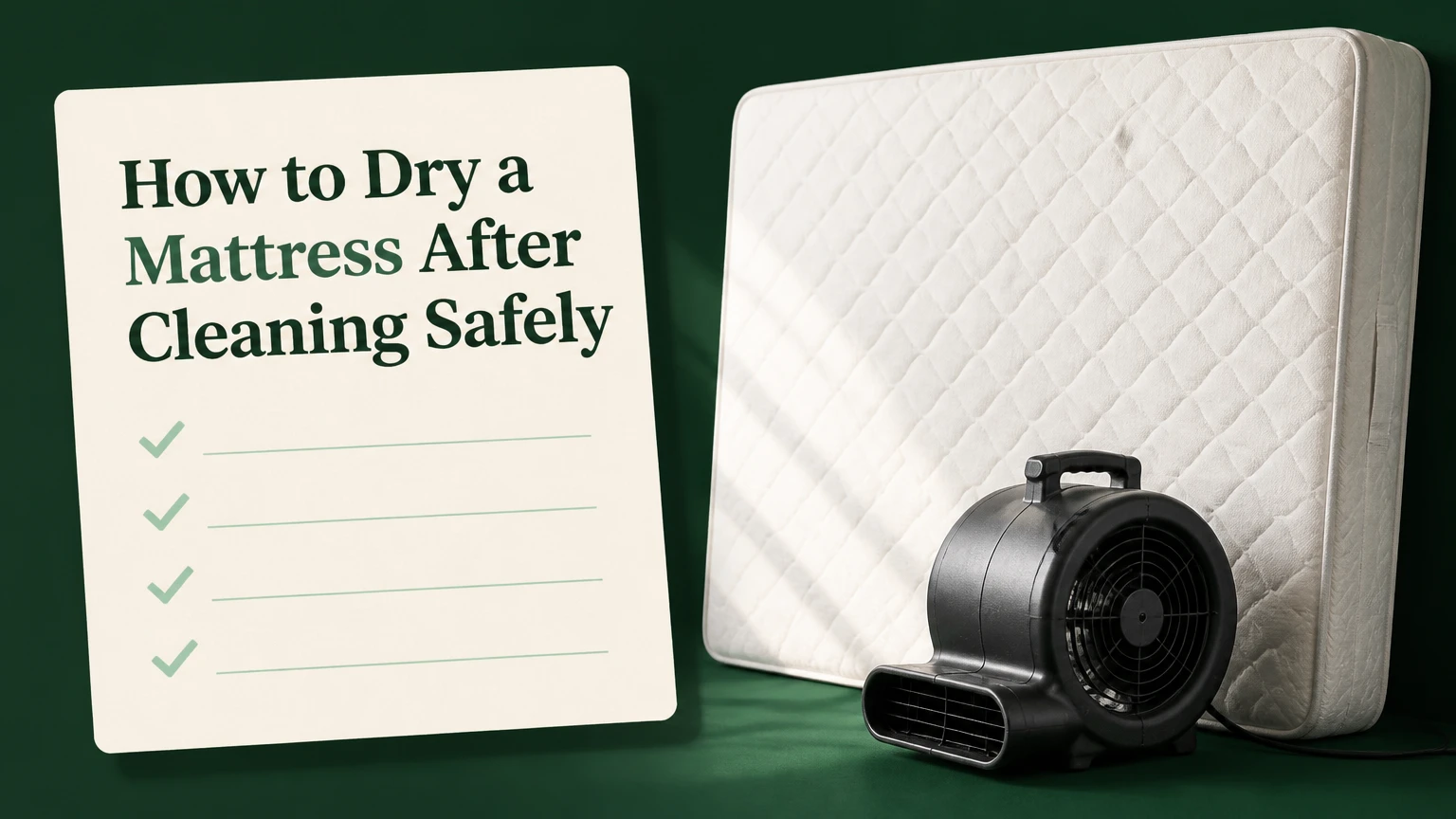
To dry a mattress after cleaning, remove as much water as possible with absorbent towels or a wet/dry vacuum, then expose the mattress to moving air in a low-humidity room. Most lightly damp surfaces dry in 8-24 hours, while saturated foam can require 24-48 hours or professional extraction.
Key Facts at a Glance
- A mattress is ready for bedding only when the surface and deeper layers feel dry, coolness has disappeared, and no musty odor develops after several hours.
- Fans move moisture away from the fabric, while a dehumidifier lowers the room’s relative humidity so evaporation can continue.
- Memory foam dries slowly because its dense cells restrict airflow; direct high heat can deform foam and damage adhesives.
- Baking soda can reduce odor, but it does not reliably remove water from a soaked mattress.
- Relative humidity below 50% usually supports faster indoor drying, while an open window can slow drying in damp weather.
- A wet/dry vacuum is useful for liquid extraction, but it cannot make a mattress dry without continued airflow.
Before You Start: Tools, Time, and Safety
Drying a cleaned mattress usually takes 8-24 hours, costs $0-$40 with household equipment, and requires moderate physical effort because a queen mattress can weigh more than 60 pounds. The main success factor is not heat. It is the amount of liquid removed before the mattress begins air-drying.
Prepare these supplies
| Item | Typical quantity or setting | Purpose |
|---|---|---|
| White microfiber towels | 6-12 towels, 40 x 60 cm | Pressing and moisture transfer |
| Wet/dry vacuum | 1 unit, upholstery nozzle | Removing liquid from fabric and foam |
| Floor or box fan | 1-2 units, 900-1,500 CFM typical | Moving air across surfaces |
| Compressor dehumidifier | 1 unit, 20-35 pints per day | Lowering indoor humidity |
| Hygrometer | 1 digital meter | Measuring relative humidity |
| Baking soda | 250-500 g for a large area | Odor absorption after blotting |
| Plastic sheeting or tarp | Large enough for the mattress | Protecting floors during extraction |
Unplug electric equipment before moving a wet mattress near outlets. Do not place a mattress against a radiator, portable heater, or exposed electrical cable. Read the mattress manufacturer’s care label first, because some covers cannot be removed and some warranties exclude liquid cleaning.
If urine, vomit, floodwater, sewage, or chemical cleaner caused the moisture, identify the contamination before drying. Clean water and a small shampooing job are reasonable DIY cases. Sewage, floodwater, and heavily contaminated foam may require disposal or a professional remediation service.
How Mattress Drying Works
Mattress drying combines liquid extraction with evaporation. Towels and a wet vacuum remove free water, while airflow carries water vapor away from the fabric and a dehumidifier reduces the moisture content of the surrounding air.
Mattress materials behave differently. Polyester covers release surface water relatively quickly; cotton batting holds moisture in its fibers; latex and memory foam may retain liquid in deeper channels; and coil systems can hide moisture below the quilted surface. A mattress can therefore feel dry on top while remaining damp inside.
The U.S. Environmental Protection Agency states, “The key to mold control is moisture control.” That principle matters because drying time depends on moisture removal, room humidity, temperature, exposed surface area, and mattress thickness. Warm air alone is insufficient if the room remains humid or the mattress sits on an airtight platform.
Baking soda requires a more precise explanation. Household baking soda is primarily an odor absorber and mild surface cleaner, not a dependable drying agent for saturated foam. Use it after extraction for odor control, but do not treat powder as a substitute for a wet vacuum, towels, fans, or dehumidification.
Step 1: Extract Liquid Before It Sinks
Press clean towels into the wet area or use a wet/dry vacuum with an upholstery attachment before doing anything else. Continue until a fresh towel picks up little or no moisture, because water left in the comfort layer can extend drying from one day to several days.
Towel extraction method
- Remove sheets, protectors, and mattress pads immediately.
- Lay two or three white towels over the wet area.
- Press straight down for 30-60 seconds without rubbing.
- Replace saturated towels and repeat in overlapping sections.
- Use a clean plastic storage bin filled with light household items for five-minute pressure intervals if more force is needed.
- Avoid standing directly on the mattress, especially on soft memory foam, because concentrated weight can damage the cover or compress the foam unevenly.
A white towel helps reveal cleaner residue, urine color, or transferred dye. Do not use colored towels on a damp mattress because textile dye can migrate into pale upholstery.
Wet vacuum method
Make slow passes with the wet/dry vacuum, keeping the nozzle moving rather than holding it in one spot. Empty the collection tank frequently, and use only a machine approved for liquid pickup. A household dry vacuum is not suitable for water and can create an electrical hazard.
You will know extraction has improved when the towel remains nearly dry after firm pressure and the mattress no longer produces a wet sheen. Extraction is incomplete if the top feels dry but the underside feels substantially heavier, colder, or clammy.
Common mistake: Pressing once and assuming the surface represents the whole mattress. Dense foam can hold water below the cover, so extraction should cover the full wet footprint plus several centimeters around its edge.
Step 2: Blot, Then Use Baking Soda Carefully
Apply baking soda only after liquid extraction, and use it mainly to absorb odor and loosen surface residue. Spread approximately 250-500 grams over a large damp zone, leave it for 2-4 hours, then vacuum it thoroughly with an upholstery attachment.
Baking soda may clump when it contacts moisture, but clumping does not prove that it has dried the mattress core. A thick layer can also obstruct surface airflow if left in place while fans operate. For that reason, use the powder as a short treatment between extraction and active drying.
Vacuum slowly in overlapping passes. Keep the upholstery brush clean, and do not force powder into seams, zipper tracks, or open foam cells. If the cover is removable and the care label permits machine washing, wash the cover separately and dry it fully before reinstalling it.
You will know the powder step is complete when no visible granules remain in stitching, piping, or the sleeping surface. The mattress may still need many hours of fan drying.
Common mistake: Applying baking soda first to a saturated mattress. Powder forms a paste, becomes difficult to remove, and does not pull enough deep water from foam to solve the underlying problem.
Step 3: Position the Mattress for Airflow
Place the mattress on a clean, dry surface that permits air beneath it. A platform with solid panels can trap moisture against the underside, so use a slatted frame, drying rack, or several broad supports that leave air channels without creating pressure points.
For a spring mattress that remains structurally stable, stand it on its long edge with two people supporting the weight. Vertical positioning exposes both faces and lets gravity assist drainage. Do not lean a heavy mattress against a sharp corner, narrow object, or unstable wall because the edge can crease or the mattress can fall.
Memory foam needs more caution. Keep it mostly flat if vertical bending causes folding, and elevate it several centimeters with clean blocks or a slatted base. Latex can be heavy and may tear when dragged, while hybrid mattresses may require two people because the coil unit shifts under wet weight.
You will know positioning is adequate when air can reach the wet area from below and no section rests directly on a sealed floor or plastic sheet. Keep the clean sleeping surface away from dusty walls and outdoor ground.
Common mistake: Drying the mattress flat on a solid bed base. The underside remains insulated from air, creating a damp layer that may not be detected until odor appears.
Step 4: Configure Fans and a Dehumidifier
Aim one fan across the broad face of the mattress and place a second fan near the opposite side or underside. Run a compressor dehumidifier in the same closed room, with doors and windows shut when outdoor air is more humid than indoor air.
A fan accelerates evaporation by replacing humid air at the mattress surface with drier room air. A dehumidifier then removes that vapor from the room. Air conditioning can help because it lowers humidity while cooling the air, but a portable evaporative cooler adds moisture and is unsuitable for this task.
Set a digital hygrometer near the mattress, not directly in the fan stream. A practical target is 40-50% relative humidity. Drying can continue above 50%, but the process often becomes slower; at 60% or higher, a dehumidifier is more useful than an open window in many climates.
Do not use a heat gun, clothes dryer, or high-temperature hairdryer. Concentrated heat can shrink fabric, soften adhesives, deform memory foam, and create a hot spot that damages one layer while leaving the interior wet. If manufacturer instructions permit gentle warmth, keep the room comfortable rather than directing heat at the mattress.
You will know the setup is working when the hygrometer reading falls, the air feels less humid, and the surface loses its cold, clammy sensation over repeated checks.
Common mistake: Pointing a fan at the mattress in a humid room while leaving all windows open. If outdoor relative humidity is higher, the open window continually replaces drier indoor air with moisture-laden air.
Step 5: Turn and Check Every Few Hours
Rotate or reposition the mattress after 3-4 hours when its construction allows safe handling. Check the original wet zone, underside, seams, corners, and areas beneath labels because moisture commonly remains where air movement is weakest.
Use three checks rather than touch alone:
- Compare the cleaned area with a dry area of the same mattress.
- Press a dry white towel firmly into the thickest section for 30 seconds.
- Check for a cool sensation, damp odor, discoloration, or humidity that returns after the fan stops.
A moisture meter designed for upholstery can provide additional information, but inexpensive wood moisture meters may give unreliable readings on foam, latex, and layered textiles. Treat the instrument as a comparison tool between a known-dry section and the cleaned section, not as a universal pass or fail test.
Allow another 6-12 hours if the center or underside remains cooler than the surrounding surface. Do not reinstall sheets merely because the top fabric feels dry.
Which Mattress Materials Need Different Care?
Memory foam, latex, innerspring, and hybrid mattresses should not be dried identically. Memory foam and thick latex usually need longer indoor drying, while innerspring designs often release surface moisture faster but can retain water around quilting, edge foam, and the coil base.
| Mattress type | Main moisture risk | Preferred setup | Avoid |
|---|---|---|---|
| Memory foam | Slow drainage through dense foam | Flat or gently elevated, fan, dehumidifier | Direct sun, heaters, folding |
| Latex foam | Heavy wet weight and tearing | Broad support, low airflow beneath | Dragging, sharp supports |
| Innerspring | Water trapped in quilting and edge foam | Slatted base or stable vertical position | Solid platform, one-person lifting |
| Hybrid | Foam comfort layer over coils | Two-person handling, fans on both faces | Assuming coils mean instant drying |
| Pillow-top | Thick batting retains cleaner | Repeated towel extraction, long airflow | Saturating the top again |
Manufacturers may specify different cleaning limits, so the care label takes precedence over generic advice. A removable cover can often be washed separately, but the foam core usually should not be machine washed or saturated.
How Long Will Mattress Drying Take?
Typical drying time ranges from 8-12 hours for a small surface spot to 24-48 hours for deeply wet memory foam. Relative humidity, extraction quality, foam thickness, and airflow influence the result more than sunlight or room temperature alone.
| Situation | Typical drying time | Equipment needed | Recheck interval |
|---|---|---|---|
| Light spot cleaning | 8-12 hours | 1 fan | Every 3 hours |
| Shampooed fabric surface | 12-24 hours | 1-2 fans | Every 4 hours |
| Deeply wet foam | 24-48 hours | Wet vacuum, fan, dehumidifier | Every 3 hours |
| Humid room above 60% RH | 24-72 hours | Dehumidifier, closed room | Every 2-3 hours |
| Clean-water saturation | 24-48 hours after extraction | Wet vacuum, two-sided airflow | Every 3 hours |
These are typical household ranges, not guarantees. A mattress that remains damp after 24 hours needs more extraction or better humidity control, not automatically more heat.
Which Drying Method Should You Choose?
For most cleaned mattresses, wet extraction followed by fans and a dehumidifier is the safest and most predictable combination. Outdoor drying can help with a lightly damp, non-foam mattress in dry weather, but it introduces contamination and heat risks.
| Method | Typical duration | Typical cost | Best use |
|---|---|---|---|
| Towels and room airflow | 12-24 hours | $0-$10 | Small surface dampness |
| Fan only | 10-24 hours | $0-$25 | Moderate moisture in dry weather |
| Fan plus dehumidifier | 6-24 hours | $10-$40 rental | Indoor drying and humid climates |
| Wet/dry vacuum plus airflow | 12-36 hours | $0-$50 rental | Spills and saturated areas |
| Outdoor shade and airflow | 8-24 hours | $0-$15 | Fabric or spring mattress in dry weather |
Outdoor drying
Use a clean tarp, keep the mattress off grass and soil, and choose shade or mild indirect sun rather than intense midday heat. Bring the mattress inside before evening dew forms. Outdoor air below roughly 50% relative humidity can support drying, but weather apps often report humidity that differs from conditions at ground level.
Sunlight is not a reliable disinfectant for a contaminated mattress. UV exposure varies with cloud cover, surface angle, shade, and exposure time, and it cannot reach microorganisms inside foam. Outdoor drying also exposes the cleaned fabric to pollen, dust, insects, and bird droppings.
Professional extraction
A professional upholstery or water-damage technician is appropriate when the mattress is saturated, contaminated by sewage or floodwater, develops a persistent musty smell, or cannot be moved safely. Ask whether the technician uses controlled low-moisture extraction and how the mattress core will be dried, rather than accepting surface cleaning alone.
What Do Drying Methods Cost?
Typical household drying costs range from $0 to $40 when fans and a dehumidifier are already available. Rental extraction equipment commonly costs $30-$80 per day, while professional mattress cleaning or remediation often ranges from $100-$300 depending on mattress size, contamination, location, and drying requirements.
| Expense | Typical price | Main variable | Cost-saving option |
|---|---|---|---|
| Hygrometer | $8-$25 | Bluetooth features | Basic digital meter |
| Box or floor fan | $15-$60 | Airflow rating | Borrow one |
| Dehumidifier rental | $10-$40 per day | Capacity and region | Use existing unit |
| Wet/dry vacuum rental | $30-$80 per day | Tank size | Rent locally |
| Professional service | $100-$300 | Contamination and size | Request extraction-only quote |
Prices vary substantially by country and city. Electricity costs also depend on the dehumidifier’s wattage and operating time, so a 500-watt appliance running for 12 hours uses approximately 6 kilowatt-hours.
Common Mistakes and How to Fix Them
Using high heat
High heat dries the cover while leaving the core wet and can deform foam. Stop the heat source, move the mattress into room-temperature airflow, and inspect for softened foam, shrinkage, or adhesive odor.
Re-covering the mattress too soon
Sheets and waterproof protectors trap vapor against the surface. Remove all coverings and resume airflow for at least 6-12 hours, then repeat the towel and odor checks before remaking the bed.
Over-wetting during cleaning
More detergent and water do not produce a cleaner mattress when extraction is weak. Remove residue with minimal distilled-water misting, extract again, and use low-moisture cleaning for future spot treatment.
Drying only the top
A dry top can conceal a wet underside or foam center. Elevate the mattress, direct air below it, and compare the underside with a dry reference area.
Rubbing a stain
Rubbing drives liquid outward and can abrade the ticking fabric. Press from the edge toward the center with white towels, then extract slowly.
Spraying vinegar into damp foam
Vinegar may alter odor temporarily but does not make a moldy mattress safe, and adding liquid delays drying. Do not mix vinegar with bleach or other cleaners. For established mold or sewage contamination, stop adding household liquids and obtain professional advice.
How Should You Dry a Mattress in Humid Weather?
In humid weather, close windows and doors, run a compressor dehumidifier continuously, and use fans to circulate air across both mattress faces. Keep the room near 40-50% relative humidity and empty the dehumidifier tank before it stops automatically.
A small closed room can be more effective than a large open room because the dehumidifier processes the same air repeatedly. Leave clearance around the appliance according to its manual, and do not place the mattress directly against the dehumidifier exhaust.
Open windows only when outdoor air is demonstrably drier than indoor air. Outdoor relative humidity can be misleading because warmer air can hold more water vapor, so compare indoor and outdoor dew point when available.
What If the Mattress Still Feels Damp After 24 Hours?
A mattress that remains damp after 24 hours usually has retained liquid in foam, has inadequate airflow underneath, or is drying in air with excessive humidity. Extract again, elevate the mattress, lower room humidity, and inspect the thickest layer before deciding whether replacement is necessary.
Use a clean towel pressed into several zones. If the towel becomes damp, extraction remains worthwhile. If the towel stays dry but the mattress feels cool, allow additional airflow because evaporation can make fabric feel cold even after much of the water has gone.
A professional should assess a mattress that remains wet after 48 hours, has visible mold, has a sour odor that returns after ventilation, or was exposed to sewage, floodwater, or unknown chemicals. Mold remediation guidance from the EPA treats porous materials with extensive mold growth as difficult to clean reliably, and deeply affected foam may not be salvageable.
What If the Mattress Smells Musty?
A musty smell means drying is incomplete or microbial growth may be present, so increase extraction and dehumidification rather than masking the odor with fragrance or vinegar. If the smell persists after 48 hours of dry conditions, inspect seams and the underside and consider professional evaluation.
For a mild cleaning-product odor, remove all bedding, vacuum the dry surface, and ventilate the room. For urine, enzymatic treatment may be needed, but apply only the small amount allowed by the product and extract it thoroughly.
Do not claim that baking soda or vinegar kills all mold inside a mattress. Neither product can disinfect an inaccessible foam core. Visible mold covering a substantial area, respiratory symptoms, or contamination from a flood are reasons to isolate the mattress and seek qualified advice.
How Do You Remove Water Rings After Drying?
Water rings usually result from uneven wetting, detergent residue, or minerals left behind as water evaporates. Lightly mist the entire affected panel with distilled water, blot from the outer edge inward, and dry the panel evenly with airflow.
Treating only the dark ring can create another boundary. Use the smallest amount of distilled water that allows residue transfer, and test an inconspicuous area first. Avoid tap water when mineral deposits are already visible.
A ring that returns after two controlled treatments may indicate residue deep in the batting or foam. Professional low-moisture upholstery cleaning is safer than repeatedly soaking the mattress.
When Is Drying No Longer a Safe DIY Job?
Replace or professionally assess a mattress when it has deep floodwater contamination, sewage exposure, extensive visible mold, structural distortion, or an odor that remains after complete drying. A clean-water spill on a washable surface is different from contaminated water inside porous foam.
A mattress also warrants replacement when the foam has collapsed, the cover has torn, springs protrude, or the internal layers remain wet despite 48-72 hours of controlled extraction and dehumidification. Sleeping on a damp mattress can reintroduce moisture from body heat and bedding, restarting the problem.
FAQ
Can I sleep on a mattress that is slightly damp?
No. Wait until the mattress is dry at the surface and inside the affected area, with no cool clammy zones or returning odor. Body heat, sheets, and a protector can trap residual moisture and prolong drying, especially in memory foam.
Can I dry a mattress with a hairdryer?
Use a hairdryer only on a cool or low-air setting, held well away from the fabric, and only for a small surface spot. Do not use concentrated high heat on foam, latex, synthetic covers, or adhesive seams because localized heating can cause damage without drying the core.
Is a dehumidifier better than an open window?
A dehumidifier is usually better when outdoor humidity is above indoor humidity or exceeds approximately 50-60% relative humidity. An open window helps when outdoor air is genuinely dry and moving air through the room does not introduce dampness.
How much baking soda should I put on a mattress?
Use approximately 250-500 grams for a large damp or odorous area after liquid extraction. Leave it for 2-4 hours, then vacuum it completely. Baking soda helps with odor and surface residue, but it cannot replace mechanical extraction or dehumidification.
Can I dry memory foam in direct sunlight?
Avoid direct, intense sunlight for memory foam unless the manufacturer specifically permits it. Heat can deform foam and damage adhesives, while outdoor dust and pollen contaminate the cover. Indoor airflow with a dehumidifier gives better control.
How do I know the mattress is completely dry?
Compare the cleaned section with a dry section, press a white towel firmly into the thickest area, inspect the underside, and check for returning odor after several hours. A dry mattress should not feel colder, heavier, or clammy in the cleaned zone.
The Bottom Line
To dry a mattress after cleaning, extract liquid first, use baking soda only for limited odor control, elevate the mattress for airflow, and run fans with a dehumidifier at approximately 40-50% relative humidity. Expect 8-24 hours for light dampness and 24-48 hours for saturated foam. Do not remake the bed until the surface, underside, and deeper layers pass the towel, touch, and odor checks.