
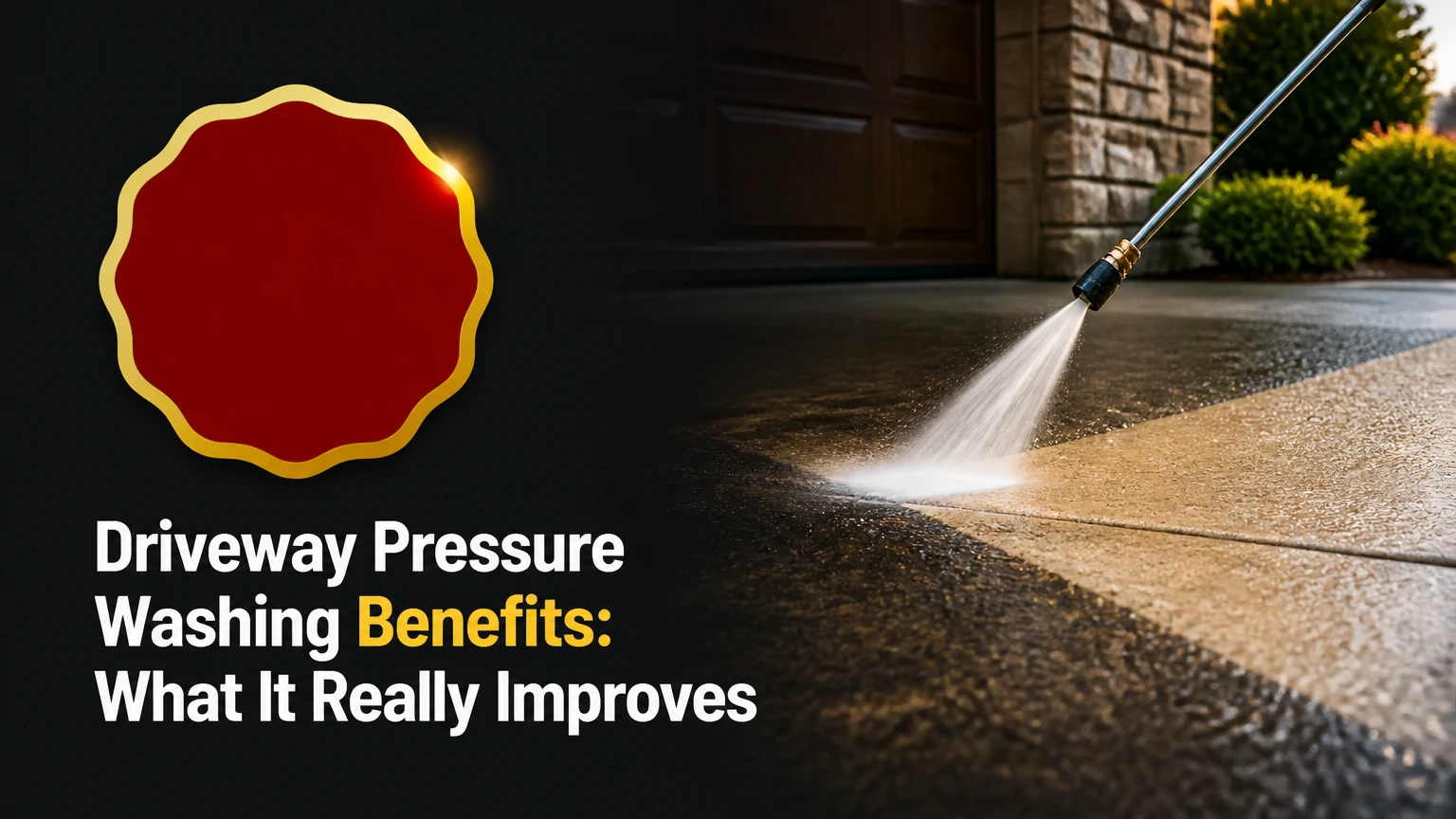
Driveway pressure washing benefits include removing embedded dirt, algae, mildew, mud, and some oil residue while improving appearance, traction, and the visibility of surface defects. Pressure washing can extend maintenance intervals, but it cannot repair structural cracks, replace eroded asphalt binder, or remove every stain without appropriate chemicals, heat, or surface treatment.
Key Facts
Pressure washing cleans a driveway; it does not restore failed concrete, cracked asphalt, or unstable pavers.
Concrete commonly tolerates more pressure than asphalt or polymeric-jointed pavers, but the correct setting depends on surface condition and distance.
A 15-inch or larger surface cleaner usually produces a more uniform finish than a wand used in sweeping arcs.
Typical professional driveway cleaning costs about $150-$350 for roughly 400 square feet, excluding extensive stain treatment or sealing.
Oil, rust, paint, and organic growth require different treatments; higher PSI alone is not a universal solution.
Sealer should be applied only after the surface is clean, fully dry, and suitable for sealing.
What Are Driveway Pressure Washing Benefits?
The main driveway pressure washing benefits are improved appearance, reduced organic growth, better surface inspection, and removal of slippery deposits. Cleaning also removes contaminants that can hold moisture against concrete, obscure cracks, and make an otherwise maintained home look neglected.
The value is highest when grime is superficial but extensive. A dirty concrete driveway may have intact slabs beneath dark traffic lanes, algae, tire marks, and leaf tannins. A controlled cleaning process can reveal the original condition without the cost of replacement.
Appearance and curb appeal
Pressure washing removes gray traffic film, green algae, muddy deposits, and darkened organic staining from many hard driveway surfaces. The visual improvement is often immediate because light-colored concrete reflects more light after residue leaves its pores and texture.
Cleaning does not guarantee a uniform new color. Concrete may have aged unevenly, and areas protected beneath vehicles may remain lighter than exposed sections. A professional should test a small inconspicuous area before promising a consistent finish.
Slip resistance and safer walking
Algae, mildew, and decomposing leaves can create a slick film, especially where shade and irrigation keep the driveway damp. Removing that film improves the traction of footwear and tires, although pressure washing cannot correct a polished concrete finish, steep grade, poor drainage, or ice formation.
A clean surface is not automatically slip-proof. Drainage and slope still control how quickly water disappears.
Earlier detection of damage
A clean driveway makes settlement, spalling, open joints, oil saturation, and widening cracks easier to see. That inspection benefit can prevent a homeowner from sealing over a defect or overlooking water movement near the garage.
Pressure washing may expose damage rather than cause it. Weak concrete can lose loose paste or aggregate during cleaning, revealing deterioration that was already present.
Contaminant and maintenance control
Removing organic debris reduces the food and moisture available for recurring algae and mildew. Cleaning also removes grit that can migrate into joints and drainage channels, although biological growth returns when shade, water, and nutrients remain unchanged.
Pressure washing is maintenance, not permanent biological control. Improving gutter discharge, trimming vegetation, and repairing irrigation overspray often produces a longer-lasting result than washing alone.
How Does Driveway Pressure Washing Work?
A pressure washer combines pump pressure, water flow, nozzle geometry, and movement speed to deliver mechanical cleaning energy. Detergents loosen soils and oils, while dwell time gives chemistry an opportunity to work before rinsing removes the suspended residue.
PSI describes pressure, while GPM describes water volume. A machine rated at 3,000 PSI may not deliver that pressure at the nozzle under real operating conditions, and excessive pressure with low flow can damage a surface while cleaning slowly.
Mechanical action
A narrow spray concentrates water energy over a small area. That energy can break the bond between dirt and the substrate, but the same concentration can etch concrete, remove asphalt binder, dislodge joint sand, or scar a previously sealed finish.
Movement controls exposure. Keeping the nozzle moving, maintaining a consistent distance, and overlapping passes prevents isolated impact marks.
Chemical action
Concrete detergent, alkaline degreaser, surfactant, or an appropriate biological treatment can loosen contamination before rinsing. Chemical selection must match the stain and surface; a product that helps with oil may harm nearby plants, painted trim, metals, or asphalt.
Never combine cleaning chemicals casually. Follow the product label, use protective equipment, and prevent concentrated runoff from reaching storm drains or waterways.
Heat and power washing
Power washing usually refers to pressure washing with heated water. Heat can improve removal of grease, gum, and heavy petroleum residue, but hot water is not automatically better for every driveway.
Hot water requires specialist equipment and careful temperature control. Asphalt is particularly vulnerable because heat can soften its binder, while a previously applied coating may blister or soften.
Which Driveway Materials Can Be Pressure Washed?
Concrete, asphalt, brick, and concrete pavers can often be cleaned, but each material has a different tolerance for pressure, heat, chemicals, and water intrusion. Surface age, existing damage, joint condition, coatings, and previous repairs matter as much as the nominal material type.
| Surface | Typical working approach | Main risk | Better treatment choice |
|---|---|---|---|
| Cured concrete | 2,000-3,000 PSI, 2.5-4 GPM, surface cleaner | Etching, spalling, exposed aggregate | Neutral or alkaline cleaner, controlled rinse |
| Asphalt | 800-1,500 PSI, wide spray, cool water | Binder loss, loose aggregate | Low-pressure detergent and gentle rinse |
| Brick | 500-1,500 PSI, 25-40 degree spray | Mortar erosion, brick-face damage | Low-pressure wash with masonry-safe cleaner |
| Concrete pavers | 800-2,000 PSI, wide spray | Joint-sand displacement | Gentle cleaning, joint restoration afterward |
| Natural stone | 500-1,200 PSI, test area first | Surface erosion, color change | Stone-specific cleaner and low pressure |
| Coated concrete | Manufacturer-approved setting | Peeling, whitening, coating failure | Soft wash or coating-safe cleaner |
Concrete driveway considerations
Sound, fully cured concrete generally permits the broadest pressure range, but 2,500-3,000 PSI is not a mandatory target. A neglected or weak slab may clean safely at a lower setting, especially when detergent and a surface cleaner do most of the work.
New concrete should normally cure for at least 28 days before routine pressure washing. The concrete contractor’s specification controls when admixtures, sealers, decorative finishes, or unusual weather conditions are involved.
Asphalt driveway considerations
Asphalt needs a gentler process than concrete. High pressure can strip fine aggregate and petroleum binder from the surface, producing loose stone, pale patches, or accelerated raveling.
Use cool water, a wide spray pattern, and low pressure. If the asphalt is already cracked, brittle, or losing aggregate, cleaning should wait until a paving professional evaluates whether repair is necessary.
Pavers, brick, and joints
Pavers and brick can tolerate cleaning, but their joints often cannot tolerate concentrated spray. A narrow nozzle can remove polymeric sand, wash out ordinary joint sand, and create spaces where weeds or water infiltration become more likely.
A contractor should inspect joint stability first. Re-sanding and compaction may be required after cleaning, particularly when the surface cleaner exposes hollow or eroded joints.
What Equipment and Settings Produce a Safe Result?
A surface cleaner, suitable detergent, controlled spray tip, and adequate water supply produce more reliable results than maximum advertised PSI. Equipment must be selected for the substrate and stain, not simply for speed or power.
| Equipment or setting | Typical value | Appropriate use | Important limitation |
|---|---|---|---|
| Electric pressure washer | 1,500-2,300 PSI, 1.5-2.3 GPM | Small residential concrete areas | Slower cleaning and limited recovery |
| Gas pressure washer | 2,500-4,000 PSI, 3-5.5 GPM | Large or heavily soiled driveways | More noise, fuel, and handling risk |
| Surface cleaner | 15-20 inches | Flat concrete and paver areas | Must match machine flow |
| Green nozzle | 25 degrees | General edges and controlled cleaning | Can etch if held too close |
| White nozzle | 40 degrees | Rinsing and sensitive surfaces | May lack stain-cutting power |
| Black nozzle | Low pressure | Detergent application | Not a high-pressure cleaning tip |
| Red nozzle | 0 degrees | Specialist hard-surface work only | Unsafe for routine driveway cleaning |
Nozzle colors are common industry conventions, not a universal substitute for testing. A green 25-degree tip can still damage concrete when held close, used on a weak surface, or left stationary.
A surface cleaner should be compatible with the washer’s GPM. An attachment designed for 4 GPM may rotate poorly on a 1.5 GPM electric machine, leaving uneven cleaning and forcing the operator to compensate with unsafe wand work.
How Do You Pressure Wash a Driveway Safely?
A safe driveway cleaning job follows preparation, stain treatment, controlled washing, rinsing, and inspection. A typical 400-square-foot driveway takes a homeowner about 3-5 hours including setup and cleanup, while an experienced technician may complete the washing portion in 45-90 minutes.
Before starting
Remove vehicles, toys, bins, furniture, and loose debris. Locate electrical connections, nearby doors, garage thresholds, drainage paths, irrigation heads, and fragile plants before introducing water or detergent.
Wear eye protection, hearing protection near gas equipment, long trousers, gloves suited to the chemical, and closed-toe slip-resistant footwear. Never point a pressure washer at skin, animals, people, or electrical equipment.
Step 1: Protect surroundings and manage runoff
Pre-wet nearby vegetation with clean water and cover vulnerable plants when the product label permits covering. Block or redirect concentrated detergent runoff where local rules require it, and never assume that biodegradable detergent makes unrestricted storm-drain discharge acceptable.
Success checkpoint: Water flows toward an intended drainage area without entering a basement, garage, neighboring property, or untreated storm drain.
Common mistake: Starting at the street without checking where dirty water will collect.
Step 2: Sweep and pre-treat stains
Sweep sand, leaves, gravel, and loose dirt first. Apply a compatible detergent to the whole surface when organic growth is widespread, then spot-treat oil, rust, paint, or chewing gum with a product designed for that contaminant.
Allow about 5-15 minutes of dwell time unless the label specifies otherwise. Keep the chemical wet and agitate heavy spots with a stiff nylon brush.
Success checkpoint: Organic film softens, and oily spots lose their glossy appearance before washing begins.
Common mistake: Letting detergent dry into white residue or increasing pressure to compensate for inadequate dwell time.
Step 3: Wash with overlapping passes
Start at the garage end and work downhill in overlapping rows. Use a surface cleaner on flat areas, maintain a steady walking pace, and avoid stopping while the spray bar is rotating over one spot.
For edges and corners, use a wider spray first and increase intensity only after a test patch. Keep the nozzle distance consistent rather than chasing dark marks with sudden close passes.
Success checkpoint: The cleaned area has a consistent color without circular arcs, stripes, or exposed aggregate.
Common mistake: Using a wand like a broom. Arcing passes create zebra striping because distance and impact vary across each swing.
Step 4: Rinse thoroughly
Rinse detergent and suspended soil from the highest point toward the planned drainage zone. A 40-degree tip is often suitable for rinsing, but the operator should maintain a safe distance and adjust for the material.
Flush joints, edges, garage thresholds, and low spots without forcing water beneath slabs or into buildings. Stop if water begins entering a crack, wall opening, or poorly sealed threshold.
Success checkpoint: No visible foam or dirty tide line remains after the surface settles.
Common mistake: Rinsing too quickly, leaving detergent that dries into a film and attracts fresh soil.
Step 5: Inspect, dry, and decide on sealing
Let the driveway dry before judging the final color or applying a sealer. Drying commonly takes 24-48 hours, depending on weather, shade, humidity, porosity, and drainage.
Inspect for remaining stains, loose aggregate, open cracks, joint loss, and coating failure. Apply sealer only when the product permits the substrate, the moisture level meets its instructions, and repairs are complete.
Success checkpoint: The surface is dry, evenly clean, and free of residue or active defects that the sealer would trap.
Common mistake: Sealing damp concrete. Trapped moisture can cause whitening, poor adhesion, blistering, or premature failure.
How Much Does Driveway Pressure Washing Cost?
Typical professional driveway cleaning costs $150-$350 for about 400 square feet, or approximately $0.25-$0.70 per square foot before difficult-stain treatment and sealing. DIY rental commonly costs $75-$125 per day, with another $20-$40 for detergent and possible fees for transport or surface-cleaner attachments.
| Service scenario | Typical price | Typical duration | Cost drivers |
|---|---|---|---|
| Small DIY electric job | $35-$90 supplies | 2-4 hours | Existing washer, detergent, hose access |
| Gas washer rental | $75-$125 per day | 3-5 hours | Rental, fuel, transport, attachment |
| Standard professional cleaning | $150-$350 | 45-90 minutes | Area, access, soil level, local labor |
| Heavy oil or rust treatment | $250-$600 | 1.5-3 hours | Poultice, degreaser, repeat treatment |
| Cleaning plus sealer | $400-$800 | 1-2 days total | Sealer type, drying time, preparation |
| Large or commercial driveway | $0.20-$0.60 per sq. ft. | 1-4 hours | Volume, water recovery, scheduling |
Prices vary by region and minimum service charge. A narrow 150-square-foot driveway may cost more per square foot than a 1,000-square-foot area because setup, travel, and equipment costs remain similar.
Sealing adds value only when the substrate is suitable and the product matches the surface. A sealer cannot rebuild damaged concrete, stabilize loose asphalt, or hide oil that remains active beneath the surface.
Is DIY Cleaning Better Than Hiring a Professional?
DIY cleaning costs less when the homeowner already owns compatible equipment and the driveway is small, sound, and lightly soiled. Professional service becomes more defensible when the area is large, the surface is fragile, the stains are chemical, or runoff and equipment handling create meaningful risk.
| Decision factor | DIY homeowner | Professional contractor | Practical winner |
|---|---|---|---|
| Upfront cost | $55-$165 typical | $150-$350 typical | DIY |
| 400 sq. ft. labor time | 3-5 hours | 45-90 minutes | Professional |
| Surface consistency | Variable | Surface cleaner and trained passes | Professional |
| Oil-stain capability | Limited cold-water treatment | Degreaser, hot water, poultice options | Professional |
| Damage risk | Operator-dependent | Lower with experience and insurance | Professional |
| Scheduling control | Immediate | Appointment required | DIY |
| Runoff management | Homeowner responsibility | Contractor-specific procedures | Depends on provider |
Ask a contractor whether the quote includes pretreatment, edge cleaning, runoff management, sealing, and repairs to displaced joint sand. Verify that the provider carries liability insurance, identifies the driveway material, and performs a test patch.
A low quote may omit chemical treatment or define cleaning as a quick wand rinse. Those omissions explain why two apparently similar estimates can differ substantially.
Can Pressure Washing Remove Every Driveway Stain?
Pressure washing removes loose and surface-level contamination, but it cannot remove every stain because some discoloration is chemical, mineral, or structural. Oil that has penetrated deeply, rust from reinforcing steel, tannin discoloration, paint, and efflorescence require diagnosis before treatment.
| Stain | Likely cause | Recommended first treatment | Expected limitation |
|---|---|---|---|
| Green or black film | Algae, mildew, lichen | Biocidal or compatible detergent, dwell time | Regrowth if shade and moisture remain |
| Dark oil spot | Petroleum absorption | Absorbent, degreaser, or poultice | May leave a shadow after repeat treatment |
| Orange rust | Iron deposits or reinforcing steel | Acid-compatible masonry treatment | Structural rust may return |
| Brown leaf marks | Tannins from organic debris | Detergent or labeled oxidizer | Porous concrete may retain color |
| White haze | Efflorescence or salt | Dry brushing, water management | Source moisture must be corrected |
| Paint | Coating spill or overspray | Product-specific remover and low-pressure test | Removal may alter the substrate |
| Tire marks | Rubber transfer and heat | Degreaser, agitation, controlled rinse | Hot tires can create persistent deposits |
Hot water can improve grease removal, but heat is not a safe shortcut for asphalt or coated surfaces. When a stain does not respond to a compatible chemical and controlled rinse, more pressure often increases damage without materially improving color.
When Is Soft Washing or Scrubbing Better?
Soft washing is preferable for fragile coatings, biological growth near delicate landscaping, and surfaces that cannot tolerate concentrated impact. Manual scrubbing or a low-pressure chemical treatment may be better than pressure washing for small stains, painted concrete, old brick, and deteriorated asphalt.
Pressure washing remains efficient on sound, flat concrete with broad soil coverage. The correct method depends on the contaminant and substrate rather than the label attached to the machine.
Choose pressure washing when
- The surface is sound, flat, and hard.
- Mud, loose dirt, algae, and traffic film cover a broad area.
- A surface cleaner can maintain even pressure.
- Drainage and runoff can be controlled.
- A test patch shows no etching, coating failure, or aggregate loss.
Choose a gentler method when
- Asphalt is soft, raveling, or newly installed.
- Brick mortar is weak or visibly eroded.
- Paver joints are loose.
- A decorative coating is peeling.
- The stain is small enough for targeted hand treatment.
- The driveway drains directly into a sensitive waterway.
What Problems Can Pressure Washing Cause?
Pressure washing can etch concrete, strip asphalt binder, remove joint sand, damage coatings, injure plants, and force water into buildings when the operator uses excessive pressure or unsuitable chemicals. Damage is more likely when a person chases isolated stains with a narrow nozzle instead of correcting pretreatment or dwell time.
Common failure modes include:
- Concrete zebra striping: Wand speed and distance change across overlapping arcs. A surface cleaner and deliberate rows usually provide a more even finish.
- Etched or pitted concrete: A 0-degree tip, close standoff, or stationary spray removes cement paste. Stop immediately and assess the damaged area.
- Loose asphalt aggregate: Excess pressure or heat removes binder. Reduce pressure, widen the spray, and avoid hot-water equipment.
- Displaced paver sand: Concentrated spray excavates joints. Refill with compatible joint material only after the surface dries.
- Plant injury: Concentrated detergent runoff burns foliage. Pre-wet plants, shield them where appropriate, and rinse according to the product label.
- Water intrusion: Spray enters garage thresholds, cracks, vents, or wall interfaces. Change direction and use less water near vulnerable openings.
A practitioner rule is to remove contamination with chemistry and flow before increasing pressure. Pressure is the least forgiving control because the damage can occur before the operator sees it.
How Should You Maintain a Clean Driveway?
Most residential driveways benefit from inspection and light maintenance every six to twelve months, with professional pressure cleaning commonly scheduled every one to three years. The correct interval depends on shade, rainfall, irrigation, vehicle leakage, tree cover, traffic, and the presence of a sealer.
Sweep leaves and grit regularly, correct downspout discharge, repair irrigation overspray, and absorb fresh oil before it spreads. Cleaning a small spill promptly is safer than repeatedly attacking an old stain with aggressive pressure.
Penetrating silane or siloxane sealers may help suitable concrete resist water and chloride intrusion, while acrylic sealers can alter color and sheen. Product choice, surface moisture, application temperature, and manufacturer instructions determine performance.
Sealer is not a substitute for drainage repair. If water repeatedly crosses the driveway or pools beside the foundation, correct the water path before paying for a protective coating.
What Should You Check Before Hiring a Contractor?
A reliable contractor should identify the surface, explain the planned pressure and chemical approach, describe runoff handling, and provide a written scope. The contractor should also distinguish cleaning from sealing, stain treatment, joint restoration, crack repair, and asphalt maintenance.
Ask these questions:
- What pressure and flow will you use on my material?
- Will you use a surface cleaner on the main area?
- Which chemical will treat oil, algae, rust, or paint?
- How will you protect plants, siding, garage doors, and drains?
- Does the quote include edges, pretreatment, and final rinsing?
- What happens if cleaning reveals spalling or loose aggregate?
- Is liability insurance current?
- When can the driveway be sealed or driven on?
Do not select a provider solely by advertised PSI. A higher rating can indicate greater risk, while cleaning performance depends heavily on GPM, nozzle choice, surface contact, chemical dwell time, and operator control.
FAQ
How often should a driveway be pressure washed?
A typical residential driveway needs pressure washing every one to three years, while shaded or damp driveways may need attention annually. Regular sweeping, corrected drainage, and prompt oil cleanup can extend the interval. Cleaning should respond to visible organic growth, slippery film, and accumulated soil rather than an inflexible calendar.
Does pressure washing increase a home’s value?
Pressure washing can improve presentation and perceived maintenance before a sale, but no universal dollar increase should be promised. Clean paving improves photographs, removes distracting stains, and reveals defects for disclosure. Buyers may still discount a property for cracked slabs, drainage problems, failing asphalt, or extensive replacement needs.
Can I pressure wash a driveway with a garden hose?
A garden hose can rinse loose dust and fresh mud, but it usually lacks the mechanical energy needed for embedded algae, traffic film, and oil residue. A hose-end nozzle may help with light maintenance, while a pressure washer or professional cleaning is more effective for broad, established contamination.
How long after pressure washing can I drive on concrete?
Many driveways can accept vehicle traffic after the surface has visibly dried, often within 24 hours in warm, dry weather. Sealed or chemically treated surfaces may require longer. Follow the sealer label, keep vehicles away while the surface is damp, and avoid judging final appearance until drying is complete.
Should cracks be repaired before pressure washing?
Open cracks should be inspected before cleaning because water can enter beneath slabs or expose unstable edges. Minor repairs may occur after washing, once the crack is clean and dry. Structural movement, settlement, wide separation, and recurring water infiltration require repair assessment rather than cosmetic filling alone.
Is pressure washing environmentally friendly?
Pressure washing can use less water than an unrestricted garden hose, but environmental performance depends on flow rate, detergent selection, and runoff capture. Dirty water containing oil, sediment, or chemicals should not be allowed to enter storm drains untreated. Local stormwater rules and product labels determine the acceptable disposal method.
The Bottom Line
The strongest driveway pressure washing benefits are cleaner appearance, reduced slippery organic film, improved inspection, and easier ongoing maintenance. Pressure washing is worthwhile when the driveway is structurally sound and the method matches its material.
Concrete generally offers the widest cleaning margin, while asphalt, brick, pavers, coatings, and natural stone need lower-impact methods. Use pretreatment before pressure, a surface cleaner for broad flat areas, controlled runoff, and adequate drying time before sealing. Cleaning can restore a neglected surface, but it cannot replace repairs, correct drainage, or reverse material failure.