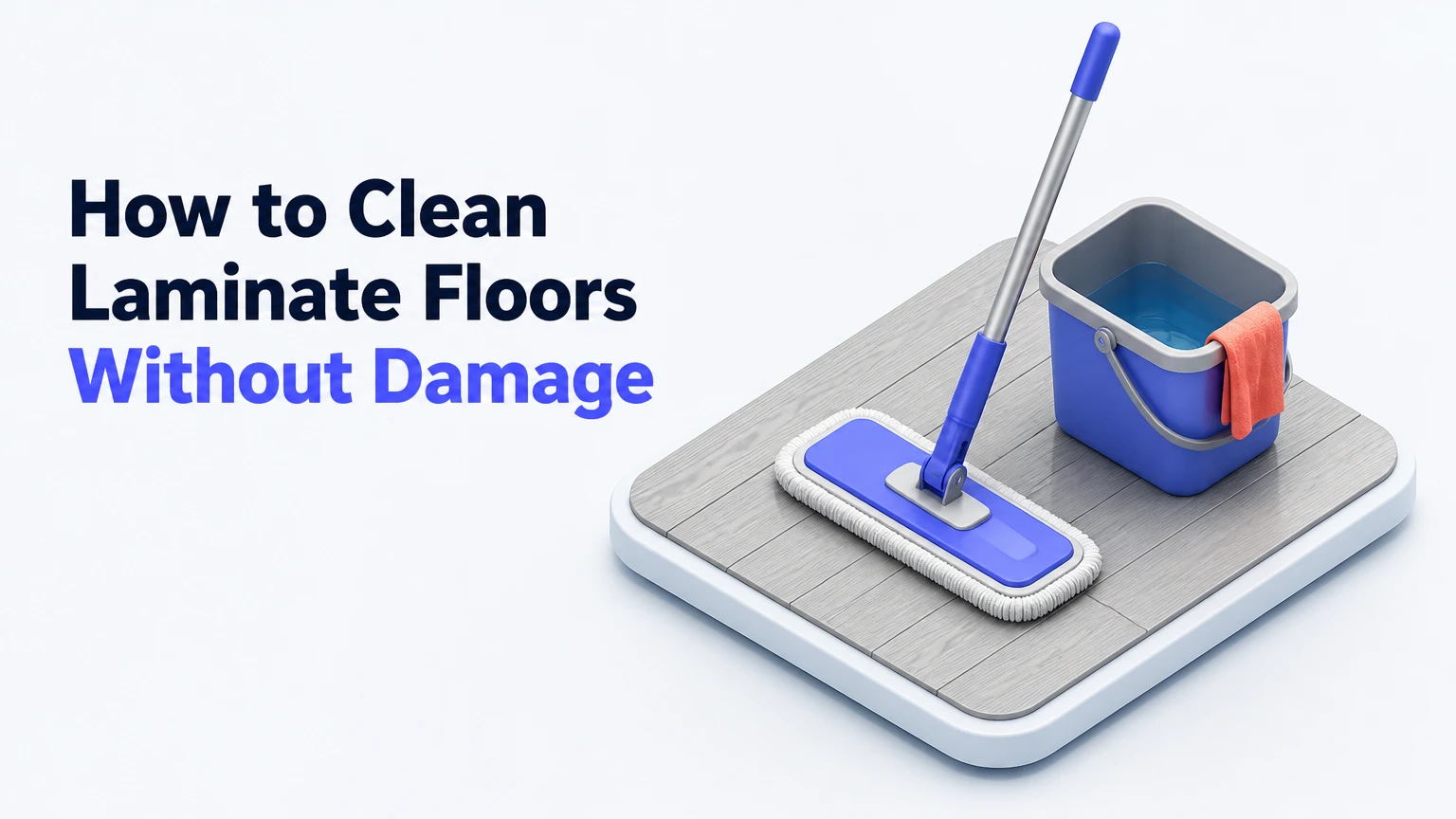
To clean laminate floors safely, remove dry grit first, blot spills immediately, then damp-mop with a nearly dry microfiber pad and a laminate-safe cleaner. The complete routine takes about 15-20 minutes for a 300-square-foot room, and moisture control matters more than scrubbing strength because water can swell the fiberboard core.
Key Facts at a Glance
Laminate floors should be cleaned with dry or lightly damp methods, never a saturated mop.
A soft-bristle broom or hard-floor vacuum removes grit that can scratch the wear layer.
Spills should be blotted immediately, especially along plank joints and exposed edges.
A pH-neutral laminate cleaner is the safest routine choice when the flooring manufacturer permits it.
Steam mops, wax, oil, abrasive pads, bleach, and ammonia can damage the finish or leave residue.
Water-resistant laminate may tolerate more exposure, but water-resistant does not automatically mean waterproof.
Why Laminate Needs Low-Moisture Cleaning
Laminate flooring has a wear layer, decorative image layer, high-density fiberboard core, and backing layer. The wear layer resists ordinary abrasion, while the HDF core provides stiffness; however, the core can swell when water reaches unfinished plank edges or locking joints.
The top surface may look similar to sealed wood, but laminate does not behave like a refinishable hardwood floor. Laminate cannot be sanded and recoated after a deep scratch, and soaked boards usually require replacement rather than restoration.
Water travels through seams by capillary action. Once moisture reaches the HDF core, swollen edges may create peaking, open joints, bubbling, or buckling. Chemical damage can also weaken the bond between laminate layers, a condition called delamination.
The practical rule is simple: use enough liquid to collect soil, but not enough to leave a wet trail behind the mop. The National Wood Flooring Association gives a similar principle for wood-based floors: “Never wet-mop a wood floor,” because excess water can damage the surface and structure. Laminate is not solid wood, but its moisture-sensitive fiberboard core requires the same caution.
Is water-resistant laminate safe to wet-mop?
Water-resistant laminate is more tolerant of short-term moisture than standard laminate, but it is not permission to flood the floor. Product performance depends on the plank construction, joint design, installation quality, perimeter sealing, and the manufacturer’s tested exposure period.
Some products advertise protection against surface spills lasting 24 hours or longer. That protection generally assumes correctly installed boards and does not cover standing water entering unsealed edges, damaged joints, or moisture beneath the floor.
Check the installation guide before using a spray mop, robot mop, vinegar solution, or disinfectant. The flooring warranty is the controlling source, not the product category printed on a retail box.
What Should You Prepare Before Cleaning?
A basic laminate floor cleaning kit costs about $20-$40 and needs one flat microfiber mop, two washable microfiber pads, a soft brush or hard-floor vacuum, a spray bottle, and a manufacturer-approved cleaner. Remove loose furniture, check the floor for lifted edges, and test any unfamiliar solution in a hidden area first.
Before You Start
| Requirement | Typical specification | Why it matters |
|---|---|---|
| Cleaning time | 15-20 minutes per 300 sq. ft. | Includes damp mopping and drying |
| Routine cost | $20-$40 initial kit | Covers mop, pads, and cleaner |
| Mop pad | Flat microfiber, machine washable | Controls moisture and traps fine soil |
| Cleaner amount | 2-4 light sprays per 10 sq. ft. | Limits liquid at plank joints |
| Drying time | 2-5 minutes after each section | Removes visible moisture before seepage |
| Floor condition | No active leak or standing water | Cleaning cannot correct structural moisture |
Use a clean pad rather than trying to make one dirty pad cover the entire floor. Grit embedded in microfiber can drag across the wear layer, and excess cleaner in a heavily soiled pad can redistribute film instead of removing it.
Do not mix cleaning chemicals. In particular, never combine vinegar with bleach, ammonia, or chlorine-containing disinfectants. Chemical mixtures can produce hazardous gases or corrosive solutions.
How to Clean Laminate Floors Step by Step
The safest sequence has four stages: remove loose debris, blot spills, treat spots, and damp-mop small sections. Work from the cleanest area toward the dirtiest area, keep liquid off the seams whenever possible, and dry any visible moisture before moving on.
Step 1: Remove Dry Dirt and Grit
Sweep the entire floor with a soft-bristle broom or vacuum it in hard-floor mode with the rotating brush turned off. Pay special attention to entryways, kitchen work zones, chair paths, and the narrow gap beneath cabinet fronts, where abrasive grit accumulates.
Vacuum first if sand, pet litter, or tracked-in salt is present. A vacuum’s suction removes particles from bevels and joints more effectively than a broom, provided the vacuum head has no exposed metal edge and the brush roll is disabled.
Move lightweight rugs and inspect their undersides before replacing them. Small stones trapped beneath a rug can scratch a concentrated path across the floor as people walk over it.
You will know Step 1 worked when: the floor feels smooth under a clean, dry hand and no visible grit remains along plank edges.
Common mistake: using a vacuum’s powered carpet brush. A rotating brush can scatter grit and create repeated abrasion on a textured laminate surface.
Step 2: Blot Spills Immediately
Place a dry microfiber cloth over milk, water, juice, grease, or pet urine and press downward rather than wiping outward. Fold the cloth to a dry section, remove the remaining film with a lightly damp corner, then dry the area completely.
For a spill near a seam, use a dry cotton swab or the corner of a folded cloth to draw liquid away from the joint. Do not allow pet urine or sugary drinks to remain while you search for supplies, because liquid can migrate beneath the edge of a plank.
Pet accidents require odor removal as well as surface cleaning. After blotting, use a small amount of a laminate-compatible enzymatic cleaner only if the flooring and cleaner manufacturers permit it. Apply the product to the cloth, not directly onto the floor, and prevent liquid from entering seams.
You will know Step 2 worked when: the area has no visible wetness, tackiness, or odor and the plank joints remain flat.
Common mistake: spraying a large puddle over the spill. More product does not improve cleaning when the core is vulnerable to moisture.
Step 3: Treat Stains and Sticky Spots
Identify the stain before choosing a solvent. Use a barely damp microfiber cloth with a drop of laminate cleaner for ordinary food residue, while dried glue, ink, oil, nail polish, and rubber marks may need a targeted solvent applied to the cloth.
| Stain or residue | First treatment | Escalation | Stop condition |
|---|---|---|---|
| Dried food | Warm water on microfiber | Laminate cleaner on cloth | Surface no longer feels tacky |
| Grease or oil | pH-neutral cleaner | Small amount of isopropyl alcohol | Film disappears without rubbing |
| Ink | Isopropyl alcohol on cotton swab | Repeat once after drying | Color transfers to cloth |
| Nail polish | Acetone on cotton swab | Manufacturer-approved spot product | Finish changes or gloss shifts |
| Candle wax | Harden with ice in a bag | Lift with plastic card | No scraping pressure remains |
| Rubber scuff | Dry microfiber rubbing | Tiny alcohol application | Mark fades without abrasion |
| Construction adhesive | Plastic scraper at low angle | Flooring repair specialist | Plank surface begins to lift |
Test acetone and alcohol in an inconspicuous location. Solvents can remove or soften printed details, alter gloss, or affect a damaged wear layer even when the surrounding laminate is chemically resistant.
Never use a razor blade, steel wool, melamine sponge, or abrasive powder. A stain is usually less visible than the broad dull patch created by aggressive scrubbing.
You will know Step 3 worked when: the residue is gone and the treated patch matches the surrounding sheen under side lighting.
Common mistake: rubbing a stain with a stiff brush. Laminate’s clear wear layer can become permanently hazy before the stain is removed.
Step 4: Damp-Mop in Small Sections
Spray a laminate-safe cleaner lightly onto a flat microfiber pad, or apply a controlled mist in a section no larger than 20-30 square feet. Mop along the plank length using overlapping passes, then inspect the area before applying more solution.
A pad should feel damp, not wet. If squeezing the pad produces drops, wring it again. Replace or rinse the pad when it becomes visibly dirty, because a saturated pad leaves more water and soil behind.
Use a dry microfiber pad after each section if the room is humid, the planks have beveled edges, or moisture remains visible for more than a minute. Do not push liquid toward walls, thresholds, floor vents, or damaged joints.
You will know Step 4 worked when: the floor looks clean without cloudy trails, feels dry underfoot, and no moisture remains at the seams.
Common mistake: cleaning with a bucket of cloudy water. Repeatedly dipping a mop into dirty water spreads grit and increases the amount of liquid deposited on the floor.
Which Mop and Cleaner Should You Use?
A flat microfiber mop or controlled spray mop is the best choice for most laminate floors because both tools limit water. A spin mop can work when thoroughly wrung, but traditional string mops and steam mops create avoidable moisture and heat risks.
Mop comparison
| Mop type | Typical price | Moisture control | Best application |
|---|---|---|---|
| Flat microfiber mop | $12-$30 | High, pad misted manually | Weekly maintenance and spot work |
| Spray mop | $25-$60 | High, metered trigger spray | Fast routine cleaning |
| Spin mop | $25-$50 | Medium, depends on wringing | Larger rooms with careful technique |
| String mop | $10-$25 | Low, retains excess water | Not recommended for laminate |
| Robot mop | $200-$1,000 | Variable, software-controlled | Frequent light maintenance on open plans |
Cleaner comparison
| Cleaner | Typical dilution or use | Residue risk | Appropriate use |
|---|---|---|---|
| Manufacturer cleaner | Follow product label | Low when correctly dosed | Safest warranty-aligned option |
| pH-neutral laminate cleaner | Usually ready to use | Low | Routine damp mopping |
| White vinegar | Maximum 1 cup per gallon of water | Medium if overused | Occasional film removal, only if permitted |
| Isopropyl alcohol | Small amount on cloth or approved dilution | Low, evaporates quickly | Grease, ink, and sticky residue |
| Dish soap | One drop in a full bucket | High if overdosed | Rare spot treatment, not routine mopping |
Vinegar is not automatically harmless because it is familiar or inexpensive. Its acidity can gradually affect some finishes, and concentrated vinegar leaves a stronger odor and a greater risk of surface dulling. Manufacturer instructions take priority over generic recipes.
Dish soap has a different problem: surfactant residue. Even a small excess can leave a cloudy film that attracts more dust, making the floor appear dirty soon after cleaning.
How Often Should Laminate Floors Be Cleaned?
Most laminate floors need dry debris removal two or three times per week, immediate spill treatment, and damp mopping every one to two weeks. Increase dry cleaning in homes with pets, children, outdoor access, or renovation dust, but do not increase water exposure simply because traffic is heavy.
| Task | Typical frequency | Time for 300 sq. ft. | Main purpose |
|---|---|---|---|
| Entryway debris removal | Daily | 2-5 minutes | Prevents grit from spreading |
| Whole-floor vacuuming | 2-3 times weekly | 5-10 minutes | Removes abrasive particles |
| Spill treatment | Immediately | 1-3 minutes | Prevents seam penetration |
| Spot cleaning | As needed | 2-5 minutes | Removes localized residue |
| Damp mopping | Every 1-2 weeks | 15-20 minutes | Removes bonded soil and film |
| Under-furniture cleaning | Every 1-3 months | 20-40 minutes | Removes hidden grit and hair |
High traffic changes the amount of dry soil, not the flooring’s tolerance for water. A busy household is usually better served by more frequent vacuuming and smaller spot treatments.
Wash microfiber pads without fabric softener. Fabric softener can coat fibers, reduce soil pickup, and transfer a residue during the next cleaning cycle.
What Should You Avoid?
Avoid steam mops, soaking-wet mops, wax, polish, oil, abrasive scrubbers, bleach, ammonia, and powder cleaners on laminate unless the flooring manufacturer explicitly approves a specific product. These methods either introduce excess moisture, leave a difficult film, or attack the decorative and protective layers.
Common failure modes
- Steam cleaning: Heat and pressurized moisture can enter joints and damage the HDF core. A warranty may exclude steam-related swelling even when a retail cleaner advertises steam use for hard floors.
- Wax or polish buildup: Laminate has a sealed, non-porous surface and cannot absorb wood oil or wax. The product remains on top, creating tackiness, footprints, and a dull layer that traps soil.
- Bleach or ammonia: Strong chemicals can discolor the image layer or degrade the finish. Disinfectant claims do not override flooring compatibility.
- Abrasive scrubbing: Steel wool, scouring pads, stiff brushes, and abrasive powders create fine scratches that scatter light and appear as permanent haze.
- Excess detergent: Soap residue produces streaks and attracts dust. If a product requires rinsing, do not use it unless you can remove rinse water safely and dry the floor immediately.
- Furniture dragging: Felt pads reduce sliding scratches, but they do not eliminate grit. Lift heavy furniture, use clean glides, and replace crushed felt protectors.
The counterintuitive rule is that a cleaner-looking mop can produce a dirtier floor. When a pad becomes saturated with soil and detergent, it redistributes both across the wear layer.
How Do You Remove Streaks and Cloudy Film?
Remove laminate streaks by stopping the soap or polish that caused them, vacuuming loose residue, and wiping small sections with a clean microfiber pad lightly dampened with the manufacturer’s cleaner. A small amount of isopropyl alcohol on a cloth can help dissolve greasy film, but test first and never flood the floor.
Start with the least aggressive method. Use clean water sparingly if the product label permits it, then make a second pass with a dry pad. Do not add more soap to a floor that already has visible detergent buildup.
If streaks appear only when sunlight crosses the room, inspect the cleaning pattern and pad condition. A dirty pad, excess spray, or overlapping wet passes can create optical variation without causing structural damage.
A persistent cloudy patch may be finish damage rather than residue. If the patch remains after two careful cleaning attempts, stop using solvents and consult the flooring manufacturer or an experienced flooring professional.
What If Laminate Boards Swell or Buckle?
Swollen or buckled laminate boards indicate moisture has reached the plank edges or subfloor and should be dried immediately, not scrubbed. Remove the water source, blot the surface, increase ventilation, and use a dehumidifier; minor moisture effects may stabilize, but permanently swollen HDF usually requires plank replacement.
Check nearby appliances, exterior doors, radiators, toilets, pet bowls, and washing machines. Moisture can come from below, so a dry-looking surface does not rule out a subfloor leak.
Do not force a buckled board flat with furniture. Pressure can break locking profiles and spread damage to adjacent planks. Photograph the affected area, record the source and timing of the water, and contact the installer or manufacturer if the floor is under warranty.
Damage assessment table
| Symptom | Likely cause | Immediate response | Usual outcome |
|---|---|---|---|
| Raised plank edges | Moisture at seams | Dry and dehumidify | May stabilize if recent |
| Open end joints | Expansion or wet core | Stop water and inspect perimeter | Repair or replacement possible |
| Bubbling surface | Delamination | Isolate area and stop scrubbing | Usually permanent |
| Broad buckling | Leak or inadequate expansion gap | Find moisture source | Professional assessment |
| Dark edge staining | Repeated liquid exposure | Dry, document, inspect subfloor | May require replacement |
| Mild musty odor | Moisture beneath boards | Ventilate and investigate | Source correction required |
Laminate damage is not the same as a dirty surface. Cleaning products cannot reverse swollen fiberboard, separated layers, or a broken locking mechanism.
How Do You Handle Special Situations?
Different households need different cleaning emphasis, but the moisture rule remains unchanged. Pet owners should prioritize immediate blotting, allergy-sensitive households should use unscented products and ventilation, and robot-mop users should select the lowest water setting that leaves no wet trail.
Pets and children
Place absorbent mats beneath water bowls, keep a dry cloth near food areas, and use felt protectors under dining chairs. Vacuum entryways more often because tracked grit causes more long-term abrasion than ordinary dust.
For a pet accident, blot first and use a compatible enzymatic product sparingly. Do not saturate the area in an attempt to remove odor from the subfloor.
Kitchens and entryways
Clean grease spots before they accumulate into a film. A cloth with a small amount of laminate cleaner or isopropyl alcohol can remove oil more safely than repeated detergent mopping.
Use exterior and interior doormats, but inspect the underside for trapped grit and moisture. Rubber-backed mats can hold moisture against some floors, so follow the flooring manufacturer’s mat guidance.
Robot vacuums and robot mops
A robot vacuum is generally useful for daily dry debris removal when its wheels and brush are clean and its hard-floor settings are enabled. A robot mop is acceptable only when its water output is low, its pad remains clean, and it does not leave damp tracks or park on a wet pad.
Keep the charging station off areas that repeatedly receive spills. Automation increases cleaning frequency, but it does not make laminate waterproof.
Recently installed flooring
Remove construction dust with a soft vacuum rather than immediately wet-mopping. Follow the installer’s curing, adhesive, and transition guidance, particularly where trim, sealant, or underlayment has recently been installed.
How Much Do Laminate Floor Cleaning Supplies Cost?
A functional laminate cleaning kit typically costs $20-$40, while a spray mop costs about $25-$60 and annual replacement supplies commonly total $15-$50. Costs vary by pad quality, cleaner concentration, room size, and whether a household already owns a suitable vacuum.
| Purchase | Typical price | Replacement interval | Cost-control choice |
|---|---|---|---|
| Flat microfiber mop | $12-$30 | 2-5 years | Replaceable-head model |
| Washable pad set | $8-$20 | 6-18 months | Buy four pads |
| Laminate cleaner | $6-$15 | 2-6 months | Use label dose |
| Spray mop | $25-$60 | 2-4 years | Refillable reservoir |
| Hard-floor vacuum | $80-$300 | 5-10 years | Use existing vacuum |
| Robot vacuum | $200-$800 | 3-6 years | Choose dry-only model |
The cheapest safe routine is a soft broom or existing hard-floor vacuum, washable microfiber pads, and a small amount of approved cleaner. Spending more on a machine does not compensate for excessive water or poor maintenance.
Expert Rules That Prevent Most Damage
Rule one: clean the entry path before the room. Removing grit at the doorway prevents the same abrasive particles from traveling across every plank.
Rule two: spray the pad when possible. Applying cleaner to microfiber gives better moisture control than spraying a large floor area, especially around seams and transitions.
Rule three: judge dryness at the joints, not the center of the plank. The broad surface may look dry while liquid remains in bevels, end joints, or beneath a furniture leg.
Rule four: use a clean pad sooner than expected. A pad that looks merely gray may already contain enough grit to create fine scratches under pressure.
Rule five: treat wear ratings correctly. AC3, AC4, and AC5 describe abrasion resistance and traffic suitability. They do not establish how much water the floor can withstand, and a high AC rating does not make standard laminate waterproof.
Frequently Asked Questions
Can you use a Swiffer on laminate floors?
A Swiffer-style flat mop can be used on laminate when the pad is dry or lightly damp and the cleaning solution is compatible with the flooring. Avoid leaving a wet disposable pad on the floor, spraying excessive liquid, or using a product that contains wax, oil, or strong solvents.
Can you use hot water on laminate flooring?
Use lukewarm water rather than hot water on laminate flooring. Heat does not improve ordinary soil removal and may increase evaporation unevenly, leaving detergent residue. The main hazard remains moisture entering joints, so apply water sparingly and dry visible moisture immediately.
Can you use baking soda to clean laminate floors?
Do not use loose baking soda as a routine laminate floor scrub. Baking soda is mildly abrasive and can create fine scratches or a powdery residue when rubbed into the wear layer. Use a laminate-safe cleaner for bonded soil and a microfiber cloth for localized marks.
How do you make laminate floors shine naturally?
Laminate floors should be made clean, not coated with oil, wax, or furniture polish. Vacuuming grit, removing residue with a correctly dosed cleaner, and drying with a clean microfiber pad usually restores the intended appearance without adding a film that later turns dull.
How long should laminate flooring last with proper care?
Laminate flooring commonly lasts about 15-25 years in residential use, but actual service life depends on product quality, installation, moisture exposure, traffic, and repairability. Routine dry debris removal and prompt spill treatment protect the wear layer, while swollen boards and deep surface damage usually cannot be refinished.
When should damaged laminate be replaced?
Replace laminate when boards remain swollen after thorough drying, the decorative layer has peeled, locking joints have broken, or water damage extends beneath multiple planks. A single lightly scratched board may be concealed with a color-matched repair kit, but structural damage requires plank replacement rather than more cleaning.
The Bottom Line
The safest answer to how to clean laminate floors is to remove grit frequently, blot spills immediately, treat stains with controlled spot applications, and damp-mop with a nearly dry microfiber pad. Keep steam, standing water, wax, oil, bleach, ammonia, and abrasive tools away from the floor, then dry the plank joints before moisture can reach the HDF core.