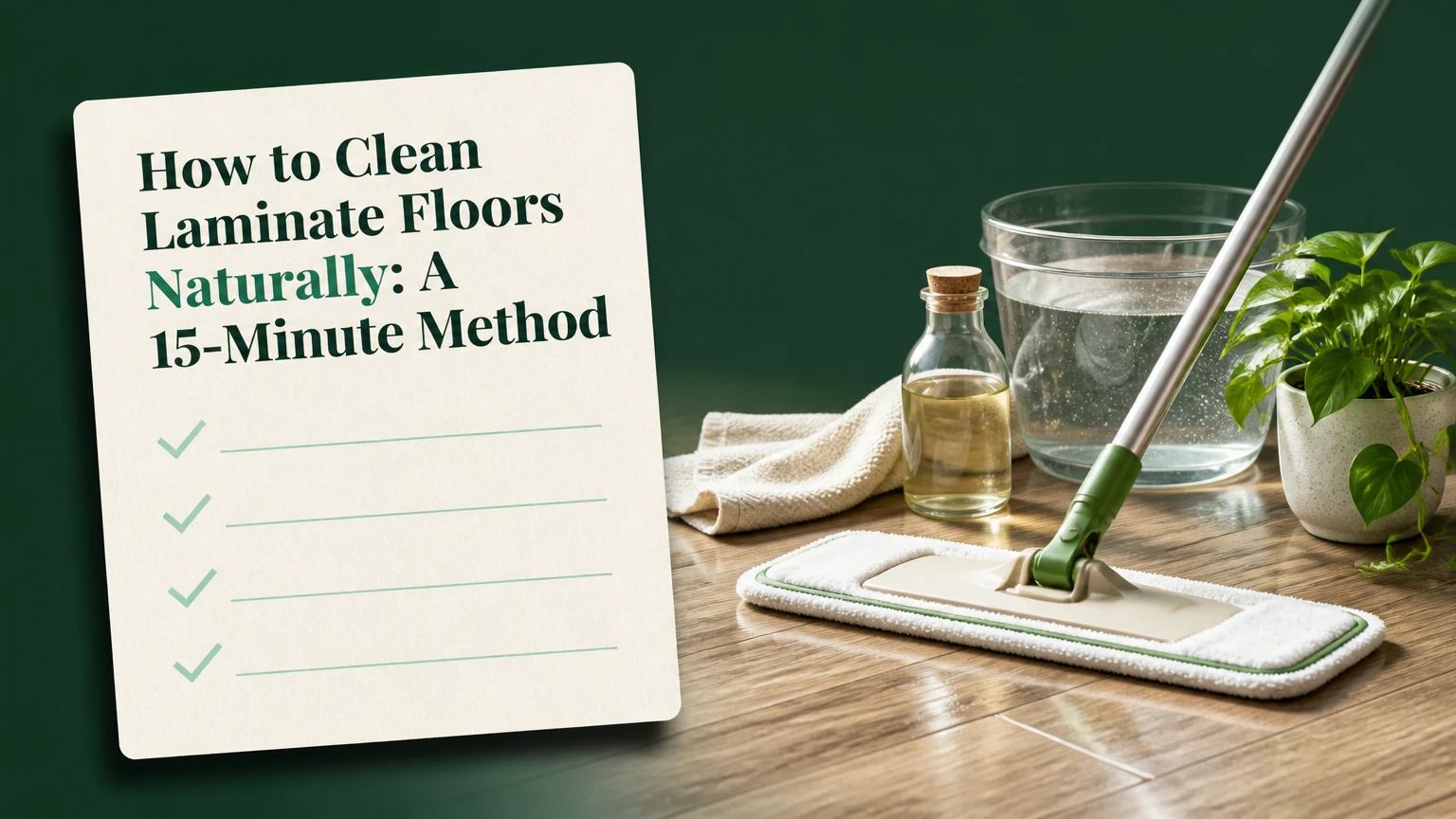
To clean laminate floors naturally, remove dry grit first, then wipe small sections with a barely damp microfiber pad and a mild solution such as distilled water or diluted vinegar. Keep moisture off the floor for under two minutes, dry each section immediately, and avoid steam, soaking, wax, oil, and abrasive tools that can damage the wear layer or swell the fiberboard core.
Key Facts at a Glance
- Laminate flooring has a resin wear layer over a printed décor layer and a moisture-sensitive fiberboard core.
- A microfiber pad should be damp, not wet enough to release droplets when squeezed.
- A practical routine uses 15-30 minutes for a typical 500-square-foot room.
- Use 1 part white vinegar to 10 parts water for occasional residue removal, not concentrated vinegar.
- Castile soap and vinegar should not be mixed because acid can reduce the soap’s cleaning performance and leave residue.
- Manufacturer care instructions take priority because some laminate products have water-resistant coatings or approved cleaning systems.
Why Does Laminate Flooring Need a Different Cleaning Method?
Laminate flooring needs low-moisture cleaning because its visible surface is more water-resistant than its plank edges and inner core. The top wear layer is usually melamine resin or a similar protective overlay, while the supporting high-density fiberboard can swell when water enters joints, damaged edges, or gaps.
The surface does not behave like unfinished wood. Laminate normally cannot be sanded and refinished after deep scratches, swelling, or delamination, so prevention matters more than aggressive cleaning.
The natural cleaning objective is simple: loosen soil without creating a second problem. Dry particles should be removed mechanically, oily films should be lifted with a small amount of surfactant, and the remaining moisture should be collected before it reaches a seam.
What Counts as a Natural Laminate Cleaner?
A natural laminate cleaner is a low-residue solution based on water, diluted white vinegar, plant-derived soap, or another ingredient with a clearly identified composition. “Natural” does not automatically mean safe, and concentrated acids, essential oils, and oily ingredients can still harm a floor or irritate pets.
The safest default is warm distilled water on a clean microfiber pad. Add a measured cleaning ingredient only when plain water cannot remove the soil. That approach reduces residue, limits chemical exposure, and makes it easier to identify the cause of streaks.
What Should You Prepare Before Cleaning?
Prepare a dry microfiber dust mop or hard-floor vacuum, two or more clean microfiber pads, a spray bottle, and a dry towel before applying liquid. A typical 500-square-foot room requires about 15-30 minutes, depending on furniture, soil level, and how often the floor is maintained.
Before You Start
| Requirement | Typical specification | Why it matters |
|---|---|---|
| Room size | 500 square feet | Typical basis for a 15-30-minute estimate |
| Cleaning solution | 16-24 fluid ounces | Enough for controlled section cleaning |
| Microfiber pads | 2-4 pads | Prevents spreading grit and saturated soil |
| Spray pattern | Fine mist, 4-by-4-foot zones | Limits liquid at seams |
| Wet contact time | Under 2 minutes | Reduces edge and core exposure |
| Drying equipment | 1 dry towel or fan | Removes remaining surface moisture |
| Typical DIY cost | $2-$5 | Water, vinegar, soap, or alcohol |
| Optional eco-cleaner | $8-$20 per bottle | Convenience and premeasured formulation |
Check the flooring warranty or care sheet first. Pergo, Mohawk, Shaw, and other manufacturers can differ on approved detergents, wet-mop limits, and warranty conditions. A manufacturer’s prohibition overrides a general homemade recipe.
Which Tools Are Safe for Laminate?
Use a vacuum with the beater bar switched off, a flat microfiber mop, and a soft cloth for spot work. A microfiber pad with short or medium pile collects grit without dragging the abrasive particles across the resin surface.
Avoid rotary scrubbers, steam heads, stiff brushes, and scouring pads. A tool that is acceptable on sealed ceramic tile can create dull tracks on laminate because the protective layer is thin and cannot be renewed by sanding.
Which Natural Solution Should You Use?
Use warm distilled water for light dust and fingerprints, diluted vinegar for occasional mineral or soap residue, and a few drops of castile soap for greasy or muddy soil. Choose one formulation at a time, test it in an inconspicuous area, and never flood the floor to compensate for weak chemistry.
| Formula | Measured recipe | Best use | Main limitation |
|---|---|---|---|
| Distilled-water solution | 16 ounces warm distilled water | Light soil, glossy finishes, routine touch-ups | Limited grease-cutting ability |
| Mild vinegar solution | 1 ounce white vinegar plus 10 ounces water | Mineral spots and cleaner residue | Repeated acid exposure may dull some finishes |
| Castile soap solution | 2 cups warm water plus 3-5 drops soap | Mud, food film, oily footprints | Excess soap leaves a visible film |
| Alcohol blend | 1 cup water, 1 cup 70% isopropyl alcohol, 1/2 cup vinegar | Stubborn film and rapid evaporation | Flammable, strong odor, finish compatibility varies |
| Approved eco-cleaner | Label dilution, commonly 1-2 ounces per gallon | Convenience and controlled pH | Higher cost and possible fragrance residue |
The alcohol-and-vinegar blend is not the universal best choice. Alcohol evaporates quickly, but the formula adds flammability and solvent exposure, and some manufacturers may not approve it. Use it only after a patch test, keep ventilation active, and store the bottle away from heat.
Is Vinegar Safe for Laminate Floors?
Diluted white vinegar can be suitable for occasional laminate cleaning when the flooring manufacturer permits it, but concentrated vinegar is not a routine floor cleaner. A conservative maintenance mixture is 1 part vinegar to 10 parts water, applied to a cloth or fine mist rather than poured onto the planks.
The acidity helps dissolve mineral deposits and some alkaline detergent residue. It does not repair a worn wear layer, remove deep scratches, or reverse swelling. If a floor looks hazy after repeated vinegar use, stop using acid and reset the surface with clean water and dry microfiber.
Can You Use Castile Soap on Laminate?
Castile soap can remove oily footprints and muddy residue when used at 3-5 drops per 2 cups of warm water. The small dose matters because soap is a surfactant, and excess surfactant remains behind as a dull or sticky film after the water evaporates.
Do not mix castile soap with vinegar in the same bottle. The acid can react with the soap’s alkaline components, reducing its ability to stay dispersed and increasing the chance of streaks. If soap cleaning leaves residue, use a separate cloth lightly dampened with clean distilled water.
How Do You Clean Laminate Floors Naturally?
Clean laminate floors naturally in five controlled stages: dry extraction, solution preparation, zone wiping, immediate drying, and inspection. The factor that most determines success is moisture control, not the strength of the recipe.
Step 1: Remove Dry Grit
Vacuum the floor in hard-floor mode with the beater bar off, or use a dry microfiber dust mop. Work from the farthest corner toward the exit, and collect grit from bevels, thresholds, corners, and beneath cabinet edges.
Dry soil is abrasive. If a wet mop drags sand across the surface, even a mild solution can produce fine scratches and dull paths. Use a crevice attachment around baseboards, but keep the plastic edge from scraping the floor.
You will know it worked when: the dry pad picks up little visible grit and no loose particles move when you slide a clean hand over the surface.
Common mistake: wet-cleaning first. Water turns loose dust into a paste that spreads into embossed texture and joints.
Step 2: Mix One Measured Solution
Add the chosen ingredients to a clean spray bottle. For a mild vinegar solution, combine 1 ounce of white vinegar with 10 ounces of water. For greasy traffic lanes, add 3-5 drops of castile soap to 2 cups of warm water instead.
Use warm water, not boiling water. High heat is unnecessary, can soften some residues unpredictably, and increases the risk of burns or rapid vapor release when alcohol is present.
Label the bottle with its ingredients and date. Do not add essential oils merely to create fragrance, especially in homes with cats, birds, or scent-sensitive occupants.
You will know it worked when: the solution looks uniform and the bottle contains no undissolved soap or oily layer.
Common mistake: adding more soap because the mixture appears too weak. Cleaning strength comes from mechanical wiping and correct soil removal, not visible foam.
Step 3: Dampen the Microfiber Pad
Spray the solution onto the microfiber pad until the pad is evenly damp, or apply one fine mist to a 4-by-4-foot floor section. Do not use a full bucket-and-string-mop method because the mop can hold and release far more water than laminate seams can tolerate.
A properly damp pad feels cool and moist but does not drip when lifted. Keep a second dry pad nearby for immediate finishing.
You will know it worked when: the cleaned area has a thin, even film of moisture that begins disappearing within seconds.
Common mistake: saturating the pad until it leaves puddles at plank ends. Wring or replace it before continuing.
Step 4: Wipe in Small Zones
Clean 4-by-4-foot sections, following the visual plank direction where practical. Use overlapping passes with light pressure, and turn to a clean side of the pad when soil becomes visible.
Do not scrub aggressively. The cleaning solution loosens surface soil, while microfiber captures it. For a sticky spot, hold the damp cloth over the mark for 20-30 seconds, then wipe gently rather than attacking it with a hard brush.
You will know it worked when: fingerprints, loose soil, and ordinary marks disappear without a wet border around the section.
Common mistake: spraying the entire room before wiping. Large wet areas stay exposed longer and make it harder to notice water entering a seam.
Step 5: Dry and Buff Immediately
Run a clean, dry microfiber pad or towel over each section as soon as it is wiped. Give extra attention to bevels, plank ends, transitions, and areas near sinks or exterior doors.
The floor should not remain visibly wet for two minutes. Use a fan or dehumidifier when the room is humid, but do not use high heat directly on the floor.
You will know it worked when: the surface feels dry, shows no water beads, and has an even appearance when viewed from several angles.
Common mistake: letting the floor air-dry while moving furniture. Air-drying can leave mineral marks and gives liquid more time to enter joints.
How Do Natural Options Compare With Commercial Cleaners?
Natural DIY solutions cost less and provide ingredient control, while commercial laminate cleaners offer predictable dilution and manufacturer-specific compatibility. Neither category is automatically safer; pH, residue, fragrance, solvent content, and application volume determine the practical result.
| Cleaning option | Typical cost | Drying profile | Residue risk | Best scenario |
|---|---|---|---|---|
| Warm distilled water | $0.10-$0.50 per room | 30-90 seconds | Very low | Light daily soil |
| Diluted white vinegar | $0.05-$0.25 per room | 45-120 seconds | Low when diluted | Mineral or alkaline residue |
| Castile soap mix | $0.05-$0.30 per room | 60-120 seconds | Moderate if overdosed | Greasy footprints |
| Alcohol blend | $0.50-$1.50 per room | 20-60 seconds | Low, but finish-dependent | Stubborn film |
| Commercial eco-cleaner | $0.50-$2.00 per room | Label-dependent | Low to moderate | Convenience and approved care |
| Conventional degreaser | $0.25-$1.50 per room | Product-dependent | Moderate to high | Rare heavy contamination |
Natural formulas are useful for routine soil, but they are not a substitute for repairing swollen boards or removing construction adhesive. A commercial product with a documented laminate-safe label is the more defensible choice when a warranty, rental inspection, or manufacturer instruction requires it.
What Is the Cheapest Safe Method?
Warm water and a washable microfiber pad are the cheapest safe combination for ordinary dust and footprints. Typical consumable cost is under $1 per room when the household already owns the mop and uses tap water that does not leave visible mineral spots.
Distilled water costs more than tap water but can be worthwhile on dark, glossy floors in hard-water regions. The savings from vinegar or soap are small if the wrong formula creates residue that requires several additional rinses.
How Should You Handle Specific Marks?
Treat the contaminant, not the entire floor, whenever possible. Spot cleaning uses less moisture and less product, which reduces the chance of seam swelling and finish dulling.
| Problem | First method | Contact time | Avoid |
|---|---|---|---|
| Fresh water spill | Blot with dry microfiber | Immediately | Pushing water into joints |
| Greasy footprint | Castile soap mix on cloth | 20-30 seconds | Undiluted dish soap |
| Dried food | Warm damp cloth | 30-60 seconds | Metal scraper |
| Rubber shoe scuff | Dry microfiber or clean tennis ball | 10-20 seconds | Oil-based cleaner |
| Crayon or wax | Plastic card and cloth | 30-60 seconds | Solvent soaking |
| Pet urine on surface | Blot, then clean distilled water | Immediately | Bleach or ammonia |
| Hard-water spot | 1:10 vinegar solution | 15-30 seconds | Repeated acid treatment |
| Sticky residue | Damp cloth, repeated passes | 20-30 seconds | Abrasive sponge |
For shoe scuffs, start with a dry microfiber cloth or a clean white tennis ball. Avoid the olive-oil trick sometimes recommended online: oil can spread into texture, attract dust, and create a slippery film that requires another cleaning step.
Pet accidents require speed. Blot liquid with absorbent towels, clean the surface with a small amount of approved neutral cleaner, and dry the seams. If odor remains, urine may have entered the joint or underlayment, where surface cleaning cannot solve the problem.
How Can You Remove Cloudiness?
Remove laminate cloudiness by first suspending all polish, wax, and excess soap use, then wiping a small test area with clean warm water and drying it immediately. If the haze is alkaline or mineral residue, a 1:10 vinegar solution may help, provided the manufacturer allows mild acid.
Test under furniture before treating the whole room. If two separate cleaning attempts do not change the haze, the cause may be abrasion, finish damage, delamination, or a coating incompatible with laminate. More product will not restore a damaged wear layer.
A cloudy floor often signals too much cleaner rather than too little. This is counterintuitive: stronger chemistry can increase visible dullness because dried surfactants form a thin film that catches light.
What Should You Never Use on Laminate?
Never use steam, standing water, liquid wax, furniture oil, abrasive pads, steel wool, bleach, ammonia, or an unapproved solvent on laminate flooring. These products can force moisture into seams, scratch the wear layer, discolor the printed décor layer, or leave a coating that traps soil.
Why Are Steam Mops Risky?
Steam mops are risky because heat and pressurized moisture can reach plank joints faster than the surface can dry. Many laminate manufacturers exclude steam cleaning from warranty care, although a specific product may state otherwise, so the product manual is the controlling authority.
Steam does not “instantly melt” every laminate adhesive, but repeated heat and moisture can contribute to edge swelling, bond failure, and core deformation. The safe general rule is to avoid steam unless the flooring manufacturer explicitly approves the exact appliance and method.
Why Are Wax and Polish Poor Choices?
Wax and polish sit on top of laminate because the sealed wear layer is nonporous. The coating can create slipperiness, attract hair, obscure the printed texture, and produce uneven gloss that ordinary damp cleaning cannot remove easily.
A clean laminate floor does not need a wax shine. Its appearance comes from an intact wear layer, removed residue, and controlled light reflection.
Which Household Ingredients Are Unsafe?
Bleach and ammonia are poor routine choices because they can discolor finishes, create irritating vapors, and offer no advantage over a mild neutral cleaner for ordinary soil. Never combine bleach with vinegar, ammonia, or another cleaner because the resulting vapors can be hazardous.
Essential oils also deserve caution. “Plant-based” does not mean harmless to animals, and oils can leave a greasy film on laminate. Fragrance-free water or a labeled laminate cleaner is the safer household default.
What If the Floor Gets Too Wet?
If laminate gets too wet, remove standing liquid immediately, dry the surface and joints with towels, increase air movement, and inspect the edges after 24-48 hours. Do not apply more cleaner, heat, wax, or pressure to flatten a swollen board.
Excess-Water Recovery
- Blot liquid instead of pushing it toward plank gaps.
- Lift rugs and furniture pads that hold moisture.
- Run a fan across the floor and a dehumidifier in humid conditions.
- Check board ends, transitions, and baseboards for raised edges.
- Photograph swelling or buckling for warranty or installer documentation.
- Stop using the area if boards separate, cup, or remain soft.
Squeaking after wet cleaning does not prove that the locking system has swollen, because subfloor movement and seasonal humidity can produce similar sounds. However, new popping, raised seams, or visible edge expansion after a spill warrant prompt drying and inspection.
How Often Should You Clean Laminate Floors?
Dust laminate floors daily or every few days in high-traffic homes, damp-clean them about once weekly when soil requires it, and spot-clean spills immediately. A household with pets, children, or outdoor entry traffic may need frequent dry removal but not necessarily more wet mopping.
| Cleaning frequency | Action | Typical duration | Suitable condition |
|---|---|---|---|
| Daily or alternate days | Dry microfiber or hard-floor vacuum | 3-8 minutes | Pets, sand, entryways |
| Weekly | Controlled damp microfiber cleaning | 15-30 minutes | Ordinary household traffic |
| Monthly | Edges, thresholds, furniture zones | 20-40 minutes | Dust accumulation |
| Immediately | Blot spills and spot-clean marks | 1-5 minutes | Water, food, urine |
| Seasonally | Inspect seams and furniture pads | 10-20 minutes | Humidity or furniture changes |
Entry mats reduce abrasive grit more effectively than extra cleaning solution. Use mats with a nonstaining backing, and lift them periodically so trapped moisture does not remain against the floor.
Furniture pads should be clean felt or another laminate-compatible material. Replace compressed pads, and lift heavy furniture rather than dragging it across the wear layer.
Which Method Fits Your Floor and Household?
Choose distilled water for glossy laminate, diluted castile soap for greasy family traffic, and diluted vinegar only for occasional mineral or residue problems. Homes with pets, asthma-sensitive occupants, or young children should favor fragrance-free formulas and strong ventilation over added scents.
High-Gloss Laminate
Use distilled water and a short-pile microfiber pad. High-gloss surfaces reveal mineral droplets and soap film more readily than textured matte finishes, so immediate dry buffing matters.
Textured or Embossed Laminate
Use a slightly more absorbent microfiber pad and wipe along the printed plank direction. Avoid stiff brushes that can wear the raised texture or drive damp soil into the grooves.
Homes With Pets
Dry-remove hair and grit frequently, then use a tiny amount of neutral cleaner for paw marks. Do not use essential oils as a deodorizer, and address urine quickly because liquid can enter beveled seams.
Humid Rooms
Reduce solution volume and increase air movement. A dehumidifier is useful after cleaning, but it cannot repair swelling that has already changed the board’s dimensions.
Practitioner Rules That Prevent Most Damage
Three rules account for most successful laminate maintenance: remove grit before liquid, measure cleaner precisely, and dry every section immediately. These rules matter more than whether the bottle contains vinegar, soap, or a commercial plant-based formula.
- A dry floor is not necessarily a clean floor, but a wet floor is not necessarily cleaner. Soil removal depends on capture, not saturation.
- The dirtiest pad should never be the final pad. Change microfiber pads when they become gray, greasy, or visibly loaded.
- A test patch is a finish test, not a formality. Gloss level, embossed texture, edge treatment, and factory coatings vary among laminate products.
- The strongest odor is not evidence of stronger cleaning. Vinegar and alcohol smell quickly, but mild chemistry plus mechanical removal is usually sufficient.
- Do not judge a formula while the floor is wet. Water temporarily changes reflectivity and can hide streaks until evaporation is complete.
Frequently Asked Questions
Can I Clean Laminate Floors With Only Water?
Yes, warm water can clean light dust, fingerprints, and fresh surface marks when applied with a barely damp microfiber pad. Distilled water is useful on glossy laminate or in hard-water areas because it contains fewer dissolved minerals that can dry into visible spots.
Can I Use Dish Soap Instead of Castile Soap?
Use dish soap only if the flooring manufacturer permits it and the product is heavily diluted, because many dish soaps contain degreasers, fragrances, dyes, or additives that leave residue. Castile soap at 3-5 drops per 2 cups of water is easier to measure for a low-residue spot-cleaning mixture.
Does Vinegar Make Laminate Floors Shine?
Vinegar does not create a protective shine and cannot restore a scratched or worn wear layer. Diluted vinegar may improve appearance by removing alkaline residue or mineral film, but overuse can dull some finishes, so clean water and immediate buffing are safer for routine shine.
How Do I Clean Laminate Floors Without Leaving Streaks?
Remove all grit, use a clean microfiber pad, apply minimal solution to 4-by-4-foot zones, and dry each area immediately. Streaks usually come from excess cleaner, mineral-rich water, a saturated dirty pad, uneven spraying, or a coating already present on the floor.
Can a Robot Mop Clean Laminate Flooring?
A robot mop can be suitable only when its manufacturer and the flooring manufacturer allow it and the device releases very little liquid. Disable high-water modes, avoid repeated passes over one seam, and inspect the first cleaning cycle for damp edges or pooling.
When Should Laminate Flooring Be Replaced?
Consider replacement when boards remain swollen, delaminated, buckled, or structurally soft after complete drying. Surface residue can often be removed, but damage to the fiberboard core and printed layer cannot be reversed through natural cleaning.
The Bottom Line
The safest answer to how to clean laminate floors naturally is a low-moisture microfiber routine, not a powerful homemade chemical. Dry-vacuum first, select distilled water or one measured mild additive for the specific soil, clean in small zones, keep wet contact under two minutes, and buff dry immediately. Avoid steam, soaking, wax, oils, bleach, ammonia, and abrasives, then follow the flooring manufacturer’s care instructions whenever they differ.