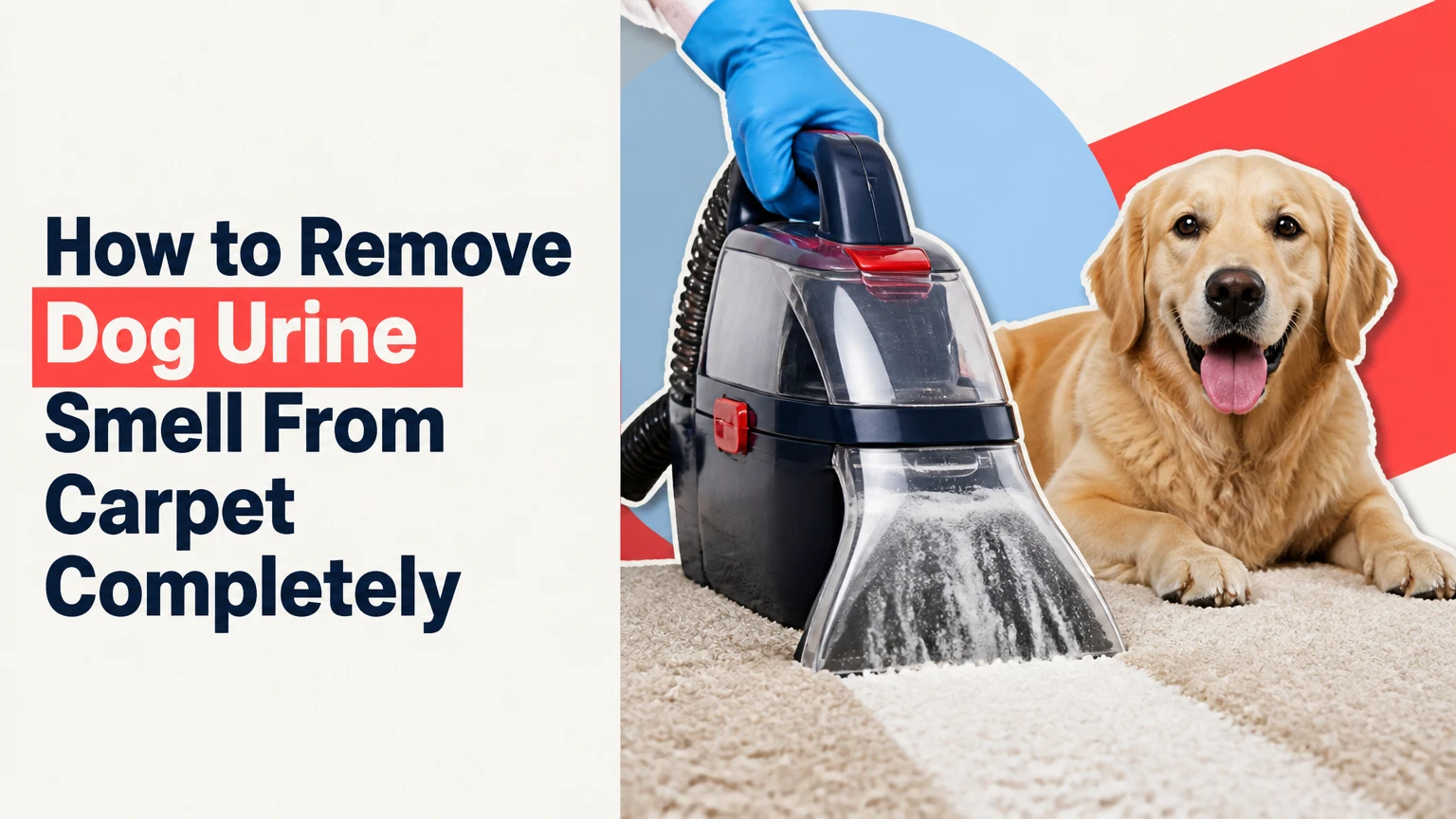
To remove dog urine smell from carpet, blot fresh liquid, locate the full contaminated area, and saturate the carpet with a labeled enzymatic urine cleaner so it reaches the backing and pad. Keep the treatment wet for the label’s contact time, extract excess moisture, and dry the carpet completely for 24-48 hours.
Key Facts
Enzymatic urine cleaners work best when they contact every urine-contaminated layer, including carpet backing and padding.
A visible stain can be smaller than the odor source because urine spreads sideways through the pad.
Vinegar and baking soda mixed together are not a reliable treatment for old urine because they largely neutralize each other.
A 395 nm UV flashlight can reveal many dried urine deposits, but it cannot identify every contaminated area.
Humidity-related odor usually indicates untreated residue in the pad, backing, tack strip, or subfloor.
Never combine enzyme cleaners with bleach, ammonia, peroxide, vinegar, or other chemical products.
What Causes Dog Urine Odor in Carpet?
Dog urine odor comes from decomposing organic residue and dried uric acid salts. Fresh urine may smell mild, but bacterial activity breaks down urea into ammonia-related compounds, while uric acid deposits remain in carpet fibers and porous backing.
Carpet creates a difficult cleaning environment because it has several layers. A small accident can travel from the pile into the primary backing, secondary backing, underlay, and, in severe cases, wood or concrete beneath the floor. Cleaning only the visible tips leaves the strongest odor source untouched.
Dried uric acid is especially troublesome because its salts are poorly removed by light spraying. Moisture from humid air, carpet shampoo, or a later spill can dissolve part of the residue and release the smell again. That explains why a carpet can seem clean for several days and then smell after rain or mopping.
The United States Environmental Protection Agency advises following product labels and never mixing household cleaning chemicals. That principle matters here because urine treatments often contain enzymes, oxidizers, acids, or surfactants that can react unpredictably when combined.
Before You Start: Time, Tools, and Cost
Prepare the work area before applying liquid. A successful treatment usually takes 30-60 minutes of active work, followed by 24-48 hours of drying; old or saturated contamination can require a second treatment or professional extraction.
| Item | Typical specification | Purpose | Typical cost |
|---|---|---|---|
| Enzymatic urine cleaner | 1-4 litres | Digests urine residue | $10-$35 |
| White towels | 6-12 towels, cotton or microfiber | Blotting and wicking | $5-$20 |
| UV flashlight | 395 nm wavelength | Locating dried deposits | $10-$30 |
| Wet-dry vacuum | 1-5 gallon tank | Removing treatment liquid | $50-$150 |
| Nitrile gloves | 2-4 pairs | Hand protection | $5-$12 |
| Fan or air mover | 1 unit, 1,000-2,000 CFM typical | Accelerating drying | $30-$250 |
Vacuum loose debris first, remove children and pets from the room, and open windows if outdoor humidity is lower than indoor humidity. Photograph the area before cleaning if you rent or need evidence of its original condition.
Check the carpet care label. Nylon and solution-dyed polyester usually tolerate properly labeled enzyme products, while wool, silk, viscose, jute, and antique rugs need a manufacturer-approved product or a rug specialist. Test a hidden 2-inch area and wait until it dries before treating the visible carpet.
How Do You Remove Fresh Dog Urine?
Fresh dog urine is easiest to remove when you extract it before it reaches the pad. Press white towels into the spot, replace them as they become wet, and use a wet-dry vacuum for a large accident; rubbing spreads urine and drives liquid downward.
Step 1: Blot the Fresh Accident
Put on gloves and lay several white towels over the wet area. Stand or press firmly on the towels for 30-60 seconds, then lift them vertically rather than dragging them across the carpet.
Continue with dry towels until they show little or no moisture. A wet-dry vacuum can remove more liquid, but use a clean head and empty the recovery tank promptly. Do not use a household vacuum designed only for dry debris.
Success checkpoint: the carpet feels damp rather than wet, and a fresh towel remains mostly dry after firm pressure.
Common mistake: scrubbing the stain. Scrubbing frays pile, spreads the urine laterally, and forces liquid toward the backing.
Step 2: Locate and Map the Full Area
For old or partially dried accidents, inspect the room in darkness with a 395 nm UV flashlight. Urine deposits often appear yellow, green, or cream-colored, although optical brighteners, detergents, fibers, and pet vomit can fluoresce too.
Mark the visible boundary with removable painter’s tape, then extend the treatment area at least 2-4 inches beyond the apparent edge. For repeated accidents, inspect nearby baseboards, furniture edges, dog beds, and carpet transitions because dogs often return to familiar odor zones.
UV light is a locator, not a chemical test. Some old deposits will not fluoresce strongly, and a clean-looking area may still contain odor beneath the pile. Your nose, moisture history, and the dog’s repeated behavior remain important evidence.
Success checkpoint: every visible deposit and likely migration path has a boundary marked before cleaner is applied.
Common mistake: treating only the brightest UV patch. The pad may contain a larger contaminated footprint than the carpet surface.
How Should You Apply Enzymatic Cleaner?
Apply enough enzymatic cleaner to contact the entire contaminated thickness, but follow the product label rather than blindly using a fixed dilution. Enzymes require moisture and contact time, yet excessive liquid can delaminate carpet backing, soak wood, or create a secondary mold problem.
Step 3: Choose and Patch-Test the Cleaner
Select a product specifically labeled for dog urine, carpet, and odor removal. Useful label information includes enzyme or bacterial action, carpet-material compatibility, dilution instructions, required dwell time, and whether extraction is permitted afterward.
Do not judge a product by fragrance strength. A perfume can cover ammonia for hours without removing uric acid residue. Oxygen-based products containing hydrogen peroxide can help with discoloration and odor, but they may lighten dark dyes and are not interchangeable with enzyme formulas.
Apply a small amount to an inconspicuous location. Place a white towel over it for five minutes, then inspect the towel and carpet after drying. Color transfer, whitening, sticky residue, or pile distortion means the product is unsuitable for that material.
Step 4: Saturate the Contaminated Carpet
Apply cleaner from the outside edge toward the center to avoid spreading contamination. Use a squeeze bottle or controlled pour for a localized spot, because a fine mist usually wets only the upper fibers.
The treatment should reach the depth the urine reached. For a fresh surface accident, 250-500 millilitres may be enough; a large or old patch can require 1-4 litres, depending on area, carpet density, and pad thickness. These are typical working ranges, not universal dosing rules.
Never pour blindly over hardwood flooring, unsealed subfloor, electrical outlets, or a carpet edge where liquid can run underneath. If the carpet is already saturated, lift a corner if possible and inspect the pad rather than adding unlimited cleaner.
Success checkpoint: the marked pile and backing feel evenly damp, with no dry perimeter around the suspected urine area.
Common mistake: misting a large old stain. Surface dampness cannot dissolve residue in the pad.
Step 5: Keep the Cleaner Wet for the Label Time
Cover the treated area with a clean white towel or loose plastic sheet if the product instructions permit covering. Enzyme activity stops when the solution dries too quickly, so a 15-30 minute dwell may be inadequate for old contamination if the label specifies several hours.
Many consumer products require 10-30 minutes for fresh spots and 8-24 hours for severe odor. Follow the label’s stated time, keep children and pets away, and do not add another cleaner during the dwell period.
Success checkpoint: the treatment remains visibly damp for the complete contact period and the odor begins to change from sharp ammonia to a mild wet-cleaner smell.
Common mistake: extracting immediately. Premature extraction removes active solution before it contacts the deeper residue.
Step 6: Extract and Dry the Carpet
After the required dwell time, press towels into the area or use a wet-dry vacuum to remove excess solution. Do not rinse with a heavily fragranced shampoo unless the enzyme product specifically instructs you to do so.
Place a folded white towel over the spot and weigh it with a clean, nonporous object for 6-12 hours. Replace the towel when it becomes damp. Then direct a fan across the carpet, not straight down into the pad, and maintain ventilation for 24-48 hours.
Success checkpoint: the pile feels dry at its base, the pad does not feel cool or squishy, and the odor remains absent after the room warms and humidity changes.
Common mistake: closing the room while the pad is damp. Trapped moisture prolongs drying and can create musty odor.
Which Dog Urine Removal Method Works Best?
Enzymatic cleaner is the best first choice for most carpet urine odors because it targets organic residue rather than merely masking it. Professional extraction becomes the better choice when urine has saturated the pad or subfloor, while vinegar and baking soda are limited to light surface freshening.
| Method | Best use | Typical active time | Main risk |
|---|---|---|---|
| Enzymatic cleaner | Fresh and dried organic urine | 15 minutes-24 hours | Over-wetting backing or wood |
| Hydrogen peroxide oxidizer | Light stains on colorfast synthetic carpet | 1-4 hours | Dye loss or fiber damage |
| Hot-water extraction | Removing soluble residue after treatment | 1-3 hours | Spreading or setting untreated odor |
| Vinegar solution | Mild surface odor on washable synthetic fibers | 10-30 minutes | Residual sour smell and limited depth |
| Baking soda | Absorbing surface moisture after cleaning | 8-24 hours | Powder residue and weak uric-acid action |
| Professional urine treatment | Pad, backing, or subfloor contamination | 2-6 hours onsite | Service cost and possible carpet removal |
Vinegar is acidic, while baking soda is alkaline. Mixing them produces fizzing carbon dioxide, but the reaction consumes much of each ingredient and does not create a powerful urine-destroying formula. For that reason, do not rely on the commonly repeated recipe that combines vinegar, water, and baking soda in one bottle.
A safer limited alternative is to blot the accident, apply a small amount of diluted white vinegar to a tested synthetic carpet, blot again, and use baking soda only after the carpet is nearly dry. This may reduce a mild surface smell, but it is not a dependable solution for old deposits in padding.
Steam cleaning has a narrower role than many homeowners assume. A professional can use hot-water extraction after chemical treatment, but heat alone does not remove uric acid from a saturated pad, and uncontrolled moisture can reactivate odor.
How Much Does Dog Urine Odor Removal Cost?
DIY treatment typically costs $15-$60 for cleaner, towels, gloves, and inspection equipment, while professional treatment commonly costs $100-$500 or more for severe contamination. Replacement padding, carpet removal, subfloor sealing, furniture moving, and regional labor rates can raise the total.
| Situation | DIY supplies | Active work | Total elapsed time |
|---|---|---|---|
| One fresh spot | $10-$25 | 20-40 minutes | 12-24 hours |
| Several dried spots | $25-$75 | 1-3 hours | 24-72 hours |
| One saturated room | $50-$150 | 2-4 hours | 2-4 days |
| Professional surface treatment | $100-$250 | 2-4 hours | 24-48 hours |
| Pad and subfloor remediation | $300-$1,500+ | 4-10 hours | 2-7 days |
Treat price estimates as typical North American ranges, not fixed market rates. Ask a professional whether the quote includes UV inspection, enzyme dwell time, extraction, furniture movement, pad replacement, and subfloor sealing.
The cheapest option is not always the least expensive outcome. Repeatedly spraying fragrance or vinegar can delay diagnosis, allowing urine to damage backing or flooring while the odor continues.
What Changes for Wool, Rugs, and Hardwood Floors?
Wool carpet and natural-fiber rugs require a lower-risk process than synthetic wall-to-wall carpet. Use the manufacturer’s care instructions, avoid prolonged saturation, and contact a certified rug cleaner when urine has reached the backing or fringe.
For a removable rug, move it to a washable, ventilated surface if possible. Treat the face and backing separately only when the construction and care label allow it. Never assume a carpet enzyme cleaner is safe for wool, silk, viscose, jute, or dyed antique textiles.
Hardwood beneath carpet needs controlled moisture. Remove the carpet and pad if contamination has penetrated the floor, clean the surface with a compatible product, allow complete drying, and use an odor-blocking sealer only when the floor finish and manufacturer instructions permit it.
Concrete is porous enough to retain urine odor. A surface spray may not reach the pores, so severe contamination can require repeated treatment, mechanical cleaning, or a compatible concrete sealer after the slab is dry.
Why Does the Smell Return on Humid Days?
Dog urine odor returns during humid weather when moisture reactivates dried residue that remains in carpet backing, padding, tack strips, or subfloor. Re-treating only the surface usually provides temporary relief because the odor source is deeper than the visible pile.
Repeat the UV inspection after the first treatment has dried. Compare the odor at the center, perimeter, nearby baseboard, and underside of the carpet if accessible. A persistent odor at one edge often indicates urine migration beneath the carpet rather than treatment failure at the original center.
If the pad feels stiff, discolored, or strongly odorous, professional inspection is usually more effective than repeated surface spraying. A technician may lift the carpet, replace contaminated pad, clean the subfloor, and seal porous flooring before reinstalling new underlay.
When Should You Replace Carpet Padding?
Replace a section of carpet padding when it remains strongly odorous after one or two correctly performed treatments, feels saturated, shows extensive discoloration, or has transferred odor to the subfloor. Padding is inexpensive compared with replacing an entire carpet, but seams and transitions require careful cutting.
Do not automatically replace padding after one small accident. First determine whether the treatment reached the pad and whether the area dried fully. Replacement is justified when the pad acts as a reservoir that continually recontaminates the carpet.
Common Mistakes and How to Fix Them
| Mistake | Why it fails | Recovery action |
|---|---|---|
| Using ammonia cleaner | Ammonia resembles part of urine odor | Rinse and extract, then use a labeled enzyme product |
| Spraying only the surface | Cleaner misses backing and pad | Map the area and apply controlled deeper treatment |
| Mixing cleaners | Chemicals can neutralize or react | Stop, ventilate, blot, and follow one product label |
| Using a hair dryer or heater | Rapid heat can spread odor and damage dyes | Remove excess moisture and use cool airflow |
| Scrubbing aggressively | Fibers fray and liquid migrates | Blot vertically and clean the wider affected zone |
| Replacing carpet too early | The subfloor may still hold odor | Inspect pad and flooring before installing new carpet |
Ammonia-based products also create a behavioral problem. The odor may signal an established bathroom location to a dog, increasing the chance of repeat soiling even when the homeowner can barely smell it.
A peroxide product should always be tested for colorfastness. Dark nylon, wool, and dyed rugs can lighten even when the cleaner appears mild on a white towel.
How Do You Stop a Dog From Returning to the Spot?
Prevent repeat soiling by removing the odor source, restricting access while the carpet dries, and addressing the reason for the accident. A clean carpet can still attract a dog if urine remains in the pad or if the dog has an established location cue.
Use a temporary gate, closed door, furniture, or washable waterproof mat until the area has passed an odor check after drying. Wash nearby dog bedding and clean baseboards if splashing or marking reached them.
Frequent accidents, sudden indoor urination, straining, blood in urine, excessive thirst, or accidents in a previously house-trained dog warrant veterinary advice. Urinary infection, diabetes, kidney disease, medication effects, pain, and incontinence can all change elimination patterns.
For puppies, inspect the same area daily during training and keep an enzyme cleaner ready. For senior dogs, add more frequent outdoor breaks and use washable barriers while a veterinarian investigates new accidents. For multi-dog homes, treat every marked location because one untreated patch can maintain the whole odor pattern.
When Should You Call a Professional?
Call a carpet-cleaning or restoration professional when urine covers a room, odor persists after two complete enzyme treatments, the pad is saturated, the smell reaches baseboards, or the subfloor may be contaminated. Professional equipment can extract deeper moisture, but the technician still needs to identify and treat the urine chemistry first.
Ask for a pet-urine protocol rather than generic carpet shampoo. Confirm that the service includes inspection, treatment depth, dwell time, extraction method, drying plan, and a written explanation of whether pad replacement may be necessary.
Professional cleaning has limits. Extraction cannot reverse delamination, permanently discolored fibers, rotted wood, or odor sealed inside inaccessible construction. A careful provider should explain when localized carpet and pad removal is more rational than repeated chemical treatment.
FAQ
Can I remove dog urine smell with dish soap?
Dish soap can lift surface soil, but dish soap alone does not reliably break down dried urine salts in carpet padding. Use it only if the carpet manufacturer permits it and only for a small fresh surface spill, followed by thorough blotting and rinsing. A labeled enzymatic cleaner is the better odor treatment.
Does hydrogen peroxide remove dog urine odor from carpet?
Hydrogen peroxide can oxidize some odor compounds and lighten organic staining, but it can also bleach carpet dyes and damage wool or delicate fibers. Patch-test first, never mix it with vinegar or bleach, and choose an enzyme product when the main problem is deep urine in the pad.
How long should dog urine cleaner sit on carpet?
Dog urine cleaner should sit for the contact time printed on its label, commonly 15-30 minutes for a fresh spot and several hours for dried contamination. The carpet must remain damp during that period, but prolonged soaking is unsafe for wood-backed floors and some carpet constructions.
Can baking soda damage a carpet?
Baking soda usually does not damage colorfast synthetic carpet when used sparingly, but heavy powder can remain in the pile, clog some vacuums, and provide little benefit against deep uric acid. Apply it only to a nearly dry surface, vacuum carefully, and do not treat it as a replacement for enzymatic cleaning.
Will dog urine smell disappear after the carpet dries?
Dog urine smell may disappear after drying when contamination is fresh and limited to the pile, but drying alone does not remove urine residue. If odor returns with humidity, moisture has likely reactivated untreated deposits in the backing, pad, tack strip, or subfloor.
Is it safe for my dog to walk on enzyme cleaner?
Keep dogs away until the treated carpet is dry and the product label permits re-entry. Enzyme formulas vary, and a dog can ingest residue by licking wet fibers. Ventilate the room, remove towels and coverings, and follow the manufacturer’s pet-safety directions.
The Bottom Line
The reliable way to remove dog urine smell from carpet is to find the complete contaminated footprint, blot fresh liquid, use one compatible enzymatic cleaner at the required depth, maintain its contact time, extract excess moisture, and dry the carpet for 24-48 hours. If how to remove dog urine smell from carpet leads to repeated surface treatments without success, inspect the padding and subfloor rather than adding more fragrance or vinegar.