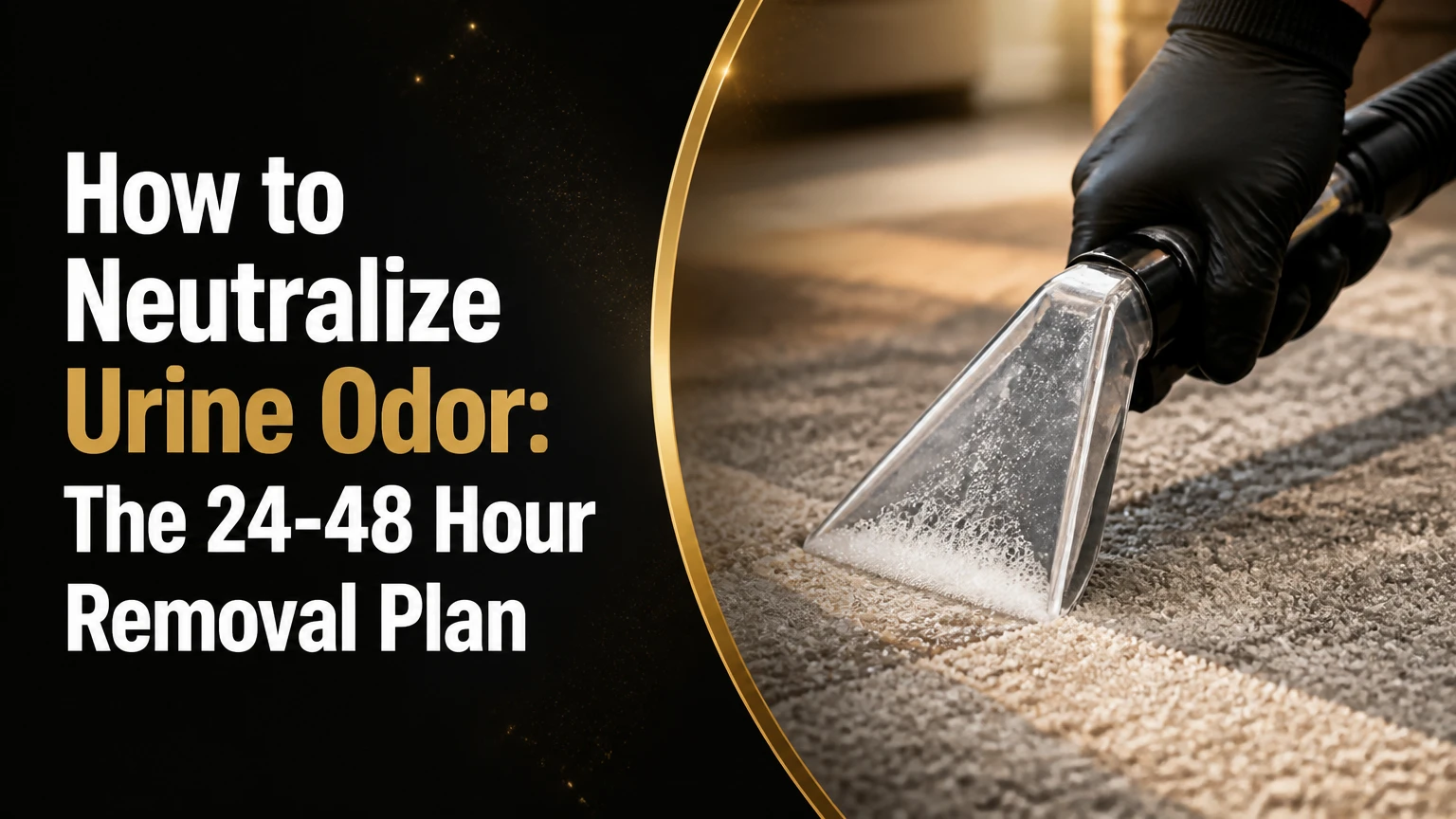
To neutralize urine odor, remove the liquid, dissolve or biologically break down the residue, and dry the contaminated material completely. An enzyme-based urine cleaner is usually the best first treatment for porous carpet, fabric, and pet stains, while extraction, peroxide-based products, or sealing may be better for specific hard surfaces and deep structural contamination.
Key Facts
Fresh urine odor usually comes from volatile ammonia and other odor compounds formed as urea decomposes.
Dried urine residue can remain inside carpet padding, mattress foam, wood pores, grout, and concrete.
Enzyme cleaners require sufficient contact time and usually perform poorly when sprayed only on the visible surface.
Vinegar can reduce an ammonia smell temporarily, but it does not reliably remove deep urine residue.
Never mix bleach with ammonia, vinegar, peroxide, or other cleaners.
A returning odor usually indicates remaining contamination, moisture movement, or a new accident rather than a failed fragrance product.
How Urine Odor Forms
Urine odor develops when urea and other organic compounds decompose, producing ammonia and additional volatile compounds. Fresh urine may smell mild, but bacteria, evaporation, and porous materials can transform a small spill into a persistent odor source that becomes noticeable whenever humidity rises.
Urine is mostly water, with urea, salts, creatinine, pigments, and other dissolved compounds. Cat urine is often more concentrated than human urine, and a cat’s marking behavior can deposit a small amount repeatedly in the same location. The odor profile therefore depends on the animal or person, concentration, age, temperature, and surface depth.
The common description that uric-acid crystals “reactivate” is directionally useful but simplified. Dried residue can absorb moisture, dissolve partly, and release odor compounds again; microbes and alkaline residues can also contribute. Ordinary detergent may clean the visible stain while leaving odor-bearing material below it.
What actually neutralizes the smell?
A urine odor treatment works through one of four mechanisms: removal, biological degradation, oxidation, or temporary odor binding. Physical extraction is the only method that removes contaminated liquid directly, so chemical treatment without extraction often fails when a carpet pad or mattress core is involved.
Enzyme products contain biological catalysts selected to break down portions of urine’s organic residue. Results depend on formulation, temperature, pH, contact time, and whether the product reaches the full contamination depth. “Enzyme” on a label is not a guarantee that one application will remove a saturated subfloor.
Oxidizers such as hydrogen-peroxide-based products alter some colored and odor-producing molecules. They can work well on compatible, colorfast surfaces, but they may bleach textile dyes, damage finishes, or react unpredictably with previous cleaners.
Which Treatment Should You Choose?
The best urine odor treatment depends on surface porosity, contamination depth, colorfastness, and whether the odor source is fresh or aged. Enzyme cleaners are the default for porous organic materials, extraction is essential for liquid volume, and sealing or replacement becomes more practical when urine has reached a subfloor.
| Treatment | Typical cost | Typical contact time | Best application | Main limitation |
|---|---|---|---|---|
| Enzyme urine cleaner | $10-$30 per gallon | 8-48 hours | Carpet, fabric, pet stains | Needs full saturation and compatible conditions |
| Hydrogen peroxide oxidizer | $5-$15 per bottle | 10-30 minutes | Colorfast fabric, some hard surfaces | Can lighten dyes or damage finishes |
| Mild acidic rinse | $2-$10 DIY or ready-made | 5-15 minutes | Surface ammonia smell, washable items | Does not remove deep dried residue |
| Wet vacuum extraction | $30-$80 rental per day | 15-60 minutes per area | Carpet, upholstery, rugs | Extraction alone may leave bound residue |
| Odor encapsulator | $8-$20 per spray | Seconds to minutes | Temporary control, low-traffic areas | Masks or traps odor rather than removing its source |
| Professional remediation | $150-$1,000+ | 1-3 days | Large, structural contamination | Higher cost and possible flooring removal |
Are enzyme cleaners better than vinegar?
Enzyme cleaners are generally better than vinegar for old pet urine in carpet, padding, upholstery, and mattresses because the products are designed to act on organic residue at depth. Vinegar can lower surface alkalinity and reduce an ammonia smell for a short period, but its acidity does not dissolve every dried urine deposit or extract contaminated padding.
Do not combine vinegar with hydrogen peroxide or chlorine bleach. The mixtures can create irritating or hazardous chemistry, and applying several products in sequence without rinsing can inhibit an enzyme formula or damage a finish. Use one treatment at a time, follow its label, and allow the surface to dry before changing methods.
Can baking soda neutralize urine odor?
Baking soda can absorb some surface moisture and volatile odor, but it is not a complete urine-removal treatment. Sprinkling baking soda over a wet carpet may create a paste that is difficult to extract, while baking soda cannot reach contamination inside foam, carpet backing, or a wood subfloor.
Use baking soda only after the material is clean and completely dry, and vacuum it from a textile after several hours. For a deep stain, extraction and a compatible urine cleaner matter more than deodorizing powder.
What Should You Do Before Cleaning?
Before cleaning, identify the material, estimate the contamination boundary, remove loose items, and test the chosen product in an inconspicuous location. The safest basic setup requires disposable gloves, white absorbent towels, a measuring container, a wet vacuum or extractor when available, ventilation, and the product label.
Before You Start
Typical active work: 30-90 minutes
Typical total treatment: 12-48 hours
Difficulty: Moderate for fabrics, high for padding or subfloors
Typical DIY cost: $15-$80
Materials: 1-2 gallons of compatible cleaner for a large carpet treatment, towels, gloves, plastic sheeting, and an extractor
Prerequisite: Check the surface manufacturer’s care instructions and perform a hidden patch test
Safety: Keep children and animals away until the treated surface is dry
A 395-nanometer UV flashlight can help locate some dried urine residue in a dark room. UV fluorescence is not proof of urine because optical brighteners, detergents, fibers, and other substances can glow; use odor, location, moisture, and visual evidence to confirm the boundary.
How to Neutralize Urine Odor Step by Step
The following five-step process works best for fresh or moderately aged contamination on carpet and washable upholstery. Plan on 30-90 minutes of active work plus 12-48 hours of dwell and drying time; full-depth saturation, not surface fragrance, determines the outcome.
Step 1: Blot the Fresh Urine
Press white paper towels or clean microfiber towels into fresh urine immediately, replacing them as they become wet. Apply firm downward pressure for 30-60 seconds at a time, and repeat until little liquid transfers to a dry towel.
Do not scrub. Scrubbing spreads the liquid sideways and can drive it through carpet fibers into the backing and pad. For a large puddle, a wet vacuum can remove more liquid than towels, but empty and rinse the machine afterward to prevent odor transfer.
You will know extraction is working when a dry towel remains nearly dry after repeated pressure. The common mistake is using one towel briefly, which removes only the surface liquid.
Step 2: Expand the Treatment Boundary
Treat beyond the visible mark because liquid can migrate horizontally under carpet, beneath furniture, or through mattress ticking. A practical starting boundary is 2-4 inches beyond the visible stain, although a large spill may require inspection under the carpet or pad.
For pet accidents, inspect nearby vertical surfaces, baseboards, furniture legs, and repeated marking locations. A UV flashlight can help locate possibilities, but do not saturate every fluorescent area without confirming that the material is urine.
You will know the boundary is reasonable when odor and visible or UV evidence are covered without wetting unaffected furniture or flooring. The common mistake is treating only the darkest central spot.
Step 3: Apply a Compatible Urine Cleaner
Apply enough product to reach the full depth of the contamination. For carpet, a typical starting quantity is approximately 1-2 cups per square foot for a pad-level accident, but the product label takes priority because formulas and application methods differ.
A light spray is appropriate only for a shallow surface odor. If urine reached the backing or pad, the cleaner must reach that same layer. Avoid flooding hardwood, laminate seams, electronics, unsealed masonry, or mattress foam beyond what the material can safely dry.
Blotting first does not mean the area must be dry before treatment. It means free liquid should be removed so the treatment is not unnecessarily diluted.
Step 4: Keep the Product Wet for Its Labeled Dwell Time
Allow an enzyme cleaner to remain wet for the label’s stated period, commonly 8-24 hours for deep pet contamination and 15-60 minutes for a lighter surface application. A loose plastic sheet can slow evaporation on carpet, but it must not create a dangerous slip hazard or trap moisture against vulnerable wood.
Keep the room near normal indoor temperature, commonly 18-27°C, and provide ventilation without blowing the treatment onto walls or adjacent furniture. Do not add detergent, bleach, ammonia, disinfectant, or fragrance during the dwell period.
You will know the step was adequate when the treated zone stayed damp for the required time and odor decreases after complete drying. The common mistake is removing an enzyme product after five minutes because the surface appears clean.
Step 5: Extract Residue and Dry Completely
After the dwell period, remove excess liquid with towels or a wet-dry vacuum, then dry the material with air movement and controlled ventilation. Do not use high heat to accelerate drying on carpet, wood, foam, or unknown finishes.
Drying may take 12-48 hours, depending on humidity, material thickness, airflow, and product volume. A moisture meter can help compare the treated area with an unaffected area; a carpet pad that remains substantially wetter than its surroundings needs additional extraction.
You will know the treatment is complete when the material is dry and the odor remains absent after several hours of normal humidity. A temporary odor increase during drying can occur, but a strong odor after the area is fully dry indicates remaining contamination or another source.
How Do Surface Materials Change the Method?
Surface material determines whether urine can be extracted, whether moisture can be safely applied, and whether the odor source is below the visible layer. Carpet and mattresses tolerate more controlled wet treatment than hardwood, laminate, electronics, or unsealed furniture.
| Surface | First treatment | Moisture rule | Typical drying or decision point |
|---|---|---|---|
| Carpet and pad | Blot, enzyme saturation, extraction | Reach pad only if it can dry safely | 12-48 hours; replace pad after repeated failure |
| Mattress foam | Blot, limited enzyme application, fan drying | Avoid saturating the entire core | 24-72 hours; replace foam if odor remains deep |
| Finished hardwood | Blot, barely damp compatible cleaner | Never leave standing liquid | Dry within 1-4 hours; refinish or replace damaged boards |
| Laminate flooring | Blot, neutral cleaner on cloth | Keep liquid out of seams | Dry within 1-2 hours; inspect swollen joints |
| Concrete | Extract, enzyme or detergent-compatible treatment | Concrete can hold moisture and salts | 24-72 hours; seal only after dry |
| Ceramic tile and grout | Absorb, clean grout, rinse carefully | Grout may absorb more than tile | 4-24 hours; inspect backing and cracks |
| Washable clothing | Cold rinse, detergent wash, repeat if needed | Check care label | Dry only after odor is gone; heat can set residual odor |
| Upholstery | Blot, controlled treatment, extraction | Avoid soaking frame and backing | 12-48 hours; inspect cushion interior |
Mattresses and Upholstery
For a mattress, remove bedding, blot the surface, apply a small test amount of compatible cleaner, and treat the affected zone without saturating the entire foam core. Use a fan, elevate the mattress for airflow, and wait until the interior is dry before replacing bedding.
Hydrogen peroxide can lighten yellow staining on some fabrics, but it is not automatically safe for dyed ticking, memory foam, latex, or adhesives. A waterproof, breathable mattress protector prevents future liquid from reaching the core; a non-breathable cover can trap condensation if used improperly.
Finished Wood and Laminate
For finished wood or laminate, use the least liquid that can clean the surface and dry every seam immediately. Deep urine that penetrated between boards may require removal of the affected boards, sanding and refinishing, or treatment of the subfloor from below.
Do not pour a gallon of enzyme cleaner onto a hardwood floor. Excess moisture can swell wood fibers, damage finish adhesion, and move contamination into joints. Product compatibility and moisture control matter more than maximum saturation on these surfaces.
Concrete, Tile, and Outdoor Areas
Concrete can retain urine in pores, cracks, and expansion joints, so surface wiping may remove the stain while leaving the odor source below. Scrub with a compatible cleaner, extract or wet-vacuum the solution, and allow the slab to dry before deciding whether a second treatment or odor-blocking sealer is needed.
Outdoor urine on concrete, brick, or soil often requires repeated rinsing and biological treatment because weather, drainage, and organic debris affect performance. Do not allow concentrated chemicals to enter storm drains, ponds, garden beds, or areas accessible to pets.
What Mistakes Make Urine Odor Return?
Urine odor usually returns because the treatment did not reach the contaminated layer, the area was not extracted or dried, or a new accident occurred nearby. Fragrance sprays can lower perceived odor briefly while leaving the original residue unchanged.
- Using ammonia cleaner: Ammonia resembles a major urine odor component and can leave a similar smell. Use a labeled urine product or a neutral cleaner instead.
- Mixing products: Never mix chlorine bleach with ammonia or acids. Avoid combining peroxide and vinegar, and rinse or dry between incompatible treatments.
- Applying heat too early: Steam and hot water can spread liquid, damage finishes, and set some protein-based stains. Heat does not guarantee permanent fixation of uric-acid residue, but cool or lukewarm treatment is safer.
- Under-saturating carpet: Surface misting cannot treat urine in the backing or pad. Use controlled depth treatment followed by extraction.
- Ignoring humidity: A humid room can make residual salts and organic material smell stronger. Measure the source rather than repeatedly adding deodorizer.
- Skipping a patch test: Peroxide, strong detergents, and acidic products can alter dyes, wood finishes, stone, and grout.
- Drying too slowly: Wet carpet pad and foam can develop a separate musty odor. Use airflow and extraction, not high heat.
Why Does the Smell Return in Humidity?
A urine odor that returns during rain or high indoor humidity usually indicates residue below the surface or moisture entering a contaminated material. Re-cleaning the visible top layer will not solve the problem if urine reached carpet padding, subfloor, wall trim, mattress foam, or cracks in concrete.
First, confirm that the odor is not coming from a new accident, a litter box, a drain, or damp padding. Then inspect the full perimeter, compare moisture readings with an unaffected area, and remove or lift materials when safe.
Professional remediation becomes appropriate when contamination covers more than about 10-20 square feet, reaches multiple rooms, involves porous subflooring, or remains after two properly performed treatments. Typical professional costs range from $150 for localized work to more than $1,000 when carpet, padding, trim, or flooring must be removed and sealed.
When should a subfloor be sealed or replaced?
Seal a dry, structurally sound subfloor after cleaning and extraction have reduced contamination but residual odor remains. Replace damaged carpet pad, swollen laminate, deteriorated particleboard, or persistently contaminated porous materials when sealing cannot isolate the odor source.
Use a stain-and-odor-blocking primer approved for the substrate, such as a shellac-based product where appropriate, and follow its ventilation and recoat instructions. Sealing wet wood or concrete traps moisture and can cause adhesion failure, mold growth, or recurring odor.
How Do Cat, Dog, and Human Urine Differ?
Cat urine often smells stronger because cats may produce concentrated urine and repeatedly mark a small area, while dog accidents can cover larger zones. Human urine varies with hydration, diet, medication, age, and medical conditions, so treatment should match the surface and contamination depth rather than rely on species alone.
| Source | Common pattern | Treatment implication | Prevention measure |
|---|---|---|---|
| Cat | Small repeated marks, strong concentrated odor | Inspect vertically and below flooring | Litter-box assessment and veterinary check |
| Dog | Larger wet patches, carpet or outdoor areas | Map the full liquid boundary | Frequent outdoor breaks and enzyme spot treatment |
| Human | Mattress, clothing, upholstery, bathroom areas | Prioritize washable barriers and controlled drying | Breathable waterproof protectors and laundry routine |
| Unknown | Multiple sources or recurring room odor | Inspect with moisture and UV tools | Track timing, humidity, and access points |
A sudden change in human urine odor accompanied by burning, fever, pelvic pain, blood, confusion, or frequent urination warrants medical advice rather than household deodorizing. Dehydration can concentrate urine, while infection and other conditions can alter odor; cleaning cannot address the underlying cause.
Caregivers should wear gloves, wash contaminated textiles promptly, and follow facility infection-control procedures when bodily-fluid exposure is substantial. Household cleaning is not a substitute for professional biohazard remediation after extensive contamination.
What Does Removal Cost and How Long Does It Take?
Typical DIY urine odor removal costs $15-$80 and takes 12-48 hours when the contamination is localized and the material is recoverable. Professional structural remediation commonly costs $150-$1,000 or more because technicians may need moisture mapping, extraction equipment, pad removal, subfloor treatment, and sealing.
| Scenario | DIY supplies | Active labor | Total elapsed time |
|---|---|---|---|
| Fresh carpet spot, under 2 square feet | $10-$25 | 20-40 minutes | 12-24 hours |
| Aged carpet with pad involvement | $25-$80 | 60-120 minutes | 24-48 hours |
| Mattress accident, single zone | $15-$50 | 30-60 minutes | 24-72 hours |
| Hardwood joint contamination | $15-$60 | 30-90 minutes | 1-4 days |
| Concrete or grout odor | $20-$100 | 60-180 minutes | 24-72 hours |
| Subfloor remediation | $150-$1,000+ | 4-12 labor hours | 2-7 days |
These are typical United States consumer and service ranges, not fixed prices. Location, square footage, material replacement, access, and disposal requirements can change the final estimate substantially.
The Bottom Line
To neutralize urine odor permanently, remove as much liquid as possible, treat the full contamination depth with a compatible product, maintain the required dwell time, extract residue, and dry the material completely. Enzyme cleaners are usually the strongest first choice for carpet, upholstery, mattresses, and pet stains, while wood, laminate, concrete, and subfloors require tighter moisture control and may need sealing or replacement.
A clean-looking stain is not proof of odor removal. Test after drying, inspect adjacent materials, and escalate when humidity repeatedly brings the smell back.
Frequently Asked Questions
Does rubbing alcohol remove urine odor?
Rubbing alcohol is not a reliable primary treatment for urine residue because it evaporates quickly and does not provide the biological or extraction action needed for deep contamination. It may disinfect some compatible hard surfaces, but it can damage finishes, ignite near heat, and spread dissolved residue. Use the surface manufacturer’s approved cleaner instead.
How long should I wait before judging whether treatment worked?
Wait until the treated material is completely dry, usually 12-48 hours for carpet and 24-72 hours for mattress foam. Wet surfaces can smell temporarily different from dry surfaces, and fragrance can conceal residual odor. Judge the result after normal room humidity returns, not immediately after application.
Will a UV blacklight show every urine stain?
A UV blacklight will not show every urine stain and cannot prove that fluorescence is urine. Detergent brighteners, fibers, minerals, and old cleaning products can fluoresce, while heavily soiled or sealed areas may not. Use UV inspection as a mapping aid alongside odor, moisture, location, and surface evidence.
Can I use chlorine bleach on a urine stain?
Do not use chlorine bleach directly on urine or on a surface that still contains ammonia-based residue. Chlorine bleach and ammonia can produce dangerous chloramine gases. Bleach can also damage carpet, upholstery, wood, and colored fabrics. If disinfection is necessary, first remove organic contamination and follow the product label and safety guidance.
Why does my clean carpet still smell like urine?
A clean-smelling surface can conceal urine in the carpet backing, pad, tack strip, subfloor, or nearby baseboard. Odor may also come from a second accident outside the original treated area. Inspect the perimeter, use a moisture meter or UV light as supporting tools, and treat or remove the deepest affected layer.
Is professional urine odor removal worth the cost?
Professional remediation is usually worth considering when odor covers several rooms, returns after two correct treatments, reaches a subfloor, or affects a rental, sale, or health-sensitive environment. Technicians can locate moisture, extract deeper contamination, remove pad, and seal structural materials, tasks that household sprays cannot complete reliably.