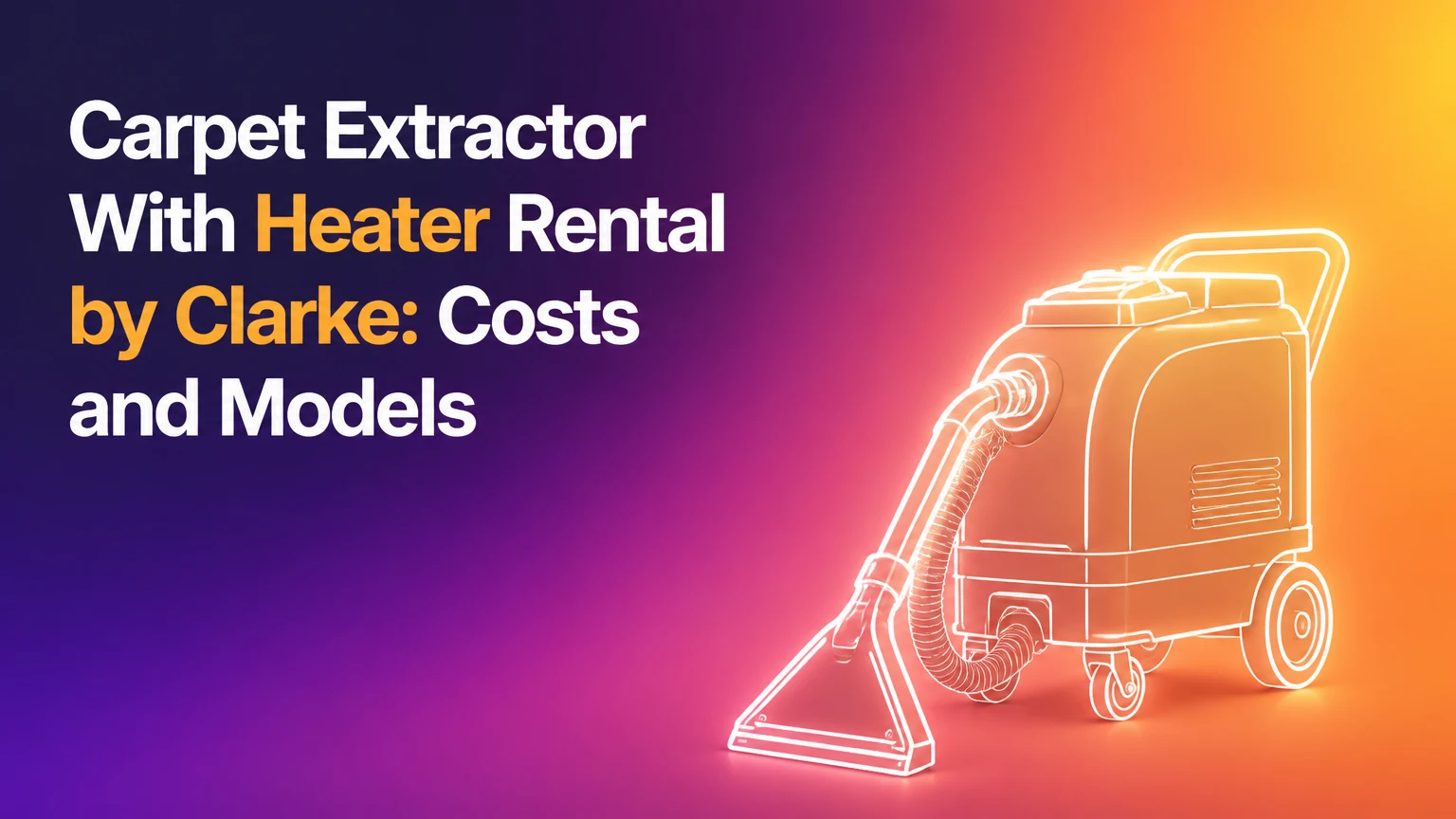
A carpet extractor with heater rental by Clarke is a portable commercial hot-water extraction machine that sprays heated cleaning solution into carpet and immediately recovers soil-laden water through a vacuum hose. Clarke EX20 units are common rental examples, but availability, specifications, accessories, and pricing vary by branch, so verify the exact model before reserving it.
Key facts at a glance
- Clarke EX20 heated extractors commonly use approximately 100 PSI solution pressure and a three-stage vacuum system.
- EX20 100SC models use one power cord, while EX20 100H models require two separately powered circuits for the heater and machine.
- Rental listings commonly show approximately 12.5 gallons of solution capacity and 11 gallons of recovery capacity, but branch inventory can differ.
- Typical advertised rental pricing is approximately $65-$75 for four hours and $95-$120 for one day, excluding chemicals and optional tools.
- Heated extraction is not steam cleaning. The machine sprays liquid water and recovers it through a wand or upholstery tool.
- Carpet drying depends more on water recovery, airflow, humidity, carpet construction, and operator technique than on heater temperature alone.
What Is a Clarke Heated Carpet Extractor?
A Clarke heated carpet extractor is a commercial portable machine that combines solution injection, controlled heating, manual agitation, and vacuum recovery. The operator pre-vacuums the carpet, applies a suitable pre-spray, pulls a wand across the fibers, and uses dry vacuum passes to remove suspended soil and moisture.
The term “heated” describes an inline heater in the solution circuit. It does not mean the machine produces a cloud of steam or sterilizes every surface. Water temperature at the wand can vary with fill temperature, flow rate, hose length, heater condition, electrical supply, and continuous operating time.
Clarke is associated with Nilfisk, and rental agencies may list the equipment under Clarke, Nilfisk, a corporate rental asset number, or a generic description such as “commercial carpet extractor.” The rental counter’s model plate matters more than the website category.
Heated extraction versus steam cleaning
Hot-water extraction sprays liquid solution and removes it with suction. Steam cleaning uses vapor or very low-moisture steam equipment, which has a different process, moisture profile, and surface suitability. A Clarke EX20 should therefore be treated as a hot-water extractor, not as a steam cleaner.
The often-repeated claim that every heated extractor reaches exactly 212°F at the carpet tip is too broad. A heater may have a high internal rating, but delivered temperature falls as water flows through the system. Never select a carpet chemical, fiber, or safety procedure on the assumption that the wand always delivers boiling water.
How Does a Clarke Extractor Work?
A Clarke extractor follows four linked actions: chemical treatment loosens soil, pressurized solution reaches the carpet, agitation separates soil from fibers, and vacuum recovery removes liquid into a separate tank. Cleaning quality depends on the balance among chemistry, dwell time, agitation, solution flow, and recovery.
The pump forces water and detergent through a spray jet. Heat can improve the dissolution of oily soil and activate some detergents, while the wand’s glide and operator pressure provide mechanical agitation. The vacuum motor then creates negative pressure through the wand, hose, and recovery tank.
A useful practitioner rule is to improve soil suspension before increasing solution volume. Extra water can increase drying time without removing more soil when the pre-spray, agitation, or vacuum seal is inadequate.
What the main specifications mean
| Specification | Typical Clarke rental value | Practical meaning |
|---|---|---|
| Solution pressure | 100 PSI on common EX20 units | Suitable for many residential and commercial carpets when used with a floor wand |
| Variable pressure | 0-400 PSI on some BEXT Pro configurations | Allows different settings, but higher pressure can damage backing or increase moisture |
| Solution capacity | Approximately 12.5 gallons | Supports longer cleaning runs before refilling |
| Recovery capacity | Approximately 11 gallons | Requires monitoring because the recovery tank fills during extraction |
| Vacuum system | Three-stage motor on listed EX20 units | Supports stronger recovery than many consumer uprights |
| Empty machine weight | Approximately 87 pounds | Requires two-person handling for stairs, loading, or awkward thresholds |
| Heater output | Approximately 1,100-1,750 watts on listed variants | Affects heat recovery and electrical demand, not guaranteed tip temperature |
Specifications are model-dependent. The Clarke EX20 100SC and EX20 100H are not interchangeable simply because both are heated. Rental branches may substitute an equivalent machine, omit a hose length, or include a different wand.
Which Clarke Models Are Commonly Rented?
The Clarke EX20 family is the most recognizable box-and-wand rental choice, while BEXT Pro machines target higher-pressure commercial work. The best rental model is the one that matches the available circuits, carpet construction, cleaning area, and included tool package, not automatically the model with the largest heater.
| Model or configuration | Power arrangement | Pressure and heater detail | Best rental situation |
|---|---|---|---|
| Clarke EX20 100SC | One standard circuit | Approximately 100 PSI and 1,100-watt heater | Homes with limited electrical access |
| Clarke EX20 100H | Two separate circuits | Approximately 100 PSI and 1,750-watt heater | Larger jobs with confirmed circuit separation |
| Clarke BEXT Pro | Configuration-dependent | Adjustable pressure, commonly up to 400 PSI | Professional carpet and selected hard-surface work |
| Generic non-heated portable extractor | Usually one circuit | Tap-water temperature and model-dependent pressure | Light soil, small rooms, or power-sensitive locations |
EX20 100SC or EX20 100H?
Choose the EX20 100SC when a home, vehicle-detailing bay, or small office cannot reliably provide two separate circuits. Choose the EX20 100H when faster heat recovery is useful and a qualified operator can confirm that both cords feed different breakers.
A separate wall receptacle does not necessarily mean a separate circuit. Two outlets on opposite walls can share one breaker, especially in older homes and commercial tenant spaces. A dual-cord machine can trip breakers when the heater cord and machine cord share the same circuit.
When does BEXT Pro make sense?
BEXT Pro equipment makes sense for trained operators who need adjustable pressure, specialized tools, or repeated commercial work. A pressure range reaching 400 PSI is not a recommendation to use 400 PSI on ordinary residential carpet. High pressure can force moisture into backing, delaminate vulnerable materials, or leave more water than the vacuum can recover.
The CHAT heated agitation tool can support certain tile and grout applications where the rental package includes it. Confirm the attachment, surface compatibility, chemical instructions, and recovery setup before using a carpet extractor on hard surfaces.
How Much Does Clarke Heated Extractor Rental Cost?
Typical Clarke heated extractor rental pricing is approximately $65-$75 for four hours, $95-$120 for one day, and $380-$420 for one week. The final invoice can rise through chemical charges, upholstery tools, delivery, taxes, cleaning fees, deposits, and branch-specific minimums.
| Rental component | Typical amount | Planning implication |
|---|---|---|
| Four-hour rental | $65-$75 | Appropriate for one or two prepared rooms |
| One-day rental | $95-$120 | Usually safer for a full house or office |
| Weekly rental | $380-$420 | Suitable for repeated facility work |
| Low-foaming extraction chemical | $20-$35 | Verify dilution and whether the rental package includes it |
| Deposit or card hold | $100-$250 | Available credit must cover the authorization |
| Upholstery hand tool | Branch-dependent | Confirm before reserving for vehicles or furniture |
Rental prices are local commercial benchmarks, not guaranteed quotations. The Home Depot Rental listing cited in the supplied results identifies a Clarke heated extractor by asset number, but inventory and pricing require location selection. Call the branch with the exact model name and ask whether the machine includes a wand, hoses, vacuum hose cuffs, floor tool, upholstery tool, and operating instructions.
How much carpet can one rental clean?
A prepared operator can typically clean about 500-1,500 square feet during a day rental, depending on soil, furniture, pre-spray dwell time, wand speed, refills, stairs, and drying passes. A heavily soiled office with furniture may produce far less productivity than an open, lightly soiled room.
Estimate water use from recovery rather than floor area alone. Deeply soiled carpet, slow wand passes, and repeated rinsing can consume several gallons per room. Plan a drain location before filling the machine.
What Should You Do Before Operating the Machine?
Before operating a Clarke extractor, allow 30-60 minutes for setup and inspection, budget the rental, chemical, and transport costs, and confirm the carpet is suitable for wet extraction. The greatest success factor is moisture control: use enough solution to suspend soil, then remove it with slow wet passes and repeated dry passes.
Before-you-start checklist
| Requirement | Recommended preparation | Failure prevented |
|---|---|---|
| Time | Four-hour minimum for one or two rooms, one day for a house | Rushed extraction and incomplete drying |
| Transport | SUV, hatchback, van, or pickup with approximately 87 pounds of capacity | Dropping or awkwardly lifting the machine |
| Tools | Dry vacuum, pump sprayer, measuring cup, towels, gloves, extension-free outlet access | Poor soil removal and unsafe setup |
| Chemical | Manufacturer-approved low-foaming extraction solution | Foam shutdown and vacuum contamination |
| Water | Clean water, filled below the machine’s stated limit | Sediment, overflow, or pump problems |
| Testing | Hidden-area fiber and dye test | Bleeding, browning, shrinkage, or texture damage |
Inspect the carpet and backing
Identify fiber type, colorfastness, backing condition, seams, stair edges, and areas near wood or laminate. Wool, viscose, jute-backed rugs, damaged seams, delaminated carpet, and moisture-sensitive installations require professional assessment rather than a routine rental cleaning.
Do not use a hot-water extractor to hide an unresolved water leak, sewage contamination, widespread mold growth, or loose carpet. Extraction removes suspended soil; it does not repair backing, reset permanent crushing, or guarantee removal of dye, rust, oil, or pet urine contamination.
How Do You Use a Clarke Heated Extractor?
Use a Clarke extractor in six stages: dry vacuum, pre-spray, fill, connect power, extract with controlled passes, and clean the machine. A typical room requires 20-45 minutes of active work plus 4-12 hours of drying, with airflow and low humidity reducing the final time.
Step 1: Dry-vacuum the carpet
Move small furniture, protect legs with foil or plastic blocks, and vacuum slowly in two directions. Remove hair, sand, and loose grit before wet cleaning because dry soil is easier to remove with a conventional vacuum.
You will know this step worked when the vacuum collects substantially less debris on a second pass. A common mistake is wet-cleaning first, which turns loose dust into slurry and increases hose or jet contamination.
Step 2: Apply the pre-spray
Mix the low-foaming or manufacturer-approved pre-spray according to its label, then apply an even coat with a pump sprayer. Allow approximately 10-15 minutes of dwell time, but prevent the product from drying on the carpet.
Use enzyme products only where the label permits them, and do not combine alkaline cleaners, acids, oxidizers, or disinfectants in one sprayer. A visible wet sheen is enough; puddling indicates excessive application.
Step 3: Fill the solution tank
Fill the solution tank with clean water below the machine’s maximum mark. Warm tap water can reduce heater recovery time, but do not pour water hotter than the rental manual permits; the supplied overview’s 130°F limit should be treated as a safety ceiling only when confirmed by the specific manual.
Keep detergent out of the recovery tank and avoid adding concentrated, high-foaming soap to the solution tank. Pre-spray chemistry belongs on the carpet unless the machine manufacturer specifically approves in-tank dosing.
Step 4: Connect power safely
Plug a single-cord model into a grounded circuit that can support the machine’s rated load. For a dual-cord EX20 100H, connect the primary and heater cords to receptacles confirmed to be on separate breakers, without using a power strip.
Check the rental unit’s circuit indicator if present, but do not rely on an indicator as a substitute for safe electrical practice. Stop when breakers trip repeatedly, cords heat, plugs discolor, or water approaches electrical connections.
Step 5: Extract in controlled passes
Turn on the vacuum and pump according to the machine instructions, then pull the floor wand backward at roughly one foot per second while squeezing the trigger. Release the trigger at the end of the wet stroke and make one or two slower vacuum-only passes.
Overlap adjacent strokes by approximately 1-2 inches. Keep the wand head sealed to the carpet without grinding it into the pile. You will know the pass is effective when the recovery hose carries steady water and the carpet looks damp rather than saturated.
Step 6: Drain, rinse, and return the machine
Monitor the recovery tank and stop when the float shuts off suction or the tank approaches its marked capacity. Drain wastewater into an approved drain, rinse the recovery tank, flush the vacuum hose if instructed, clean the wand jet, and wipe the machine before return.
Never return a tank containing foul water or chemical residue. Rental contracts may charge cleaning fees, and retained debris can damage the next user’s pump or vacuum system.
How Long Does the Carpet Take to Dry?
A correctly extracted carpet often dries in 4-12 hours, while heavily saturated carpet, dense padding, high humidity, and poor ventilation can extend drying beyond 24 hours. The 2-4 hour claim sometimes associated with powerful heated extractors is possible in favorable conditions, not a universal result.
Place air movers so air travels across the carpet surface, open windows only when outdoor humidity is lower, and use air conditioning or dehumidification where available. Keep foot traffic low until the pile and backing feel dry.
Heater temperature is only one part of drying. Excessive spray flow, slow wet strokes, blocked vacuum airflow, a damaged wand seal, or a full recovery tank can leave more water behind than a stronger heater can offset.
Clarke Heated Extractor Versus Alternatives
A Clarke heated extractor is usually the middle choice between a lightweight consumer upright and a truck-mounted professional system. It offers stronger recovery and greater capacity than many retail machines, but it requires transport, electrical planning, operator skill, and a suitable drain.
| Option | Typical pressure or recovery profile | Typical drying window | Best use | Main limitation |
|---|---|---|---|---|
| Clarke heated portable | Approximately 100 PSI, three-stage vacuum | 4-12 hours | Deep residential or commercial cleaning | Heavy and power-sensitive |
| Non-heated portable extractor | Model-dependent, tap-water operation | 8-16 hours | Small jobs with limited circuits | Slower heat-assisted soil release |
| Consumer upright rental | Commonly lower vacuum performance | 12-24 hours | Light residential cleaning | Smaller tanks and weaker recovery |
| Truck-mount system | Higher sustained heat and vacuum | 1-8 hours | Large professional workloads | Expensive, vehicle-based, inaccessible areas |
| Low-moisture encapsulation machine | Low water application | 1-4 hours | Maintenance cleaning and rapid re-entry | Less suitable for heavy embedded soil |
The comparison ranges are typical planning figures, not universal laboratory measurements. Manufacturer design, wand condition, carpet construction, weather, and operator technique can change every result.
Is a Clarke extractor better than a Rug Doctor?
A Clarke portable extractor is generally better for large or heavily soiled areas when the operator can manage its weight, hose, electrical demand, and drying requirements. A Rug Doctor-style upright is easier to transport and simpler for a small room, but it usually has less tank capacity and recovery power.
Choose the consumer upright when convenience outweighs maximum soil removal. Choose Clarke when a commercial floor wand, separate recovery tank, higher capacity, and stronger vacuum are worth the additional setup.
Is a truck mount better?
A truck mount usually provides greater sustained heat, vacuum, and productivity, particularly for professional crews cleaning multiple rooms. A portable Clarke unit can reach upper floors, apartment interiors, offices without vehicle access, and buildings where truck-mount hoses cannot reasonably travel.
The portable machine wins on building access. The truck mount wins on sustained production.
What Are the Most Common Rental Mistakes?
The most damaging rental mistakes are excess solution, incorrect detergent, unsafe electrical connections, and failure to inspect carpet construction. Correcting those errors improves cleaning and prevents equipment charges more effectively than choosing a higher-pressure setting.
- Using high-foam soap: Foam can lift the recovery float, reduce suction, and contaminate the vacuum motor. Use approved low-foaming chemistry and keep concentrated soap out of the tank.
- Moving the wand too slowly: Slow wet passes can flood the pad and cause browning, wicking, or extended drying. Release the trigger earlier and add dry passes.
- Assuming two outlets are separate circuits: Confirm breaker separation, especially in older homes and offices.
- Pouring boiling water into the tank: Excessive fill temperature can deform tanks or damage components. Follow the model manual.
- Skipping a hidden-area dye test: Red dyes, unstable carpet colors, and natural fibers can bleed after wetting.
- Leaving furniture directly on wet carpet: Use protective blocks or foil to reduce rust transfer, staining, and compression.
An experienced cleaner often spends more time on dry vacuuming and pre-spray agitation than a novice expects. That time reduces the temptation to compensate with excessive water.
Can Clarke Extractors Clean Upholstery and Tile?
Clarke extractors can clean upholstery or selected hard surfaces when the correct hand tool, pressure, jet, and chemical are supplied. A carpet floor wand is not automatically safe for upholstery, and a high-pressure BEXT Pro setting can force water through cushions, seams, grout, or porous backing.
For vehicle seats, use an upholstery hand tool, reduce solution flow where possible, make short overlapping passes, and follow immediately with dry vacuum strokes. Avoid soaking foam cushions because trapped moisture can create odor and slow drying for several days.
For tile and grout, verify that the rental includes a compatible heated agitation or hard-surface tool, such as the cited CHAT attachment. Protect adjacent painted surfaces, control splash, and confirm that the floor material tolerates the chemical and pressure.
Clarke Extractor Troubleshooting
| Symptom | Likely cause | Safe response |
|---|---|---|
| No spray from wand | Empty tank, blocked jet, air in pump line | Refill, rinse the jet, and prime according to the manual |
| Weak or absent suction | Full recovery tank, open drain cap, poor lid seal | Drain tank, tighten cap, and reseat the recovery lid |
| Vacuum shuts off | Float has risen because recovery tank is full or foamy | Stop spraying, drain and rinse the tank, then reduce foam |
| Heater stays cold | Heater switch off, second cord unpowered, thermal protection active | Check switches and power, then follow reset instructions |
| Breaker trips | Both cords share a circuit or circuit is overloaded | Stop and move the heater cord to a verified separate circuit |
| Carpet remains soaked | Excessive flow, slow passes, blocked airflow, poor wand seal | Use shorter wet strokes, add dry passes, and inspect hose and wand |
Do not bypass a float switch, thermal protector, ground connection, or breaker. Repeated trips and overheating indicate an equipment or electrical fault that requires the rental provider.
How Do You Choose the Right Rental?
Choose an EX20 100SC for a small home or location with uncertain electrical capacity, an EX20 100H for a larger prepared job with two verified circuits, and BEXT Pro equipment for trained commercial operators needing variable pressure or specialized attachments. Reserve a consumer upright when the area is small and transport simplicity matters most.
Before paying, ask the rental branch these questions:
- What exact model and asset number are available?
- Does the price include the floor wand, hoses, and upholstery tool?
- How many cords does the machine use?
- What circuit rating and breaker separation are required?
- Which chemical and dilution does the branch approve?
- What is the tank capacity and machine weight?
- Where should wastewater be discharged?
- What happens if the reserved model is unavailable?
Take photographs of the machine, cords, tank, hoses, wand, and accessories at pickup. Confirm that spray jets, seals, wheels, switches, and the clear recovery lid are intact before leaving the branch.
FAQ
Does a Clarke heated extractor remove pet urine?
A Clarke heated extractor can remove dissolved urine residue and contaminated cleaning solution from carpet, but it cannot guarantee removal from deep padding or subfloor. Treat the affected area with a compatible enzyme product, allow label-directed dwell time, extract carefully, and replace contaminated pad when odor persists.
Can one person move a Clarke EX20?
One person may roll an EX20 across a level surface, but approximately 87 pounds makes loading, stairs, thresholds, and vehicle lifting hazardous. Use a second person or loading ramp, keep the tank empty during transport, and secure the machine upright.
Should I rent a heated extractor for one bedroom?
A heated extractor can be worthwhile for one bedroom when soil is heavy, the carpet needs stronger recovery, or a professional hand tool is required. For a lightly soiled room, a smaller upright may cost less and involve fewer electrical and drying concerns.
Can I use an extension cord?
Avoid extension cords unless the rental manual explicitly permits a correctly rated cable. Long or undersized cords can cause voltage drop, heat buildup, nuisance breaker trips, and reduced heater performance. Direct connection to properly grounded circuits is the safer arrangement.
Why does carpet look clean and then become dirty again?
Rapid resoiling can result from detergent residue, insufficient rinsing, oily soil left below the surface, or wicking from the backing. Use measured low-residue chemistry, recover more solution with dry passes, and allow the carpet to dry completely before judging the result.
Is a heated extractor suitable for wool carpet?
Wool carpet requires fiber-specific chemistry, controlled temperature, limited moisture, and careful agitation. A rental heated extractor may be unsuitable without professional assessment because heat, alkalinity, overwetting, and aggressive passes can cause shrinkage, dye bleeding, or texture change.
The Bottom Line
A carpet extractor with heater rental by Clarke is a strong portable option for deep carpet cleaning when commercial vacuum recovery, tank capacity, and heated solution are more important than lightweight handling. Verify the exact model, rental accessories, electrical circuits, chemical requirements, and drying plan before pickup. For most homes, the single-cord EX20 100SC is easier to manage; the dual-cord EX20 100H suits larger prepared jobs; BEXT Pro belongs with trained operators.