
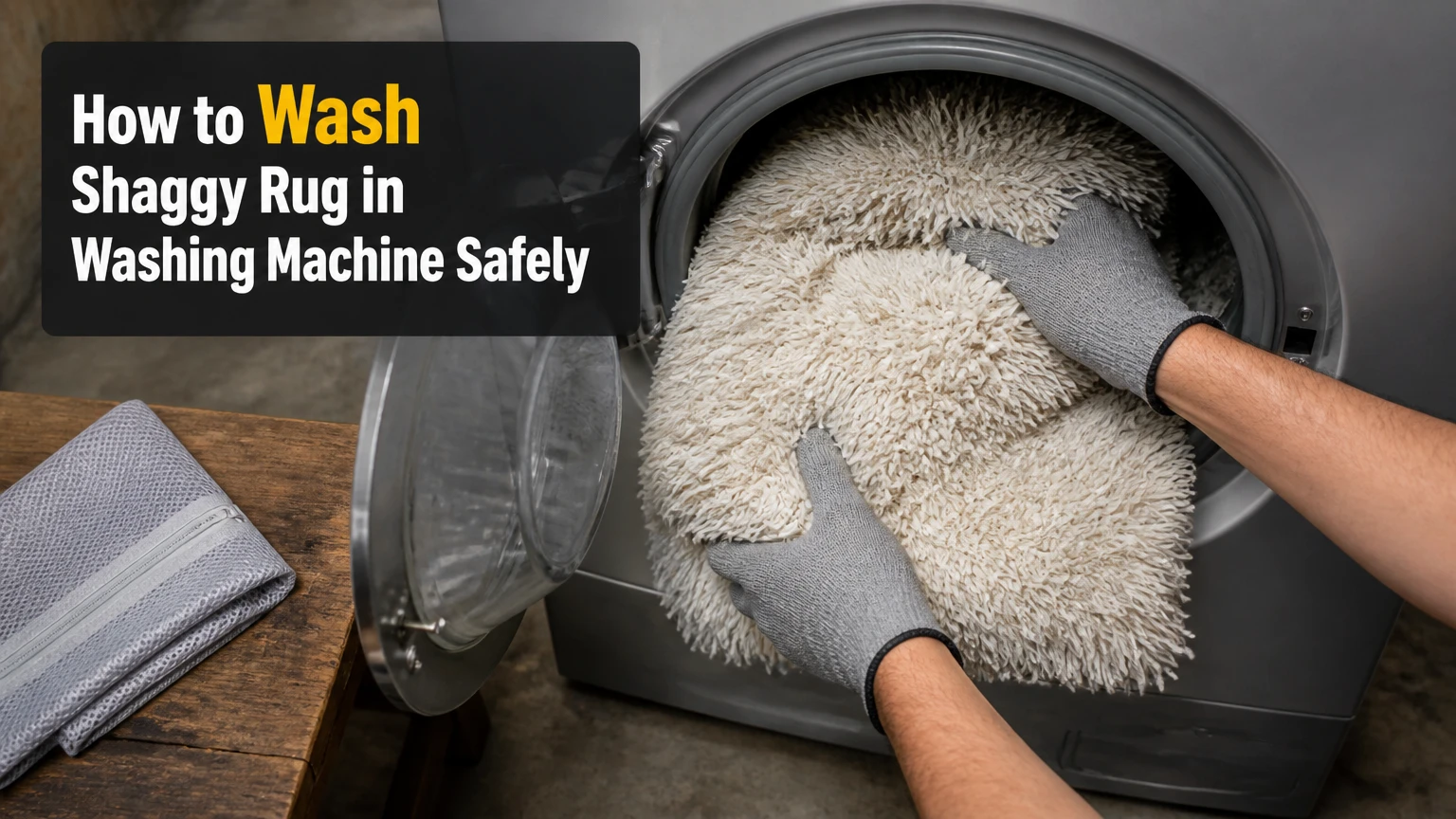
You can wash a shaggy rug in a washing machine only when the care label permits machine washing and the rug is small, lightweight, colorfast, and made from a washable synthetic fiber. Use a cold or 20-30°C delicate cycle, low spin, mild liquid detergent, and complete air drying. Do not machine-wash wool, jute, sisal, fragile latex, or oversized rugs.
Key Facts at a Glance
A machine-washable shaggy rug must pass both a care-label test and a washer-capacity test.
Polyester, nylon, and polypropylene are usually safer choices than wool, jute, sisal, or delicate cotton.
Remove grit and pet hair before washing because abrasive debris can damage fibers, seals, and the washer pump.
Use 20-30°C water, a delicate cycle, low spin, and approximately 15-30 mL of mild liquid detergent for one small rug.
Air drying typically takes 24-48 hours, depending on pile depth, humidity, airflow, and backing thickness.
A musty smell, cracking backing, color transfer, or severe washer imbalance means the rug needs a different cleaning method.
Can You Wash a Shaggy Rug in a Washing Machine?
A small synthetic shaggy rug with a washable label can usually go into a residential washing machine. The decision depends on four physical properties: fiber type, backing condition, dry weight, and whether the rug can move freely inside the drum without filling it tightly.
A shag rug is a floor covering with long, loose fibers, commonly about 25-75 mm deep. That pile holds more water and air than a low-pile mat, so the rug becomes heavy during the wash and can form a dense, unbalanced bundle during spinning. The backing can also separate if heat, aggressive agitation, or chemical exposure weakens its adhesive.
Do not rely on the phrase “synthetic” alone. A polyester rug with a brittle latex backing may be less washable than a polypropylene rug with a flexible woven backing. The care label remains the controlling instruction because manufacturers know the construction, dye, adhesive, and backing combination.
The washer-capacity test
Use a large front-loading washer when possible. A small shag rug should occupy no more than roughly two-thirds of the washer’s usable drum space when dry, leaving room for water circulation and movement.
The 60% load rule is a practical safety margin, not a universal engineering standard. A rug that weighs 2 kg dry may hold several kilograms of water, but the exact increase depends on fiber density and backing. If you must force the rug through the door, wash it in a bathtub or use a commercial machine instead.
Which Materials Can Go in the Washer?
Polyester, nylon, and polypropylene shag rugs are the most likely to tolerate machine washing, but the manufacturer’s label and backing still determine eligibility. Wool, jute, sisal, sheepskin, and fragile rubber-backed rugs generally require surface cleaning, specialized washing, or professional care.
| Rug material or construction | Machine decision | Main risk | Safer approach |
|---|---|---|---|
| Polyester shag | Usually suitable if labeled washable | Heat distortion or backing failure | 20-30°C, delicate cycle, air dry |
| Nylon shag | Usually suitable if labeled washable | Dye bleeding and snagging | Colorfastness test, low spin |
| Polypropylene or olefin | Often suitable | Heat can deform fibers | Cold wash, no dryer |
| Cotton shag | Conditional, small sizes only | High water absorption and shrinkage | Wash a small labeled mat, low spin |
| Acrylic or faux fur | Conditional | Matting, tangling, shedding | Mesh bag, cold wash, gentle brushing |
| Wool or Flokati | Usually unsuitable | Felting, shrinkage, distortion | Follow wool label or use a rug specialist |
| Jute, sisal, or seagrass | No household machine | Swelling, staining, fiber breakage | Dry soil removal and low-moisture cleaning |
| Latex or brittle rubber backing | Usually unsuitable | Cracking, flaking, adhesive release | Spot clean or replace if backing deteriorates |
Wool is not automatically “dry-clean only,” and professional dry cleaning is not suitable for every wool rug. Some wool products are designed for specialized wet cleaning, while others require low-moisture methods. The Woolmark Company advises following the product care label because wool treatments differ by construction and finish.
A rug with powdery black flakes, sticky latex, visible cracks, or a strong chemical smell should not enter the washer. Water may loosen the backing, while loose particles can spread through the drain system.
What Should You Do Before Washing?
Prepare the shaggy rug outdoors or over a hard floor, remove loose contamination, test the dyes, and inspect the backing before adding water. Preparation commonly takes 10-20 minutes and prevents grit, hair, and unstable backing material from creating larger problems inside the washer.
Step 1: Shake and vacuum the rug
Take the rug outside and shake it firmly, or hang it over a railing and tap the back with your hand. Avoid beating delicate latex or old woven backings because impact can release adhesive and fibers.
Vacuum both sides using suction only. Turn off the rotating beater bar or brush roll, since long shag fibers can wrap around the roller and pull yarn from the backing. Use a crevice tool around the edges, where grit collects and can abrade the floor underneath.
For pet hair, scrape the dry pile lightly with a rubber squeegee or grooming glove before vacuuming. Do not saturate hair first. Wet pet hair can bind into the pile and make removal harder.
You will know Step 1 worked when no visible grit falls from the rug after a firm shake and the vacuum can run across the pile without collecting large debris.
Common mistake: vacuuming only the top surface. Dirt beneath a shag rug can return through the pile during washing.
Step 2: Test colorfastness and spot-treat stains
Mix a small amount of mild liquid laundry detergent with cool water. Apply the solution to a hidden corner using a white cloth, wait five minutes, and press with a second dry white cloth. Stop if dye transfers or the backing becomes tacky.
For ordinary food or soil stains, blot from the outside toward the center. Use approximately 5 mL of diluted detergent solution for a stain smaller than a dinner plate, then remove residue with a damp cloth. Avoid soaking the backing.
Grease, red wine, permanent marker, rust, and old pet urine may need specialized treatment. A washing machine can spread a stain through wet fibers rather than remove it, especially when the contaminant has penetrated the backing.
You will know Step 2 worked when the stain has lightened without color transfer, the treated area feels only slightly damp, and no detergent film remains.
Common mistake: scrubbing aggressively. Scrubbing bends and knots long fibers, creating a permanently rough patch.
How to Wash Shaggy Rug in Washing Machine
Wash the prepared rug alone on a delicate cycle with 20-30°C water, low spin, and 15-30 mL of mild liquid detergent. Fold the rug loosely with the pile facing inward, place it in a large mesh bag if the construction allows, and stop the cycle if the washer begins repeated violent imbalance.
Step 3: Load the rug without compressing it
Fold the rug loosely into a broad rectangle or roll it with the pile inward. Do not make a tight cylinder, because compact folds prevent detergent and water from reaching the center.
A large zippered mesh laundry bag can reduce snagging on a washable synthetic rug. The bag must be large enough for the rug to move. A small bag compresses the pile, produces poor cleaning, and increases imbalance.
Wash the rug by itself. Do not add clothing, towels with zippers, shoes, or items with hooks. A second similarly sized washable rug can sometimes balance a front-loader, but only when the washer manual permits mixed bulky loads and the combined dry weight remains within capacity.
You will know Step 3 worked when the door closes without force, the rug occupies about half to two-thirds of the drum, and the pile is not packed into a hard mass.
Common mistake: stuffing an oversized rug into the washer because it technically fits through the door.
Step 4: Select the cycle and detergent
Choose Delicate, Gentle, Hand Wash, or the manufacturer’s washable-rug setting. Use cold water or 20-30°C, low or medium-low spin, and approximately 15-30 mL of mild liquid detergent for a small rug.
Avoid powdered detergent when possible because powder can lodge in deep pile. Never use chlorine bleach, oxygen bleach without label approval, fabric softener, antibacterial additives, or strong solvents. Fabric softener coats fibers, can reduce absorbency, and may make the pile attract soil or mat.
The following settings are practical starting points, but the care label overrides them.
| Washer control | Recommended setting | Why it matters | Do not choose |
|---|---|---|---|
| Water temperature | Cold or 20-30°C | Limits shrinkage and adhesive damage | Hot or sanitizing cycles |
| Cycle | Delicate or Gentle | Reduces agitation and fiber stress | Heavy duty or bedding cycle |
| Spin | Low, approximately 400-800 rpm | Reduces backing strain and imbalance | Maximum-speed spin |
| Detergent | 15-30 mL mild liquid | Limits residue in deep pile | Bleach, softener, solvent |
| Load | One small rug | Preserves movement and balance | Full drum with clothes |
Run an extra rinse if the pile feels slippery after washing. Residual detergent can attract dust and leave the fibers stiff when dry.
You will know Step 4 worked when the rug is wet throughout, the machine remains stable, and the rinse water contains no visible suds at the end of the cycle.
Common mistake: selecting a high-temperature “hygiene” program to remove odors. Heat is more likely to damage a synthetic backing than to solve the odor source.
How Should You Remove Water and Dry the Rug?
Remove a shaggy rug from the washer immediately, support its full weight, and dry it flat or over a broad ventilated rack for 24-48 hours. Do not wring, twist, or place the rug in a heated tumble dryer unless the manufacturer explicitly approves that method.
Step 5: Extract water without wringing
Lift the rug with both hands or support it in a laundry basket. A saturated shaggy rug can stretch at the edges if lifted by one corner.
For a small rug, place it on clean, absorbent towels, roll it loosely, and press along the roll. Unroll, replace saturated towels, and repeat once. For a larger rug, use a shower floor or slatted drying rack so water can drain without sharp folds.
Do not twist the rug to force water out. Twisting places uneven tension on the backing, which can create curling, delamination, or permanent distortion.
You will know Step 5 worked when the rug feels damp rather than dripping and no standing water emerges when you press the pile gently.
Common mistake: leaving the wet rug in the closed washer for several hours. Enclosed moisture encourages odor and can transfer dye between folded sections.
Step 6: Air-dry with ventilation
Lay the rug flat on a clean drying rack, or drape it over a broad shower rod only when the rug is small and the rod can support the wet weight. Position a fan nearby, leave interior doors open, and turn the rug every two to four hours during the first day.
Avoid direct high heat from radiators, hair dryers, heat guns, and strong sunlight. Heat can shrink some fibers, harden adhesives, distort plastic fibers, and crack rubber. A shaded outdoor location with moving air can work, provided rain, pollen, and prolonged ultraviolet exposure are controlled.
Check the thickest part of the pile and the backing, not only the surface. The rug is dry when both sides feel room-temperature and no cool, damp area remains after pressing a dry paper towel into the deepest pile.
| Drying condition | Typical timeframe | Required action | Failure risk |
|---|---|---|---|
| Warm, dry room with fan | 12-24 hours | Turn every 2-4 hours | Low if backing is thin |
| Average indoor humidity | 24-48 hours | Elevate and ventilate both sides | Musty odor |
| Thick cotton or dense shag | 36-72 hours | Use a rack, fan, and frequent turning | Stretching and mildew |
| Cold or humid basement | More than 48 hours | Move to a warmer ventilated room | Persistent dampness |
| Direct heater exposure | Not recommended | Use airflow instead | Shrinkage or backing damage |
The U.S. Environmental Protection Agency recommends drying wet materials promptly and controlling indoor humidity to reduce mold risk. That principle applies to rugs: fast, ventilated drying is safer than sealing a damp pile in a warm room.
Step 7: Restore the pile after complete drying
Fluff the rug only after the backing and deepest pile are completely dry. Use your fingers, a wide-tooth comb, or a soft upholstery brush, working in small sections from the backing outward.
A slicker pet brush may restore some synthetic shag, but it can pull loops or cut fragile fibers. Test it on a hidden edge first. Do not steam acrylic, polypropylene, rubber-backed, or adhesive-based rugs unless the care label specifically permits steam, because heat and moisture can compound matting.
You will know Step 7 worked when the pile separates into individual tufts without pulling from the backing and the rug lies flat without a damp center.
Common mistake: brushing aggressively while the rug is still wet. Wet fibers stretch easily, and brushing can lock them into uneven clumps.
Which Cleaning Method Is Best for Your Rug?
A washing machine is the least expensive convenient option for a small labeled synthetic rug, while a laundromat or professional cleaner is safer for larger, heavier, older, or valuable rugs. Low-moisture spot cleaning is the best alternative when the backing or fiber cannot tolerate full immersion.
| Cleaning method | Suitable rug size | Typical cost | Typical time | Main limitation |
|---|---|---|---|---|
| Home washing machine | Small, usually up to about 4 x 6 feet if light | $2-$8 | 1-2 days including drying | Washer imbalance and backing damage |
| Commercial laundromat | Medium to large washable rugs | $8-$25 | 2-3 hours plus drying | Transport and shared equipment |
| Professional rug cleaner | Valuable, oversized, wool, or fragile rugs | $75-$250 or more | 3-10 days | Higher price and appointment time |
| Low-moisture surface cleaning | Any size with stable surface fibers | $5-$30 DIY | 30-90 minutes | Does not flush contamination from backing |
| Outdoor hose cleaning | Labeled synthetic outdoor rugs | $5-$20 | 1-3 days | Requires clean drying area and suitable weather |
Prices are typical consumer ranges, not fixed quotes. Local labor, rug size, stain severity, pickup service, and fiber type can change the final price substantially.
When is a laundromat safer?
A laundromat is safer when the rug is washable but too large or heavy for the household washer. Choose a front-loading commercial machine rather than a top-loader with a central agitator, and check the laundromat’s posted capacity before loading the rug.
A commercial washer does not make a non-washable rug washable. Wool, jute, fragile latex, and antique rugs can still shrink, bleed, or delaminate in a larger drum.
When should you hire a professional?
Use a rug specialist for wool, sheepskin, Flokati, antique, hand-knotted, silk-blend, heavily soiled, or expensive rugs. Professional cleaning is also appropriate when the rug has urine saturation, floodwater exposure, mold growth, or a backing that is already cracking.
The best professional is not necessarily a general carpet cleaner. Ask whether the provider identifies fiber content, tests for dye stability, and explains the drying method before accepting the rug.
What Can Go Wrong After Machine Washing?
Most failures come from unsuitable construction, excess water, heat, or incomplete drying rather than from the detergent itself. A damaged backing, severe imbalance, dye bleed, odor, or matted pile requires a different recovery step.
The washer shakes or stops during spin
Pause the cycle and redistribute the rug around the drum. If the machine repeatedly stops, remove the rug and extract water by towel-rolling instead of forcing another high-speed spin.
Repeated imbalance can damage suspension components, especially in older top-loaders. A rug that repeatedly bunches is too large, too absorbent, or too dense for that machine.
The backing flakes or the rug curls
Stop using heat and do not wash the rug again. Allow the rug to dry flat, remove loose flakes outdoors, and assess whether the backing still holds the pile securely.
Cracking latex or rubber is a construction failure, not a stain problem. Replacement is often safer than trying to re-glue a floor covering that will continue shedding particles.
The rug smells musty
Dry the rug completely in a ventilated room with a fan. If odor remains, inspect the backing and deepest pile for dampness before repeating any cleaning process.
White vinegar may reduce some household odors, but it is not a guaranteed disinfectant or mold treatment, and acidic solutions can affect dyes or backing. Do not pour a cup of vinegar into the washer as a universal remedy. For visible mold or sewage contamination, use a professional remediation service.
The pile is flat or matted
Wait until the rug is fully dry, then separate clumps gently with fingers or a wide-tooth comb. For severe matting, stop before using steam or a powered brush because heat and aggressive brushing can permanently damage synthetic fibers.
Some faux-fur and acrylic rugs never regain their original loft after immersion. That limitation should be accepted before washing, especially when the rug has a long, delicate pile.
Colors bleed
Remove the rug promptly and rinse it in cold water only if the care label permits further wet handling. Keep the rug flat while drying and avoid applying heat, which can set some dyes.
If bleeding is extensive, professional dye correction may be possible, but home stain removers often make the contrast worse. Test every product on a hidden area first.
How Often Should a Shaggy Rug Be Washed?
Wash a labeled synthetic shaggy rug only when surface cleaning no longer controls soil, commonly every 3-6 months in a low-traffic room and more often in homes with pets or young children. Vacuuming without a brush roll once or twice weekly reduces the need for full immersion.
Spot-clean spills immediately, rotate the rug every one to three months to distribute wear, and use a rug pad that does not trap moisture. A rug pad also reduces sliding, but the pad itself should be cleaned separately according to its material.
Full washing is not automatically healthier than vacuuming. Repeated soaking can shorten the life of latex, adhesive, cotton, and low-quality synthetic backings.
Variations for Common Situations
Washing a small bathroom shag mat
Confirm that the mat has a machine-washable label and no deteriorating rubber. Wash it separately at 20-30°C with low spin, then dry both sides thoroughly before returning it to a humid bathroom.
Bathroom mats dry more slowly than they appear to because dense pile and non-slip backing retain water. A fan is especially useful after washing.
Cleaning a pet-soiled shag rug
Remove solid material, blot liquid, and use an enzyme cleaner only when the label and fiber manufacturer permit it. Rinse residue thoroughly because enzyme products left in deep pile can create odor or attract soil.
Severe urine contamination that reaches the backing may not be removable in a household washer. Professional extraction is more reliable when odor returns after drying.
Washing a large synthetic area rug
Do not force a large rug into a household drum. Check the dry weight, roll diameter, and care label, then use a laundromat’s commercial front-loader or a professional cleaner.
A large rug can exceed the washer’s safe wet-load limit even when the dry fabric seems light. The water weight, not the floor area alone, determines the mechanical risk.
Frequently Asked Questions
Can I wash a shaggy rug with clothes or towels?
No. Wash a shaggy rug alone unless the manufacturer specifically permits another washable rug for balance. Clothing hardware, towels, lint, and loose dyes can snag long fibers or transfer debris, while a bulky rug may prevent smaller items from cleaning properly.
Can I put a shaggy rug in a front-loading washer?
A front-loader is generally preferable because it has no central agitator and usually handles bulky items more gently. The rug still needs a washable label, adequate drum space, stable backing, and a dry weight within the manufacturer’s load limit.
Can I use laundry pods on a shaggy rug?
Liquid detergent is easier to dose for a small rug and dissolves more consistently in a short delicate cycle. A pod may deliver more detergent than necessary, leaving residue in deep pile, particularly in a high-efficiency washer using limited water.
Can I dry a synthetic shaggy rug in a dryer?
Only use a dryer when the rug’s care label explicitly permits it and specifies a suitable temperature. For most shaggy rugs, air drying is safer because heat can distort polypropylene, weaken adhesives, shrink cotton, and crack rubber or latex backing.
What is the safest alternative when machine washing is prohibited?
Vacuum with suction only, spot-treat with a label-approved diluted cleaner, blot rather than scrub, and dry each treated area quickly. For full-depth soil, animal contamination, wool, jute, antique construction, or unstable backing, use a rug-cleaning professional.
The Bottom Line
How to wash shaggy rug in washing machine safely depends on eligibility more than on detergent or cycle selection. Machine-wash only a small, labeled, colorfast rug with a stable washable backing, use 20-30°C water and low spin, then air-dry it completely for 24-48 hours. If the rug is wool, jute, oversized, valuable, or deteriorating, choose low-moisture cleaning, a commercial machine, or professional rug care instead.