
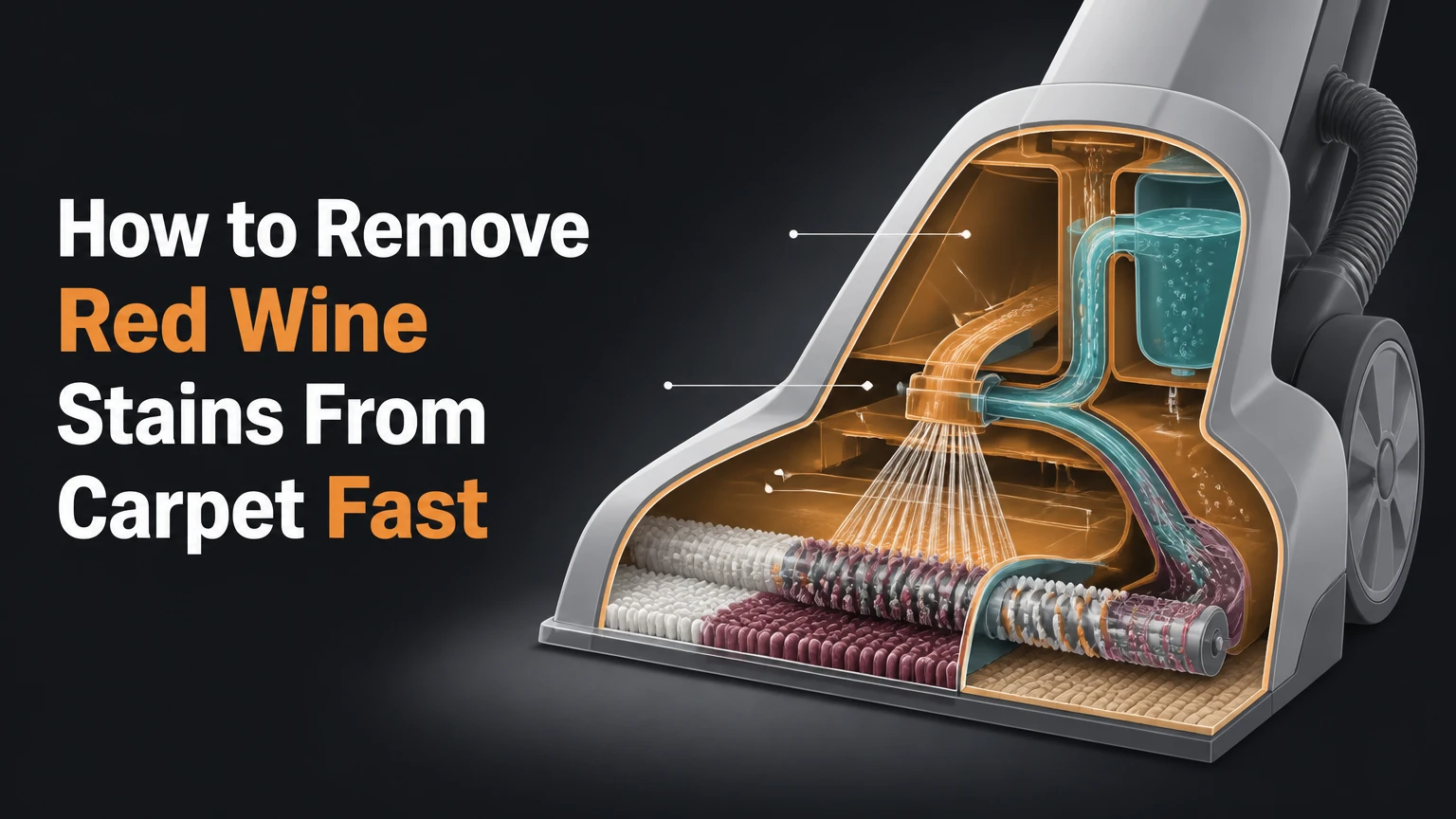
To remove red wine stains from carpet, blot the spill immediately, dilute the remaining wine with a small amount of cool water, then apply a carpet-safe spot treatment and blot until the towel stays clean. Fresh stains usually take 10-30 minutes to treat; dried, wool, silk, sisal, or pad-soaked stains require more caution.
Key Facts at a Glance
Blotting removes more wine than scrubbing because scrubbing drives liquid into the pile and backing.
Use white towels and cool water; colored cloths can transfer dye, while excessive heat can damage fibers or set some dyes.
A 3% hydrogen peroxide solution can remove color from some carpets, so patch testing is mandatory.
Wool, silk, viscose, sisal, and unknown-fiber carpets should not receive peroxide, vinegar, or repeated soaking without manufacturer guidance.
Salt and baking soda absorb surface moisture, but neither reliably removes pigment already bonded to carpet fibers.
A stain that returns after drying usually indicates wicking from the backing or carpet pad, not a need for more aggressive scrubbing.
Why Red Wine Stains Are Difficult to Remove
Red wine stains contain water, alcohol, sugars, tannins, and anthocyanin pigments from grape skins. Anthocyanins create the red, purple, and blue tones, while tannins and sugars help leave a sticky residue that can hold pigment in carpet fibers.
Carpet construction determines the difficulty. Nylon and polyester are generally more tolerant of controlled water-based cleaning, while wool, silk, viscose, and plant fibers can shrink, brown, bleed, or lose texture when overwet or exposed to unsuitable chemistry. The Carpet and Rug Institute recommends checking care instructions and testing cleaning solutions in an inconspicuous area before treatment.
Fresh wine is easier to remove because much of the liquid remains above the backing. A dried mark is harder because evaporation leaves concentrated pigment and residue behind. Drying does not always make a stain chemically permanent, but repeated heat, oxidation, and previous cleaning can make removal incomplete.
What makes a stain “set”?
A red wine stain is considered set when ordinary blotting and water dilution no longer remove visible pigment. The stain may still respond to a suitable reducing or oxidizing product, but the risk of changing the carpet’s original dye rises as treatment strength increases.
Professional cleaner rule of thumb: stop escalating when the towel shows little transfer but the carpet color itself begins changing. Removing the last trace of red is not worthwhile if the treatment creates a pale patch.
Before You Start
Prepare the materials before touching the spill. A controlled treatment uses less liquid, reduces spreading, and lets you evaluate progress after each cycle.
| Requirement | Typical amount or specification | Purpose |
|---|---|---|
| White paper towels or cotton towels | 8-15 towels | Absorb wine without transferring dye |
| Cool tap water | 60-120 milliliters per cycle | Dilute remaining wine |
| Mild clear dish detergent | 1/4 teaspoon | Loosen oily and sugary residue |
| White spray bottle or bowl | 1 container | Mix and apply solution accurately |
| Household measuring spoon | 1 tablespoon and 1 teaspoon | Prevent overconcentration |
| Fan or open window | 1 airflow source | Dry the carpet and limit wicking |
| Plastic bag or tray | 1 | Hold used towels and prevent secondary transfer |
Time: 10-30 minutes for a fresh, small spill; 1-3 hours for a dried or repeatedly treated mark.
Difficulty: Moderate for synthetic carpet, high for natural or unidentified fibers.
Typical cost: $0-$5 with household materials, $8-$15 for a dedicated wine remover, or $100-$300 for professional room cleaning.
Before applying liquid, identify the carpet if possible. Look for a manufacturer label, spare offcut, rental inventory description, or fiber information under an area rug. If the carpet is wool, silk, viscose, sisal, jute, antique, hand-dyed, or valuable, use only the maker’s approved method or contact a rug professional.
How to Remove Red Wine Stains From Carpet
The safest general sequence is: remove liquid, dilute sparingly, apply one tested treatment, rinse residue, and dry quickly. Complete the steps in order rather than combining vinegar, baking soda, peroxide, and commercial products.
Step 1: Blot the spill immediately
Press a folded white towel or several white paper towels onto the wet area. Apply firm downward pressure for 5-10 seconds, lift, move to a clean section, and repeat from the outside edge toward the center.
Do not scrub, brush, or rub in circles. Friction can fuzz cut-pile carpet, distort loop pile, and push wine through the face yarn into the backing. Replace saturated towels instead of pressing wine back into the carpet.
You’ll know it worked when: the towel shows less red transfer after each press and no liquid beads on the surface.
Common mistake: starting in the middle, which pushes the spill outward and enlarges the treatment area.
Step 2: Remove nearby furniture and protect the floor
Move furniture away from the wet spot. If a furniture leg must remain nearby, place it on a plastic barrier after the carpet is mostly dry, because moisture and acidic residue can stain wood, metal, or floor finishes.
For a large spill, lift removable rugs and inspect the underside. Wine that reaches the rug backing or pad cannot be fully removed by treating only the visible top surface.
You’ll know it worked when: the treatment zone is accessible on all sides and no furniture touches wet carpet.
Common mistake: placing a colored towel under the carpet, which can transfer dye through moisture.
Step 3: Dilute with cool water
Add approximately 15-30 milliliters of cool water to a small fresh stain, then blot immediately with a clean white towel. Repeat two or three times, using a fresh towel section each time.
Do not flood the area. The purpose is to dilute wine that remains in the face fibers, not to drive liquid into the carpet pad. On a shallow synthetic carpet, a total of 60-120 milliliters is typical; thick pile, large spills, and uncertain backing require smaller staged applications.
You’ll know it worked when: the towel receives mostly pale pink or clear moisture rather than dark red liquid.
Common mistake: pouring a glass of water over the mark, which can spread the stain and create wicking.
Step 4: Apply a mild detergent solution
For colorfast synthetic carpet, mix 1/4 teaspoon of clear, mild dish detergent with 250 milliliters of cool water. Apply the solution to a white cloth, not directly to the carpet, and dab from the edge inward.
Allow the solution to sit for 3-5 minutes, then blot repeatedly. Dish detergent is a surfactant, so it helps water detach residue and lower surface tension. It does not bleach anthocyanin pigment and may leave a sticky film if overused.
You’ll know it worked when: the spot looks lighter and the towel shows diluted color without a slippery feel on the fibers.
Common mistake: using concentrated detergent, laundry soap, or colored dish liquid, all of which increase residue or dye-transfer risk.
Step 5: Use a tested oxidizing treatment only when appropriate
For a light-colored, synthetic, colorfast carpet, test ordinary 3% hydrogen peroxide in a hidden location. Wait 10 minutes, blot, and compare the test area after it dries. If there is no lightening, apply a small amount to a white cloth and dab the remaining stain.
A cautious spot mixture is one part 3% hydrogen peroxide to two parts water, with no more than one drop of clear dish detergent per 30 milliliters of mixture. Dwell for 3-5 minutes, keep the area visibly damp rather than saturated, then blot and rinse with a small amount of cool water.
You’ll know it worked when: red or purple pigment fades without the surrounding carpet becoming lighter.
Common mistake: leaving peroxide for 30-60 minutes or applying it repeatedly. Hydrogen peroxide is a mild bleaching agent, and color damage may appear only after drying.
Step 6: Rinse away cleaner residue
Dampen a clean white cloth with cool water and press it over the treated area. Blot with a dry towel, then repeat once or twice until the fibers no longer feel slick.
Rinsing matters because detergent residue attracts soil and can create a dark ring around the former stain. Use the least water that removes the cleaner, especially over carpet pad, laminate flooring, or wood subfloor.
You’ll know it worked when: the carpet feels close to its untreated texture and the towel shows no visible detergent foam.
Common mistake: skipping the rinse because the stain appears gone.
Step 7: Extract moisture and dry the carpet
Place a dry white towel over the spot and stand on it for 10-20 seconds, or apply a flat weight for 30-60 minutes. Replace the towel when damp, then direct a fan across the carpet until the area is fully dry.
Do not seal damp carpet under plastic. Trapped moisture can promote odor, slow drying, and pull dissolved residue back toward the surface. The exact drying time varies with humidity, pile height, backing, and pad thickness; 4-12 hours is typical after controlled spot treatment.
You’ll know it worked when: the carpet matches its surrounding texture and color after complete drying.
Common mistake: judging the result while the carpet is wet, when fibers look darker and temporary color shifts are common.
Which Cleaner Fits Your Carpet?
Synthetic carpet gives the widest DIY margin, while wool and other natural fibers need a low-moisture, low-chemical approach. Hydrogen peroxide is the strongest household option in this guide, but it is unsuitable for many dark, dyed, or delicate carpets.
| Carpet or rug material | Safest first action | Avoid without professional approval | Typical DIY risk |
|---|---|---|---|
| Nylon | Blot, cool-water rinse, tested detergent | Unchecked peroxide, chlorine bleach | Moderate color loss |
| Polyester | Blot, cool-water rinse, mild detergent | High-alkaline cleaners, excess heat | Moderate residue |
| Olefin or polypropylene | Blot, detergent, careful rinse | Solvent spotters, aggressive brushing | Low-to-moderate spreading |
| Wool | Blot, minimal cool water, wool-approved cleaner | Peroxide, vinegar, alkaline powder | Shrinkage, browning, dye bleed |
| Silk or viscose | Remove surface liquid only | Water saturation, peroxide, vinegar | High texture and color damage |
| Sisal, jute, or seagrass | Dry blotting, specialist advice | Wet DIY treatment | Browning, distortion, shrinkage |
Is vinegar safe for red wine stains?
White vinegar is not automatically safe for wool, silk, viscose, or plant-fiber carpet. On colorfast synthetic carpet, a cautious solution of 1 tablespoon white vinegar, 1/4 teaspoon clear dish detergent, and 500 milliliters of cool water can help with residue, but the solution must be patch tested and rinsed.
Vinegar changes pH; it does not reliably dissolve every wine pigment. Never mix vinegar with hydrogen peroxide in the same container, because household cleaning mixtures should remain separate and controlled. Vinegar’s odor also makes it a poor choice where rapid occupancy matters.
Do salt, baking soda, or club soda work?
Salt and baking soda can absorb some surface moisture, but they are not dependable pigment removers. Club soda offers no special stain-removal chemistry beyond water and dissolved carbon dioxide, so plain cool water is usually just as useful.
| Home remedy | What it actually does | Best use | Main limitation |
|---|---|---|---|
| Table salt | Absorbs some surface liquid | Fresh, shallow spill | Leaves crystals and does not extract pad |
| Baking soda | Absorbs moisture and odor | Residue after blotting | Alkalinity can shift wine color and leave powder |
| Club soda | Adds water and mild carbonation | Emergency dilution | No proven advantage over cool water |
| White vinegar | Lowers pH and helps residue release | Tested synthetic carpet | Can damage or discolor delicate fibers |
| Cool water | Dilutes soluble wine residue | First-line treatment | Cannot remove all dried pigment |
Do not pour baking soda onto a heavily wet carpet and then scrub it in. The powder can cake in the pile, and an alkaline product may turn red wine purple or blue temporarily.
Which Method Is Best for Your Situation?
The best method depends on carpet fiber, stain age, spill volume, and whether the wine reached the pad. Fresh synthetic-carpet spills favor blotting plus mild detergent; natural fibers and deep contamination favor professional extraction.
| Method | Typical cost | Working time | Suitable carpet | Main drawback |
|---|---|---|---|---|
| Blotting and cool water | $0-$2 | 10-20 minutes | Most fibers | Limited on dried pigment |
| Mild detergent solution | $0-$3 | 20-40 minutes | Colorfast synthetics | Residue if overapplied |
| 3% peroxide treatment | $2-$5 | 15-30 minutes | Tested light synthetics | Can bleach carpet dye |
| Commercial wine remover | $8-$15 | 5-20 minutes | Label-approved fibers | Formula and residue vary |
| Professional extraction | $100-$300 | 1-3 hours plus drying | Deep or valuable carpet | Cost and appointment delay |
Commercial products such as Wine Away and Folex can be practical for frequent hosts because they provide labeled directions and consistent concentration. Follow the product label, check whether the formula is approved for wool or upholstery, and do not assume a product designed for clothing is safe for carpet.
A portable carpet machine can extract dissolved wine from the face and backing, but repeated wet passes can overwet the pad. Professional hot-water extraction is preferable when a large spill penetrates below the surface, especially if the carpet can be lifted for inspection.
What Should You Do About Dried Red Wine?
Dried red wine requires controlled rehydration, not aggressive scrubbing. First vacuum loose debris, place a cool damp white cloth over the mark for 5-10 minutes, then use the detergent or manufacturer-approved spotter appropriate for the fiber.
Work in sections no larger than 10 by 10 centimeters. Blot after each application and allow the carpet to dry before deciding whether another treatment is justified. A dried stain may need two or three low-moisture cycles, while a dark shadow that remains unchanged may represent permanent dye alteration.
For light synthetic carpet only, a patch-tested peroxide treatment can follow detergent cleaning. Do not use peroxide on wool, silk, viscose, sisal, or an expensive hand-dyed rug merely because the stain is old.
How Do You Handle Special Situations?
White or beige synthetic carpet
White and beige nylon or polyester provide the greatest visibility but can reveal peroxide halos. Use the mild detergent process first, then test 3% peroxide in a hidden area and treat only the colored fibers, keeping the application smaller than the original stain.
Dark carpet
Avoid peroxide unless the manufacturer confirms colorfastness. A faint red mark may be less noticeable than an irreversible orange, gray, or pale patch created by oxidation.
Wool or expensive area rug
Blot without rubbing, use minimal cool water, and stop if color transfers from the carpet itself. WoolSafe-approved products and qualified rug cleaners are safer choices than vinegar, baking soda, peroxide, or steam applied at home.
Large spill or soaked pad
If more than approximately 250-500 milliliters reached the carpet, inspect the backing and pad if possible. Remove standing liquid with an extractor, avoid repeated surface spraying, and call a professional when the pad remains wet, odor develops, or the stain reappears.
Rental property
Photograph the spill and the carpet condition before treatment. Use the least aggressive labeled method, retain receipts for a commercial remover or cleaner, and avoid peroxide if the carpet’s fiber and dye are unknown.
Common Mistakes and How to Fix Them
Scrubbing the stain
Problem: Friction spreads pigment, damages pile, and drives wine downward.
Fix: Stop rubbing, place a dry white towel over the spot, and use pressure-release blotting.
Applying too much water
Problem: Excess moisture reaches the backing, spreads laterally, and causes wicking.
Fix: Stop adding liquid, extract with dry towels, and use a fan. Reassess only after complete drying.
Using hot water
Problem: Heat can accelerate dye migration and damage some fibers. The common explanation that hot water “cooks wine proteins” is inaccurate because red wine is not primarily a protein stain.
Fix: Use cool or lukewarm water, never boiling water or a steam iron.
Mixing products
Problem: Vinegar, peroxide, alkaline powders, and commercial chemicals can react unpredictably or create color shifts.
Fix: Rinse and blot one product away before considering another, and never mix peroxide with vinegar or chlorine bleach.
Treating the surface while ignoring the pad
Problem: Moisture below the pile rises as the carpet dries, producing a returning mark.
Fix: Extract from the surface with a weighted towel or machine, then obtain professional pad-level cleaning if wicking persists.
Using colored towels
Problem: Wet carpet can absorb dye from red, blue, or patterned cloth.
Fix: Use white cotton, white microfiber, or plain white paper towels only.
Why Did the Stain Turn Purple or Reappear?
A purple or blue shift usually reflects a pH change in the anthocyanin pigment, while a stain that returns after drying usually reflects wicking from deeper carpet layers. Neither problem is solved by scrubbing harder.
If baking soda or an alkaline cleaner caused a purple mark, remove the product with small amounts of cool water and blot thoroughly. Do not immediately add vinegar or lemon juice; acidifying a carpet without testing can create another color change or damage the fiber. Let the area dry before judging the result.
For wicking, place a slightly damp white towel over the mark, apply flat weight for 30-60 minutes, replace the towel, and use airflow. If the stain returns after one controlled extraction cycle, the backing or pad needs deeper treatment.
When Should You Hire a Professional?
Hire a professional when wine covers more than about 0.1 square meter, reaches the pad, returns after drying, or affects wool, silk, viscose, antique, or hand-dyed carpet. Professional cleaning is also sensible when a landlord, insurer, or rug dealer requires documented treatment.
Typical residential carpet cleaning costs range from $100-$300 for a room or service visit, with drying commonly taking 6-24 hours depending on extraction quality and ventilation. Ask whether the cleaner will inspect the backing, identify the fiber, use a pH-appropriate product, and protect adjacent flooring.
Professional extraction cannot restore carpet dye that peroxide has already removed. A cleaner can often remove residual wine and reduce a shadow, but no treatment guarantees an invisible result when the original fiber color has changed.
How Much Time and Money Should You Expect?
A fresh surface spill usually takes 10-30 minutes and costs nothing if towels and water are available. A dried stain may require 30-90 minutes of active work plus overnight drying, while a professional visit typically costs $100-$300.
| Situation | Active treatment | Drying period | Typical out-of-pocket cost |
|---|---|---|---|
| Fresh, 5-centimeter synthetic spot | 10-20 minutes | 2-6 hours | $0-$2 |
| Fresh, 15-centimeter spill | 20-40 minutes | 4-12 hours | $0-$5 |
| Dried synthetic stain | 30-90 minutes | 6-24 hours | $0-$15 |
| Wool or silk rug | 10-20 minutes before referral | Specialist-dependent | $25-$150 plus transport |
| Pad-soaked or recurring stain | 1-3 hours professionally | 6-24 hours | $100-$300 |
The deciding factor is not the product price. It is whether the selected treatment matches the carpet’s fiber and limits moisture below the pile.
FAQ
Can I remove red wine from carpet without vinegar?
Yes. Blot the spill, apply small amounts of cool water, and use a mild clear detergent solution on colorfast synthetic carpet. Vinegar is optional and not automatically safer, especially for wool, silk, viscose, sisal, or hand-dyed rugs.
Does white wine remove a red wine stain?
No reliable household method uses white wine to remove red wine from carpet. White wine adds moisture and acidity but does not extract the full pigment load. Blotting followed by controlled cool-water dilution is more predictable and leaves less residue.
Can I use rubbing alcohol on a red wine stain?
Avoid rubbing alcohol unless the carpet manufacturer or a qualified cleaner approves it. Alcohol can affect carpet dyes, backing adhesives, and protective treatments, while its rapid evaporation may leave the pigment behind. Use a labeled carpet spotter instead.
How do I remove red wine from carpet the next morning?
Rehydrate the dried mark with a cool damp white cloth for 5-10 minutes, blot, then apply a fiber-appropriate detergent or labeled remover. Test peroxide only on light, synthetic, colorfast carpet. Stop after two or three cycles if the color does not improve.
Will a carpet cleaner remove an old red wine stain?
A carpet cleaner can remove residual wine from carpet fibers and pad, particularly with professional extraction, but it cannot restore dye that has been bleached, permanently altered, or transferred. Tell the technician which products and amounts were previously applied.
How do I stop a red wine stain from coming back?
Extract moisture from the backing, not only the carpet surface. Use dry weighted towels, replace them as they become damp, and run a fan across the area. If the mark returns after full drying, professional pad-level extraction is usually needed.
The Bottom Line
To remove red wine stains from carpet, blot first, dilute with small amounts of cool water, use a mild tested treatment, rinse away residue, and dry the area quickly. Peroxide can help light synthetic carpet but can bleach dyes, while wool, silk, viscose, sisal, large spills, and recurring stains deserve professional care.