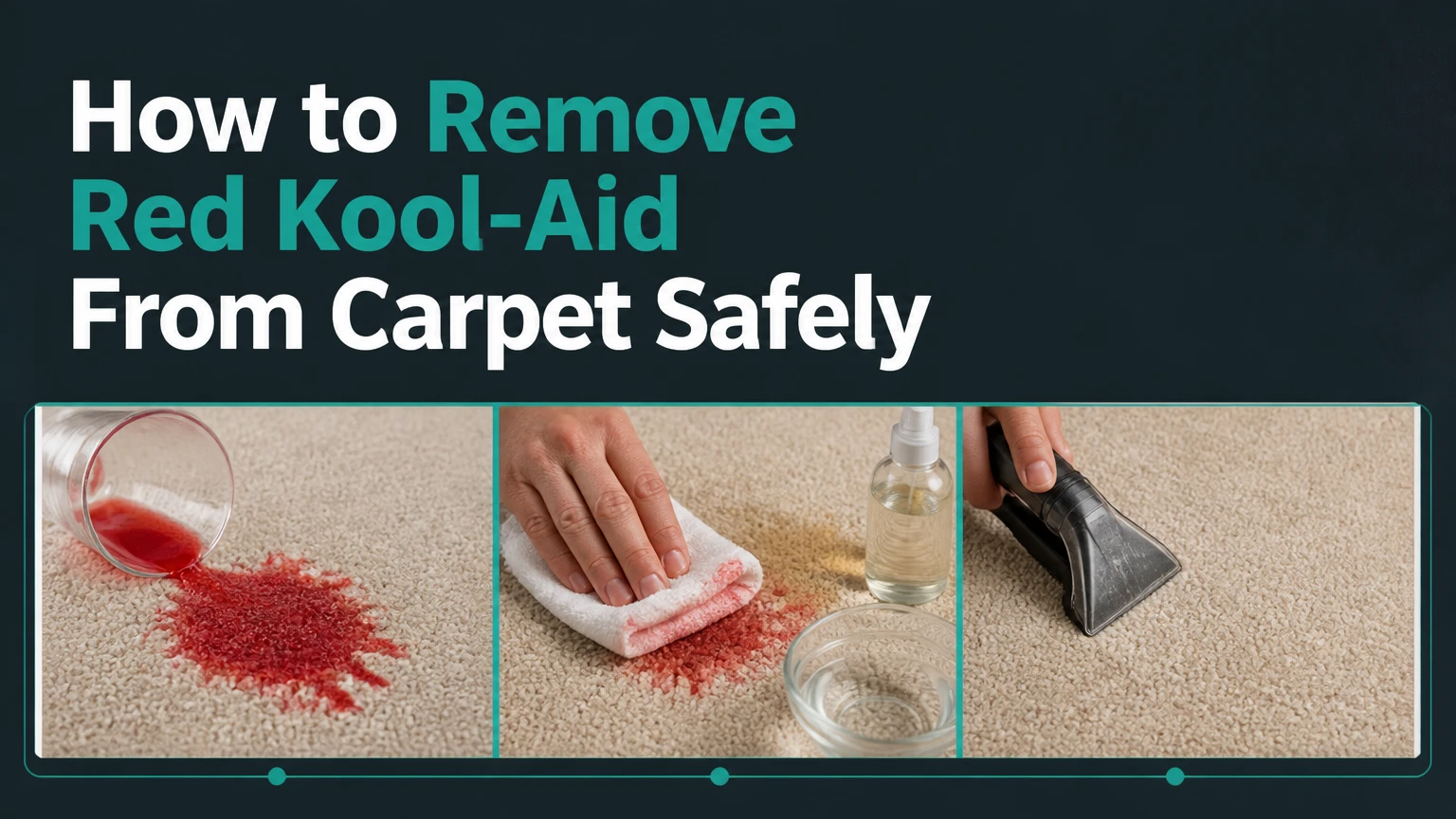
To remove Red Kool-Aid from carpet, blot the liquid immediately, apply a small amount of diluted clear dish detergent, rinse with cool water, and extract moisture with white towels. The carpet fiber determines the safe next step: synthetic carpet may tolerate a labeled dye remover, while wool requires gentle treatment or professional cleaning.
Key facts
Red Kool-Aid is a water-based drink containing food coloring, commonly including Allura Red AC, also called Red 40.
Fast blotting removes more dye before the color migrates into the face fiber, backing, or pad.
Scrubbing spreads liquid and damages carpet tips; pressing and lifting is safer.
A damp towel and low-moisture application are safer than placing a hot iron directly over carpet.
Wool, silk, antique rugs, viscose, and unknown fibers need a conservative approach.
A stain that returns after drying usually indicates wicking from deeper carpet or padding.
Before You Start
Red Kool-Aid removal usually takes 15-30 minutes for a fresh spot and 30-90 minutes for a set-in stain, excluding drying. The method is low difficulty, but the risk rises sharply when a cleaner uses excessive water, heat, or an incompatible chemical.
| Item | Typical specification | Purpose |
|---|---|---|
| White absorbent towels | 6-10 towels, at least 12 by 12 inches | Blotting and moisture extraction |
| Clear dish detergent | 1 teaspoon | Surfactant for the cleaning solution |
| Cool or lukewarm water | 2 cups for solution, 1 cup for rinsing | Dilution and residue removal |
| White spray bottle or bowl | 16-ounce capacity | Controlled application |
| Soft white cloth | 1-2 pieces | Gentle agitation at fiber level |
| Wet vacuum or extractor | 1 machine, optional | Removing liquid from backing and pad |
| Nitrile gloves | 1 pair | Skin protection during chemical treatment |
Use white towels because colored fabric can transfer dye. Vacuum loose particles around the spill, but do not vacuum a wet stain with a standard household vacuum. Read the carpet manufacturer’s care label if one is available.
Identify the Carpet Fiber
Carpet fiber changes the acceptable pH, temperature, dwell time, and chemical choice. Nylon can hold red dye strongly, polyester generally resists water-based color, triexta often releases fresh drink stains readily, and wool can suffer fiber damage or color change from alkaline cleaners and heat.
| Fiber or construction | Typical stain behavior | Safer home approach | Avoid |
|---|---|---|---|
| Nylon | Red dye may bond strongly and remain after drying | Blot, dilute detergent, rinse, then consider labeled dye remover | High heat, prolonged wetting, aggressive scrubbing |
| Polyester | Drink usually remains near the surface | Cool water, mild detergent, thorough extraction | Solvent products not labeled for PET carpet |
| Triexta | Built-in stain resistance often helps with fresh spills | Water first, then very dilute detergent | Strong chemicals before testing |
| Wool | Protein fiber can felt, fade, or become alkaline-damaged | Blot and use wool-approved neutral cleaner | Ammonia, chlorine bleach, steam, high heat |
| Viscose or rayon | Water can distort or brown the fiber | Stop and consult a rug or textile cleaner | Saturation and repeated rubbing |
| Unknown or antique rug | Construction and dyes may be unstable | Blot only until identified | DIY oxidizers, reducers, and heat |
Check a hidden edge by touching a white cloth dampened with the proposed solution to the carpet for 10 seconds. Stop if the cloth picks up the carpet’s own color, the fibers become rough, or a lighter ring appears after drying.
How to Remove Red Kool-Aid From Carpet
The safest sequence is absorb, dilute, lift, rinse, and dry. Use no more liquid than necessary, because the goal is to move dye into a towel or extractor rather than drive it through the carpet.
Step 1: Remove Excess Kool-Aid
Place several folded white towels over the wet area and press straight down for 10-15 seconds. Replace the towel as soon as it becomes pink or wet, working from the outside edge toward the center.
Do not rub in circles. Rubbing pushes dye sideways, roughens the pile, and can force colored liquid into the carpet backing. Continue until a dry towel picks up little or no liquid.
Success checkpoint: The carpet feels damp rather than wet, and the stain edge is no longer expanding.
Common mistake: Lifting the towel too quickly. Short, firm pressure extracts more liquid than rapid dabbing.
Step 2: Prepare a Diluted Detergent Solution
Mix 1 teaspoon of clear, dye-free dish detergent with 2 cups of cool or lukewarm water. Do not use concentrated detergent directly on the carpet, because soap residue can attract soil and create a stiff, dark patch.
For wool, use a product specifically labeled for wool or fine textiles, preferably near neutral pH. Do not assume a homemade vinegar, ammonia, or baking-soda mixture is fiber-safe.
Apply the solution with a cloth or spray bottle, using about 1-2 tablespoons per square foot. The carpet should become damp, not saturated.
Success checkpoint: The solution wets the stained fibers without forming a puddle or reaching the floor beneath.
Common mistake: Pouring a cup of cleaner onto a small spot. Excess moisture is a leading cause of wicking and backing damage.
Step 3: Blot the Dissolved Dye
Press a clean white cloth onto the dampened stain, hold it for 5-10 seconds, and lift vertically. Rotate to a clean section after every few presses. Work inward from the perimeter, then treat the center.
Surfactants in dish detergent loosen drink residue and help suspend dye in the moisture. Detergent does not guarantee chemical destruction of Red 40, so repeated low-moisture extraction is safer than increasing the detergent concentration.
Allow the solution to dwell for 3-5 minutes on synthetic carpet. Limit wool to the product label’s dwell time, often less than 5 minutes.
Success checkpoint: Pink or red color transfers to the cloth while the carpet becomes visibly lighter.
Common mistake: Scrubbing harder when the first pass leaves color. Use a fresh cloth and another controlled pass instead.
Step 4: Rinse Away Detergent
Dampen a new white cloth with cool water and press it over the treated area. Follow with dry towels, repeating the water-and-blot cycle two or three times.
Rinsing matters because leftover detergent forms a sticky residue. That residue can attract soil, leave a dark outline, and make the area appear stained again even after the red color has faded.
A portable carpet extractor can improve removal on synthetic broadloom carpet. Make slow extraction passes, then make additional passes without spraying water.
Success checkpoint: The towel no longer feels soapy, and the treated patch is only lightly damp.
Common mistake: Skipping the rinse because the red color appears gone. Residue is invisible while wet and often becomes obvious after drying.
Step 5: Dry the Carpet Completely
Cover the spot with a stack of dry white towels and press for 30-60 seconds. Replace damp towels, then aim a fan across the carpet. Keep normal room ventilation running and avoid closing the area while it remains wet.
Most small surface spills should dry within 4-12 hours. Thick carpet, humid rooms, and wet padding can require 24 hours or longer.
Success checkpoint: The pile feels dry at its base, not merely dry on top, and no red halo appears around the original spot.
Common mistake: Judging the result while the fibers are wet. Some dyes look lighter temporarily and become more visible after drying.
Why Is the Iron Method Risky?
An iron is not a first-line Kool-Aid stain treatment because uncontrolled heat can set some dyes, flatten carpet pile, melt synthetic fibers, damage latex backing, or transfer towel color. Professional textile technicians sometimes use controlled heat with a suitable chemical and absorbent transfer medium, but a household iron is difficult to regulate at carpet level.
The common “damp towel plus iron” method also has a measurement problem. A clothing iron may exceed the temperature that nylon, polyester, or adhesive backing can safely tolerate, even when the dial says silk. Steam adds moisture that can carry dye deeper into the backing.
If a professional product specifically requires heat, follow its label and test a hidden area first. Never place the iron directly on carpet, never leave it stationary, and never use heat on wool, viscose, silk, unknown fibers, or glued carpet tiles.
Which Red-Stain Method Should You Choose?
The best method depends on stain age, fiber, dye concentration, and whether the spill reached the pad. Mild detergent is the safest starting point, while commercial reducing agents are more appropriate for persistent dye on compatible synthetic carpet.
| Method | Best situation | Typical time | Typical cost | Main risk |
|---|---|---|---|---|
| Water and white towels | Fresh spill under 5 minutes old | 10-20 minutes | $0-$5 | Incomplete extraction |
| Diluted clear detergent | Fresh or lightly dried synthetic stain | 15-30 minutes | $2-$8 | Soap residue |
| Portable extractor | Large spill or carpet with dense pile | 20-45 minutes | $0-$40 rental | Overwetting and wicking |
| Commercial dye reducer | Persistent red dye on tested synthetic carpet | 15-45 minutes | $10-$35 | Color loss or chemical damage |
| Professional spot treatment | Wool, antique rug, severe stain, or pad saturation | 1-3 hours onsite | $75-$250 typical minimum | Cost and possible residual discoloration |
Choosing a Commercial Product
Select a product that explicitly identifies red food dye, red beverage stains, or carpet dye removal on its label. Product chemistry varies: reducing agents may chemically alter some dye molecules, while oxygen-based products oxidize colored compounds. Neither category is automatically safe for every carpet color.
Follow the manufacturer’s dilution, dwell time, ventilation, and rinse requirements. Test for both dye transfer and carpet color loss, because a successful red reduction can expose an underlying fiber that has also been lightened.
Never mix a reducing product with bleach, peroxide, ammonia, vinegar, or another cleaner. Chemical combinations can produce heat, irritating vapors, or unpredictable bleaching.
Can Hydrogen Peroxide Remove Red Dye?
Hydrogen peroxide can lighten some organic and synthetic colorants, but it can also lighten the carpet’s original dye. It is not a universal or risk-free Red Kool-Aid treatment.
Avoid peroxide on wool, dark carpet, patterned carpet, unstable dyes, and unknown fibers unless the manufacturer specifically approves it. Even on white or very light synthetic carpet, use only a labeled carpet product, perform a hidden test, and rinse thoroughly.
How Does Carpet Fiber Change the Treatment?
Carpet fiber is the first decision point because the same cleaner can remove beverage color from polyester while damaging wool. The Carpet and Rug Institute identifies nylon, polyester, and triexta as common face fibers, but construction, dye stability, backing, and previous treatments also affect the result.
Nylon
Nylon often requires more passes because its dye sites can retain food coloring. Use controlled detergent application and extraction first. If a pink shadow remains after complete drying, a professional-grade red-dye reducer may work, but test for color loss before treating the visible area.
Polyester and Triexta
Polyester and triexta commonly release fresh liquid stains more readily than nylon because their fibers have lower moisture absorbency. That advantage does not justify saturation. Drink liquid can still travel through the pile into the backing and pad.
Wool and Natural Fibers
Wool needs a neutral, wool-approved cleaner and minimal moisture. WoolSafe, an international textile-care organization, advises using products tested and approved for wool and avoiding harsh alkaline chemistry that can damage the fiber or alter color.
Stop home treatment if wool begins to felt, develops a yellow or brown cast, or shows color on the white test cloth. A certified rug or carpet professional can assess the dye and construction before permanent damage occurs.
What If the Stain Is Old or Set In?
An old Red Kool-Aid stain needs repeated controlled extraction, not stronger household chemicals by default. First vacuum the dry area, moisten it lightly with the detergent solution, allow 3-5 minutes of dwell time on compatible synthetic carpet, blot, rinse, and dry fully before deciding whether another method is necessary.
Set-in color may involve the face fiber, backing, and pad. A single surface treatment can make the spot look better while leaving deeper dye behind. If the stain lightens but remains pink, repeat the low-moisture process once after drying, then consider a labeled dye remover or professional treatment.
Old stains can also reveal pre-existing color loss. Compare the treated area with a nearby concealed section under the same lighting before assuming the remaining difference is removable residue.
Why Did the Red Stain Come Back?
A returning Kool-Aid stain is usually caused by wicking, where moisture and dissolved dye move upward from the backing or pad as the carpet dries. Surface blotting removes visible color but cannot remove liquid that has penetrated below the face fibers.
To address mild wicking, lightly dampen the area with clean water, place several dry white towels over it, and apply firm weight for 30-60 minutes. Replace damp towels and repeat until little moisture transfers. Dry the carpet with airflow.
If the stain returns after two drying cycles, the pad may contain dye. Professional hot-water extraction or localized pad replacement may be necessary. Repeatedly adding cleaner makes the reservoir larger and can spread the stain.
What If Kool-Aid Reached the Carpet Pad?
A spill that reaches the pad requires extraction rather than repeated surface spraying. Press towels through the carpet, use a wet extractor if suitable for the carpet, and make several dry extraction passes without adding more solution.
Signs of pad involvement include a wet feel at the carpet base, a spreading perimeter, a stain that reappears within hours, or a musty odor after drying. Saturated pad under a seam can also weaken adhesive and cause carpet edges to loosen.
Do not flood carpet near hardwood flooring, electrical outlets, floor vents, or glued seams. For spills larger than approximately 2 square feet, professional extraction is often more economical than treating the whole affected area repeatedly.
Common Mistakes and How to Fix Them
| Mistake | What it causes | Corrective action | Escalation point |
|---|---|---|---|
| Scrubbing the stain | Spread, fuzzy pile, deeper migration | Stop rubbing and blot with fresh towels | Visible pile distortion |
| Applying undiluted soap | Sticky residue and dark soil ring | Rinse with small amounts of water and extract | Residue remains after drying |
| Using chlorine bleach | Permanent color loss or yellowing | Do not add more chemicals; rinse only if safe | White patch or fiber damage |
| Using ammonia on wool | Alkaline damage and possible color change | Stop, blot, ventilate, and contact a professional | Any wool discoloration |
| Using hot iron or steam | Melted fibers, set dye, backing damage | Stop heat immediately and let carpet cool | Shiny, flattened, or fused pile |
| Overwetting the area | Wicking, odor, delamination | Extract moisture and use fans | Stain returns or odor develops |
A counterintuitive practitioner rule is that a lighter stain is not always a successful stain. If the red color disappeared because the carpet dye was bleached, the apparent improvement is permanent color loss rather than cleaning.
Another rule is to stop increasing chemical strength once the stain stops responding. A stable pink shadow may require a dye specialist, while stronger household products mainly increase the chance of a larger damaged area.
Fresh Spills, Large Spills, and Nearby Furniture
Fresh spills deserve immediate towel extraction before any cleaner is mixed. Remove cups, toys, and furniture from the area, place a waterproof barrier beneath movable rugs, and avoid stepping across the wet spot.
For a large spill, begin at the outside edge and work inward in sections no larger than 12 by 12 inches. Treating small sections prevents the cleaner from spreading farther than the original liquid.
Protect wood flooring beneath rugs by lifting the rug and placing towels underneath. Red beverage dye can migrate through rug backing, and moisture trapped against wood can produce a separate flooring problem.
When Should You Call a Professional?
Call a professional immediately for wool, silk, viscose, antique rugs, hand-knotted rugs, extensive pad saturation, chemical damage, or a stain that has survived two careful treatment cycles. Professional cleaners have fiber testing procedures, extraction equipment, and specialized dye-reduction products that are safer than improvised mixtures.
A typical minimum service charge for a small residential spot is $75-$150, while larger room or rug treatment commonly costs $150-$300 or more, depending on location, access, fiber, and contamination depth. Ask whether the quoted service includes testing, rinsing, extraction, and a disclaimer for pre-existing color loss.
No cleaner can guarantee removal when Red Kool-Aid has permanently altered the carpet color, when the fiber was previously bleached, or when the backing has delaminated. A transparent limitation is preferable to aggressive treatment that creates a larger visible repair.
How Can You Prevent Another Kool-Aid Stain?
Keep a small spill kit near eating areas: white towels, clear detergent, a spray bottle, gloves, and a plastic bag for used cloths. Store colored drinks in lidded cups, and place a washable mat under beverage stations.
Record the carpet fiber and manufacturer’s care instructions before a spill occurs. That information determines whether a dye reducer, oxygen cleaner, extraction machine, or professional service is appropriate.
FAQ
Does vinegar remove red Kool-Aid from carpet?
Vinegar is not a reliable Red Kool-Aid dye remover. Its acidity may change the appearance of some stains temporarily, but it can leave odor, affect sensitive fibers, or interact unpredictably with previous cleaners. Use cool water and diluted, clear detergent first, then rinse and extract.
Can baking soda remove a red drink stain?
Baking soda absorbs some surface moisture but does not reliably dissolve or reduce Red 40 in carpet fibers. Applying dry powder to a wet beverage can also create residue that is difficult to remove from dense pile. Extraction is more useful than powder absorption once the spill has penetrated the carpet.
Will club soda remove Kool-Aid?
Club soda may dilute a fresh spill, but plain cool water performs the same essential function without introducing additional minerals or carbonation. Blot first, apply a controlled amount of water, and extract it. Club soda does not chemically neutralize persistent red dye.
How long should the carpet dry after cleaning?
A small treated spot typically dries in 4-12 hours with airflow, while saturated backing or pad can take 24 hours or longer. Do not judge the final color until the carpet is fully dry. If moisture remains after 24 hours, continue extraction and ventilation to limit odor and wicking.
Can a carpet cleaner remove an old Kool-Aid stain?
A carpet cleaner can remove residual beverage and extract dye from the pile, but machine cleaning cannot guarantee removal of permanent color loss or deeply absorbed dye. Tell the technician the drink type, stain age, chemicals already used, and whether the spot has returned after drying.
The Bottom Line
To remove red Kool-Aid from carpet, blot immediately, use 1 teaspoon of clear dish detergent in 2 cups of cool water, apply only a small amount, rinse with clean water, and extract until nearly dry. Avoid bleach, ammonia on wool, direct heat, and repeated soaking. For old stains, pad contamination, delicate fibers, or color loss, stop experimenting and use a qualified carpet or rug professional.