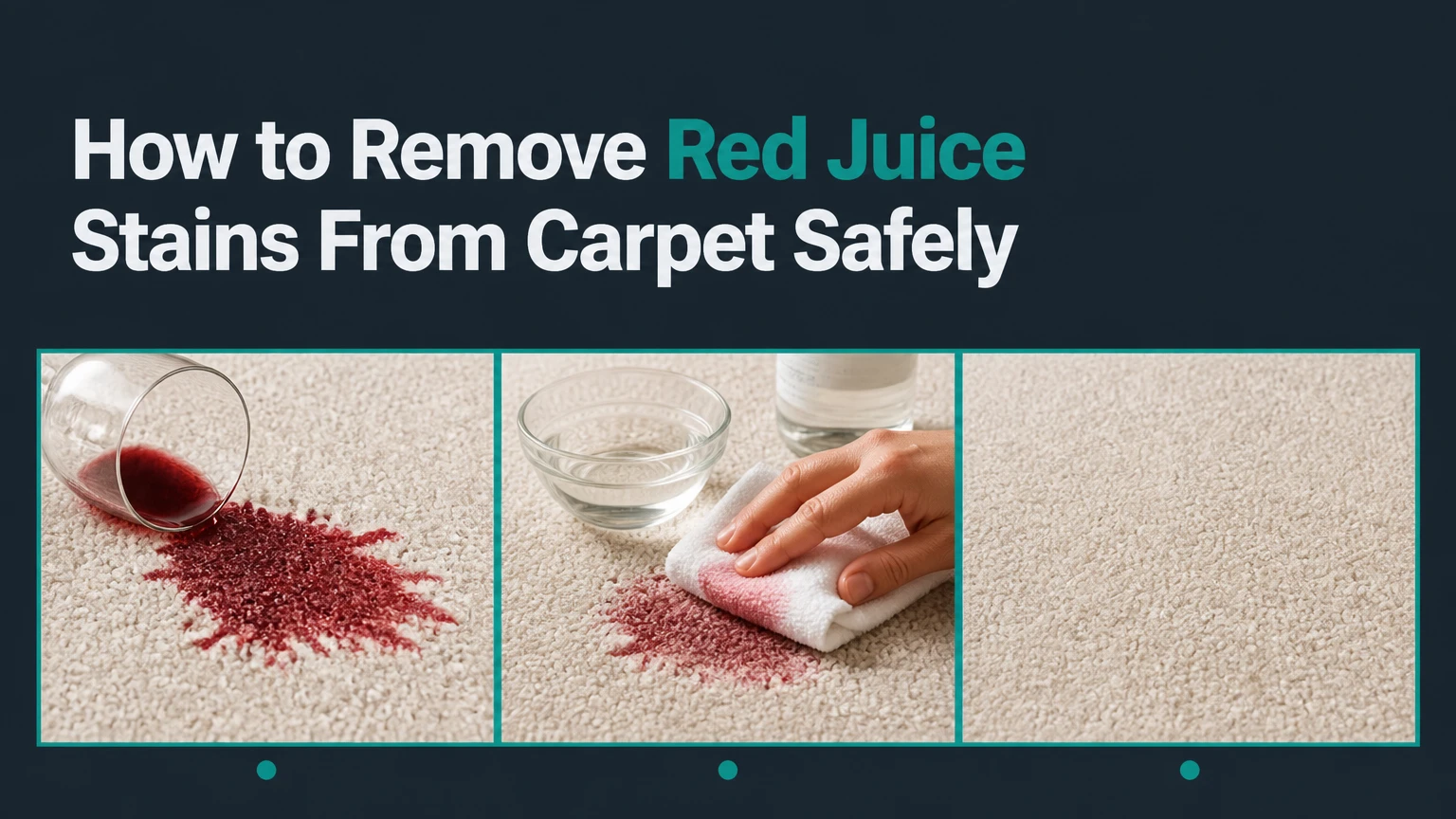
To remove red juice stains from carpet, blot the spill immediately, dilute remaining sugars with a small amount of cold water, then treat synthetic carpet with diluted dish soap and vinegar. For persistent artificial dye on a light, colorfast carpet, use 3% hydrogen peroxide or a labeled red-dye remover after a hidden-area test.
Key Facts at a Glance
- Fresh red juice stains are easier to remove because less liquid has reached the carpet backing and pad.
- White towels, small amounts of solution, and repeated extraction reduce dye transfer and re-soiling.
- Nylon and polyester usually tolerate more treatment than wool, silk, sisal, or other natural fibers.
- Hydrogen peroxide can remove carpet color as well as juice dye, especially on dark or unstable carpets.
- A stain that returns after drying usually indicates wicking from the backing or underlay, not a new spill.
- Never mix hydrogen peroxide, vinegar, chlorine bleach, ammonia, or commercial reducing agents.
Before You Start
A red juice spill usually takes 10-20 minutes to stabilize and 20-45 minutes to treat at home. The difficulty is moderate, and the main success factor is controlling moisture so the stain does not spread into the backing.
| Requirement | Typical amount or range | Practical specification |
|---|---|---|
| White absorbent towels | 6-12 towels | Microfiber or plain cotton, no printed color |
| Cold water | 100-250 milliliters | Use only enough to dilute the spot |
| Clear dish detergent | 1 teaspoon | Use a low-color, grease-cutting liquid |
| White vinegar | 1 tablespoon | Mix only with water and detergent |
| Treatment time | 20-45 minutes | Includes blotting, rinsing, and drying |
| Household cost | $0-$8 | Assumes towels and detergent are available |
Remove solid material with a spoon before touching the liquid. Check the carpet label or identify the fiber if possible. Photograph the stain first if you rent the property, because repeated chemical treatment can create a separate color-loss dispute.
Identify the Carpet Fiber First
Nylon and polyester are common synthetic fibers that generally handle careful water-based spot treatment. Wool, silk, sisal, jute, and viscose require greater restraint because moisture, alkalinity, abrasion, and oxidizers can alter their color or texture.
| Carpet type | Safer first response | Treatments to avoid without testing |
|---|---|---|
| Nylon | Blot, cold-water rinse, mild detergent | Strong oxidizer on dark or unstable dye |
| Polyester | Blot, dilute detergent, careful extraction | Aggressive heat and repeated solvent use |
| Wool | Blot with minimal moisture, call a cleaner | Peroxide, vinegar mixtures, steam, hot iron |
| Silk or viscose | Absorb and stop; use a specialist | Water saturation, scrubbing, oxidizers |
| Sisal or jute | Dry absorption and professional advice | Wet extraction and prolonged dampness |
| Unknown fiber | Treat as delicate until identified | Peroxide, heat, and large wet applications |
How to Remove Red Juice Stains From Carpet
The safest process has six stages: remove excess liquid, blot outward-to-inward, dilute with cold water, apply a measured detergent solution, rinse, and dry with extraction. A fresh spill may clear in one cycle, while an old artificial dye stain can require a commercial reducing product or professional treatment.
Step 1: Absorb the Spill Immediately
Place a folded white towel over the wet area and press straight down for 10-15 seconds. Lift the towel vertically, move to a clean section, and repeat until the towel shows little or no red transfer.
Do not rub, brush, or twist the carpet. Rubbing spreads the stain laterally, distorts the pile, and can drive colored liquid through the face yarn into the backing. Work from the outside edge toward the center when the spill has already spread.
You will know this step is working when fresh towel sections pick up less liquid each time. The common mistake is using one saturated towel for the entire process, which redistributes juice instead of removing it.
Step 2: Dilute With a Small Amount of Cold Water
Apply approximately 1-2 tablespoons of cold water per square foot of affected carpet, using a spoon, spray bottle, or damp cloth. Do not pour a cup of water onto a small spot, because the extra moisture can reach the pad and cause wicking.
Blot immediately after each small application. Repeat once or twice if the towel continues to show strong red transfer. Cold water is a useful first rinse because it dilutes sugar and pigment without adding the heat associated with dye setting and fiber damage.
The checkpoint is a visibly lighter area with no pooling around the edges. The mistake is leaving diluted juice in place while deciding what chemical to use.
Step 3: Apply a Mild Detergent Solution
For colorfast synthetic carpet, mix 1 teaspoon of clear dish detergent with 250 milliliters of lukewarm water. For natural fruit juice on a synthetic carpet, adding 1 tablespoon of white vinegar to that mixture can help with acidic pigment and residue, but vinegar is not a reliable remover for heavy synthetic red dye.
Dampen a white cloth with the solution rather than flooding the carpet. Press the cloth onto the stain for 5-10 seconds, lift it, and repeat with clean sections. Keep the working area slightly smaller than the original wet boundary to prevent unnecessary spreading.
You will know the detergent stage is effective when red material transfers to the cloth and the surface feels clean rather than sticky. The mistake is using extra detergent, which leaves a residue that attracts soil after drying.
Step 4: Rinse the Detergent Out
Use a second white cloth dampened with clean cold water to rinse the treated area. Press, lift, and replace the cloth repeatedly until it no longer feels slippery and the cloth shows minimal sudsing.
Rinsing matters because detergent residue can cause rapid re-soiling and a brown-looking halo. A wet-dry vacuum or carpet spot extractor improves removal, but make several slow extraction passes rather than saturating the area with more rinse water.
The checkpoint is a damp, non-soapy surface without visible foam. The mistake is skipping the rinse because the red color appears to have disappeared.
Step 5: Dry the Carpet Completely
Fold several dry white towels over the spot and press down with a flat, stable object for 15-30 minutes. Replace wet towels, then allow air movement from a fan for several hours.
Avoid placing furniture over the area until the carpet and backing feel fully dry. Surface dryness can occur before the pad dries, especially over concrete floors or dense underlay.
You will know the drying stage is complete when the pile has returned to its normal texture and no cool, damp feeling remains. The mistake is judging success immediately after wet cleaning, when remaining moisture can hide a returning stain.
Step 6: Escalate Persistent Dye Carefully
Use 3% hydrogen peroxide only on a light-colored, colorfast synthetic carpet after testing an inconspicuous area. Apply a small amount to a white cloth or the stain, wait 5 minutes, and check for lightening of the carpet’s original color before proceeding.
For a set artificial dye stain, a purpose-made red-dye remover may work better than household vinegar because reducing agents target dye chemistry differently from detergent. Follow the product’s two-part mixing instructions, ventilation requirements, contact time, heating instructions, and rinsing directions exactly.
The checkpoint is dye reduction without a pale patch or weakened yarn. The mistake is repeating peroxide or commercial remover indefinitely; more chemical exposure can damage the carpet after the stain has stopped responding.
Which Stain-Removal Method Should You Choose?
Mild detergent is the best first choice for nearly every washable synthetic carpet, while a commercial red-dye reducer is the stronger option for old artificial dye. Hydrogen peroxide belongs between those choices, but only for tested, light, synthetic carpet where possible color loss is acceptable.
| Method | Best target | Typical time | Typical cost | Main risk |
|---|---|---|---|---|
| Cold water and blotting | Fresh juice within 30 minutes | 10-20 minutes | $0-$3 | Over-wetting |
| Detergent and vinegar | Natural fruit juice on synthetic fiber | 20-30 minutes | $1-$5 | Soap residue or spreading |
| 3% hydrogen peroxide | Persistent dye on light synthetic carpet | 15-30 minutes | $2-$8 | Bleaching carpet color |
| Commercial red-dye reducer | Dried or intense artificial dye | 20-60 minutes | $15-$40 | Chemical or heat damage |
| Professional spot treatment | Wool, silk, sisal, severe saturation | 1-3 days including scheduling | $75-$250 typical | Cost and delayed service |
Why Does Red Juice Resist Cleaning?
Red juice can contain both water-soluble sugars and strongly colored molecules. Artificial colorants, including common beverage dyes such as Red 40, can remain conspicuous after the sugar has been removed; cranberry, pomegranate, grape, and berry juices also contain natural pigments and tannin-like compounds that may darken as they dry.
Detergent lifts oily or particulate soil and suspends residue for extraction, but detergent alone may not destroy the chromophore that produces the red appearance. Oxidizers such as peroxide alter dye molecules, while reducing agents used in professional red-dye products chemically reverse or remove certain synthetic dyes.
Chemical action is only part of the result. Mechanical extraction determines how much dissolved dye leaves the carpet instead of drying in the backing.
Is Vinegar and Dish Soap Enough?
Vinegar and dish soap can remove fresh natural fruit juice from many synthetic carpets, but the mixture is not dependable against old Red 40, concentrated sports drink, or dye that has bonded strongly to the fiber. Use the mixture as a low-risk first treatment, not as a guarantee.
| Situation | Recommended first treatment | Expected result |
|---|---|---|
| Fresh cranberry juice | Cold blotting, detergent rinse | Often substantial reduction |
| Fresh grape juice | Detergent solution, careful rinse | Usually improves after one cycle |
| Red sports drink | Blotting, then tested peroxide or dye reducer | Household mixture may leave color |
| Dried fruit punch | Rehydrate lightly, extract, escalate | May require two treatment cycles |
| Dark red juice on wool | Minimal blotting, professional cleaner | DIY chemicals may create permanent loss |
Vinegar also does not neutralize every other cleaning chemical. Never combine it with chlorine bleach, ammonia, peroxide in the same container, or an unidentified commercial product.
What Changes for Dried or Old Red Juice?
Dried red juice needs controlled rehydration before removal, and an old stain that has penetrated the backing may never respond fully to surface cleaning. Place a damp, not wet, white cloth over the spot for 2-3 minutes, blot the softened residue, then use the detergent procedure once.
Do not scrape aggressively with a knife or brush. A blunt spoon can lift crusted material from the carpet tips, but pulling at hardened fibers can create a permanent texture change.
For stains older than several days, identify whether the remaining mark is dye, soil trapped in sticky residue, or carpet discoloration. If the carpet itself has been bleached by sunlight or a previous product, cleaning cannot restore the original color.
Can Hydrogen Peroxide or Heat Damage Carpet?
Hydrogen peroxide can lighten the carpet’s own dye, and direct heat can shrink, distort, or melt some fibers. Do not use peroxide on wool, silk, viscose, sisal, dark carpet, or any material that fails a hidden-area color test.
Some professional red-dye procedures use a damp towel and controlled heat to transfer dye into the towel. That method is not equivalent to placing a household iron on carpet: iron temperature varies, steam can inject moisture into the backing, and nylon or polyester can deform under excessive heat.
| Risk factor | Lower-risk condition | Higher-risk condition |
|---|---|---|
| Peroxide | 3% solution, pale nylon, 5-minute test | Dark wool, unknown dye, repeated applications |
| Heat | Product-approved low setting, damp towel, brief contact | Dry iron, high heat, direct contact with pile |
| Moisture | 1-2 tablespoons per square foot | Cupfuls poured over a small stain |
| Mechanical action | Vertical blotting | Scrubbing, brushing, twisting |
| Chemical mixing | One product at a time | Peroxide with vinegar or bleach |
A pale ring after treatment usually indicates color loss, not remaining juice. Stop chemical treatment immediately and consult a carpet repair or dye-restoration specialist.
How Do You Fix a Red Stain That Comes Back?
A returning red mark is usually wicking, where dissolved juice moves from the backing or pad into the drying carpet fibers. Re-cleaning the surface alone often fails because the deeper reservoir remains wet.
Lightly dampen the spot with clean water, extract as much liquid as possible, then cover it with a thick layer of white towels. Weigh the towels with a flat object for 12-24 hours, replacing them when they become damp. This encourages the towels to draw moisture upward during drying.
If the stain returns repeatedly, the spill may have reached the pad or subfloor. A professional cleaner may need to flush and extract the area, lift the carpet edge, replace contaminated pad, or treat the backing from below.
What If a Brown Halo Appears?
A brown halo can result from soil attracted to detergent residue, oxidized natural pigment, or browning from prolonged moisture. Rinse the area with a small amount of clean water, extract thoroughly, and dry it rapidly with airflow.
Do not apply more detergent simply because the halo looks darker. If the halo follows the exact wet boundary, moisture control and residue removal are more likely to help than stronger stain chemistry.
When Should You Hire a Professional?
Hire a certified carpet or rug cleaner immediately for wool, silk, viscose, sisal, antique rugs, broad saturation, color bleeding, or a stain that covers more than approximately 0.5 square meter. Professional equipment can extract liquid from the backing, while a technician can select a reducing or oxidizing treatment based on a fiber and dye test.
Professional treatment is also sensible when a rental deposit, expensive rug, or visible room is at stake. DIY cleaning is not good for restoring carpet color after peroxide or bleach has removed the original dye; that requires repair, spot dyeing, or replacement.
Typical service pricing varies by region, minimum callout, rug construction, and access. A small carpet spot commonly costs $75-$150, while a specialty rug may cost $100-$300 or more because it can require off-site washing and controlled drying.
Common Mistakes and How to Fix Them
| Mistake | Why it fails | Recovery |
|---|---|---|
| Rubbing the spill | Spreads dye and roughens pile | Stop friction, blot from edge inward |
| Pouring on hot water | Drives moisture into backing and may set color | Extract, then use small cold-water applications |
| Using a colored towel | Towel dye can transfer during wet treatment | Switch to white towels and rinse |
| Adding excessive soap | Residue attracts soil and creates a halo | Rinse with small amounts of water and extract |
| Repeating peroxide blindly | Can create permanent bleaching | Stop, rinse, dry, and assess color loss |
| Leaving the pad wet | Causes wicking and odor | Extract again and increase airflow |
One practitioner rule matters more than most home recipes: use the smallest effective amount of liquid. A carpet stain is easier to remove when the dye stays near the face yarn instead of migrating into the backing.
Situation-Specific Treatment Paths
Red Juice on a Dark Carpet
Start with blotting, cold-water dilution, mild detergent, rinsing, and drying. Avoid peroxide unless a professional or the product manufacturer confirms compatibility, because a stain-free pale spot is still visible damage.
Red Juice on a Wool Rug
Blot without rubbing, use very little cold water, and stop if color transfers from the rug itself. Do not use vinegar, peroxide, steam, or an iron as a home experiment; wool dyes can bleed, and the backing can shrink.
Red Juice Near Carpet Padding
Use a wet-dry vacuum if available, working from the outside toward the center. If the area remains damp after several hours or the stain returns after drying, treat the backing and pad as part of the problem rather than applying more surface cleaner.
Red Juice in a Rental Property
Photograph the original spill, test every product in a hidden location, and avoid heat-based procedures unless the carpet-care label permits them. A professional receipt and documented treatment may be preferable to creating a larger discolored patch before moving out.
FAQ
Does baking soda remove red juice from carpet?
Baking soda absorbs some moisture and odor but does not reliably dissolve or destroy concentrated red beverage dye. Use blotting and a measured detergent rinse first. If baking soda has already been applied, vacuum the dry powder completely before adding liquid, because paste-like residue can complicate extraction.
Can club soda remove red juice stains?
Club soda is mostly water with dissolved carbon dioxide and does not provide a special dye-removal reaction. It may dilute a fresh spill, but plain cold water gives the same practical rinsing function without adding minerals or unnecessary liquid. Blotting speed matters more than carbonation.
Will a carpet steam cleaner remove red juice?
A steam cleaner can extract diluted juice and detergent from compatible synthetic carpet, but high heat and excessive water can spread dye or cause wicking. Pre-blot first, use the machine’s lowest effective solution volume, perform extra extraction passes, and dry the area quickly.
Can enzyme cleaner remove fruit juice?
Enzyme cleaners target biological residues such as proteins, starches, or fats, while many red juice stains are primarily sugars and coloring molecules. An enzyme product may help with a mixed food spill, but it is not the first choice for artificial red beverage dye and should be tested for carpet compatibility.
How many times can I treat the same carpet stain?
Use one complete mild treatment cycle, including rinsing and drying, before deciding whether to escalate. Two careful cycles may be reasonable on colorfast synthetic carpet, but repeated peroxide, heat, or reducing chemicals increase the chance of bleaching, texture change, and backing damage.
Will professional cleaning remove every red juice stain?
Professional cleaning improves the odds but cannot guarantee restoration when dye has altered the fiber, the carpet has been bleached, or the pad has remained saturated for a long period. A technician should inspect fiber, dye stability, stain depth, and previous chemicals before selecting a treatment.
The Bottom Line
The safest answer to how to remove red juice stains from carpet is to blot immediately, use small amounts of cold water, apply mild detergent to compatible synthetic carpet, rinse thoroughly, and dry the backing completely. Reserve peroxide and commercial dye reducers for tested synthetic carpet, and use a professional for wool, silk, sisal, severe saturation, or any sign of color loss.