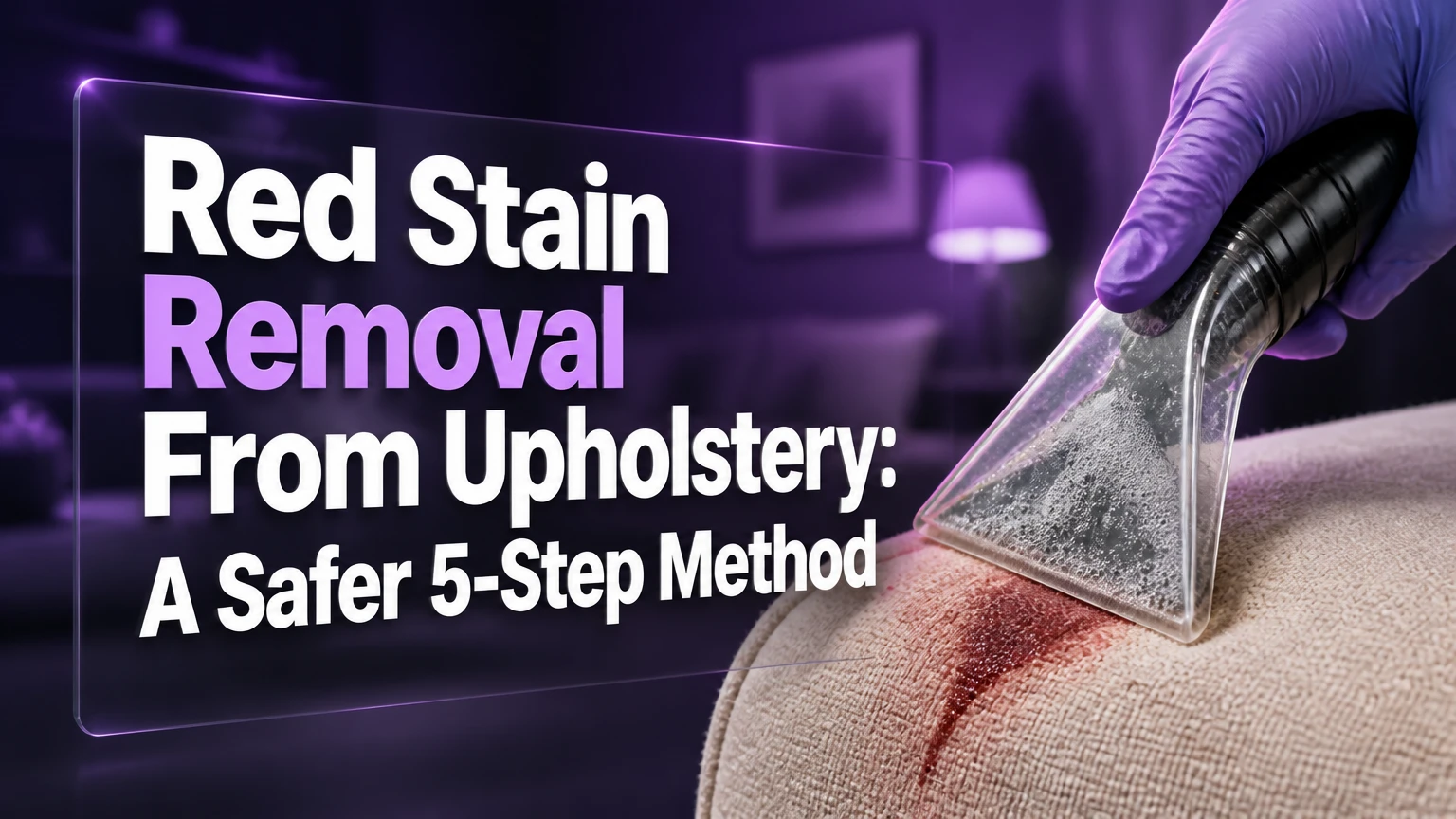
Red stain removal from upholstery works best when you identify the fabric code, remove surface liquid by blotting, and use a small amount of compatible cleaner. For most W or WS fabrics, diluted dish soap or a labeled upholstery cleaner can lift fresh wine, juice, and berry stains. Blood requires cold water, while S-coded and delicate fabrics need solvent guidance or professional treatment.
Key Facts at a Glance
Blot a red spill within minutes with a white, absorbent cloth; rubbing enlarges the stain and damages fibers.
Upholstery code W permits water-based cleaning, S requires a solvent, WS permits either, and X allows vacuuming only.
Use cold water for blood because heat can bind blood proteins more firmly to textile fibers.
A 3% hydrogen peroxide solution can remove some organic red stains, but it can also lighten colored upholstery.
Never iron upholstery to transfer dye unless the fabric manufacturer specifically approves heat; synthetic fibers can melt, glaze, or distort.
A red mark that returns after drying usually indicates wicking from the cushion interior, not a new spill.
How Should You Start Red Stain Removal From Upholstery?
Start by stopping transfer, checking the care code, and removing liquid without adding more moisture. Place a folded white towel beneath or behind removable fabric when possible, then blot from the outer edge toward the center using a fresh section of cloth. Test every solution on a hidden seam for color change, texture change, or dye transfer.
Before You Start
| Item | Typical amount or setting | Purpose |
|---|---|---|
| White microfiber cloths | 6-10 cloths, 30 x 30 cm | Blotting without color transfer |
| Distilled or filtered water | 250-500 ml | Rinsing and controlled dilution |
| Clear dish detergent | 1 teaspoon per 250 ml water | Surfactant for fresh water-based stains |
| Soft upholstery brush | 1 brush, soft nylon bristles | Gentle agitation after testing |
| Dry towels | 2-4 bath or hand towels | Cushion extraction and drying |
| Fan | 1 fan, low or medium speed | Reduces drying time and wicking |
Typical DIY treatment takes 10-30 minutes, excluding drying. The main success factor is moisture control: a small stain treated with several light applications is safer than one flooded with a large volume of solution.
What Does the Upholstery Cleaning Code Mean?
| Code | Permitted method | Suitable first action | Main restriction |
|---|---|---|---|
| W | Water-based cleaner | Diluted detergent or labeled upholstery spray | Avoid soaking foam |
| S | Water-free solvent | Manufacturer-approved upholstery solvent | Do not use water-based mixtures |
| WS | Water or solvent | Patch-tested method with lower risk | Follow the fabric label first |
| X | Vacuum only | Vacuum loose material and call a professional | Do not apply liquid or solvent |
Cleaning codes describe the fabric manufacturer’s permitted method, not the stain’s severity. The Association of Contract Textiles and upholstery-care manufacturers commonly place these codes on care labels, although individual brands may add stricter instructions. If the label is missing, treat unknown fabric as potentially water-sensitive and test a hidden area before cleaning the visible stain.
What Is the Safest Five-Step Cleaning Method?
The safest general method uses five controlled stages: remove liquid, test the solution, apply sparingly, blot-extract residue, and dry rapidly. The sequence suits many W and WS fabrics, but it is not a universal treatment for S, X, silk, rayon, leather, or unstable dyed textiles.
Step 1: Remove Surface Liquid
Scoop solids with a spoon and lift powder or dried particles with a vacuum attachment. For a wet spill, press a white cloth straight down for 5-10 seconds, lift it, rotate to a dry section, and repeat until little color transfers.
Do not rub in circles. Circular scrubbing pushes pigment sideways, roughens the nap, and can create a visible lighter or darker patch. For a large spill, work in sections no larger than 10-15 cm so the liquid does not spread into seams.
You will know this step worked when: the cloth absorbs less liquid after several presses and the stain’s boundary stops expanding.
Common mistake: using one saturated towel repeatedly. Replace or refold the cloth as soon as its stained area becomes damp.
Step 2: Make and Patch-Test a Cleaner
For a W or WS fabric, mix 1 teaspoon of clear, dye-free dish detergent with 250 ml of cool water. Apply one drop to a hidden seam, leave it for five minutes, blot with a white cloth, and inspect the cloth and fabric for transferred color.
A commercial upholstery cleaner is preferable when its label names the fabric code and gives a dilution ratio. Enzyme cleaners suit protein or food residues, but they do not automatically remove every artificial red dye. The American Cleaning Institute advises prompt stain treatment because dried residues become more difficult to dissolve and extract.
You will know this step worked when: the hidden test area shows no color loss, sticky residue, stiffening, or change in sheen.
Common mistake: applying concentrated detergent. Excess surfactant leaves a sticky film that attracts soil and can create a dark ring.
Step 3: Apply a Small Amount and Blot
Dampen a white cloth with the cleaning mixture rather than spraying the cushion heavily. Press the cloth onto the stain for 10-15 seconds, lift, and repeat from the outside edge toward the center. Use only enough solution to moisten the fibers near the surface.
Allow a 2-5 minute dwell time, unless the product label specifies another duration. Gentle brushing may help on durable, low-pile polyester, but avoid brushing velvet, chenille, loose weaves, and raised microfiber in multiple directions.
You will know this step worked when: red color transfers to the cloth and the visible area becomes smaller or less saturated without spreading.
Common mistake: scrubbing harder when color remains. Use another light application instead; force increases fiber damage without necessarily improving pigment removal.
Step 4: Rinse and Extract Residue
Use a second cloth dampened with cool distilled water to blot the treated area. Follow with a dry towel and firm, vertical pressure to pull out detergent, loosened pigment, and water. Repeat the damp-cloth and dry-towel cycle once or twice without saturating the cushion.
A wet vacuum can help on removable, water-safe cushions, but keep the nozzle moving and avoid flooding seams. Upholstery foam holds liquid far longer than the surface fabric, so surface dryness does not prove that the interior is dry.
You will know this step worked when: the rinse cloth shows minimal suds and the dry towel absorbs little moisture after pressing.
Common mistake: skipping the rinse because the stain appears gone. Residual detergent can leave a stiff texture, attract soil, or produce a ring after drying.
Step 5: Dry, Inspect, and Vacuum
Stand cushions on edge if the manufacturer permits it, open zippers only when the cover is designed for removal, and direct a fan across the fabric. Keep the area in moving air for 4-12 hours, depending on cushion thickness, humidity, and the amount of water used.
Inspect the stain only after complete drying. Vacuum the surface with a soft upholstery attachment to restore the nap and remove dried residue. Do not use high heat from a hair dryer because heat can set protein stains, distort synthetic fibers, or create uneven drying.
You will know this step worked when: the fabric feels dry and flexible, no odor develops, and the red mark does not reappear after several hours.
Common mistake: replacing a damp cushion immediately. Trapped moisture encourages wicking and can contribute to odor or microbial growth.
Which Cleaner Matches the Red Stain?
The best cleaner depends on the red substance, fabric code, and whether the mark is fresh or dried. Dish detergent is a cautious first option for many fresh water-based spills, cold water is the first choice for blood, and peroxide or enzyme products require color testing rather than automatic use.
| Stain source | First choice on W or WS fabric | Typical dwell time | Avoid |
|---|---|---|---|
| Red wine | Diluted detergent, then labeled oxygen product if needed | 2-10 minutes | Rubbing, chlorine bleach |
| Berry juice | Diluted detergent or enzyme cleaner | 5-15 minutes | Hot water before testing |
| Sports drink or juice | Diluted detergent, repeated blotting | 2-5 minutes | Flooding the cushion |
| Blood | Cold water, then enzyme cleaner | 5-30 minutes | Warm or hot water |
| Tomato sauce | Remove solids, detergent solution | 5-10 minutes | Scraping with a sharp tool |
| Artificial food dye | Labeled oxygen upholstery product | Product label | Unapproved heat or solvent |
| Unknown red mark | Patch-tested upholstery cleaner | 2-5 minutes | Mixing several chemicals |
How Do You Remove Red Wine From a Sofa?
Remove red wine from a sofa by blotting immediately, applying a cool detergent solution to W or WS fabric, and rinsing with minimal water. A 1:1 mixture of 3% hydrogen peroxide and clear dish detergent can be a later option on light, colorfast fabric, but peroxide must be patch-tested because it may bleach upholstery.
Salt can absorb some liquid from a fresh wine spill, but salt does not dissolve or chemically erase wine pigment. If used, vacuum the dry salt after a short period and continue with the fabric-approved cleaning method. Do not treat salt as a substitute for extraction.
Wine contains water, alcohol, colored plant compounds, and tannins. The detergent helps suspend oily and particulate residues, while controlled blotting moves the dissolved material into the cloth instead of deeper into the cushion.
How Do You Remove Blood From Upholstery?
Remove blood from upholstery with cold water and blotting, followed by a fabric-approved enzyme cleaner if needed. Blood is protein-based, so hot water, steam, and heated drying can make the residue more difficult to remove. Wear disposable gloves when handling blood and follow local health guidance for larger contamination.
For light-colored, colorfast W or WS fabric, a small amount of 3% hydrogen peroxide may break down remaining blood residue. Apply it to a cloth, not directly to the cushion, and stop if the fabric lightens or fizzes excessively. Enzyme cleaners are usually a better first choice on durable colored textiles when the label permits them.
The U.S. Centers for Disease Control and Prevention recommends gloves and appropriate disinfection procedures for blood cleanup, especially when the source is unknown. Upholstery cleaning removes visible staining, but it does not make heavily contaminated foam hygienic.
Can Vinegar Remove Red Dye?
Vinegar is not a reliable universal red-dye remover, and its mild acidity does not automatically neutralize synthetic food dyes. A diluted vinegar solution may help reduce odor or mineral residue in some water-safe fabrics, but it can alter dyes, damage finishes, or leave moisture rings.
Do not mix vinegar with hydrogen peroxide, chlorine bleach, ammonia, or commercial cleaners unless the product manufacturer explicitly confirms compatibility. Chemical mixtures can release irritating vapors or produce unwanted reactions. A labeled upholstery product with a defined fabric range is more predictable.
How Do Fabric, Color, and Material Change the Method?
Fabric construction determines how much moisture, agitation, solvent, and heat the upholstery can tolerate. Polyester and acrylic often tolerate controlled water-based cleaning better than silk or rayon, while velvet, linen, wool, and dark unstable dyes can show texture or color changes even after a technically successful stain treatment.
| Upholstery material | Main red-stain risk | Safer home approach | Professional threshold |
|---|---|---|---|
| Polyester microfiber | Water rings, directional nap | Cloth-applied low-moisture cleaner | Large halo or embedded dye |
| Cotton or linen | Rapid absorption, browning | Minimal water, fast drying | Antique, loose weave, old stain |
| Wool | Fiber felting and dye bleeding | Blot only after label approval | Any peroxide or solvent uncertainty |
| Velvet | Pile crushing and sheen change | Dry blotting, no brushing | Most visible red stains |
| Rayon or viscose | Permanent water marks | Avoid wet DIY treatment | Any liquid stain |
| Leather or faux leather | Finish damage, pigment stripping | Manufacturer leather cleaner | Cracked, aniline, or unfinished leather |
Microfiber and Polyester
Microfiber upholstery often has a dense synthetic surface that releases fresh liquid reasonably well, but its directional nap can show a darker patch after cleaning. Blot with the nap direction, use very little solution, and restore the texture with a soft brush only after complete drying.
Some microfiber labels use W, S, or WS codes, so the word “microfiber” does not establish the correct cleaner. A water-sensitive S-coded microfiber requires a compatible solvent, not a dish-soap mixture.
Velvet, Wool, Silk, and Rayon
Velvet, wool, silk, and rayon are poor candidates for improvised peroxide, vinegar, steam, or aggressive brushing. These materials can bleed, shrink, felt, develop water marks, or lose surface sheen even when the red color appears to improve.
Blot gently with a dry white cloth, photograph the stain and care label, and contact a professional upholstery cleaner when the material is valuable or the stain covers a seam. Professional treatment cannot guarantee complete removal from unstable dyes, but it reduces the chance of turning a small mark into permanent texture damage.
Should You Use Peroxide, Enzyme Cleaner, or Upholstery Shampoo?
Choose an enzyme cleaner for protein-rich residue, a peroxide product for a patch-tested light and colorfast textile, and upholstery shampoo only when the label permits water-based cleaning and thorough extraction. No single product safely handles blood, wine, artificial dye, velvet, leather, and S-coded fabric.
| Product type | Best match | Typical working time | Main limitation |
|---|---|---|---|
| Clear dish detergent | Fresh wine, juice, food residue | 5-15 minutes | Leaves residue if overused |
| Enzyme cleaner | Blood, milk, food proteins | 15-60 minutes | May not remove synthetic dye |
| 3% hydrogen peroxide | Light, colorfast organic stains | 1-10 minutes | Can bleach colored fabric |
| Oxygen-based upholstery product | Labeled synthetic or organic stains | 5-30 minutes | Patch testing remains necessary |
| Water-based upholstery shampoo | Larger W-coded areas | 20-60 minutes plus drying | Requires extraction and airflow |
| Upholstery solvent | S-coded fabrics | Product label | Flammable or finish-sensitive |
A practitioner rule of thumb is to escalate one variable at a time. Change the cleaner only after blotting and rinsing the previous product, because combining uncertain residues makes both diagnosis and recovery harder.
How Do You Remove a Dried or Set-In Red Stain?
Remove a dried red stain by vacuuming loose residue, rehydrating the surface lightly, and repeating controlled applications rather than flooding the cushion. Set-in pigment may require an oxygen-based product or professional extraction, and complete removal is less likely when heat, solvent, or previous scrubbing has altered the fibers.
- Vacuum or brush away dry particles.
- Patch-test the chosen cleaner.
- Apply it with a cloth in a 10-15 cm working section.
- Allow the label-specified dwell time.
- Blot, rinse, and extract.
- Dry fully before deciding whether another cycle is warranted.
Artificial Red 40 and similar dyes can remain visible after ordinary detergent because their molecules bind strongly to some synthetic fibers. Heat-transfer ironing is often presented as a home solution, but upholstery is not a flat, heat-rated garment. An iron can melt polyester, flatten pile, transfer adhesive from backing, or create a permanent glossy patch. Avoid it unless the upholstery manufacturer provides explicit heat instructions.
What Should You Never Do?
Never use heat, chlorine bleach, unapproved solvents, or excessive water on unknown upholstery. The most damaging failures occur when a person treats a textile as if it were a washable shirt, especially when the cushion contains foam or the cover has a non-colorfast backing.
- Do not scrub a wet red stain.
- Do not pour water directly onto a cushion.
- Do not use chlorine bleach on colored upholstery, wool, silk, or unknown fibers.
- Do not combine vinegar, peroxide, ammonia, bleach, or multiple commercial products.
- Do not use steam on blood or heat-sensitive synthetic fabrics.
- Do not remove a zippered cover for machine washing unless the care label specifically permits it.
- Do not judge success while the fabric is still damp.
- Do not use a colored towel, paper with printed ink, or dyed sponge.
A counterintuitive professional observation is that a faint remaining spot is often safer than a large pale halo. Removing color by over-oxidizing the surrounding fabric can make the furniture look worse and may be impossible to reverse.
Why Did the Red Stain Return After Drying?
A red stain returns after drying when dissolved pigment remains in the cushion, seam, or backing and travels upward as moisture evaporates. The effect is called wicking. It is common after a spill penetrates foam or after a cleaning attempt uses more liquid than the towel can extract.
| Symptom after drying | Likely cause | Recovery action | Escalation point |
|---|---|---|---|
| Red center returns | Pigment in foam | Lightly dampen, towel-wick, dry with fan | Returns after two cycles |
| Dark circular ring | Soil or detergent migration | Rinse the full affected panel lightly | Ring expands |
| Stiff texture | Cleaner residue | Distilled-water blot and extraction | Residue remains dry |
| Lighter patch | Color loss or abrasion | Stop chemical treatment | Professional color repair |
| Musty odor | Slow internal drying | Remove cushion, ventilate 12-24 hours | Odor persists |
To correct mild wicking, lightly dampen the affected surface with distilled water, place folded white towels over it, and apply even pressure. Replace the towels as they absorb color, then dry the cushion with airflow. Do not place heavy books directly on delicate pile or leave the area compressed overnight without checking moisture.
Soil rings can require cleaning the entire cushion panel or a natural seam-to-seam section, because spot-cleaning only the center may leave a visible boundary. On fixed cushions, professional low-moisture cleaning is often more consistent than repeated home spot treatments.
How Much Does Upholstery Stain Removal Cost?
Typical costs range from nearly zero for household materials to $150 or more for professional treatment, depending on location, furniture size, fabric risk, access, and whether the stain has entered the foam. A single fresh spot is inexpensive to attempt, while a large sofa or delicate textile may justify professional cleaning immediately.
| Option | Typical direct cost | Typical active time | Best use |
|---|---|---|---|
| Household detergent and cloths | $0-$10 | 10-30 minutes | Fresh W or WS spill |
| Ready-made upholstery cleaner | $8-$25 | 15-45 minutes | Labeled fabric and moderate stain |
| Rental extractor | $30-$80 per day | 1-3 hours | Several water-safe cushions |
| Professional spot treatment | $50-$150 | 30-90 minutes | Persistent localized stain |
| Professional sofa cleaning | $100-$300 | 1-3 hours, 6-12 hours drying | Whole sofa or recurring marks |
| Delicate textile specialist | $150-$500+ | Appointment-dependent | Velvet, silk, antique, rayon |
Prices are typical North American consumer ranges, not fixed quotes. Local labor, travel fees, upholstery construction, and stain-protection treatments can change the final bill. Ask whether the quote includes pretesting, stain treatment, extraction, and drying advice.
When Should You Call a Professional?
Call a professional when the fabric is coded S or X, the material is velvet, silk, wool, rayon, aniline leather, or antique textile, or the stain has penetrated through seams into foam. Professional help is also appropriate after two controlled treatment cycles fail, after a chemical reaction changes the color, or when blood contamination is extensive.
Before booking, provide the cleaner with the fabric code, stain substance, approximate age, products already used, and photographs in natural light. Ask whether the technician performs a hidden colorfastness test and whether they use low-moisture or hot-water extraction for that specific fabric.
Professional cleaning is not a guarantee. Permanent dye damage, heat setting, abrasion, and unstable upholstery color may remain. The value of professional service is controlled testing, suitable chemistry, extraction equipment, and lower risk of spreading the defect.
FAQ
Can baking soda remove a red stain from a couch?
Baking soda can absorb some surface moisture and reduce odor, but it does not reliably dissolve wine pigments, blood proteins, or synthetic food dyes. Use it only after the area is dry, vacuum it thoroughly, and follow the upholstery code for actual stain removal. Powder residue can lodge in textured fabric.
Can I use rubbing alcohol on red dye?
Rubbing alcohol may dissolve some dyes on S-coded synthetic upholstery, but it can also strip finish, spread pigment, or create a light patch. Use it only when the manufacturer permits solvent cleaning and a product label or professional technician supports that method. Never apply it to unknown fabric without a hidden test.
How do I remove a red stain from a white sofa?
A white, colorfast W or WS sofa can usually tolerate a patch-tested oxygen product or 3% hydrogen peroxide more readily than colored upholstery, but bleaching risk still exists. Blot first, apply the smallest practical amount, rinse the residue, and compare the treated area with an adjacent seam after drying.
How do I clean red stains from car upholstery?
Use the vehicle manufacturer’s upholstery instructions and identify whether the seat is cloth, vinyl, leather, or Alcantara-style microfiber. For cloth W-coded seats, use a cloth-applied diluted detergent and extract moisture quickly. Avoid saturating seat bolsters, electrical components, heating elements, and seat-belt assemblies.
Will a red stain disappear completely after one treatment?
Fresh surface stains may improve substantially in one treatment, but complete removal is not guaranteed. Dried artificial dye, heat-set blood, unstable upholstery dye, and pigment inside foam often need repeat treatment or professional extraction. Wait until the fabric is completely dry before deciding whether the result is final.
Does professional cleaning remove every red stain?
Professional cleaning improves the odds but cannot remove every red stain. Heat damage, fiber abrasion, permanent dye bonding, color loss, and stains that reached the backing may be irreversible. A qualified technician should explain the likely outcome after inspecting the material and testing a hidden area.
The Bottom Line
Red stain removal from upholstery is safest when the treatment follows the fabric code and the stain chemistry. Blot immediately, use a small amount of compatible cleaner, rinse away residue, and dry the cushion with airflow. Use cold water for blood, avoid unapproved heat for synthetic dyes, and call a professional for delicate, solvent-only, heavily contaminated, or repeatedly wicking upholstery.