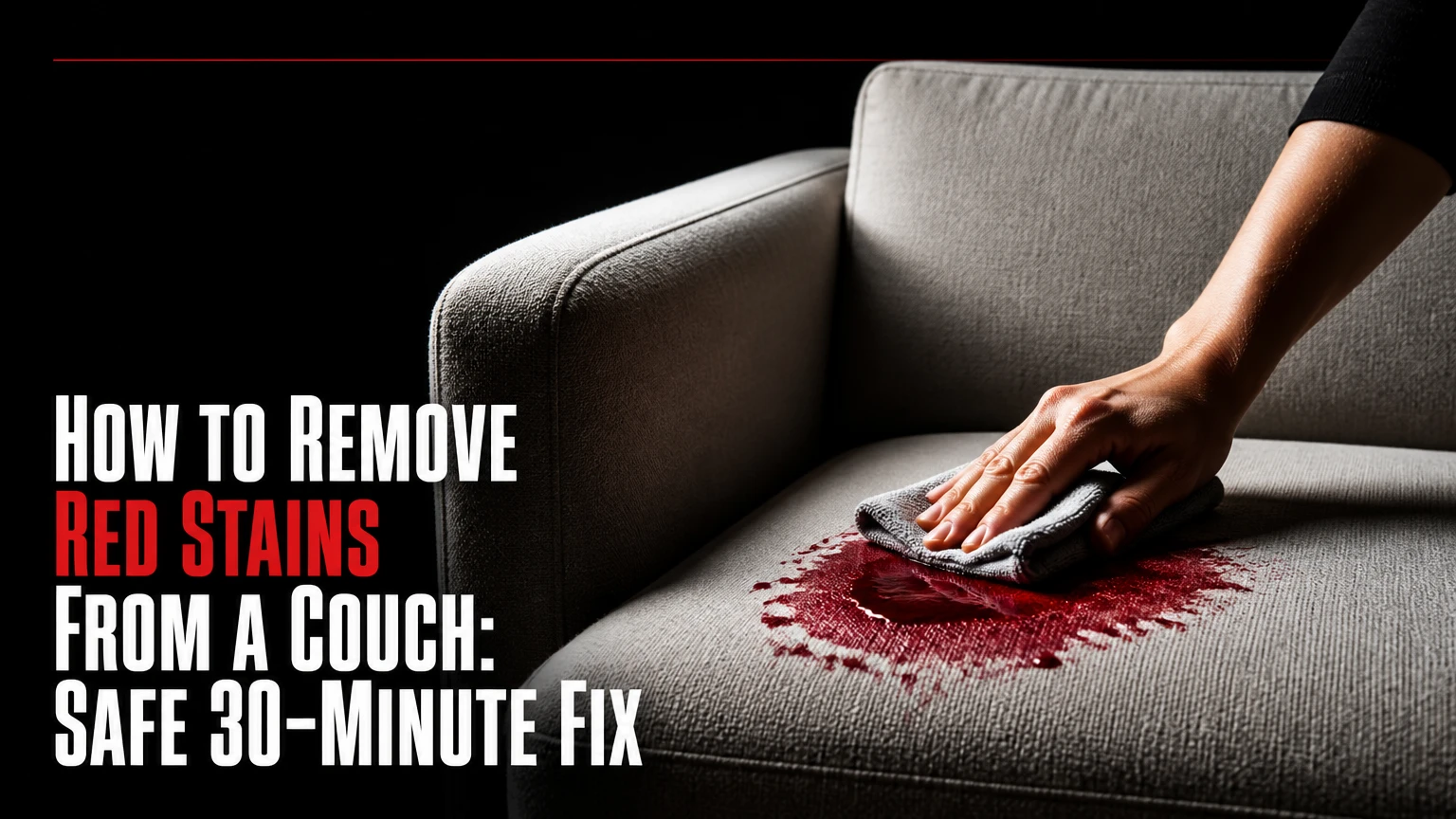
To remove red stains from a couch, identify the upholstery care code, blot excess liquid with a white towel, and use the least aggressive compatible cleaner. For most fresh stains on W or WS fabric, cool water plus a small amount of dish detergent works in 15-30 minutes; blood, synthetic dye, leather, S-code, and X-code upholstery require different treatment.
Key Facts at a Glance
A couch care code determines whether water, solvent, both, or neither may touch the upholstery.
Cool water is the safest first response for blood, while heat can set protein stains.
Blotting removes liquid through capillary action; scrubbing spreads pigment and damages fibers.
Three percent hydrogen peroxide can fade dark upholstery, so test it on a hidden area first.
A red sports drink or candy stain may contain synthetic dye that dish soap cannot chemically erase.
Drying the treated area quickly and evenly reduces wicking, water rings, and tide marks.
Before You Start: Identify the Stain and Fabric
The stain source and upholstery code determine the safest cleaning chemistry. Red wine and berry juice are primarily plant pigments and acids, blood contains protein, and sports drinks often contain synthetic dyes that may remain after the liquid carrier has been removed.
Look for a sewn-in tag beneath a cushion, along the platform, or under the couch frame. Manufacturer instructions override general advice because fiber blends, backings, finishes, and cushion foams tolerate moisture differently.
| Code | Permitted approach | Avoid | Suitable first action |
|---|---|---|---|
| W | Water-based upholstery cleaner | Dry-cleaning solvent unless approved | Blot, then use diluted detergent |
| S | Water-free solvent cleaner | Water, vinegar, peroxide, steam | Blot, then follow solvent label |
| WS or SW | Water-based or solvent cleaner | Unapproved bleach and heavy saturation | Test either compatible method |
| X | Vacuuming only | Liquids, foam, solvent, steam | Blot only and call a professional |
| No readable code | Manufacturer-approved method only | Guessing from appearance | Test hidden seam or stop |
A “W” code does not mean the fabric can be soaked. Upholstery has a woven face, backing, adhesive layers, and foam, and excess water can create rings or leave the cushion damp internally for more than 24 hours.
What tools and quantities are needed?
For a typical fresh stain on W or WS upholstery, gather two or three white microfiber cloths, 2 cups of cool water, 1 teaspoon of clear liquid dish detergent, a spoon, a bowl, paper towels, and a fan. Use a vacuum only after the area is completely dry.
Avoid colored cloths because textile dye can transfer during wet cleaning. Avoid concentrated dish soap, powdered detergent, chlorine bleach, abrasive powders, and household steam unless the couch manufacturer specifically permits them.
How to Remove Red Stains From a Couch
A fresh red spill on compatible W or WS upholstery usually needs four stages: extract excess liquid, apply diluted detergent, rinse sparingly, and dry evenly. The full process typically takes 15-30 minutes of active work, although a thick cushion may need 12-24 hours to dry completely.
Step 1: Remove excess liquid without rubbing
Press a folded white towel straight down onto the stain for 5-10 seconds, lift it, and move to a dry section. Repeat until the towel picks up little or no liquid.
Work from the outside edge toward the center when the stain is still wet. This limits lateral spreading, while firm vertical pressure draws liquid into the towel rather than forcing it farther into the cushion.
You will know it worked when: the towel shows progressively less red transfer and the stain boundary stops expanding.
Common mistake: dragging the towel across the fabric. Dragging distributes pigment along the weave and can enlarge a 2-inch spill into a 6-inch mark.
Step 2: Make a low-residue cleaning solution
Mix 2 cups of cool water with 1 teaspoon of clear dish detergent. Stir gently rather than creating a bowl full of foam.
The detergent supplies surfactants that lower water tension and loosen oily or sugary material around the pigment. The solution does not chemically destroy every red dye, so stronger treatment is appropriate only after the carrier has been removed and the fabric passes a colorfastness test.
You will know it worked when: the solution feels slightly slippery but does not leave a thick layer of foam on the cloth.
Common mistake: using 1 tablespoon of detergent in a small bowl. Excess soap is difficult to rinse from upholstery and can leave a stiff, darkened patch.
Step 3: Dab the stain from edge to center
Dip a white cloth into the solution and wring it until damp, not dripping. Dab the outer edge first, then work inward in short passes; do not pour the mixture onto the couch.
Allow the dampened area to sit for 3-5 minutes. Short contact time gives surfactants an opportunity to loosen residue without saturating the backing or cushion foam.
You will know it worked when: the red color transfers to the cloth and the visible edge becomes less distinct.
Common mistake: scrubbing with a brush. Mechanical agitation can fuzz chenille, flatten velvet pile, and drive liquid below the upholstery face.
Step 4: Rinse out cleaner and dry the cushion
Use a second cloth dampened with plain cool water to make two or three light passes. Immediately press a dry towel over the area, then aim a fan at the cushion and leave space around it for air circulation.
Do not remove a cushion and place it in direct sunlight unless the manufacturer permits it. Uneven sunlight can fade surrounding fabric and make the cleaned area look lighter even when no chemical damage occurred.
You will know it worked when: the fabric dries without a sticky feel, detergent odor, or expanding dark edge.
Common mistake: stopping after detergent application. Soap residue attracts soil and can produce a stiff patch several days later.
Which Method Fits the Red Stain?
The best method depends on the stain’s chemistry, not simply its color. Dish detergent is the lowest-risk starting point for fresh food and beverage spills, while cold water and an enzyme product are more appropriate for blood or other protein-based material.
| Red stain source | First choice on W or WS | Typical contact time | Main limitation |
|---|---|---|---|
| Red wine | Cool water and diluted detergent | 3-5 minutes | Old tannin shadow may remain |
| Berry or cherry juice | Detergent, then careful peroxide test | 5-15 minutes | Peroxide can lighten dyed fabric |
| Tomato sauce | Remove solids, detergent solution | 5 minutes | Oil may require upholstery detergent |
| Blood | Cold water, then enzyme cleaner | 5-10 minutes | Heat sets protein |
| Sports drink or candy | Detergent, then professional dye reducer | 5-15 minutes | Synthetic dye may bond to fibers |
| Red lipstick or makeup | Manufacturer-approved solvent | 1-5 minutes | Water may spread wax and oils |
| Unknown red liquid | Blot and use the mildest tested method | 3 minutes | Incorrect chemistry can fix or spread it |
How do you remove red wine, berry, or tomato stains?
For fresh red wine, berry, cherry, and tomato stains, remove solids, blot liquid, and use the diluted detergent method above. A teaspoon of detergent in 2 cups of cool water is a safer starting ratio than undiluted vinegar, salt, or a large volume of water.
White vinegar is sometimes useful for acidic beverage residue, but vinegar is not a universal red-pigment remover and can affect some finishes, adhesives, or natural fibers. If used on a W-code fabric, dilute 1 tablespoon of white vinegar in 2 cups of cool water, test first, and apply only after detergent treatment has been blotted and lightly rinsed.
Tomato sauce needs a separate oil check. If the fabric still feels greasy after the red color fades, use a manufacturer-approved upholstery detergent rather than adding more vinegar, because acid does not remove upholstery oils effectively.
How should blood be treated?
Blood should be treated with cool water and never hot water. Protein in blood can become more firmly attached when heated, so blot fresh blood, rinse with a cool damp cloth, and apply a fabric-safe enzyme cleaner only if the care code permits water.
Use disposable gloves when handling blood, especially if the source is unknown. Do not mix an enzyme cleaner with peroxide, chlorine bleach, ammonia, or vinegar because the combination can deactivate the product or create irritating vapors.
For dried blood, place a cool, damp white cloth over the mark for 5-10 minutes to soften it, then lift residue gently with a blunt spoon. Repeat small applications rather than flooding the cushion, because dried protein may release gradually while the backing remains vulnerable to moisture.
When Is Hydrogen Peroxide Appropriate?
Three percent hydrogen peroxide is a second-line option for a persistent organic stain on a light-colored, colorfast W or WS fabric. Test one drop on a hidden seam for 10 minutes, blot it dry, and inspect both the wet and fully dry fabric before treating the visible stain.
Hydrogen peroxide oxidizes some colored organic compounds, but the same reaction can lighten upholstery dye. It is unsuitable as a default treatment for navy, burgundy, black, antique, silk, wool, or unknown fabric.
Mix equal parts 3% hydrogen peroxide and clear dish detergent only in a small amount, apply it to the stain with a white cloth, and wait up to 10 minutes. Blot with plain cool water afterward and dry with airflow.
Never combine hydrogen peroxide with chlorine bleach, ammonia, or other cleaners. A fizzing reaction does not prove that the fabric is safe; it only indicates chemical activity.
| Upholstery situation | Peroxide decision | Test duration | Safer alternative |
|---|---|---|---|
| White polyester, W code | Usually reasonable after test | 10 minutes | Diluted detergent first |
| Pale beige cotton blend, WS | Conditional | 10 minutes | Enzyme product for protein |
| Dark microfiber, W code | High fading risk | 10 minutes | Upholstery detergent |
| Velvet, silk, or wool | Do not use at home | Not applicable | Professional cleaner |
| S or X code | Do not use | Not applicable | Approved solvent or professional |
| Unknown fabric | Avoid until identified | Not applicable | Manufacturer guidance |
Can a Red Dye Remover Save Synthetic Stains?
A commercial textile or carpet red-dye reducer may remove some sports-drink, candy, and artificial-color stains that detergent cannot. These products commonly use reducing chemistry, such as sodium metabisulfite, but the result depends on dye type, fiber, prior cleaning, and the product’s directions.
Synthetic red dye may bond strongly to nylon or polyester. Removing the sugary liquid does not necessarily remove the color molecule, so repeated detergent applications can waste time while increasing moisture damage.
Use a commercial reducer only if the label permits upholstery and the couch’s care code permits the required application. Do not improvise with sodium metabisulfite, bleach, an iron, or a steam iron. Heat can damage upholstery fibers, adhesives, foam, and finishes, and some products require professional equipment rather than household heat.
A professional cleaner is the better choice when the stain covers more than a hand-sized area, has penetrated the cushion, or remains after one controlled treatment. Typical upholstery stain treatment costs about $75-$200 for a localized visit, while whole-couch cleaning commonly costs $150-$350, varying by region, access, fabric, and number of cushions.
What Changes for Microfiber, Velvet, Leather, and Removable Covers?
Microfiber, velvet, leather, and removable covers need material-specific handling. A visible red mark on the surface may respond well to a compatible cleaner, while moisture or friction can permanently change pile direction, sheen, texture, or leather finish.
| Material | Safe starting point | Drying or handling rule | DIY limit |
|---|---|---|---|
| Polyester microfiber | Code-directed water or solvent | Brush nap only after drying | Stop if a ring expands |
| Cotton or linen blend | Cool damp cloth on W or WS | Avoid saturation and sunlight | Professional help for old halos |
| Velvet | Blot without flattening pile | Dry with pile undisturbed | Avoid peroxide and scrubbing |
| Wool | Approved wool upholstery cleaner | Keep moisture minimal | Professional treatment preferred |
| Aniline leather | Clean water on cloth, not leather | Condition only after dry | No peroxide, vinegar, or detergent |
| Finished leather | Mild leather cleaner | Wipe dry immediately | Test hidden area first |
| Removable cover | Follow zipper-label instructions | Do not machine wash unless stated | Do not assume shrink-safe |
For leather, wipe fresh liquid with a dry cloth and use a leather cleaner approved for the finish. Water rings, pigment transfer, and red lipstick on aniline leather often require a leather specialist because aggressive spot cleaning can create a lighter, duller patch.
Velvet requires special restraint. Blot through the pile, avoid rubbing against its direction, and do not use a wet household method unless the manufacturer explicitly approves it.
What Should You Choose: DIY or Professional Cleaning?
DIY cleaning is appropriate for a small, fresh stain on colorfast W or WS fabric when the source is known. Professional cleaning is the safer decision for X-code upholstery, S-code fabric exposed to water, luxury fibers, extensive saturation, repeated failed attempts, or a stain that has reached the foam.
| Situation | DIY risk | Typical time | Recommended decision |
|---|---|---|---|
| Fresh 2-inch wine spill, W fabric | Low | 15-30 minutes | Treat at home |
| Dried blood on pale WS fabric | Moderate | 30-60 minutes | Enzyme cleaner or technician |
| Red sports drink on dark polyester | High | 30-90 minutes | Try approved reducer or call cleaner |
| Silk, wool, or velvet couch | High | 1-3 days scheduling | Hire an upholstery specialist |
| X-code couch | Very high | Varies | Vacuum and professional consultation |
| Wet cushion with odor after 24 hours | High | Same day | Professional drying and inspection |
A renter should photograph the stain and care label before treatment. A pet owner should identify whether blood, vomit, berry residue, or food dye caused the mark, because enzyme formulas and dye reducers address different residues.
The lowest-cost method is not always the least expensive outcome. A $5 home mixture can create a $150 professional repair if it leaves a permanent halo or bleaches a dark cushion.
Common Mistakes and How to Fix Them
Most failed couch stain treatments result from excess moisture, incompatible chemistry, or friction rather than insufficient cleaning power. Correcting the method early is safer than escalating immediately to bleach, heat, or repeated wet applications.
- Using hot water on blood: Switch to cool water, blot, and use a compatible enzyme cleaner.
- Scrubbing the surface: Stop friction, let the area settle, and resume with vertical dabbing.
- Flooding the cushion: Press dry towels into the area, remove the cushion if permitted, and use a fan.
- Applying peroxide to dark fabric: Blot the product out with cool water, then inspect after complete drying.
- Mixing cleaners: Stop immediately, ventilate the room, and follow each product’s first-aid and disposal instructions.
- Using a steam iron: Remove heat from the upholstery and allow the area to cool; consult the reducer manufacturer or a professional.
- Cleaning only the center of a dirty cushion: Once the spot is resolved, clean the entire cushion face using the approved method to reduce contrast.
How do you fix a brown or yellow stain after cleaning?
A brown or yellow mark that appears as upholstery dries is often wicking, where dissolved soil or pigment moves from the cushion interior toward the surface. Do not add baking soda and heavy water automatically, because more moisture can enlarge the affected zone.
Instead, blot the dry surface, inspect whether the cushion remains damp, and improve airflow. If the mark returns after a second drying cycle, professional low-moisture extraction is more reliable than repeated household applications.
How do you remove a white ring?
A white ring usually indicates uneven moisture, detergent residue, or a contrast between the cleaned spot and surrounding soil. Do not treat the ring’s center repeatedly, because concentrated spot cleaning makes the boundary more visible.
For a W or WS cushion, lightly dampen the entire cushion face with the manufacturer-approved solution, work evenly from seam to seam, and extract moisture with dry towels. S-code, X-code, velvet, silk, and leather upholstery should go to a specialist instead.
How do you fix stiff upholstery?
Stiff upholstery usually contains dried detergent or mineral residue. On W or WS fabric, make two light passes with a barely damp cloth containing plain cool water, then press with dry towels and circulate air.
Do not use a vinegar rinse as a default repair. Vinegar can alter some dyes and finishes, and residue removal works best through controlled rinsing rather than adding another chemical.
How Long Does Red-Stain Removal Take and Cost?
A fresh household red stain usually takes 15-30 minutes to treat and costs less than $5 in materials. An old, dye-based, deeply saturated, or delicate-fabric stain can require 30-90 minutes of professional work, with typical localized service prices of $75-$200.
| Treatment | Materials cost | Active time | Drying time |
|---|---|---|---|
| Cool water and detergent | $1-$5 | 15-30 minutes | 4-12 hours |
| Enzyme upholstery cleaner | $8-$20 | 20-45 minutes | 6-24 hours |
| 3% peroxide spot test | $2-$6 | 20-35 minutes | 4-12 hours |
| Commercial dye reducer | $15-$30 | 30-90 minutes | Product-specific |
| Professional spot treatment | $75-$200 | 30-90 minutes | 6-24 hours |
| Full professional couch cleaning | $150-$350 | 1-3 hours | 6-24 hours |
These are typical consumer and service ranges, not guaranteed quotes. Furniture size, city, access, stain age, fabric testing, and whether multiple cushions require treatment can change the final price.
FAQ
Can baking soda remove red stains from a couch?
Baking soda absorbs some surface moisture and odors, but it does not reliably dissolve red wine tannins, blood proteins, or bonded synthetic dye. Use it only after liquid extraction and only when the upholstery manufacturer permits dry powder. Vacuum completely after drying, since embedded powder can affect texture.
Does white vinegar remove red wine from upholstery?
Diluted white vinegar may help with some acidic beverage residue, but vinegar does not guarantee removal of red pigment and can damage sensitive finishes. Treat a W or WS couch first with cool water and diluted dish detergent, then consider a weak vinegar solution only after a hidden-area test.
Can I use OxiClean on a couch?
Use OxiClean or another oxygen-based product only when the product label specifically permits upholstery and the couch code permits water. Oxygen cleaners can lighten dyed fabric, leave residue, or create rings when over-applied. Test a hidden seam, use the smallest labeled amount, and avoid saturating the cushion.
How do I remove an old red stain from upholstery?
Old red stains need identification before treatment. Dried blood may respond to cool softening and an enzyme cleaner, while an old sports-drink stain may require a professional dye reducer. Avoid repeated random products, because previous peroxide, bleach, heat, or solvent exposure can make later correction more difficult.
Should I remove the couch cushion cover?
Remove a cushion cover only if the manufacturer’s label says it is removable and washable or dry-cleanable. A zipper does not prove that the cover is safe to launder. Unapproved washing can shrink the cover, distort seams, or prevent it from fitting over the foam again.
When should I stop treating the stain?
Stop after one controlled cleaning cycle if the color does not improve, the fabric changes texture, a halo expands, or the cushion remains wet. Professional help is appropriate for X-code upholstery, luxury fibers, unknown fabric, deeply saturated cushions, and any stain involving a chemical reaction.
The Bottom Line
To remove red stains from a couch, start with the care code, blot with a white towel, and apply the mildest compatible cleaner in small amounts. Cool water protects blood-stained upholstery, detergent handles many fresh food spills, and peroxide or commercial dye reducers belong only on tested, compatible fabrics. If the couch is delicate, deeply wet, or marked by synthetic dye, professional upholstery cleaning is the safer choice. A careful response is more effective than aggressive scrubbing.