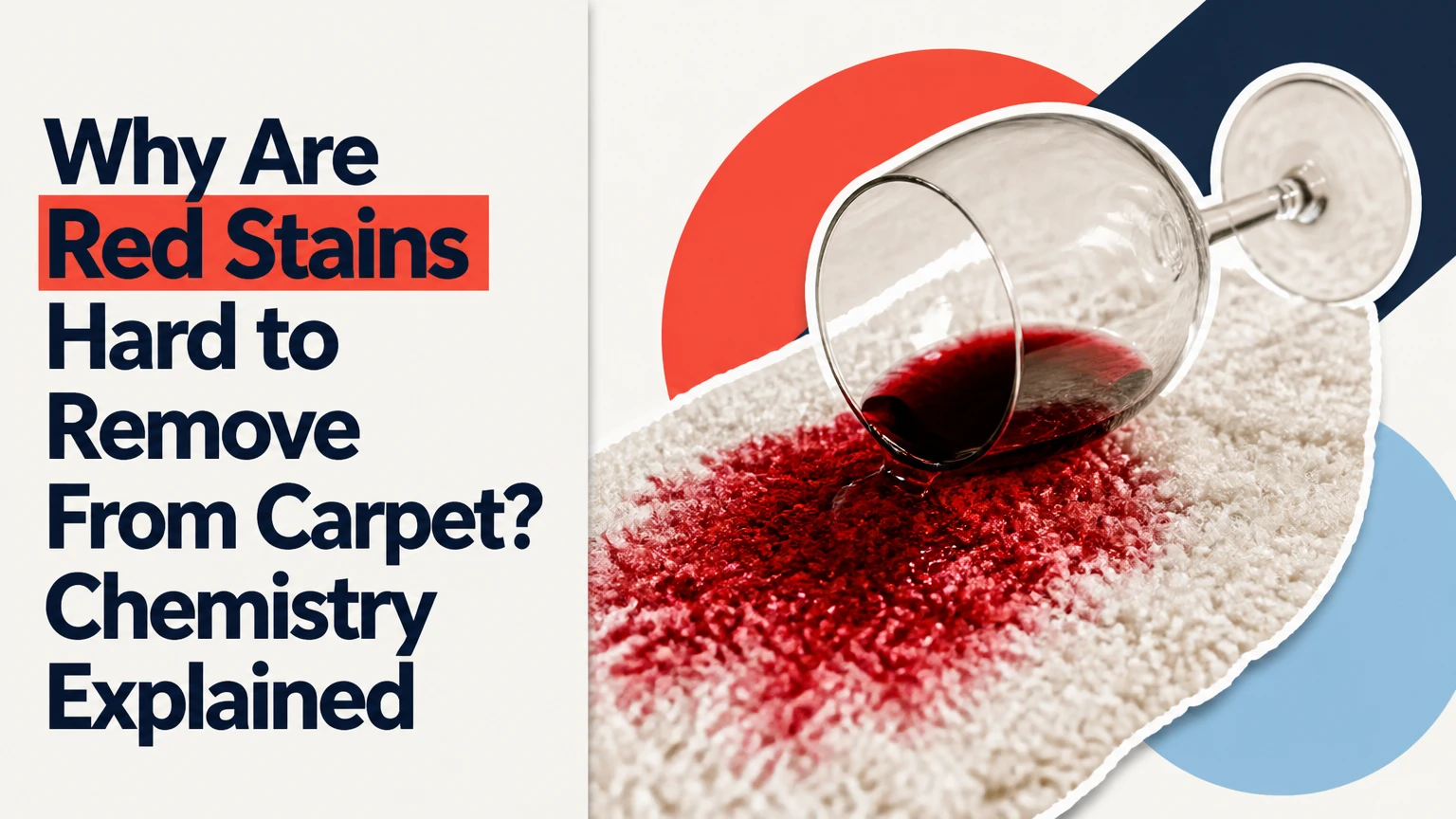
Red stains are hard to remove from carpet because red colorants can be intensely concentrated, water-soluble, oil-carried, or chemically attracted to particular fibers. Nylon and wool may retain some acid dyes, while polyester and olefin resist many water-based dyes but hold oily residues. The stain’s source, carpet fiber, moisture depth, heat exposure, and cleaning chemistry determine whether removal is realistic.
Key Facts at a Glance
Red is a visual color, not a single stain chemistry; red wine, sports drink, blood, tomato sauce, lipstick, and wax require different treatment approaches.
Nylon is often vulnerable to artificial acid dyes because its polymer contains dye-attracting sites, but the dye is not automatically bonded permanently.
Polyester and polypropylene usually resist water-based dye penetration better than nylon, yet oily red cosmetics and sauces can cling to or coat those fibers.
Heat can accelerate penetration, damage synthetic fibers, or set protein residues, but heat is also used carefully by professionals for some red-dye reduction treatments.
A stain that returns after drying usually indicates wicking from the backing or pad, not that the red pigment regenerated.
Hydrogen peroxide, reducing agents, solvents, and enzymes work on different stain components; using the wrong chemistry can create color loss or backing damage.
Why Are Red Stains Hard to Remove From Carpet?
Red stains are difficult because many red colorants absorb strongly in the visible spectrum, so a small residue remains conspicuous against pale carpet. Liquid also carries dissolved dye below the pile surface, where ordinary blotting cannot reach. The problem becomes more severe when a colorant has affinity for nylon or wool, or when oil, wax, protein, or sugar binds the residue to the fiber.
The word “red” describes appearance rather than composition. A cherry drink may contain FD&C Red No. 40, a synthetic color additive also known as Allura Red AC. A berry spill may contain anthocyanins, sugars, acids, and plant solids. Lipstick usually combines waxes, oils, emollients, and pigments.
Carpet adds another layer. A visible spot can occupy the face yarn, primary backing, adhesive layer, and pad. A surface treatment may remove the mark from the tips while dissolved material remains underneath. As the moisture evaporates, capillary action can carry that residue upward again.
The supplied AI Overview is right that dye affinity matters, but it overstates the mechanism by calling every red dye bond permanent. Removal depends on concentration, dwell time, fiber type, dye formulation, pH, and the condition of the original carpet color.
Which Carpet Fibers Make Red Dye Removal Harder?
Nylon usually presents the greatest risk from water-based artificial red dyes, while polyester and solution-dyed polypropylene commonly resist those dyes more effectively. Wool demands the most conservative treatment because strong alkalinity, oxidizers, heat, and prolonged wetting can damage its protein structure or alter its natural color.
| Fiber or construction | Typical red-stain vulnerability | Main reason | Safer starting approach |
|---|---|---|---|
| Nylon, stock-dyed | High for beverage dyes | Acid-dye affinity and absorbent polymer structure | Blot, identify dye, patch-test a labeled product |
| Wool | High treatment risk | Protein fiber, heat and pH sensitivity | Blot with cool water, use wool-safe chemistry or call a specialist |
| Polyester | Low to moderate for water dyes | Hydrophobic fiber with limited acid-dye affinity | Extract beverage residue; use controlled solvent for oily stains |
| Polypropylene, solution-dyed | Low for many water dyes | Color runs through the polymer, not a surface dye layer | Blot and rinse; remove oily residue with suitable spotter |
| Triexta or modified polyester | Moderate and product-dependent | Fiber chemistry varies by manufacturer | Follow carpet warranty instructions and test first |
Fiber labels do not tell the whole story. A nylon carpet can be solution-dyed, stock-dyed, stain-resistant, textured, or heavily worn. A “stain-resistant” finish generally improves resistance to liquid soil; it does not make the carpet immune to concentrated red dye or lipstick oils.
Carpet Institute guidance and manufacturer care documents consistently emphasize testing cleaning agents in an inconspicuous area and following the fiber maker’s instructions. That precaution matters because a successful stain removal can still leave a lighter patch if the chemical attacks the carpet’s original dye.
How Does Red Colorant Enter and Remain in Carpet?
Red colorant enters carpet through liquid transport, fiber wetting, surface adsorption, and, in some cases, chemical attraction to the fiber. The stain becomes harder to remove when the liquid reaches the backing or pad, when the colorant dries in place, or when a carrier such as oil or protein remains around the pigment.
Several mechanisms can operate at once:
- Dissolution: Water dissolves beverage dyes, sugars, acids, and some plant compounds.
- Capillary movement: Narrow spaces between yarns draw liquid downward and outward.
- Adsorption: Color molecules adhere to the fiber surface or enter microscopic irregularities.
- Dye affinity: Negatively charged acid dyes can be attracted to positively charged sites in nylon or wool under suitable conditions.
- Carrier adhesion: Oils, waxes, proteins, and resins hold pigment against the yarn.
- Drying concentration: Evaporation leaves the remaining colorant more concentrated at the stain perimeter and fiber base.
The phrase “ionic bond” needs precision. Ionic attraction can help an acid dye associate with a fiber, but household spills do not automatically create an irreversible chemical transformation of the carpet. Professional reducers work because they alter the dye molecule’s color-forming system and help release or decolorize some artificial red dyes. They do not restore fiber that has already been bleached, melted, or physically abraded.
What Kind of Red Stain Is on the Carpet?
The stain source is more useful than its color when choosing a remover. Water-based synthetic dye, natural plant pigment, protein, and oily pigment each require a different first response.
| Red source | Likely components | Common fiber behavior | Appropriate treatment family |
|---|---|---|---|
| Sports drink or fruit punch | Red 40, water, sugar, acid | Travels rapidly through nylon pile | Absorption, rinsing, then dye reducer if needed |
| Red wine or berries | Anthocyanins, tannins, sugar, water | Leaves plant color and sticky residue | Blotting, controlled rinse, oxidation only after testing |
| Blood | Hemoglobin proteins, water, salts | Protein residue can darken when heated | Cool water, extraction, enzyme or protein-safe treatment |
| Tomato sauce | Lycopene, oil, acids, solids | Oil carries pigment into yarn and backing | Remove solids, detergent or solvent-compatible degreasing |
| Lipstick or foundation | Oils, wax, pigments, polymers | Coats hydrophobic fibers and resists water | Transfer, controlled solvent, then rinse extraction |
| Crayon or candle wax | Paraffin or other wax, pigment | Solidifies around yarns | Harden, lift, absorb with paper and controlled heat if suitable |
| Red ink or paint | Resin, solvent, dye or pigment | May form a film rather than a soluble spot | Identify product, then use manufacturer-compatible solvent |
Why Red Wine and Berry Stains Behave Differently
Red wine and berry stains are difficult because they combine strongly colored plant compounds with water, acids, sugars, and sometimes tannins. Anthocyanins can change from red to purple or blue as pH changes, so a color shift after cleaning does not necessarily mean the residue has disappeared.
Tomato stains differ because lycopene is poorly soluble in water and often arrives with oil. Pouring water onto tomato sauce can spread the stain without removing the oily carrier. Blood differs again: hemoglobin is a protein residue, and hot water can denature proteins, making the mark more difficult to release.
What Should You Do in the First 10 Minutes?
Blot the spill immediately, remove solids without spreading them, and keep the liquid from reaching the backing. The first response should use white absorbent towels and small amounts of cool or room-temperature water, because aggressive scrubbing and saturation enlarge the affected area.
Step 1: Remove Excess Liquid and Solids
Place a folded white towel over the spill and press downward. Replace the towel as soon as it becomes colored or wet. Lift sauce, wax fragments, or makeup solids with a spoon or dull edge; do not drag them across the pile.
Step 2: Identify the Source
Check the container, smell, texture, and residue. Sugary drinks feel tacky after drying, lipstick leaves a greasy transfer, wax hardens, and blood may turn brownish as it dries. Source identification prevents the common mistake of applying peroxide to an oily cosmetic or an enzyme to a synthetic dye.
Step 3: Rinse Without Flooding
Apply a small amount of clean water to the towel or stain edge, then blot toward the center. Avoid pouring a cup of water directly onto carpet unless you can extract it thoroughly. A typical household towel can remove surface moisture, but it cannot reliably remove liquid from the pad.
Step 4: Stop When Color Transfer Stops
Do not keep adding products merely because a faint shadow remains. The remaining mark may be fiber distortion, chemical color loss, or residue below the pile, and repeated wetting can turn a manageable spot into wicking.
When Does a Red-Dye Reducer Work?
A reducing agent is most useful for certain synthetic red dyes, especially artificial beverage colorants that remain vivid after water-based cleaning. Professional products may contain reducing chemistry such as sodium metabisulfite, but product instructions, ventilation, patch testing, and thorough extraction are essential.
Reduction changes the chromophore, the part of a molecule responsible for visible color. The color may fade rapidly, but fading is not proof that every residue has left the carpet. The treatment may need repeated application and extraction, particularly when the drink reached the backing.
| Treatment family | Best target | Typical dwell or action | Main risk |
|---|---|---|---|
| Reducing agent | Artificial beverage dye on compatible synthetic carpet | Product label, often several minutes per application | Color change, odor, fiber or dye damage |
| Oxidizing agent | Plant pigments and some organic residues | Several minutes to 30 minutes, label-dependent | Original carpet color loss |
| Enzyme product | Blood or protein-containing food residue | Often 15 minutes to several hours | Little effect on synthetic dye or oil |
| Mild detergent rinse | Sugar, food residue, light soil | 2-10 minutes followed by extraction | Sticky residue if poorly rinsed |
| Solvent spotter | Lipstick, oily makeup, some inks | Short applications with transfer towels | Flammability, dye bleed, adhesive damage |
A professional may use controlled heat with a red-dye reducer because warmth can accelerate the chemical reaction and transfer color into a damp white towel. That procedure is not the same as ironing a carpet stain. Household irons can melt polypropylene, flatten pile, scorch fibers, loosen adhesive, or transfer towel dye.
When Does Oxidation Help?
Oxidation can help break down natural red plant pigments and some organic residues, but hydrogen peroxide is not a universal red-stain remover. Peroxide can lighten the carpet’s intended dye, and wool, silk, dark colors, and unknown fibers require particular caution.
Use oxidation only after removing excess liquid and oily material. Apply a labeled carpet product rather than relying on a random concentration of household peroxide. Keep the application controlled, observe the color change, and rinse or extract according to the product instructions.
OxiClean products use oxygen-based chemistry, but a product’s label and formulation determine suitability. “Oxygen cleaner” does not mean “safe for every carpet.” The same warning applies to chlorine bleach, which should not be used as a general carpet spot remover.
A useful diagnostic is color behavior. If the red area becomes pale orange, yellow, or white immediately after chemical exposure, the issue may be altered carpet dye rather than remaining stain. Additional remover cannot restore color that has been chemically stripped.
Why Do Oily Red Stains Need Solvent Extraction?
Lipstick, foundation, crayon, and oily tomato sauce resist ordinary water because their pigments are suspended in hydrophobic waxes, oils, resins, or fats. Solvent-compatible treatment can loosen that carrier, after which absorbent transfer and detergent rinsing remove the dissolved residue.
Start by lifting solids and blotting. Apply a small amount of an appropriate carpet-safe solvent to a white towel, not a large volume directly onto the floor. Transfer from the outside toward the center, rotate to a clean towel section, and ventilate the room.
Isopropyl alcohol is flammable and may affect carpet dye, backing, or adhesive. Acetone is more aggressive and can damage synthetic fibers, latex, backing, and surrounding finishes. It is not a default household solution. Never mix solvents with oxidizers, chlorine products, or unknown cleaners.
A solvent removes the carrier, not necessarily every pigment molecule. Follow with the label-approved rinse or extraction method, because an invisible solvent or oily film can attract new soil.
Does Heat Make Red Carpet Stains Permanent?
Heat can make some red stains harder to remove, but it does not universally “lock” every red pigment into carpet. Heat may set protein residues, accelerate dye penetration, soften wax, damage synthetic fibers, or speed a professionally controlled reduction reaction.
| Heat scenario | Likely effect | Recommended decision |
|---|---|---|
| Hot water on blood | Protein denaturation and spreading | Use cool water first |
| Hair dryer on a wet beverage stain | Faster drying and possible wicking | Extract, then air-dry gently |
| Direct iron on nylon or polypropylene | Melting, glazing, or pile distortion | Never place iron on bare carpet |
| Damp towel with professional reducer | Controlled transfer in trained hands | Follow product protocol and test first |
| Warm water on wax | Softens wax for removal | Use only with a barrier and suitable construction |
The safest household rule is simple: use no direct heat until the stain chemistry and fiber are known. Professionals may use heat because they control temperature, moisture, contact time, and transfer material.
Why Does a Cleaned Red Stain Reappear?
A red stain often reappears because dissolved colorant remains in the backing or pad and wicks upward as the carpet dries. The recurrence is usually a moisture-transport problem, not evidence that the original surface cleaning failed chemically.
Wicking is more likely after over-wetting, slow drying, thick pile, dense backing, or a spill that penetrated beneath the visible spot. A ring around the original area indicates that dissolved residue moved outward during evaporation.
Rewetting the entire area with more cleaner can worsen the problem. Instead, extract as much moisture as possible, place thick white towels over the spot, and use weight only when the carpet manufacturer and cleaning-product directions permit it. Improve airflow with fans, and remove the weight when towels become damp.
If the stain returns repeatedly, a professional may need to flush and extract the backing or pad. In severe cases, pad replacement or carpet repair is more rational than repeated surface treatment.
How Can You Tell Stain From Carpet Damage?
A true remaining stain changes or transfers color when a compatible treatment is applied, while carpet damage remains pale, yellow, shiny, rough, or differently textured despite repeated extraction. Fiber distortion can also create a dark-looking patch because crushed or frayed yarn reflects light differently.
Inspect the area from several angles. Compare the pile height, sheen, softness, and color with an adjacent undamaged section. A brown or orange change after peroxide may indicate oxidation; a white patch after bleach indicates color loss; a glossy patch on polypropylene may indicate heat damage.
Scrubbing creates “blooming,” where individual fiber tips become fuzzy and reflect light unevenly. The mark can remain visible even after the pigment has gone. Cutting or shaving the pile is a repair decision, not a cleaning method, and should be left to a carpet-repair technician.
What Changes for Wool and Specialty Rugs?
Wool and specialty rugs need cooler, milder, lower-moisture treatment than most synthetic wall-to-wall carpet. Wool can felt, shrink, bleed, or weaken when exposed to excessive agitation, heat, alkalinity, or oxidizing chemistry.
For a fresh spill, remove solids, blot with white towels, and use only a small amount of cool water unless the rug’s care instructions specify otherwise. Do not use a household iron, sodium metabisulfite reducer, chlorine bleach, or strong peroxide on wool without professional guidance.
Silk, viscose, and plant-based regenerated fibers are even less forgiving. Viscose can develop permanent texture changes after wetting, while silk can lose strength or color. A rug with a valuable hand, uncertain fiber, antique construction, or unstable dye should go to a rug-washing specialist rather than a carpet spot-cleaning service.
What Do Professional Red-Stain Treatments Cost?
Professional red-stain treatment typically costs about $50-$150 for a localized room service in the United States, while broader cleaning, difficult access, specialty rugs, and repair can raise the total. The price depends on stain size, fiber, furniture, travel, extraction requirements, and whether the pad or backing is affected.
| Service situation | Typical time | Typical U.S. price | Main cost variable |
|---|---|---|---|
| Fresh beverage spot during a scheduled visit | 10-20 minutes | $25-$75 add-on | Existing service call |
| Single difficult red dye area | 20-60 minutes | $50-$150 | Reducer, heat transfer, extraction |
| One standard room with cleaning | 45-90 minutes | $100-$250 | Room size and minimum charge |
| Specialty wool or silk rug | 1-3 weeks including drying and transport | $150-$600+ | Fiber, dye stability, rug size |
| Pad or section replacement | 1-4 hours | $150-$800+ | Matching carpet and repair area |
These are typical planning ranges, not universal prices. A professional should identify the fiber and explain the risk of color loss before promising complete removal. No reputable cleaner can guarantee removal when the carpet’s original dye has been altered or the fiber has melted.
Common Mistakes and How to Fix Them
Scrubbing the pile
Scrubbing spreads liquid, drives residue downward, and distorts fiber tips. Stop brushing, blot with a folded white towel, and use extraction rather than friction.
Pouring on club soda
Club soda may dilute a fresh water-soluble spill, but carbonation does not neutralize every red dye. Remove the liquid afterward, because leaving a sugary or mineral residue can attract soil.
Applying peroxide without a patch test
Peroxide may oxidize the stain and the carpet’s original dye at the same time. Test in a hidden area and use a product labeled for the specific carpet.
Using dish soap heavily
Dish soap can leave surfactant residue and may interfere with carpet protection or future extraction. If used at all, apply a tiny amount of diluted product and rinse-extract thoroughly.
Ironing the carpet directly
Direct heat can melt or glaze synthetic fibers. A professional transfer method requires a damp barrier towel, controlled temperature, a compatible reducer, and constant monitoring.
Mixing cleaning chemicals
Never combine peroxide, reducers, chlorine bleach, acids, ammonia, or solvents. Chemical incompatibility can release irritating vapors, generate heat, or damage the carpet.
Can a Red Stain Be Removed After It Dries?
A dried red stain can still be removable, but the probability depends on the source, fiber, concentration, and depth. Drying concentrates the residue and may make sugar, protein, oil, or dye harder to dissolve, yet dried does not automatically mean permanent.
Begin by vacuuming loose material and identifying the stain. Soften only the affected area with the product appropriate to its chemistry, allow the labeled dwell time, then blot or extract. Avoid repeated wetting when the spot has already reached the backing.
Synthetic beverage dye on nylon often needs a professional reducer rather than repeated consumer carpet shampoo. Dried lipstick requires carrier removal. Dried blood needs cool-water treatment and possibly an enzyme product. A dried, colorless pale patch may be damage rather than residue.
The Bottom Line
Why are red stains hard to remove from carpet? Red stains combine highly visible colorants with liquid penetration, fiber affinity, oily or protein carriers, and backing-level wicking. The safest solution is not the strongest cleaner. Identify the source and fiber, blot immediately, avoid direct heat and aggressive scrubbing, then match reduction, oxidation, solvent extraction, or enzyme treatment to the stain chemistry.
Frequently Asked Questions
Does salt remove red stains from carpet?
Salt may absorb a small amount of surface moisture, but it does not reliably break down synthetic red dye, oil, wax, or protein. Salt can also leave crystals and residue in the pile. Blotting and controlled extraction are more useful for a fresh spill, followed by source-specific treatment if color remains.
Is vinegar safe for red carpet stains?
Diluted vinegar can alter pH and may help with some mineral or alkaline residues, but vinegar is not a universal red-dye remover. Acid can change anthocyanin color without removing it, and vinegar must never be mixed with bleach or unknown cleaners. Test first and follow the carpet manufacturer’s care guidance.
Why did my red wine stain turn blue or purple?
Anthocyanins in wine and berries change color with pH. An alkaline cleaner can shift a red or pink mark toward purple or blue, while an acidic environment may shift it back toward red. The color change indicates altered pigment chemistry, not necessarily successful removal.
Can steam cleaning remove artificial red dye?
Steam extraction can remove liquid, sugar, and loosened residue, but ordinary steam cleaning may not decolorize a synthetic red dye attached to compatible fibers. Professional cleaners may combine extraction with a tested reducing treatment. Excess steam or moisture can deepen penetration, cause wicking, or damage sensitive fibers.
Should I replace carpet after a red stain?
Replace or repair carpet only after confirming that cleaning cannot remove the residue and that the carpet’s original color has been altered. A localized stain on a discontinued carpet may justify a donor patch, while a fresh surface spill usually deserves controlled treatment before replacement.
Is red carpet stain removal covered by renters insurance?
Renters insurance commonly excludes gradual damage and may exclude accidental stains depending on the policy, deductible, and cause. Document the spill, obtain a written cleaning estimate, and review the policy before filing a claim. A $50-$150 spot treatment may cost less than the deductible.