
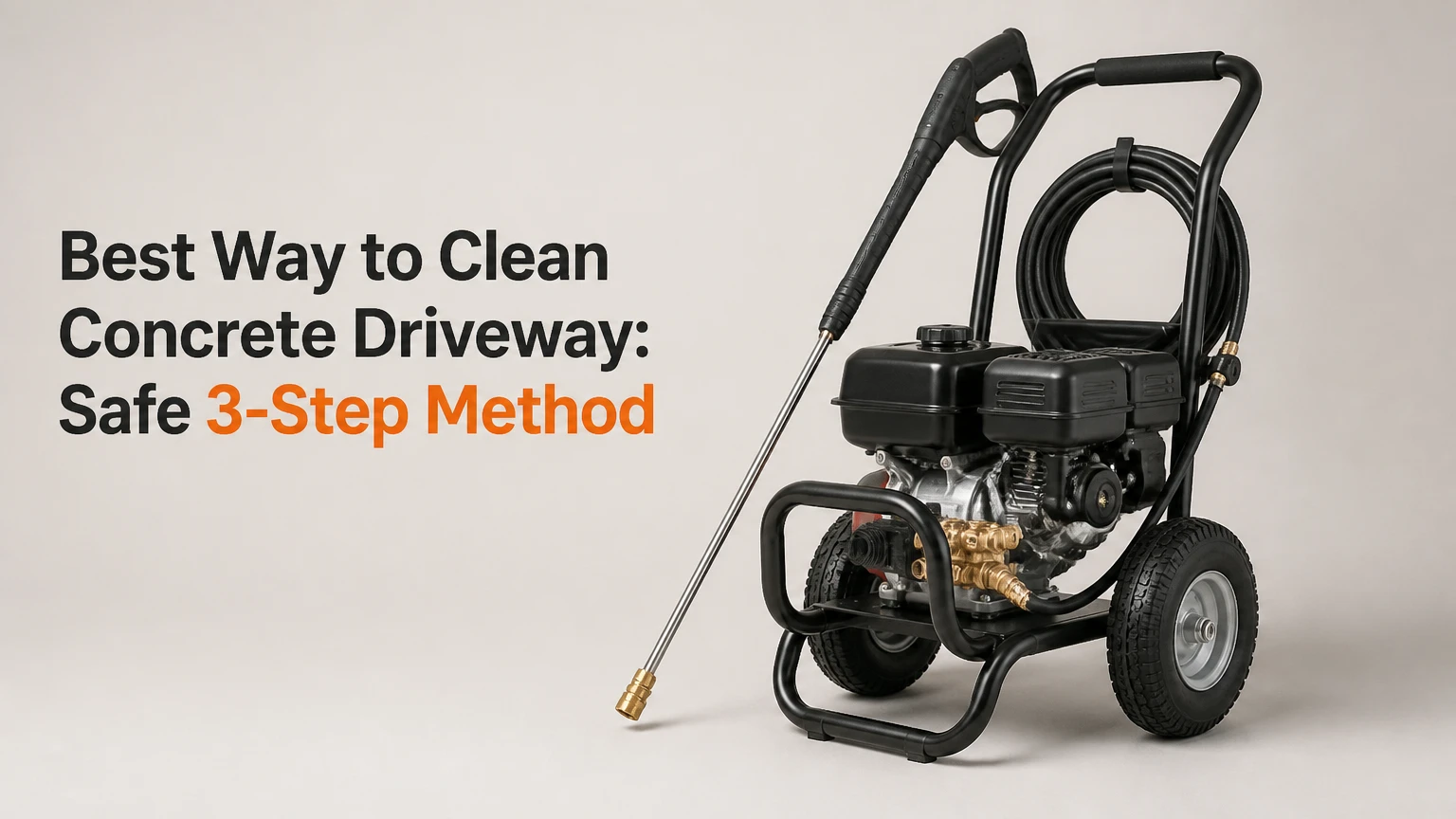
The best way to clean a concrete driveway is to pre-treat stains, apply a concrete-safe detergent, and rinse with a pressure washer fitted with a surface cleaner. Use lower pressure for decorative or damaged concrete, treat oil and rust separately, and control chemical runoff before cleaning so the driveway improves without etching, striping, or landscape damage.
Key Facts at a Glance
A detergent-assisted pressure wash removes widespread dirt more evenly than water-only spraying.
A 2,500-3,500 PSI machine with roughly 2.5-4.0 GPM is typically practical for sound, unsealed concrete, but nozzle size, distance, and technique determine the actual surface force.
A 14-16 inch surface cleaner usually produces a more uniform result than a handheld wand on a two-car driveway.
Most concrete detergents need about 10-15 minutes of dwell time and must remain wet while they work.
Concrete less than 28 days old should not receive aggressive cleaning; follow the concrete contractor’s or sealer manufacturer’s instructions.
Oil may return after washing because absorbed hydrocarbons wick upward as the slab dries.
Why Concrete Needs Both Cleaner and Rinsing
Concrete driveway cleaning works through two linked actions: chemical separation and mechanical flushing. Concrete contains capillaries that absorb oil, soil, dissolved salts, and organic residue, so a surface rinse can remove loose dust while leaving the source of a dark stain below the surface.
Alkaline detergents and degreasers help emulsify oils. Surfactants help water spread across the slab instead of beading on embedded grime. Sodium hypochlorite oxidizes and kills many organic growths, while specialty rust removers dissolve iron compounds through a controlled chemical reaction.
Pressure then carries the loosened material out of the surface texture. High pressure alone is not automatically better. Excessive pressure can remove the cement paste at the surface, leaving pale lines, rough aggregate, or a permanently fuzzy appearance.
A useful practitioner rule is to clean by stain chemistry first and pressure second. Water pressure is a transport tool, not a substitute for the correct treatment.
What Should You Do Before Cleaning?
Prepare the driveway, nearby drainage, and surrounding plants before applying any detergent. A typical two-car driveway takes 20-30 minutes to clear, sweep, inspect, and protect.
Move vehicles, bins, toys, planters, and loose furniture. Sweep gravel and leaves away because pressure can turn them into projectiles. Locate low points and storm drains, then decide where dirty water can be contained or collected rather than pushed into a street drain.
Inspect the slab for cracks, spalling, exposed aggregate, old coatings, flaking sealer, and joint deterioration. Photograph existing defects. Cleaning can reveal damage that dirt previously concealed, but it cannot repair structural cracking or replace missing concrete paste.
Pre-wet nearby grass and shrubs with clean water. Cover delicate plants when chemical overspray is possible, and remove covers quickly if sunlight or heat could trap moisture. The United States Environmental Protection Agency states, “The label is the law,” so follow the product label for dilution, personal protective equipment, surface compatibility, and disposal.
Before-you-start checklist
| Requirement | Typical value | Practical note |
|---|---|---|
| Cleaning time | 2-5 hours | Includes drying and stain re-treatment |
| Difficulty | Moderate | Higher for oil, rust, slopes, and drainage limits |
| DIY equipment cost | $50-$150 | Typical rental, detergent, gloves, and protection |
| Pressure washer | 2,500-3,500 PSI, 2.5-4.0 GPM | Use the lowest effective setting |
| Surface cleaner | 14-16 inches | Match the attachment to the machine’s flow rate |
| Detergent | 1-2 gallons ready-to-use solution | Quantity depends on driveway size and dilution |
| Safety equipment | Gloves, eye protection, boots | Add chemical-resistant clothing for corrosive products |
Which Cleaner and Pressure Setting Should You Use?
Use a concrete detergent for general dirt, an alkaline degreaser for oil, an organic-growth cleaner for algae or mildew, and a specialty rust remover for iron staining. A pressure washer should provide enough flow to rinse efficiently, but the safest setting depends on concrete age, finish, damage, nozzle angle, and working distance.
The often-repeated 3,000-3,500 PSI “sweet spot” is too broad as a universal rule. Sound, plain concrete can often tolerate that equipment rating, yet a concentrated 0-degree jet held close to the slab can damage concrete at a much lower machine setting. A 25-degree or 40-degree fan tip, a surface cleaner, and a moving spray pattern reduce concentrated impact.
Do not assume that a machine’s maximum rating equals its operating pressure. Rental equipment may advertise peak PSI while delivering different pressure under load. Gallons per minute affects productivity because more water carries loosened slurry away faster.
| Driveway condition | Starting approach | Pressure guidance | Suitable cleaner |
|---|---|---|---|
| Sound plain concrete | Detergent, then surface cleaner | 2,500-3,000 PSI | Neutral or alkaline concrete detergent |
| Heavy organic growth | Apply organics cleaner, then rinse | 1,500-2,500 PSI initially | Label-approved sodium hypochlorite product |
| Oil contamination | Degrease and agitate before rinsing | 2,000-2,500 PSI | Concrete degreaser or microbial enzyme |
| Decorative or stamped concrete | Test a hidden area first | 1,000-2,000 PSI | Manufacturer-approved cleaner |
| Exposed aggregate | Wide fan, continuous movement | 1,500-2,500 PSI | Mild concrete detergent |
| Spalling or sandy concrete | Avoid aggressive washing | Below 1,500 PSI or hand clean | Mild detergent and professional assessment |
Is a surface cleaner better than a spray wand?
A surface cleaner is better for broad, sound concrete because its enclosed rotating bars maintain a more consistent distance and produce fewer visible stripes. A 14-16 inch attachment is a practical match for many residential machines, provided the machine supplies the attachment’s required flow.
A wand remains useful around edges, expansion joints, steps, walls, and isolated stains. Use a 25-degree fan tip rather than a 0-degree tip, keep the nozzle moving, and begin around 12 inches from the surface. Test a small inconspicuous area, then reduce distance only when the finish remains intact.
A surface cleaner can still leave circular marks if the operator pauses, moves too quickly, or uses an attachment that demands more GPM than the pressure washer supplies. Keep each pass parallel, overlap by about 2 inches, and rinse edges separately.
How Do You Clean a Concrete Driveway?
The safest general process has four phases: remove loose debris, treat individual stains, wash the full slab with detergent, and rinse until no dirty residue remains. A typical 600-square-foot driveway requires approximately 2-5 hours, including chemical dwell time and drying.
Step 1: Sweep and protect the work area
Sweep the entire driveway and remove embedded pebbles from joints. Wet nearby vegetation, close doors and windows, and redirect downspouts if they discharge onto the work area.
Block the lowest edge with temporary absorbent material when runoff could reach a storm drain. Do not allow concentrated degreaser, bleach solution, or acid cleaner to collect against metal gates, painted surfaces, lawns, or waterways.
Success checkpoint: The slab has no loose gravel, vehicles are clear, and runoff has a planned path.
Common mistake: Starting the pressure washer before identifying where dirty water will travel.
Step 2: Pre-treat oil, rust, and organic growth
Apply stain-specific products before the overall wash. For fresh oil, cover the spill with an absorbent such as clay granules, allow it to draw up liquid, sweep it away, then apply a labeled concrete degreaser and scrub with a stiff nylon brush.
For older oil, allow the degreaser to dwell for 10-20 minutes without drying. A microbial or enzymatic cleaner may help with residual hydrocarbons, but it usually needs repeated applications and several days of dwell time. Enzymes do not replace a detergent wash for soil, algae, or tire dust.
For rust, choose a product labeled for concrete, commonly based on oxalic, citric, or another rust-dissolving acid. Hydrochloric or muriatic acid can etch concrete, alter its color, expose aggregate, and create hazardous fumes. It should not be a casual first choice.
For algae, moss, or mildew, use a labeled organic-growth cleaner. Sodium hypochlorite can work quickly, but dilution, contact time, ventilation, and runoff controls must follow the product label.
Success checkpoint: The stain edges soften, oil residue lifts into the brush or absorbent, and no cleaner dries on the slab.
Common mistake: Mixing bleach with acids, ammonia, or other cleaners. Dangerous gases can result.
Step 3: Apply detergent across the driveway
Apply a concrete-safe detergent with a pump sprayer, downstream injector, or manufacturer-approved soap system. Work in manageable sections of approximately 100-200 square feet so the product remains wet during its 10-15 minute dwell period.
Agitate heavily soiled areas with a nylon brush. Mist the surface with clean water if evaporation begins, especially in direct sun, low humidity, or wind. A chemical that dries before rinsing can leave streaks, residue, or uneven color.
Keep detergent off aluminum, painted siding, natural stone, and unprotected metal unless the label approves those surfaces. Some alkaline cleaners can darken aluminum, while strong acids can corrode hardware.
Success checkpoint: Dirt looks loosened, the detergent remains wet, and the surface has no dry rings or chemical swirls.
Common mistake: Applying more concentrated cleaner when the real problem is insufficient dwell time or agitation.
Step 4: Rinse with controlled pressure
Attach the surface cleaner and begin at the highest point of the driveway. Move at a slow, steady pace, overlap each pass by about 2 inches, and keep the attachment moving continuously.
Use the wand for perimeter edges and joints. Maintain a consistent distance with a 25-degree tip, and never use a 0-degree tip on the slab. If the concrete begins to look lighter in lines, stop and reduce pressure, increase distance, or switch to a wider fan.
Rinse from the top downward after the main passes. Dirty slurry should leave the driveway without pooling in low areas. Several lighter passes are safer than one concentrated blast.
Success checkpoint: The surface has an even appearance while wet, with no striping, gouges, or loose cement paste.
Common mistake: Holding the wand stationary to remove one dark mark, which creates a circular or linear etch.
Step 5: Inspect after drying and post-treat
Allow the driveway to dry for 24-48 hours before judging the final color. Oil can wick upward as moisture leaves the slab, so a stain that reappears the next day is not necessarily a washing failure.
Repeat degreaser or enzyme treatment on returning oil. Do not immediately increase pressure. For organic growth, a label-approved post-treatment may slow regrowth, but avoid uncontained chemical runoff and keep the product away from sensitive landscaping.
Success checkpoint: The slab is uniformly dry, remaining stains are identified by type, and no residue remains in joints or at the driveway edge.
Common mistake: Sealing while the concrete is still damp or while oil remains in the pores.
Which Method Works Best for Each Stain?
The best method changes with the contaminant. General dirt responds well to detergent and controlled rinsing, while oil and rust require separate chemistry because pressure alone rarely removes material embedded below the surface.
| Stain or problem | First treatment | Rinse method | Typical outcome |
|---|---|---|---|
| Tire marks | Alkaline degreaser, 10-15 minutes | 2,000-2,500 PSI, nylon brush | 70-100% improvement on recent marks |
| Fresh oil | Absorbent, then degreaser | 2,000-2,500 PSI | Often improved in one session |
| Old oil | Degreaser plus enzyme follow-up | Moderate pressure, repeated treatment | May require 2-4 applications |
| Algae or mildew | Labeled organic-growth cleaner | 1,500-2,500 PSI | Surface growth usually clears quickly |
| Moss in joints | Manual removal, then organic cleaner | Low-pressure rinse | Requires joint maintenance |
| Rust | Concrete-safe rust remover | Low to moderate rinse | Product-dependent, test first |
| Mud and soil | Concrete detergent | Surface cleaner, 2,500-3,000 PSI | Usually responds in one wash |
| Efflorescence | Dry brushing, mineral cleaner if labeled | Low-pressure rinse | Source of moisture may remain |
Can you clean concrete without a pressure washer?
You can clean a concrete driveway without a pressure washer by applying detergent, scrubbing with a stiff nylon brush, and rinsing with a garden hose, although the method takes longer and may leave deep soil or oil behind. Manual cleaning is safest for weak, decorative, freshly repaired, or heavily spalled concrete.
Use a bucket or pump sprayer, apply cleaner to a small section, allow 10-15 minutes of dwell time, scrub in overlapping directions, and rinse before the solution dries. A garden hose nozzle can improve flushing, but it cannot reproduce the flow and impact of a pressure washer.
Manual cleaning is a reasonable choice for a small 100-200 square-foot area, a few stains, or a slab beside delicate landscaping. It is inefficient for a large driveway covered in compacted dirt.
How Much Does Driveway Cleaning Cost?
Typical DIY cleaning costs $50-$150, while professional residential service commonly costs $150-$500 for a standard driveway. Local labor, driveway size, stain severity, access, water recovery, and post-treatment can move the price outside those ranges.
| Service or purchase | Typical price | Typical time | Main cost factor |
|---|---|---|---|
| Pressure washer rental | $50-$100 per day | 4-8 rental hours | Gas machine and local market |
| Surface cleaner rental | $15-$40 per day | 1-3 hours of use | Attachment availability |
| Detergent and degreaser | $20-$60 | 30-90 minutes | Concentration and stain load |
| DIY total | $50-$150 | 2-5 hours | Equipment already owned or rented |
| Professional basic wash | $150-$300 | 1-3 hours | Size and access |
| Professional stain treatment | $250-$500 | 2-5 hours | Oil, rust, recovery, repeat visits |
| Sealing after cleaning | $0.75-$2.50 per square foot | 1-2 days | Sealer type and slab condition |
A professional quote should identify the cleaning method, chemical type, runoff handling, stain-treatment limits, and whether sealing is included. Extremely low bids may indicate water-only washing, no surface cleaner, or no protection for landscaping.
When Can Pressure Washing Damage Concrete?
Pressure washing can damage concrete when concentrated spray removes the cement paste, exposes aggregate, worsens existing spalling, or drives water into failing joints. Damage risk rises with a 0-degree nozzle, short working distance, stationary spraying, excessive machine pressure, and repeated cleaning of weak areas.
New concrete commonly needs about 28 days to reach its initial design cure before aggressive cleaning, but the slab’s contractor, sealer manufacturer, and climate may justify a longer wait. The AI Overview’s one-year prohibition is not a universal concrete standard. One year may be a cautious period for some maintenance programs, but it is not the normal minimum curing requirement.
Do not pressure wash surfaces with powdery concrete, widespread scaling, exposed reinforcement, unstable decorative coatings, or large areas of delamination. Cleaning cannot correct freeze-thaw damage, poor drainage, settlement, or failed resurfacing.
What Causes Stripes, Returning Oil, and Fuzzy Concrete?
Zebra striping usually results from inconsistent wand distance, fast passes, a mismatched surface cleaner, or allowing detergent to dry. Rewash the area with detergent, use a wider fan or surface cleaner, and cross-hatch only with controlled pressure after testing a small section.
Returning oil usually results from wicking. The upper surface dries first, pulling oil from deeper pores toward the surface. Apply a poultice, degreaser, or microbial enzyme product according to its label, then allow adequate dwell time before a moderate rinse.
A fuzzy or sandy surface indicates possible cement-paste removal or existing deterioration. Stop washing immediately, document the damage, and obtain a concrete repair assessment. A resurfacer may improve appearance, but it will not restore structural strength or correct a failing base.
Other common failures include:
- White residue: Detergent or mineral deposits dried on the slab. Rewet, scrub lightly, and rinse with clean water.
- Dark border after cleaning: Dirty runoff dried along the low edge. Pre-rinse, clean in smaller sections, and flush the perimeter.
- Uneven color: Old sealer, patching, or different slab batches may absorb water differently. Cleaning cannot guarantee one uniform shade.
- Dead grass: Concentrated chemical runoff reached the root zone. Dilute immediately with clean water and improve containment on future work.
Should You Seal a Concrete Driveway After Cleaning?
Seal a concrete driveway only after the slab is clean, fully dry, structurally sound, and free from active oil contamination. Sealing can reduce water and salt absorption, but it cannot hide severe stains permanently or repair cracks, scaling, and spalling.
Many sealers require 24-48 hours of dry weather after cleaning, with application temperatures commonly between 50 and 90 degrees Fahrenheit. The exact window varies by acrylic, penetrating silane-siloxane, polyurethane, or other product chemistry.
A penetrating sealer generally changes appearance less than a film-forming coating. A film-forming sealer can deepen color and add sheen, but it may peel if moisture moves upward through the slab. Test the chosen product in an inconspicuous area and follow the manufacturer’s coverage rate.
Do not seal merely because the driveway looks clean while wet. Moisture, oil, and efflorescence trapped under a coating create adhesion and appearance problems.
When Should You Hire a Professional?
Hire a professional when the driveway has widespread oil contamination, hazardous drainage, extensive spalling, decorative finishes, nearby waterways, or a surface that becomes damaged during testing. Professional service is also sensible when equipment transport, chemical handling, or water recovery exceeds the value of a weekend project.
A capable contractor should test a small area, identify the concrete finish, select a surface-compatible cleaner, protect adjacent materials, and explain what stains may remain. Ask whether the operator uses a surface cleaner, how runoff is managed, and whether the quoted price includes stain treatment.
DIY cleaning is appropriate for sound, plain concrete with ordinary dirt, light algae, and manageable drainage. It is not a good project for untrained acid handling or aggressive treatment of deteriorated concrete.
How Do You Keep a Concrete Driveway Clean Longer?
Preventive maintenance works best when it removes contamination before concrete absorbs it. Blot oil immediately, keep vehicles from leaking, sweep monthly, rinse leaves from shaded areas, and address standing water caused by blocked drains or poor grading.
A practical maintenance schedule is:
- Sweep every 2-4 weeks during leaf or pollen season.
- Rinse bird droppings, fertilizer, and fresh spills the same day.
- Treat algae or mildew at the first visible film, usually every 6-12 months in damp shade.
- Deep-clean plain concrete every 12-24 months, depending on traffic and climate.
- Inspect sealer every 2-3 years and reapply only when the existing product and surface condition support it.
Oil-absorbent pads beneath frequently parked vehicles can prevent repeated contamination. Prompt removal is more effective than trying to extract a year-old stain with higher pressure.
Frequently Asked Questions
Is bleach safe for a concrete driveway?
Bleach can clean algae, mildew, and some organic discoloration when a product label permits concrete use, but bleach does not dissolve oil or remove rust effectively. Protect plants, avoid mixing bleach with acids or ammonia, control runoff, and rinse according to the label.
What is the best nozzle for washing concrete?
A 25-degree fan nozzle is a practical starting point for plain concrete because it spreads impact over a wider area. A 40-degree tip is safer for fragile or decorative surfaces. A 0-degree nozzle can gouge concrete and should not be used for broad driveway cleaning.
How often should a concrete driveway be pressure washed?
Most residential concrete driveways need deep cleaning every 12-24 months, although shaded, damp, or heavily trafficked driveways may need annual treatment. Sweeping and prompt spill removal reduce the need for aggressive washing.
Why does my driveway look worse after pressure washing?
Pressure washing can reveal old oil, patching, sealer differences, discoloration, and concrete deterioration that dirt previously concealed. Striping, pale lines, or fuzzy texture indicate technique or surface damage, while dark patches that return after drying often indicate absorbed oil.
Can baking soda remove oil from concrete?
Baking soda can absorb a small fresh spill and provide mild scrubbing action, but it is usually weaker than a concrete degreaser for old, embedded oil. Remove the absorbent, apply a labeled degreaser, agitate with nylon, and rinse without forcing slurry into soil or drains.
What is the safest way to clean exposed aggregate concrete?
Use a mild concrete detergent, a wide fan or surface cleaner, and moderate pressure after testing a hidden area. Avoid concentrated jets because exposed aggregate can loosen when the cement matrix is already weak.
The Bottom Line
The best way to clean concrete driveway surfaces is a stain-first workflow: sweep and protect the area, pre-treat oil, rust, or organic growth, apply a concrete-safe detergent, and rinse with controlled pressure using a surface cleaner. Start conservatively, keep chemicals wet during dwell time, manage runoff, and inspect the dry slab before repeating treatment or applying sealer.