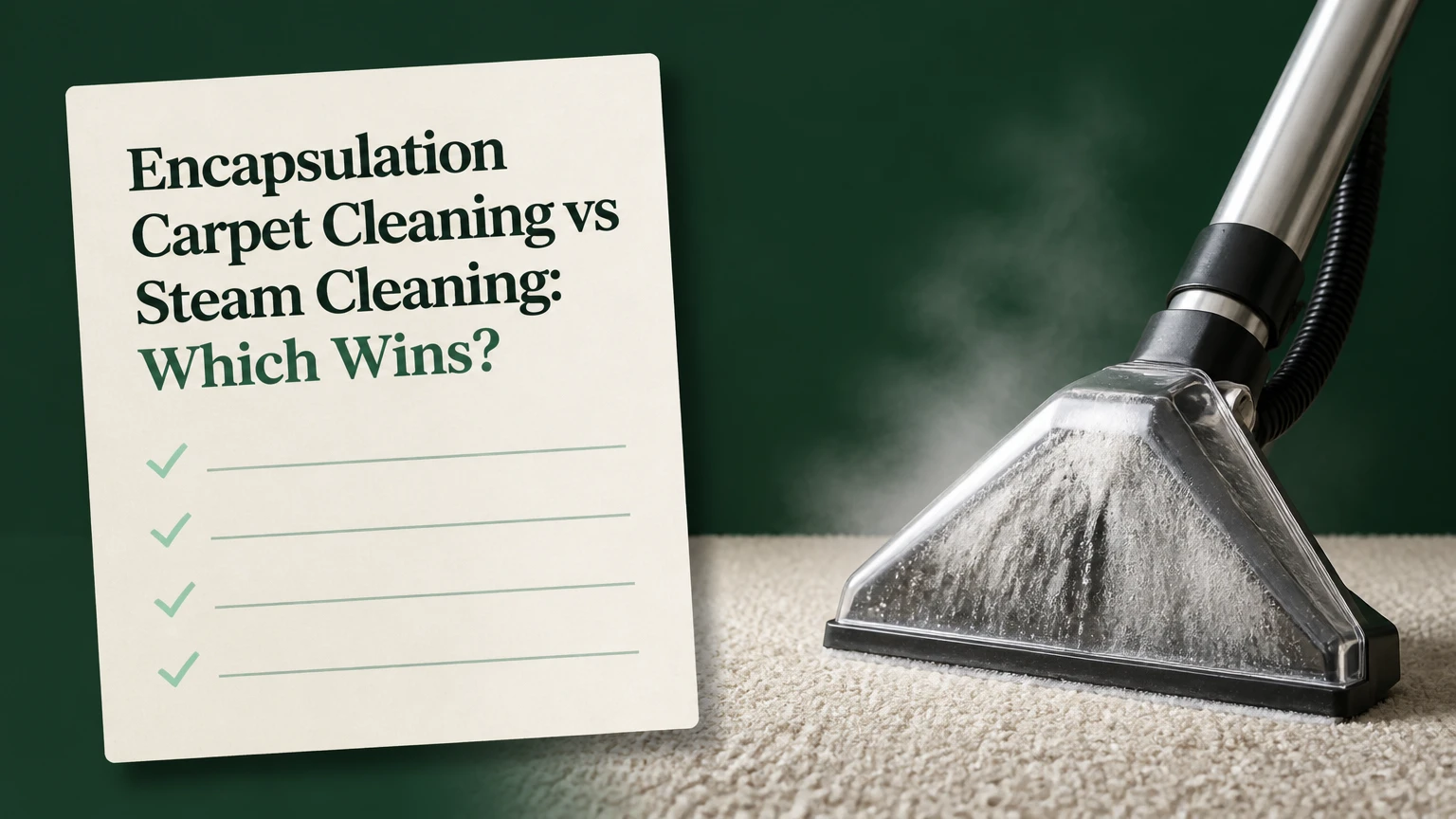
Encapsulation carpet cleaning is usually better for fast-drying routine maintenance, while steam cleaning, properly called hot water extraction, is better for flushing heavy soil, residues, and contamination from carpet. The correct choice depends on carpet fiber, backing condition, stain type, required drying time, and whether appearance maintenance or restorative soil removal is the priority.
Key Facts at a Glance
- Encapsulation carpet cleaning uses detergent and polymer chemistry to suspend soil, which dries into removable crystals that routine vacuuming must collect.
- Hot water extraction injects a measured rinse solution and recovers suspended soil through a vacuum system; “steam cleaning” is a common but technically imprecise name.
- Typical encapsulation drying takes 1-4 hours, while well-executed hot water extraction commonly takes 6-24 hours.
- Hot water extraction generally removes more deeply embedded sand, grit, urine salts, and oily soil than routine encapsulation cleaning.
- Encapsulation normally uses less water and causes less building disruption, but it does not replace extraction after major contamination.
- Neither method is automatically safe or effective: chemistry, fiber identification, moisture control, agitation, and operator technique determine the result.
What Is the Difference Between the Two Methods?
Encapsulation carpet cleaning removes suspended soil after the cleaning solution dries, whereas hot water extraction removes suspended soil while the carpet is being rinsed and vacuumed. Encapsulation is a low-moisture maintenance process; hot water extraction is a higher-moisture recovery process designed for deeper soil removal.
The difference is therefore not simply “chemical cleaning versus water cleaning.” Both methods depend on vacuuming, detergents, agitation, dwell time, and correct chemical dilution. Encapsulation shifts more of the soil-removal work to post-drying vacuuming, while extraction shifts more work to immediate recovery through a wand or powered tool.
The word “steam” causes confusion. Most professional steam-cleaning services use hot water extraction, not dry steam. Water temperature, spray pressure, vacuum lift, recovery speed, and the number of dry passes matter more than the label printed on the van.
| Decision factor | Encapsulation cleaning | Hot water extraction |
|---|---|---|
| Primary removal mechanism | Polymer crystallization and vacuuming | Rinse suspension and vacuum recovery |
| Typical drying time | 1-4 hours | 6-24 hours |
| Typical water demand | About 4-8 liters per 100 square meters | About 40-80 liters per 100 square meters |
| Typical commercial production | 180-300 square meters per technician-hour | 40-90 square meters per technician-hour |
| Best routine use | Offices, corridors, interim maintenance | Restorative residential or commercial cleaning |
| Main failure risk | Sticky residue or inadequate post-vacuuming | Over-wetting, slow drying, or incomplete recovery |
How Does Encapsulation Carpet Cleaning Work?
Encapsulation carpet cleaning begins with dry vacuuming, applies a low-moisture detergent-polymer solution, uses mechanical agitation to release soil, and ends with drying followed by vacuuming. The polymer surrounds suspended particles as the solution dries, producing brittle residue that an effective upright vacuum can remove.
A technician normally performs these stages:
- Pre-vacuum the carpet. Remove loose sand, hair, and abrasive soil before applying liquid. High-traffic carpet often contains more dry particulate soil than visible staining suggests.
- Treat spots separately. Protein, coffee, grease, ink, and alkaline urine deposits require compatible spotters. Encapsulation detergent alone is not a universal stain remover.
- Apply a measured solution. Product dilution and coverage rate must follow the manufacturer’s label. Excess solution extends drying and increases residue risk.
- Agitate the pile. A cylindrical counter-rotating brush, rotary machine, or oscillating pad distributes chemistry and opens dense traffic lanes.
- Allow complete drying. Low humidity and moving air speed crystallization. Dense carpet, humid rooms, and low airflow extend the process.
- Vacuum after drying. The crystals are not removed merely because they formed. Post-vacuuming is part of the cleaning method.
Encapsulation is strongest when the carpet has recurring appearance soil but no large contamination load. It is not a substitute for extraction after flooding, substantial pet urine migration, greasy food buildup, or soil embedded below the face yarn.
Which Encapsulation Equipment Matters?
The machine changes agitation quality, but equipment does not overcome poor chemistry or excessive application. A CRB machine is useful for lifting pile and distributing solution, while a rotary bonnet can remove some surface soil into an absorbent pad; an orbital machine offers controlled, multidirectional agitation with relatively low moisture.
| Equipment | Typical function | Best application | Important limitation |
|---|---|---|---|
| CRB machine | Counter-rotating brush agitation | Dense commercial pile and hair removal | Can damage loose loops if misused |
| Rotary bonnet | Agitation plus pad absorption | Surface soil and interim appearance work | May leave deeper soil behind |
| Oscillating pad machine | Low-moisture mechanical agitation | Large open areas with controlled spray | Requires thorough vacuum recovery |
| Commercial upright vacuum | Dry soil and crystal removal | Pre-vacuuming and post-vacuuming | Weak domestic vacuums may leave residue |
How Does Hot Water Extraction Work?
Hot water extraction applies a cleaning solution to loosen soil, uses heat and dwell time to improve soil suspension, then recovers the liquid and contaminants through a vacuum system. A truck-mounted unit generally provides stronger heat and airflow than a portable machine, but operator technique and carpet construction still control the outcome.
A professional workflow commonly includes the following:
- Dry vacuuming removes loose abrasive particles.
- A pre-spray targets oily traffic soil and is allowed to dwell for roughly 10-15 minutes.
- Agitation distributes the pre-spray through dense or matted areas.
- A wand or powered extraction tool applies rinse solution and immediately recovers liquid.
- Multiple slow vacuum passes remove additional moisture.
- Air movers improve evaporation when the carpet and backing can tolerate the process.
Truck-mounted systems can deliver high solution temperatures and strong vacuum recovery, but the temperature at the carpet is not automatically the temperature inside the machine. Excessive heat can damage wool, adhesive, latex, dye, or backing. The technician should identify the fiber and follow the manufacturer’s cleaning instructions before selecting heat and pressure.
Hot water extraction is not automatically sanitizing. Heat exposure, chemical dwell, and recovery conditions must meet the requirements of a specific antimicrobial treatment or standard. Ordinary carpet extraction can reduce soils and allergens without making a medical or infection-control claim.
Which Method Cleans Carpet More Deeply?
Hot water extraction usually cleans more deeply because recovered rinse water can carry suspended sand, grit, detergent residue, and dissolved contamination away from the pile and backing. Encapsulation performs well on recurring surface and mid-pile soil, but it depends on agitation and later vacuuming rather than flushing.
Deep cleaning does not mean unlimited water. A skilled extraction technician uses enough solution to suspend soil, then removes it with slow passes and adequate vacuum lift. Over-wetting can push contamination deeper, wet the backing, extend drying, and increase the risk of browning, odor, delamination, or microbial growth.
| Soil or contamination | Preferred method | Reason | Required qualification |
|---|---|---|---|
| Dry office dust | Encapsulation | Low moisture and efficient maintenance | Post-vacuuming is mandatory |
| Embedded sand and grit | Hot water extraction | Rinse and vacuum can remove abrasive particles | Pre-vacuum first |
| Greasy restaurant traffic lanes | Hot water extraction | Alkaline pre-spray can emulsify oil | Multiple recovery passes may be needed |
| Light drink spills | Either method | Spot treatment may be sufficient | Identify dye and fiber first |
| Pet urine in backing | Hot water extraction or replacement | Extraction can reach deeper residues | Severe saturation may require pad replacement |
| Flood or sewage contamination | Neither as a simple routine service | Restoration and containment are required | Follow professional remediation protocols |
A counterintuitive practitioner rule is that visible color is a poor measure of soil depth. Light gray traffic lanes may contain abrasive grit, while a dark-looking carpet may mainly need appearance grooming. Inspect the pile, backing, odor, and extraction recovery rather than choosing by appearance alone.
Which Method Dries Faster and Uses Less Water?
Encapsulation normally dries faster and uses substantially less water, making it the stronger choice when a building must reopen within a few hours. Typical encapsulation drying is 1-4 hours, while hot water extraction commonly requires 6-24 hours, although airflow, humidity, fiber density, and application rate can change either range.
The AI Overview’s shorter 20-minute encapsulation figure is possible in favorable, lightly soiled commercial conditions, but it should not be promised for every room. High humidity, dense nylon, heavy application, and furniture coverage can make low-moisture carpet remain damp much longer.
| Operating condition | Encapsulation | Hot water extraction |
|---|---|---|
| Typical water use per 100 square meters | 4-8 liters | 40-80 liters |
| Typical open-area production | 180-300 square meters/hour | 40-90 square meters/hour |
| Typical drying window | 1-4 hours | 6-24 hours |
| Air movers | Helpful in humid rooms | Strongly recommended |
| Building disruption | Low | Moderate to high |
Drying is a risk-control issue, not merely a convenience. Before service, ask the provider for an estimated return-to-use time, planned airflow, and the moisture-control procedure for the carpet backing.
Which Method Costs More?
Hot water extraction usually costs more because it takes longer, uses more water, requires wastewater recovery, and often involves heavier equipment. Typical commercial prices are about $0.05-$0.15 per square foot for encapsulation and $0.15-$0.35 per square foot for extraction, while residential prices vary by room size, access, furniture, stains, and minimum service charge.
Typical residential extraction pricing ranges from $30-$60 per room or $200-$500 for a standard three-bedroom home. Encapsulation is less often sold as a standalone residential service and may cost about $150-$300 when bundled into a wider maintenance visit.
| Service context | Encapsulation, typical | Hot water extraction, typical | Main price variable |
|---|---|---|---|
| Commercial per square foot | $0.05-$0.15 | $0.15-$0.35 | Area size and soil level |
| Commercial per square meter | $0.50-$1.60 | $1.60-$3.70 | Access and production rate |
| Residential room | Often bundled | $30-$60 | Room size and furniture |
| Standard three-bedroom home | $150-$300 when available | $200-$500 | Stairs, stains, and minimum charge |
Price comparisons are meaningful only when the scope matches. A low quote that excludes pre-vacuuming, furniture movement, stain treatment, or post-clean inspection may not represent the same service as a higher quote.
Is Encapsulation Carpet Cleaning Safe for Every Fiber?
Encapsulation is generally suitable for many synthetic commercial carpets when the product label and carpet manufacturer permit it, but wool, rayon, silk, unstable dyes, loose loops, and damaged backings require testing and fiber-specific procedures. Hot water extraction also requires caution, particularly with wool, glued seams, worn latex, and carpets vulnerable to shrinkage.
| Carpet characteristic | Encapsulation guidance | Extraction guidance |
|---|---|---|
| Nylon cut pile | Usually suitable with controlled application | Usually suitable with controlled heat |
| Polyester cut pile | Usually suitable, but oily stains need chemistry | Suitable when dye stability is confirmed |
| Olefin loop pile | Low moisture can reduce backing risk | Use low pressure and avoid over-wetting |
| Wool | Test first and use wool-approved chemistry | Use fiber-approved temperature and pH |
| Rayon or viscose | High caution; professional assessment | High caution; moisture can distort pile |
| Loose or damaged backing | Minimize moisture and agitation | Extraction may worsen delamination |
The safest method is determined by carpet construction, not by a universal claim that one process is gentle. Ask for a concealed-area dye test, product name, dilution, maximum moisture plan, and written manufacturer-care requirements.
Which Method Fits Your Situation?
Encapsulation is usually the better choice for occupied offices, retail corridors, schools, and other spaces that need rapid return to service. Hot water extraction is usually better for residential move-outs, heavily soiled carpet, pet contamination, and periodic restorative cleaning where longer drying can be managed.
Commercial Offices and Retail
Use encapsulation for routine appearance maintenance every few months, especially when corridors must be usable the next morning. Schedule extraction periodically when grit, oily residue, or repeated interim cleaning has accumulated below the face yarn.
Homes With Pets or Allergies
Choose extraction when pet urine, dander, tracked soil, or odor has penetrated beyond the carpet surface. Extraction can remove more contaminant mass than encapsulation, but it does not guarantee allergen elimination or disinfect the home without a separately specified treatment.
Apartment Turnovers
Use hot water extraction when the previous occupant left unknown spills, heavy soil, or pet contamination. Inspect the pad and subfloor because cleaning the carpet face alone cannot remove contamination that has migrated through the backing.
High-Rise Buildings and Humid Climates
Encapsulation may be more practical when hoses, wastewater disposal, elevator access, or overnight drying create operational problems. In humid climates, use air movers and verify dryness rather than relying on a nominal low-moisture label.
Wool and Premium Natural Fibers
Use a technician experienced with wool and follow the carpet manufacturer’s care code. Neither a generic encapsulation product nor a high-temperature extraction rinse should be selected without fiber testing.
Can You Combine Encapsulation and Steam Cleaning?
A hybrid program often produces the best long-term result: use encapsulation for interim maintenance and hot water extraction for periodic restorative cleaning. The two methods are complementary when the carpet has manageable soil, adequate drying controls, and a schedule that allows extraction before residue and grit become entrenched.
A practical commercial cycle is encapsulation every 3-4 months, with extraction annually or when inspection shows heavy embedded soil. High-traffic entrances may need more frequent vacuuming and spot treatment rather than more frequent wet cleaning.
Do not use encapsulation to disguise a contamination problem. Extraction, pad replacement, subfloor treatment, or professional restoration may be necessary after saturation, sewage, or severe urine migration.
What Common Cleaning Failures Mean
Returning stains, sticky fibers, crunchy texture, and odor usually indicate a process failure rather than proof that one method is inherently useless. The likely causes include excess chemical, incomplete recovery, wicking from the backing, inadequate drying, incompatible spotters, or missed post-vacuuming.
| Symptom | Likely cause | Corrective action |
|---|---|---|
| Stain returns after extraction | Wicking from backing or pad | Re-treat, extract carefully, and inspect below carpet |
| Sticky encapsulated carpet | Over-application or poor crystallization | Dry fully, vacuum thoroughly, and review dilution |
| Crunchy texture | Dried residue or mineral deposit | Vacuum and assess whether a controlled rinse is needed |
| Musty odor | Wet backing, poor airflow, or contamination | Dry promptly and investigate pad or subfloor |
| Brown discoloration | Browning from cellulosic backing | Use qualified corrective treatment and reduce moisture |
| Loose seams or bubbles | Delamination or adhesive failure | Stop wet cleaning and arrange carpet repair |
A second practitioner rule is that more chemical rarely compensates for poor vacuuming. Extra detergent can increase resoiling, while better dry-soil removal often improves appearance without increasing moisture.
How Should You Vet a Carpet Cleaning Company?
Ask the cleaner to name the method, cleaning chemistry, expected moisture level, drying plan, and recovery equipment before accepting a quote. A credible provider should inspect fiber and backing, explain limitations, and distinguish stain treatment from guaranteed stain removal.
Use these questions:
- Is the quoted “steam cleaning” actually hot water extraction?
- Will the technician pre-vacuum and apply a measured pre-spray?
- What temperature and pressure will be used for this fiber?
- How many dry vacuum passes are planned?
- Will air movers be provided, and when can the carpet be used?
- What happens if stains wick back after drying?
- Does the price include furniture movement and separate spot treatment?
- For encapsulation, who performs the final vacuuming and when?
Avoid providers who promise that high heat kills every allergen, that encapsulation never causes wicking, or that every carpet can be dry within one hour. Those claims ignore construction, humidity, contamination depth, and operating technique.
FAQ
Does encapsulation cleaning remove pet urine?
Encapsulation may improve surface appearance and odor when urine contamination is limited to the face yarn, but it is not a reliable treatment for urine in the pad or subfloor. Hot water extraction can remove more dissolved residue, although severe saturation may require pad removal, subfloor treatment, or carpet replacement.
Is hot water extraction better for dust mites?
Hot water extraction can remove dust, mite debris, and allergens from carpet more thoroughly than routine low-moisture cleaning, but ordinary extraction should not be described as sterilization. Dry vacuuming with effective filtration, humidity control, and source reduction remain important for allergy management.
How often should carpet be steam cleaned?
Many homes benefit from professional hot water extraction every 12-18 months, with shorter intervals for pets, children, allergies, or heavy traffic. Commercial carpet may need interim encapsulation every 3-4 months and extraction annually, subject to inspection and manufacturer guidance.
Can encapsulation leave residue in carpet?
Encapsulation can leave residue when the technician overdoses the product, uses an inferior polymer, fails to agitate evenly, or skips post-drying vacuuming. Correct dilution, adequate airflow, complete drying, and thorough vacuum recovery reduce the risk of sticky or rapidly resoiling carpet.
Will hot water extraction make carpet moldy?
Hot water extraction does not inherently cause mold, but over-wetting, slow recovery, trapped moisture, and poor airflow can create odor and microbial-growth conditions. Carpet should be left with low residual moisture, ventilated during drying, and inspected if the backing remains wet beyond the expected window.
Is encapsulation carpet cleaning vs steam cleaning a permanent choice?
No. Encapsulation carpet cleaning vs steam cleaning is usually a scheduling and contamination decision rather than a permanent either-or choice. Low-moisture encapsulation maintains appearance between deeper extraction visits, while hot water extraction removes accumulated soil when the carpet can tolerate moisture and drying time.
The Bottom Line
Encapsulation carpet cleaning wins when rapid drying, low water use, production speed, and minimal disruption matter most. Hot water extraction wins when deep soil, pet contamination, oily buildup, or unknown move-out conditions demand stronger flushing and recovery. For most commercial programs, combine both methods; for heavily contaminated residential carpet, prioritize competent hot water extraction and verify the backing, pad, and drying result.