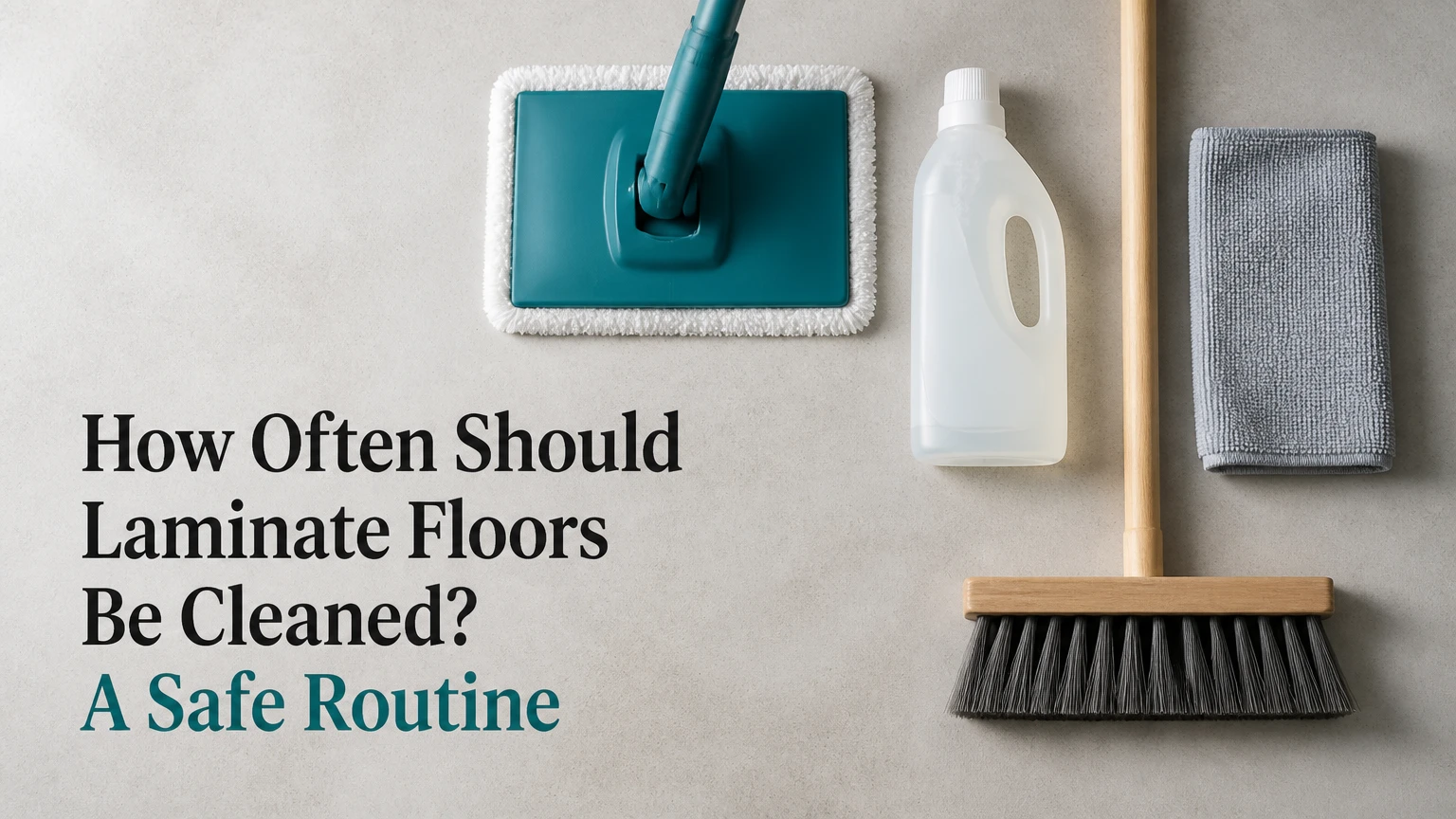
Laminate floors should be dry-cleaned every 1-2 days in an average home and damp-mopped every 1-2 weeks. Homes with pets, children, allergies, or heavy entryway traffic may need daily vacuuming and weekly damp-mopping, while low-traffic rooms can often go 2-3 weeks between damp-mopping sessions.
Key Facts at a Glance
Dry-clean laminate flooring every 1-2 days to remove grit before it scratches the wear layer.
Damp-mop laminate flooring every 1-2 weeks with a nearly dry microfiber pad and a manufacturer-approved cleaner.
Clean spills immediately, because liquid can enter plank seams and swell the fiberboard core.
Vacuum only with hard-floor mode and the brush roll turned off to reduce scratching.
Do not use a steam mop, wax, polish, or saturated string mop unless the flooring manufacturer expressly permits it.
The correct schedule depends on soil load, not a fixed calendar alone.
How Often Should Laminate Floors Be Cleaned?
Laminate floors need two different cleaning frequencies: frequent dry cleaning and occasional moisture-controlled cleaning. Dry cleaning removes abrasive particles, while damp-mopping removes attached soil and light film that a dust mop cannot lift.
| Home condition | Dry-cleaning frequency | Damp-mopping frequency | Priority areas |
|---|---|---|---|
| One adult, shoes removed indoors | Every 3-7 days | Every 2-3 weeks | Entryway and kitchen |
| Couple with regular visitors | Every 1-2 days | Every 1-2 weeks | Hallways and living room |
| Children or heavy foot traffic | Daily to every 2 days | Once per week | Kitchen, stairs, entrances |
| Pets or outdoor access | Daily | Once per week, or after muddy events | Doorways and feeding area |
| Allergy-sensitive household | Daily vacuuming | Every 5-7 days | Bedrooms and upholstered-room edges |
| Rarely used guest room | Weekly | Every 3-4 weeks | Walkways and under furniture |
These intervals are practical starting points, not universal warranty requirements. A flooring manufacturer may specify a particular cleaner, mop type, or frequency, and those instructions take priority because laminate wear layers, bevels, locking systems, and surface textures differ by product.
The fastest adjustment rule is simple: clean when soil becomes visible, gritty, sticky, or transferable to socks. A clean-looking floor can still contain sand near an exterior door, so entry mats and shoe habits often extend the life of laminate more effectively than adding stronger chemicals.
Should laminate floors be cleaned every day?
Laminate floors do not always require a full daily cleaning, but daily spot removal is appropriate in kitchens, entryways, homes with pets, and rooms exposed to outdoor grit. Use a dry microfiber mop or a hard-floor vacuum for two to five minutes rather than damp-mopping the entire floor.
Daily damp-mopping is usually unnecessary. Repeated moisture increases the chance of liquid reaching seams, especially when a spray mop releases too much solution or a dirty pad pushes slurry into bevels. Reserve moisture for attached soil, spills, and areas that remain dirty after dry debris removal.
Why Does Laminate Flooring Need Limited Water?
Laminate flooring contains a decorative image layer over a compressed wood-fiber core, usually HDF or MDF, protected by a resin-based wear layer. The top surface resists ordinary household soil, but the fiberboard core can expand when water enters plank joints, cut edges, or damaged areas.
Cleaning laminate flooring therefore depends on moisture control and friction control. Grit acts like an abrasive under shoes, while excess liquid creates swelling, edge lift, buckling, or open joints. A spray applied to a microfiber pad is safer than pouring water across the floor because the pad distributes a controlled, thin film.
Laminate is also different from sealed hardwood. Hardwood may receive periodic recoating or polishing, but laminate’s printed surface is not designed to absorb wood oil, wax, or finish. Products that leave a film can attract dust, create sticky tracks, and make later cleaning more difficult.
The European Producers of Laminate Flooring, known as EPLF, describes laminate maintenance around removing loose dirt first and avoiding excessive water. Shaw Floors care guidance similarly warns: “Do not use soap-based detergents or ‘mop and shine’ products.” That instruction matters because shine products can add residue without repairing a worn wear layer.
What Is the Safest Laminate Cleaning Routine?
The safest routine has four stages: remove dry grit, treat spots, damp-mop with minimal solution, and dry any remaining moisture. A typical 500-square-foot area takes about 10-20 minutes when the floor is maintained regularly.
Step 1: Remove loose dirt
Use a microfiber dust mop or vacuum cleaner in hard-floor mode. Turn off the rotating brush roll, remove a beater bar where possible, and inspect wheels for trapped grit before starting.
Work from the farthest corner toward the exit. Move slowly along plank joints and bevels, where sand and pet hair collect. Do not drag a vacuum nozzle with a damaged plastic edge across the surface.
Success checkpoint: the floor feels free of grit when you slide a clean, dry microfiber cloth across it.
Common mistake: using a brush roll designed for carpet, which can create fine scratches and scatter grit.
Step 2: Treat spills and spots
Blot liquid with an absorbent microfiber cloth immediately. For dried food, use a slightly damp cloth and a small amount of laminate-safe cleaner rather than scraping aggressively.
Remove gum by cooling it with an ice-filled plastic bag, then lift it with a plastic card. For ink, adhesive, or greasy marks, test a small hidden area before using a limited amount of manufacturer-approved solvent.
Success checkpoint: the spot disappears without a softened edge, cloudy halo, or color change.
Common mistake: rubbing a stain while grit remains on the surface, which turns spot cleaning into abrasion.
Step 3: Damp-mop in small sections
Apply laminate cleaner to the mop pad or use a spray mop that produces a fine mist. Clean sections of approximately 1-2 square meters, or 10-20 square feet, before moving onward.
Use a clean microfiber pad and overlapping strokes that follow the plank direction. The pad should be damp, not wet enough to release drops when squeezed. Avoid a bucket-dunked string mop because it carries an unpredictable volume of water.
Success checkpoint: each section appears clean and dries within roughly 30-60 seconds under normal indoor ventilation.
Common mistake: spraying so much solution that the floor remains visibly wet after one minute.
Step 4: Dry and inspect the seams
Run a dry microfiber cloth over streaks, puddles, or bevels. Check around dishwashers, sinks, exterior doors, pet bowls, and radiator pipes because these locations experience repeated moisture exposure.
If a seam repeatedly darkens or edges begin to swell, stop wet cleaning in that area and investigate the source. Surface cleaning cannot correct a plumbing leak, failed appliance seal, or delaminated plank.
Success checkpoint: no standing water remains, and seams look uniform after drying.
Common mistake: assuming a quick-drying cleaner makes excessive application safe.
Which Tools and Cleaners Are Safest?
A microfiber dust mop is the lowest-moisture option, while a hard-floor vacuum is more effective at extracting grit from bevels and joints. A spray mop can work well when its trigger releases a fine, measured mist and its pad is washed often.
| Tool or product | Recommended use | Typical moisture or setting | Main limitation |
|---|---|---|---|
| Microfiber dust mop | Daily or every-2-day dry soil removal | 0 liquid | Less effective in deep bevels |
| Hard-floor vacuum | Sand, hair, and joint debris | Brush roll off | Wheels and nozzle can scratch |
| Microfiber spray mop | Weekly or biweekly damp cleaning | Fine mist, damp pad | Over-spraying creates seam risk |
| Traditional string mop | Only if manufacturer permits | Often high water volume | Difficult to control moisture |
| Steam mop | Generally avoid | Heat plus pressurized moisture | May damage seams and void warranties |
| Robot vacuum | Frequent dry maintenance | Hard-floor mode, no brush damage | May drag grit or miss wet spills |
Choose a pH-neutral cleaner specifically labeled for laminate or compatible hard surfaces. “pH-neutral” alone does not prove compatibility, because surfactants, solvents, fragrances, and residues also affect the surface; the product label and flooring warranty provide the better decision rule.
Avoid wax, acrylic “mop and shine” products, furniture polish, oil soap, abrasive powder, and bleach unless the flooring manufacturer gives explicit instructions. These products may leave film, alter gloss, discolor the print layer, or attack seam treatments.
Can you use vinegar or rubbing alcohol on laminate?
Vinegar and rubbing alcohol should not be default laminate cleaners. A flooring manufacturer may tolerate a diluted vinegar spot treatment or a small amount of alcohol for a specific stain, but repeated use can conflict with warranty instructions and may produce dullness, streaks, or finish damage.
Do not assume that a 1:10 vinegar solution or a 1:1 alcohol-and-water mixture is safe for every laminate product. Test any spot-treatment formula in an inconspicuous location, use the smallest practical amount, wipe it away immediately, and follow with a clean, barely damp cloth only when the product instructions permit.
How Should Cleaning Frequency Change by Situation?
Cleaning frequency should rise with the amount of abrasive grit, biological soil, and liquid exposure entering the home. Pet hair alone does not scratch laminate, but sand carried in on paws, shoes, or mobility equipment can damage the wear layer.
| Situation | Dry-cleaning adjustment | Damp-cleaning adjustment | Preventive control |
|---|---|---|---|
| Two or more pets | Daily, especially near doors | Weekly | Washable mats and trimmed nails |
| Muddy or snowy climate | Daily during wet weather | Spot-clean immediately | Two-stage entry mat system |
| Young children | Daily in eating areas | Weekly kitchen pass | Spill cloth within reach |
| Home cooking every day | Every 1-2 days | Weekly kitchen cleaning | Keep appliance leaks visible |
| Respiratory allergies | Daily HEPA vacuuming | Every 5-7 days | Wash bedding and mop pads hot |
| Work boots indoors | Daily entryway cleaning | Weekly high-traffic pass | Remove shoes and use hard-backed mats |
| Empty seasonal home | Weekly inspection | Every 3-4 weeks | Control humidity and check leaks |
Rubber-backed or latex-backed mats can trap moisture and sometimes discolor resilient flooring surfaces. Use a manufacturer-approved non-staining rug pad, lift mats periodically, and inspect the laminate underneath after wet weather.
Pet bowls deserve a separate tray with a waterproof, removable surface. Laminate can tolerate an isolated wiped spill, but repeated water exposure at one seam can cause localized swelling long before the rest of the room looks worn.
What Is the Difference Between Laminate and Other Floors?
Laminate requires less water than tile grout cleaning and less restorative treatment than hardwood, but it is less tolerant of moisture intrusion at seams. The best method depends on the floor’s construction, finish, and manufacturer instructions.
| Flooring type | Normal dry cleaning | Moisture tolerance | Finish or treatment to avoid |
|---|---|---|---|
| Laminate | Dust mop or hard-floor vacuum | Low to moderate at seams | Steam, wax, excess water |
| Sealed hardwood | Dust mop and approved wood cleaner | Moderate with intact finish | Abrasive pads and standing water |
| Ceramic tile | Vacuum and wet mop | High on tile surface | Acid on sensitive grout or stone |
| Luxury vinyl | Vacuum and damp mop | Moderate to high | Solvent damage and abrasive scrubbers |
| Unsealed stone | Dust mop and stone cleaner | Variable, often porous | Vinegar and acidic cleaners |
A laminate floor should not be cleaned like ceramic tile merely because both appear hard and washable. Tile generally has an inorganic surface, while laminate combines resin, printed décor, compressed fiber, and mechanically joined seams.
Laminate also should not be treated like hardwood with oil or periodic polish. When laminate looks dull, the cause is usually residue, fine abrasion, poor lighting, or wear layer damage rather than a missing conditioning oil.
How Much Time and Money Does Laminate Cleaning Take?
Routine laminate maintenance typically takes 2-5 minutes for a small daily dry-cleaning pass and 10-30 minutes for a damp-mopping session, depending on room size, furniture, and soil. Typical household supply costs range from $15-$40 for a microfiber system and $8-$15 for a laminate-safe cleaner.
| Cleaning task | Typical time | Typical cost | Equipment |
|---|---|---|---|
| Dry-clean one 500-square-foot area | 5-10 minutes | $0.05-$0.30 per session | Dust mop or vacuum |
| Damp-mop one 500-square-foot area | 10-20 minutes | $0.25-$1.50 per session | Spray mop and cleaner |
| Replace or wash microfiber pads | 5-10 minutes | $5-$15 per pad set | Laundry detergent |
| Professional routine floor cleaning | 1-2 hours | $75-$175 per visit | Service equipment |
| Repair swollen or buckled planks | 2-6 hours | $100-$600 or more | Replacement boards and labor |
Professional price ranges are typical consumer-market figures, not guaranteed rates. Local labor, furniture removal, floor access, damaged materials, and minimum service charges can change the final bill substantially.
Professional cleaning is useful for widespread residue, post-construction dust, or commercial traffic, but extraction equipment cannot reverse swollen HDF, lifted edges, or delamination. Ask the provider what moisture-control method is used and whether the company has experience with laminate rather than only carpet or tile.
What Common Mistakes Damage Laminate Floors?
The most damaging mistakes combine too much water with abrasive movement. A saturated mop, dirty pad, or aggressive scrubber can create damage that ordinary daily cleaning would never cause.
- Using a steam mop: Heat and moisture can enter joints and damage the core or locking system. Use dry or lightly damp cleaning unless the product manufacturer specifically approves steam.
- Leaving grit under furniture: Chair casters and table legs grind sand into the wear layer. Add felt glides, clean casters, and lift furniture instead of dragging it.
- Reusing a dirty mop pad: A dark pad redistributes oily soil and trapped grit. Change pads when they appear gray, gritty, or saturated.
- Pouring cleaner directly on the floor: Liquid pools at bevels and plank ends. Spray the pad or use a controlled fine mist.
- Applying wax or polish: Film-forming products can produce streaks and attract dirt. They cannot restore a physically worn decorative layer.
- Ignoring appliance leaks: A dishwasher or refrigerator leak can swell boards from below or at a seam. Fix the source before cleaning the visible residue.
One practitioner rule is worth remembering: if a laminate mop head leaves a continuous wet trail rather than a faint, quickly evaporating film, the mop is too wet for routine use.
How Do You Fix Streaks, Cloudiness, and Sticky Residue?
Streaks and cloudiness usually come from cleaner residue, oil, polish, or an over-wet mop rather than from insufficient product. Stop adding cleaner, remove loose grit, and use a clean microfiber pad dampened according to the flooring and cleaner instructions.
For a small sticky deposit, freeze gum or wax with an ice pack sealed in a plastic bag, then lift the hardened material with a plastic card. Never use steel wool, a razor scraper, abrasive powder, or aggressive scouring pads.
For cloudy film, first identify the recent products used. A laminate-safe residue remover may be appropriate, but alcohol mixtures and acidic solutions should be treated as limited spot treatments, not routine formulas. Test behind a door or under furniture and follow the label contact time.
| Symptom | Likely cause | First response | Stop and escalate when |
|---|---|---|---|
| White or cloudy film | Polish, soap, or excess cleaner | Use approved residue-removal method | Gloss remains altered after one test |
| Darkened seam | Liquid intrusion or dirt in bevel | Dry immediately and inspect source | Seam stays dark or edges swell |
| Sticky footprints | Acrylic film or oil soap | Stop polish and clean with approved product | Sticky layer covers several rooms |
| Fine scratches | Grit, brush roll, or chair casters | Remove grit and add floor protectors | Printed layer is visibly worn |
| Buckled planks | Moisture or expansion pressure | Find leak and limit water | Boards remain raised after drying |
A dull but flat surface may be residue. A raised edge, peeling décor layer, or permanently white seam indicates material damage, which cleaning cannot repair.
When Should Laminate Cleaning Be Adjusted or Stopped?
Increase cleaning after renovation, storms, pest incidents, or a change in household traffic, but reduce moisture when the floor shows open seams or swelling. Cleaning should stop when liquid comes from below, boards move underfoot, or the surface layer begins peeling.
After drywall work, vacuum with a suitable filtration system before damp-mopping. Fine construction dust can clog microfiber and behave like an abrasive paste. During rainy or snowy periods, clean entry zones daily and dry wet footwear areas before moisture spreads.
Humidity also matters. The National Wood Flooring Association commonly recommends indoor relative humidity around 30%-50% for wood flooring; laminate manufacturers may specify different limits, so use the product documentation when available. Stable indoor humidity reduces movement at joints, although humidity control cannot compensate for standing water.
If the flooring is newly installed, follow the installer’s cure, acclimation, and warranty guidance. Laminate typically does not need a waiting period for ordinary dry cleaning, but wet cleaning should follow the specific installation instructions, especially near expansion gaps and transitions.
Frequently Asked Questions
Is it okay to mop laminate floors once a month?
Once-a-month mopping may be adequate for a rarely used room that stays free of outdoor grit, but most occupied areas need damp-mopping every 1-2 weeks. Dry-cleaning remains more important because sand and soil can abrade laminate between mopping sessions.
Can I use a Swiffer on laminate floors?
A Swiffer-style dry or lightly damp microfiber pad can be suitable when the flooring manufacturer permits it and the pad does not leave excess liquid. Avoid pre-moistened pads that leave a wet trail, and do not use a disposable pad after it has collected gritty debris.
How often should I clean laminate floors with pets?
Pet homes should generally vacuum or dry-mop laminate floors daily, especially near doors, feeding areas, and litter boxes. Damp-mop once per week, then spot-clean accidents immediately with a laminate-compatible product and a nearly dry cloth.
Do laminate floors need disinfecting?
Laminate floors do not normally need routine disinfecting unless a specific contamination event occurs. If disinfection is necessary, confirm that the disinfectant is approved for laminate, follow its dilution and contact-time directions, and remove residual moisture promptly.
Can dirty laminate floors be deep-cleaned?
Dirty laminate floors can usually be deep-cleaned with repeated controlled passes using clean microfiber pads and an approved cleaner. Professional extraction or aggressive scrubbing is not automatically safer, because excess water and abrasion can damage seams and the wear layer.
How long should laminate floors take to dry after mopping?
A properly damp-mopped laminate floor should appear nearly dry within 30-60 seconds in normal indoor conditions. Longer drying indicates excessive solution, poor ventilation, a saturated pad, or a textured surface holding liquid, so reduce moisture and dry the affected area manually.
The Bottom Line
The answer to how often should laminate floors be cleaned is usually every 1-2 days for dry debris and every 1-2 weeks for damp-mopping. Increase those intervals for pets, children, allergies, muddy weather, or heavy foot traffic, but never compensate with more water. Use a hard-floor vacuum or microfiber dust mop, a laminate-approved cleaner, a barely damp pad, and immediate spill removal to protect the wear layer and fiberboard core.