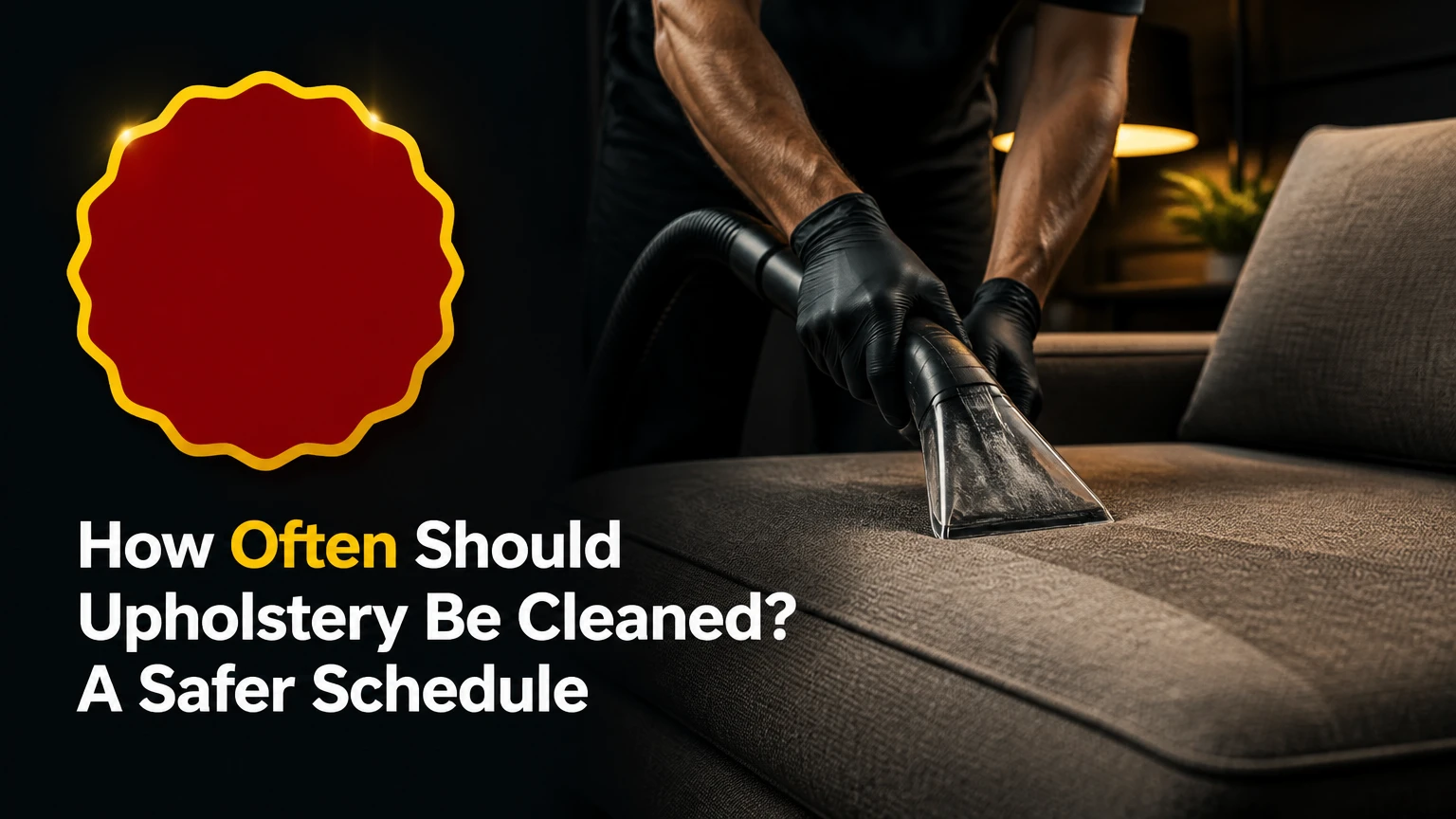
Upholstery should usually receive professional cleaning every 12-24 months, with weekly or biweekly vacuuming between services. Homes with pets, children, smokers, frequent entertaining, or allergy sufferers often need professional cleaning every 6-12 months. Immediate spot treatment matters more than the calendar after spills, urine, vomit, flooding, or persistent odors.
Key Facts at a Glance
Low-use upholstery without pets commonly needs professional cleaning every 24 months.
Active family rooms usually need professional cleaning about every 12 months.
Pet households often need professional cleaning every 6-12 months.
Allergy-sensitive homes benefit from HEPA vacuuming twice weekly and professional cleaning about every 6 months.
Upholstery should be vacuumed from weekly to every two weeks, depending on soil load.
The manufacturer’s cleaning code determines whether water, solvent, or vacuum-only care is permitted.
How often should upholstery be professionally cleaned?
Most upholstered sofas, chairs, and headboards need professional cleaning every 12-24 months. A 12-month interval fits regularly used living-room furniture, while 24 months can suit lightly used furniture in a clean, pet-free home. The correct interval depends on deposited soil, fabric stability, padding construction, and how quickly the furniture dries.
A calendar is only a starting point. Visible darkening on armrests, a greasy feel, recurring odor, flattened pile, or allergy symptoms can justify earlier service. Upholstery used for meals, naps, children’s play, or pet sleeping accumulates body oil and particulate soil faster than decorative furniture.
Professional upholstery cleaning is also appropriate after a major spill, water intrusion, renovation dust, or an illness affecting the household. Waiting until fabric looks dirty allows oily soil to migrate into the weave and padding, where removal becomes more difficult.
Recommended schedule by household
| Household profile | Vacuuming interval | Professional cleaning | Earlier trigger |
|---|---|---|---|
| One or two adults, no pets | Every 2 weeks | Every 18-24 months | Greasy arms or visible soil |
| Family with children | Weekly | Every 9-12 months | Food spills or repeated accidents |
| One dog or cat | 2-3 times weekly | Every 6-12 months | Urine, dander, or persistent odor |
| Allergy-sensitive household | Twice weekly with HEPA filtration | About every 6 months | Symptom increase near furniture |
| Smoker or frequent entertainer | Weekly | Every 6-12 months | Smoke or cooking odor |
| Commercial waiting room | Daily or several times weekly | Every 3-6 months | High contact and visible wear |
The table gives typical maintenance intervals, not a fabric warranty. A delicate silk chair may need less frequent deep cleaning but stricter spot control, while a durable polyester sofa may tolerate more frequent low-moisture cleaning.
How often should upholstery be vacuumed?
Upholstery should be vacuumed weekly in active rooms and every two weeks in lightly used rooms. Pet owners should vacuum two or three times weekly, concentrating on seams, cushion gaps, and areas where animals sleep. HEPA filtration helps contain fine particles, but vacuuming does not remove bonded oil, set stains, or contamination inside foam.
Use an upholstery attachment rather than a bare floor head. Excessive suction can distort loose weaves, lift decorative threads, or pull pile on velvet. Remove cushions when the manufacturer permits it, vacuum both sides, and clean the frame beneath them.
Rotate loose cushions weekly when their construction allows rotation. This distributes compression, body oil, and sunlight across the upholstery, although rotation cannot correct a cushion with one-sided foam or a fixed back.
A practical weekly routine
- Remove books, throws, and cushions.
- Vacuum the top surface, sides, seams, piping, and crevices.
- Use a narrow nozzle below cushions and along the frame.
- Brush pet hair toward the vacuum head with a soft rubber tool.
- Inspect stains before applying any liquid.
- Blot fresh spills immediately with a white absorbent cloth.
A clean-looking sofa can still hold fine dust in its seams. Conversely, frequent vacuuming does not justify repeated wet extraction, because excess moisture can damage padding and slow drying.
Which households need more frequent cleaning?
Pet owners, families with young children, allergy sufferers, smokers, and commercial operators need shorter upholstery-cleaning intervals. These groups add more dander, food residue, body oil, moisture, or contact traffic than a lightly used adult household, so a six-month to twelve-month professional schedule is often more practical.
Pets create two separate problems. Hair and dander remain near the surface, while urine and saliva can travel through fabric into cushion materials. A surface deodorizer may reduce smell temporarily without removing the source.
Children increase the frequency of food and drink spills, but the response should be immediate spot treatment rather than automatic whole-sofa washing. Allergy sufferers should prioritize source control, ventilation, bedding hygiene, and HEPA vacuuming because upholstery cleaning alone does not eliminate all indoor allergens.
Schedule changes for specific situations
| Situation | Immediate action | Routine adjustment | Professional response |
|---|---|---|---|
| Pet urine on a cushion | Blot, isolate, and inspect underside | Vacuum 2-3 times weekly | Enzyme-compatible treatment if code permits |
| Milk or food spill | Lift solids, blot liquid | Inspect weekly | Clean before odor develops |
| Household renovation | Cover furniture, then vacuum | Add one post-project vacuum | Low-moisture clean after dust settles |
| Vomit or bodily fluid | Wear gloves, remove solids safely | Do not share cloths or tools | Request sanitation-focused service |
| Flood or roof leak | Stop use and dry surrounding area | Check frame and foam | Assess for hidden moisture promptly |
| Smoker’s furniture | Ventilate and vacuum surfaces | Clean every 6-12 months | Ask about odor treatment, not fragrance masking |
How does the fabric code change the answer?
The upholstery cleaning code determines which cleaning chemistry and moisture level are acceptable. Code W permits water-based products, S requires a solvent-based product, WS permits either method, and X generally limits care to vacuuming or brushing unless the manufacturer gives additional instructions.
Locate the tag beneath a cushion, on the platform, or under the frame. A code describes cleaning compatibility, not stain resistance, colorfastness, shrinkage risk, or the condition of the foam.
| Code | Permitted approach | Main risk | Safer home action |
|---|---|---|---|
| W | Water-based upholstery solution | Over-wetting and water rings | Light mist, controlled blotting |
| S | Upholstery solvent | Solvent residue or poor ventilation | Use only labeled solvent |
| WS | Water or solvent | Dye bleeding and uneven drying | Patch test both options |
| X | Vacuuming or brushing | Permanent liquid damage | Do not use household sprays |
| No readable code | Manufacturer guidance first | Unknown fiber and finish | Stop before wet cleaning |
A professional should still perform a hidden-area test. Water-based cleaning can shrink cotton, distort viscose, bleed unstable dyes, or leave rings even when a tag says W. “W” means water-based care is allowed under the manufacturer’s conditions, not that saturation is safe.
Can upholstery be cleaned safely at home?
Upholstery can be cleaned safely at home when the care code is known, the soil is limited, and the fabric can dry quickly. Home maintenance is best for vacuuming, fresh spot treatment, and light surface cleaning. It is not a reliable substitute for professional extraction after urine penetration, flooding, widespread soil, or a persistent musty smell.
Safe DIY sequence
- Vacuum first. Remove dry soil before adding moisture. Vacuum seams and underside areas with an upholstery attachment.
- Read the code. Never apply water to an X or S fabric without explicit manufacturer instructions.
- Patch test. Apply a small amount behind the furniture or inside a removable cover, then check for dye transfer after drying.
- Blot the spill. Work from the outside toward the center with a white microfiber cloth. Do not scrub.
- Use minimal product. Follow the product label rather than improvising a concentrated detergent mixture.
- Dry rapidly. Separate cushions if permitted, open windows when humidity is low, and use fans without placing heat directly against fabric.
- Inspect after drying. Re-vacuum dried residue and check for rings, stiffness, odor, or color change.
Baking soda can absorb some surface odor when left for roughly 20 minutes and vacuumed thoroughly, but it does not disinfect foam or remove urine crystals. Avoid fragrance sprays that conceal odors while adding residue.
Which professional method fits each fabric?
Hot-water extraction suits many stable synthetic fabrics, low-moisture encapsulation suits light maintenance, solvent cleaning suits selected S-code materials, and leather conditioning requires a separate leather-care system. The manufacturer’s code, soil depth, dye stability, and drying conditions matter more than the method’s marketing name.
“Steam cleaning” is often used loosely. Many upholstery technicians actually perform hot-water extraction, in which solution is sprayed and immediately recovered. Steam vapor alone does not guarantee sanitation, and no method should be advertised as killing every bacterium or dust mite without defined temperature, dwell time, and contact conditions.
| Method | Suitable furniture | Typical Bangladesh price per sofa | Process and drying |
|---|---|---|---|
| Hot-water extraction | Polyester, nylon, stable microfiber | Tk 3,000-7,000 | 1-2 hours; dry 6-12 hours |
| Solvent cleaning | Selected S-code wool, velvet, delicate textiles | Tk 4,500-9,000 | 1-2 hours; dry 1-2 hours |
| Encapsulation or foam | Light soil and moisture-sensitive upholstery | Tk 2,500-5,500 | About 1 hour; dry 2-4 hours |
| Leather cleaning and conditioning | Finished leather and suitable faux leather | Tk 4,000-8,000 | 1-2 hours; usually immediate use |
These are typical service ranges from the supplied market context, not universal prices. Sofa size, cushion count, access, stain severity, city, and fabric testing can change the quotation.
What makes professional cleaning safe?
A safe service identifies the fabric code, tests dye stability, controls solution quantity, extracts or recovers residue, and measures drying progress by touch and airflow. Ask the technician what method will be used, how long the furniture should remain unused, and whether cushions will be cleaned separately.
A competent technician should explain a limitation when the fabric is unstable. A promise of complete stain removal is a warning sign, because some dye transfers, sun fading, ink, and fiber damage cannot be reversed by cleaning.
How long should upholstery take to dry?
Most fabric upholstery should dry within 6-12 hours after controlled hot-water extraction, while low-moisture methods often dry in 2-4 hours. Cushions that remain damp beyond 24 hours need immediate airflow and inspection; a musty smell that persists after 48 hours warrants professional assessment.
Drying time depends on humidity, ventilation, foam thickness, fabric density, solution volume, and cushion construction. A technician who leaves furniture saturated may create a larger problem than the original soil.
Keep people and pets off damp upholstery. Do not reinstall removable cushions against a wet frame, because trapped moisture can remain where air cannot circulate. Use fans and a dehumidifier when indoor humidity is high, but avoid high heat that can set some stains or distort synthetic fibers.
What should you do after a spill?
Fresh upholstery spills should be handled immediately by removing solids, blotting liquid, and using only a cleaner approved for the fabric code. The objective is to transfer contamination into a cloth without spreading it across the weave or forcing it into the padding.
Use a white cloth because colored textiles can release dye. Replace the cloth as it becomes soiled. Work from the perimeter inward for a small spill, then allow the area to dry with airflow.
Do not scrub velvet, chenille, linen, or loosely woven upholstery. Friction can alter the pile or spread a stain beyond the original liquid boundary. Do not use a carpet detergent unless the furniture manufacturer and machine instructions specifically permit it.
Why do upholstery-cleaning mistakes cause permanent damage?
Upholstery damage usually results from incompatible chemistry, excessive moisture, aggressive friction, or incomplete drying. Furniture fabric is attached to padding and a frame, so a cleaning error can affect shrinkage, dye stability, foam odor, adhesive bonds, and wood components.
The most important practitioner rule is to treat the furniture as a layered assembly rather than a flat carpet. A carpet can often tolerate more solution and faster extraction; a sofa cushion can retain liquid around seams and inside foam.
Four high-risk mistakes
- Saturating the cushion: Water reaches foam and can produce odor, microbial growth, or prolonged drying. Use controlled application and extraction.
- Rubbing a stain: Friction spreads liquid and abrades fibers. Blot with a white cloth instead.
- Ignoring the code: Water on an S or X fabric can cause rings, shrinkage, or permanent color change.
- Applying too much detergent: Residue attracts new soil and can leave fabric stiff or crunchy. Follow the label and recover dissolved soil thoroughly.
A second practitioner rule is to photograph stains before cleaning. The record helps distinguish removable soil from abrasion, fading, ink, and fiber damage when results are evaluated later.
How can common upholstery-cleaning problems be fixed?
Water rings, crunchy fabric, and musty odors require different responses, and re-wetting is not always safe. Water rings may result from uneven drying or soil migration, crunchy texture commonly indicates residue, and musty odor suggests moisture remained in padding or reached a contaminated layer.
Water rings
For a code W or WS fabric, a technician may blend the entire cushion panel seam to seam with a controlled amount of compatible solution rather than treating only the center. Do not attempt this on S, X, unstable dye, silk, or unknown upholstery.
Stiff or crunchy fabric
Vacuum the dried surface first to remove loose residue. If stiffness remains, professional low-moisture rinsing may be safer than adding a homemade vinegar mixture, especially because vinegar can affect dyes, finishes, and manufacturer warranties.
Musty smell
Move cushions into strong airflow and reduce indoor humidity. If the odor remains after 48 hours, stop applying fragrance or baking soda and request an inspection of the foam, underside fabric, and frame.
Pet odor returning after cleaning
A returning odor often indicates contamination below the face fabric. Surface extraction may improve appearance while urine salts remain in foam or batting, so the technician may need cushion disassembly, targeted treatment, or replacement of affected filling.
Do outdoor and commercial upholstery need a different schedule?
Outdoor upholstery often needs cleaning at least twice yearly, with additional cleaning after pollen, storms, food spills, or prolonged dampness. Commercial upholstery usually needs a three- to six-month professional schedule because contact frequency, clothing oils, and public exposure exceed residential use.
Outdoor fabric may resist sunlight and water without being immune to mildew. Remove cushions from rain when possible, dry both sides, and inspect zippers and seams where moisture collects. Follow the manufacturer’s instructions because some outdoor cushions contain water-resistant coatings that harsh detergents can weaken.
For offices, clinics, restaurants, and hotel seating, vacuuming frequency should follow traffic rather than household size. High-touch armrests may need daily wiping with a compatible product, while full fabric cleaning requires a method approved for the specific commercial textile.
What should you ask before hiring an upholstery cleaner?
Ask for the fabric code, proposed method, expected drying time, total price, stain-removal limits, and insurance or damage policy before approving service. A reliable quotation should distinguish cleaning from optional protector, deodorizer, transport, access, and cushion charges.
Use this screening list:
- Will you inspect and test the fabric before cleaning?
- Which code-based method will you use?
- How much moisture will remain in the cushions?
- What is the expected drying time at my room’s humidity?
- Can you treat pet urine below the surface?
- Is stain protection compatible with this fabric?
- What happens if dye bleeds or a stain proves permanent?
- Does the quoted price cover every cushion and both sides?
Fluorochemical protectors can extend the time available to blot a new spill, but they do not make upholstery stain-proof. Ask what chemistry is being applied and whether the furniture maker permits it, especially for performance fabrics and children’s furniture.
When should upholstery be replaced instead of cleaned?
Replacement or reupholstery may be more sensible when foam has collapsed, odor returns from internal contamination, fabric has severe abrasion, or the frame has water damage. Cleaning improves soil and odor conditions, but it cannot restore missing fibers, reverse sun fading, or rebuild degraded foam.
Consider reupholstery when the frame is structurally sound and the furniture has sentimental or high-quality construction. Consider replacement when repair costs approach the value of a comparable new piece, the frame is warped, or repeated contamination has affected inaccessible padding.
Cleaning or replacement decision
| Condition | Cleaning outcome | More appropriate action | Typical decision timing |
|---|---|---|---|
| Surface dust and body oil | Usually improves substantially | Professional cleaning | Every 12-24 months |
| Small fresh food spill | Often removable if treated quickly | DIY spot care | Within 5 minutes |
| Pet urine in removable cover | Cover may improve; foam may not | Deep treatment or insert replacement | Within 24 hours |
| Severe sun fading | Color will not be restored | Reupholstery or replacement | Before next service |
| Collapsed foam | Cleaning changes nothing | Cushion replacement | When comfort declines |
| Flooded, musty furniture | Hidden contamination possible | Inspection, disposal, or restoration | Immediately |
Frequently Asked Questions
Is professional upholstery cleaning worth it?
Professional upholstery cleaning is worthwhile when soil has entered seams or padding, household allergies are affected, pet odors return, or the furniture is too delicate for home equipment. It is less useful for severe abrasion, sun fading, collapsed foam, or unstable dye, because cleaning cannot repair damaged fibers or structure.
Can I use a carpet cleaner on a sofa?
A carpet machine should only be used on upholstery when the furniture maker, machine manual, and fabric code permit it. Carpet equipment can deliver excessive water, leave detergent in foam, or damage delicate fabric. Controlled upholstery extraction by a trained technician is safer for unknown, valuable, or heavily padded furniture.
Does upholstery cleaning remove dust mites?
Upholstery cleaning can remove some dust, skin flakes, and allergen-containing particles, but it cannot guarantee complete dust-mite elimination. HEPA vacuuming, humidity control, washable covers, and regular bedding care remain important. Hot water, drying conditions, and chemical exposure determine whether any mites are affected.
Should upholstery be cleaned before selling a sofa?
Clean upholstery before selling when fabric is structurally sound and odors or visible soil reduce its value. Photograph stains and disclose repairs or permanent marks. Cleaning will not make severe abrasion, smoke penetration, pet damage, or frame defects disappear, so compare the service cost with the expected increase in sale price.
How soon can furniture be used after cleaning?
Furniture can usually be used after the fabric and cushions are fully dry, often within 6-12 hours after extraction or 2-4 hours after low-moisture cleaning. Keep pets and children away until no cool dampness remains, because early use compresses wet foam and transfers fresh soil.
The Bottom Line
How often should upholstery be cleaned? Schedule professional cleaning every 12-24 months for lightly used furniture, every 9-12 months for active family rooms, every 6-12 months for pet households, and about every 6 months for allergy-sensitive homes. Vacuum weekly or biweekly, treat spills immediately, follow the fabric code, and shorten the interval when odor, visible soil, or moisture contamination appears.