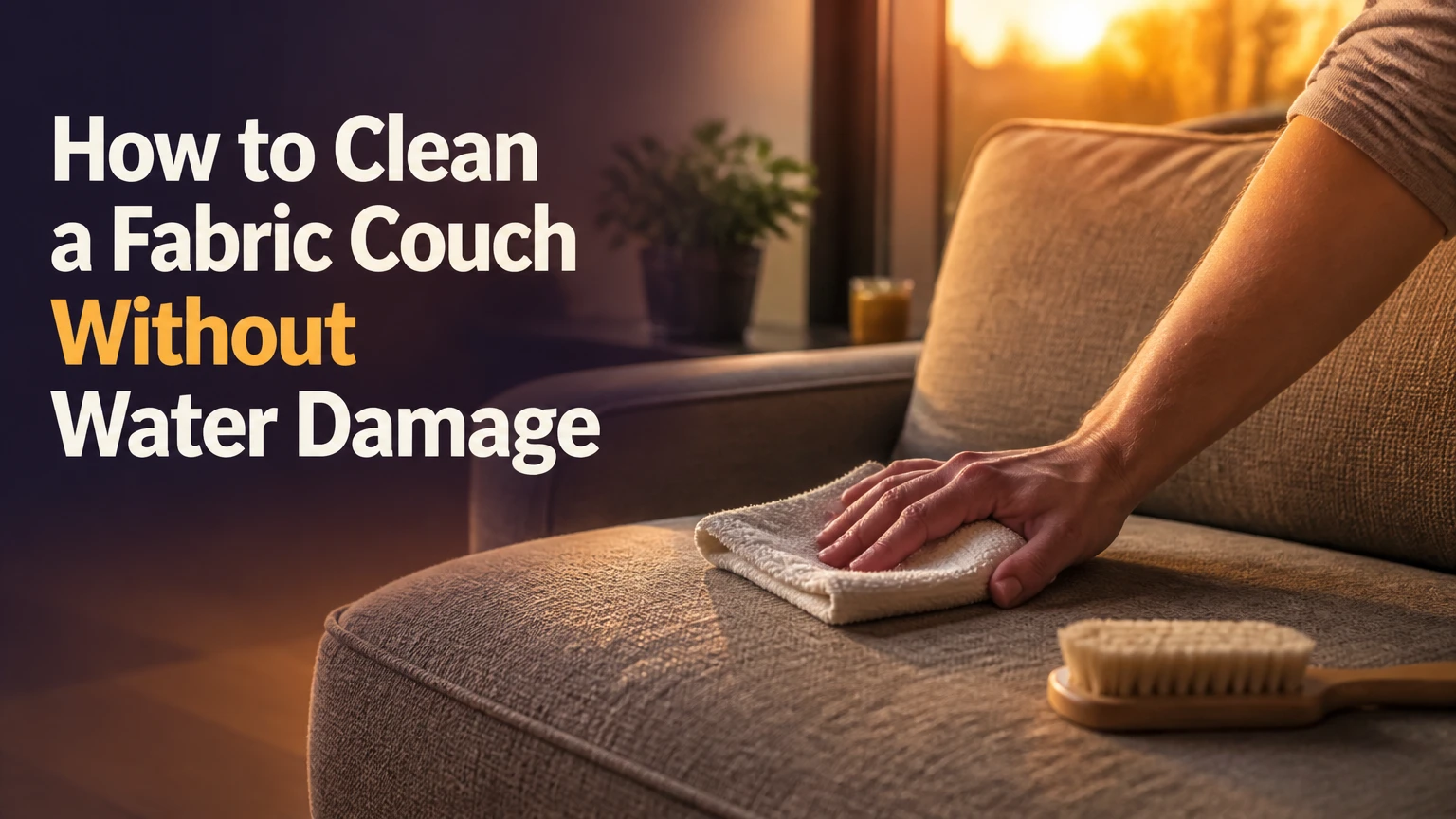
To clean a fabric couch, first read the upholstery care code, vacuum away dry soil, spot-test a compatible cleaner, apply minimal moisture, blot rather than scrub, and dry the couch quickly with moving air. A typical low-moisture cleaning takes 45-90 active minutes and requires 6-12 hours of drying, depending on humidity and cushion thickness.
Key Facts at a Glance
Upholstery code W permits water-based cleaning, while S requires a solvent labeled for upholstery.
Code W/S permits either method, but a hidden-area test remains necessary.
Code X means do not apply liquid or solvent at home; vacuuming is the routine maintenance method.
Vacuuming before wet cleaning prevents grit from becoming abrasive mud inside the fabric weave.
A couch should feel dry through the fabric and cushion edge before anyone sits on it.
Baking soda absorbs some surface odor but does not neutralize urine inside foam or remove embedded grease.
What Does Fabric Couch Cleaning Actually Remove?
Fabric couch cleaning removes loose dust, skin oils, food residue, tracked-in grit, surface stains, and some odor compounds from upholstery fibers. Vacuuming provides mechanical removal, detergent provides surfactant action against oily soil, and controlled rinsing carries loosened residue away from the fabric.
The cleaning method matters because upholstery combines a visible textile with hidden components: batting, foam, a dust cover, wood, metal fasteners, and sometimes water-sensitive adhesives. Excess liquid can migrate below the fabric, where slow evaporation produces musty odor, corrosion, dye migration, or foam deterioration.
Professional cleaners often use low-moisture upholstery cleaning or hot-water extraction. These are different processes. A steam appliance may add heat and vapor without removing dissolved soil, while an extractor sprays a controlled amount of solution and immediately recovers much of that liquid with suction.
The Institute of Inspection Cleaning and Restoration Certification, or IICRC, treats fiber identification, pretesting, controlled cleaning, and drying as separate upholstery decisions. That sequence is more reliable than choosing a homemade recipe first.
Which upholstery code applies?
The care label determines whether a fabric couch can safely receive water, solvent, or neither. Find the label beneath a seat cushion, along the platform, under the couch, or in the manufacturer’s care documentation, then follow the stricter instruction if the label and manual differ.
| Code | Permitted home approach | Main risk | DIY decision |
|---|---|---|---|
| W | Water-based upholstery cleaner, low-moisture extraction | Water rings, overwetting, dye bleed | Suitable after testing |
| S | Upholstery dry-cleaning solvent | Solvent damage, fumes, flammability | Use label-approved solvent cautiously |
| W/S | Water-based or solvent cleaner | Either water or chemical incompatibility | Choose the lower-risk tested method |
| X | Vacuuming and dry brushing only | Permanent staining or fabric damage from liquid | Do not wet-clean at home |
A code is not a guarantee that every cleaner is safe. “W” describes the cleaning medium, not the ideal pH, temperature, agitation level, or concentration. A pale linen blend and a solution-dyed performance polyester can both carry W codes while reacting differently to moisture and friction.
What Should You Do Before Cleaning a Couch?
Before cleaning a couch, identify the fabric and code, remove loose components, inspect for damage, and prepare a dry workspace. The preparation prevents the most expensive failures: wetting an incompatible textile, trapping grit in the weave, or soaking a cushion that cannot dry internally.
| Item | Typical amount or specification | Purpose |
|---|---|---|
| Upholstery vacuum tool | 1 attachment, low suction | Removes loose soil without pulling fibers |
| Crevice tool | 1 narrow nozzle | Cleans seams and cushion gaps |
| White microfiber towels | 8-12 towels | Prevents dye transfer and supports repeated blotting |
| Distilled water | 1-2 quarts | Reduces mineral rings during rinsing |
| Upholstery cleaner | Label-directed dilution | Supplies controlled surfactant action |
| White nylon brush | Soft or medium bristles | Loosens dry soil without metal abrasion |
| Box fan or air mover | 1 unit per couch section | Accelerates evaporation |
| Nitrile gloves | 1 pair | Limits skin exposure to cleaner |
Remove throws, pillows, toys, and removable seat cushions. Photograph the couch before treatment if the furniture is rented, valuable, or under warranty. Check for torn seams, loose buttons, exposed foam, unstable dye, and areas where the fabric has already become thin.
Do not remove a cushion cover and machine-wash it merely because the zipper opens. The cover may shrink while the foam remains the original size, making reassembly difficult or impossible. Use the manufacturer’s washing instructions, water temperature, drying method, and closure requirements.
How do you test a fabric couch cleaner?
Test the cleaner on a hidden area and wait until the test patch is fully dry, not merely until it appears unchanged while wet. Apply the intended dilution to a white towel, press it against the fabric for 10-15 seconds, and inspect the towel and textile for dye transfer, tide marks, texture change, and odor.
A successful test has four results: no color on the white towel, no lightened or darkened patch, no stiff or sticky hand-feel, and no altered nap after drying. Test near a seam because fabric can behave differently on exposed panels than on a concealed edge.
Stop immediately if dye transfers, the fabric becomes shiny, the backing separates, or the test area dries with a distinct halo. Code S and X upholstery, antique textiles, silk, rayon, unstable velvet, and heavily soiled luxury furniture generally warrant a professional assessment.
How to Clean a Fabric Couch, Step by Step
A standard W or W/S fabric couch can usually be cleaned in six controlled steps: vacuum, test, prepare a small solution, treat limited sections, rinse-blot, and dry. Plan 45-90 minutes of active work, use only enough liquid to dampen the textile, and never saturate foam.
Step 1: Vacuum every dry surface
Vacuum the back, arms, seat deck, cushions, piping, underside of removable cushions, and seams using an upholstery attachment. Use the crevice tool at gaps, but keep the nozzle from scraping the textile because grit and friction can abrade fibers.
For dried mud, let the soil become completely dry, loosen it gently with a white nylon brush, and vacuum the fragments. Do not wet mud first. Water turns mineral soil into a paste that travels farther and penetrates deeper.
You will know Step 1 worked when the vacuum collects noticeably less debris from a second pass and the fabric no longer feels gritty under a clean hand. The common mistake is beginning with spray, which converts removable dry soil into sticky residue.
Step 2: Check colorfastness and fabric response
Mix or dilute the cleaner exactly as its label specifies, then test it on a concealed area. For a homemade low-moisture approach on a confirmed W or W/S synthetic fabric, use 2 cups of distilled water with 1 teaspoon of clear, mild dish detergent, rather than a tablespoon that may leave excessive residue.
Avoid adding vinegar automatically. Acetic acid can affect dyes, finishes, metal components, and some natural fibers, and its odor does not remove the source of a biological stain. Use a manufacturer-approved upholstery product when available.
You will know Step 2 worked when the dry test patch matches the surrounding fabric in color and texture. The common mistake is judging safety after 10 minutes while the area is still damp.
Step 3: Treat one small section at a time
Work on a panel approximately 12-18 inches wide, beginning with a low-visibility area. Spray the solution onto a white towel or use a controlled mist, then press and lightly wipe the fabric in the direction of its weave or nap.
Do not flood armrests, cushion seams, or the deck. High-traffic areas often contain more oil, but oil-rich soil needs repeated light passes rather than one heavy application. Keep solution away from wooden trim, metal hardware, electrical components, and exposed foam.
Allow the cleaner to dwell for 2-5 minutes, unless the product label gives a different period. You will know Step 3 worked when soil transfers to the towel without the fabric becoming soaked. The common mistake is scrubbing in circles until the nap becomes fuzzy or shiny.
Step 4: Blot and lift loosened soil
Use a clean white microfiber towel to blot from the outside of a mark toward its center. Turn the towel frequently so removed soil does not return to the upholstery, and replace it when the towel becomes visibly dirty or damp.
For a broad dirty panel, use overlapping strokes from seam to seam. Treating only the center of a visibly marked panel can create a clean spot surrounded by a darker boundary, especially on woven polyester, cotton, and linen.
You will know Step 4 worked when the towel picks up less soil on successive passes and the fabric has an even appearance while drying. The common mistake is rubbing a wet stain aggressively, which spreads dissolved dye and pushes liquid toward the cushion core.
Step 5: Rinse away cleaner residue
Dampen a fresh white towel with distilled water and wring it until it is damp, not dripping. Blot or wipe the treated panel lightly, then press a dry towel into the area to recover moisture and dissolved detergent.
Rinsing is important because dried surfactant attracts soil and can leave a crunchy hand-feel. Repeat with a second damp towel if the fabric feels slippery, tacky, or unusually stiff after the first drying cycle.
A portable upholstery extractor can replace repeated towel blotting on code W furniture, but use the least liquid setting that still removes soil. Follow the machine manufacturer’s upholstery instructions, and make extra dry passes without spraying.
You will know Step 5 worked when the fabric feels clean rather than slick and the dry towel removes little moisture. The common mistake is treating extraction as permission to saturate the cushion.
Step 6: Dry the couch completely
Stand removable cushions on their long edges if the construction permits, separate them from the couch, and expose all sides to moving air. Place a fan so air crosses the upholstery rather than merely circulating across the room; operate a dehumidifier when indoor humidity is high.
Typical drying time is 6-12 hours for lightly dampened upholstery and 12-24 hours for thicker cushions or humid rooms. Do not use the couch while the seat, seams, and cushion edges remain cool, damp, or musty.
You will know Step 6 worked when a clean paper towel pressed into the seam stays dry and the fabric has its normal texture and odor. The common mistake is closing windows on a humid day without using a dehumidifier, which slows evaporation despite visible surface dryness.
Which Cleaning Method Fits Your Couch?
The best method depends on the care code, fiber, soil load, and available drying capacity. Low-moisture towel cleaning suits routine W upholstery, extraction suits substantial embedded soil on compatible fabric, and professional solvent or specialty cleaning suits delicate or restricted materials.
| Method | Suitable code or use | Active time | Typical drying time | Typical DIY or professional cost |
|---|---|---|---|---|
| Vacuum and dry brush | X maintenance, light dust | 15-30 minutes | None | $0-$15 |
| Low-moisture hand cleaning | W or W/S, light to moderate soil | 45-90 minutes | 6-12 hours | $10-$30 |
| Portable extraction | W, heavy soil, removable cushions | 60-120 minutes | 8-24 hours | $30-$60 rental |
| Professional hot-water extraction | W, large sectional or severe soil | 1-3 hours | 6-24 hours | $120-$350 |
| Upholstery solvent cleaning | S, tested compatible textile | 30-90 minutes | 1-4 hours | $20-$50 DIY, $150-$400 professional |
| Professional specialty cleaning | Silk, rayon, antique, unstable velvet | Appointment-based | 12-48 hours | $200-$600 or more |
Steam is not automatically the best deep-cleaning choice. A steam-only machine can leave dissolved soil behind, and high heat can distort some synthetic fibers, flatten velvet pile, or affect adhesives. Use steam only when the upholstery manufacturer permits it and the machine is designed for the textile.
Code X deserves particular caution. Baking soda and vacuuming can refresh a dry surface, but neither method removes a liquid stain, deep grease, or urine inside foam. A professional may recommend a specialized low-moisture or dry process, but the decision must come from the fabric and furniture construction.
How much does professional couch cleaning cost?
Professional fabric couch cleaning typically costs $120-$350 for a standard sofa and $200-$600 or more for a sectional, specialty textile, severe odor, or difficult access. Local labor, minimum service charges, fabric testing, stain treatment, and furniture size account for much of the variation.
Ask whether the quote includes fabric identification, pretesting, stain treatment, deodorizing, extraction, and moving lightweight furniture. A low quote that excludes drying or treats every textile with the same process may create a larger repair bill later.
How Do You Handle Different Fabrics?
Fabric type changes the safe amount of moisture, agitation, heat, and brushing. The care code remains the first decision, but fiber and surface construction determine how aggressively a tested method can be applied.
| Fabric or construction | Typical behavior | Safer home approach | Avoid |
|---|---|---|---|
| Polyester or performance polyester | Usually abrasion-resistant; may retain oily soil | Code-approved low-moisture cleaner | Excess detergent and high heat |
| Microfiber | Can show water marks and directional shading | Test, clean small panels, brush nap after drying | Random circular scrubbing |
| Linen or cotton blend | Can shrink, wrinkle, or develop rings | Minimal moisture, seam-to-seam panel treatment | Saturation and hot drying |
| Velvet | Pile can flatten or develop pressure marks | Manufacturer-approved method, often professional | Steam, stiff brushing, strong rubbing |
| Wool | Sensitive to alkaline products, heat, and agitation | Wool-safe labeled cleaner or professional service | Household bleach and high-pH detergent |
| Chenille | Loops can snag and texture can distort | Gentle vacuuming and light blotting | Aggressive brush agitation |
Microfiber deserves a separate drying check. After the fabric dries, use a soft upholstery brush in one consistent direction if the manufacturer permits it; changing direction across a panel can create visible shading that resembles a stain.
Velvet, silk, rayon, antique upholstery, and fabrics with fragile backing are poor candidates for improvised recipes. A professional cannot guarantee every stain will disappear, but controlled assessment is safer than testing multiple household chemicals on the visible face.
How Do You Remove Common Couch Stains?
Treat a couch stain according to its chemistry and age, not according to a universal recipe. Blot fresh liquid first, remove solids mechanically, test the cleaner, and stop if the stain is actually dye migration, fabric damage, or a permanent color change.
| Stain | First action | Compatible treatment direction | Important limit |
|---|---|---|---|
| Coffee or tea | Blot with a dry towel | Mild W upholstery cleaner, then rinse-blot | Heat can set tannin discoloration |
| Grease or butter | Lift solids, do not spread | Label-approved detergent or solvent by code | Water alone does not dissolve oil |
| Red wine | Blot, do not add salt | Tested upholstery stain product | Red dye may require professional treatment |
| Ink | Isolate the mark | Professional solvent assessment | Alcohol can dissolve backing dyes |
| Pet urine | Blot and remove source | Enzyme product labeled for upholstery | Surface deodorizer cannot reach foam |
| Mud | Dry fully, brush, vacuum | Mild cleaner only after dry removal | Wet mud spreads mineral soil |
| Gum | Harden with wrapped ice | Lift gently with a blunt tool | Solvent may affect synthetic fibers |
How do you remove pet urine from a fabric couch?
For pet urine on code W or W/S upholstery, blot the fresh liquid, apply an enzyme cleaner labeled for upholstery, respect its dwell time, and prevent the product from soaking the cushion core unless the label and construction permit it. Persistent odor usually indicates contamination beneath the visible textile.
Remove the cushion cover only if the manufacturer permits it. Do not combine enzyme products with bleach, disinfectant, vinegar, or ammonia, because those chemicals can reduce enzyme performance or create irritating fumes.
If urine reached foam, a surface spray and baking soda are unlikely to solve the problem. A professional may need to inspect the cushion, treat or replace foam, and assess the barrier fabric.
How do you deodorize a fabric couch?
To deodorize a dry fabric couch, vacuum first, apply a thin layer of baking soda for 30-60 minutes, and vacuum it thoroughly. Baking soda can reduce light surface odor, but it does not remove smoke oils, decomposed food, or pet urine absorbed into foam.
For smoke, cleaning must address both particulate residue and odor-bearing oils on fabric, wood, and nearby walls. Repeated fragrance sprays only add volatile compounds and can make source identification harder.
What Are the Common Cleaning Failures?
Most upholstery failures come from excess moisture, excess chemistry, or excess friction. The visible mark is often easier to repair than a shrunken panel, altered nap, dye bleed, or musty cushion core.
| Failure | Likely cause | Recovery action | Escalation point |
|---|---|---|---|
| Water ring or halo | Uneven wetting or mineral residue | Lightly reblend the whole panel with distilled water, then blot evenly | Ring persists after complete drying |
| Crunchy texture | Dried detergent residue | Damp-blot with distilled water and dry-towel extract | Fabric remains stiff after two passes |
| Fuzzy or shiny patch | Friction changed the nap | Stop rubbing; brush only after dry if approved | Texture remains visibly altered |
| Musty smell | Cushion core stayed damp | Separate cushions, fan all sides, dehumidify 12-24 hours | Odor persists after full drying |
| Dye transfer | Cleaner or moisture mobilized unstable dye | Stop, blot without spreading, avoid further chemistry | Bleeding continues or patch is large |
| Dark seam | Liquid migrated into piping or core | Dry aggressively from all sides | Seam remains damp beyond 24 hours |
How do you fix water rings on upholstery?
To fix a water ring, lightly dampen the entire affected fabric panel from seam to seam with distilled water, then blot the panel evenly with dry white towels and force air across it. Treating only the ring usually creates another boundary rather than restoring uniform color.
This approach can reduce mineral and drying-boundary marks on stable W upholstery. It cannot reverse dye migration, shrinkage, bleaching, or a damaged finish. Test first, especially on linen, cotton, rayon, and dark fabrics.
Why does fabric feel crunchy after cleaning?
Fabric feels crunchy after cleaning when dried detergent or suspended soil remains between the fibers. Rinse-blot the area with a barely damp distilled-water towel, press with dry towels, and repeat once after the first drying cycle if the stiffness remains.
Do not pour water onto the couch to remove residue. Residue removal still requires moisture control, rapid towel extraction, and airflow.
When Should You Hire a Professional?
Hire a professional when the couch has code S or X restrictions, fragile or expensive fabric, extensive pet urine, smoke contamination, dye bleeding, severe water damage, or a cushion that remains damp for more than 24 hours. Professional service is also sensible when the sofa is too large to dry quickly in your room.
Ask the cleaner to identify the fiber, inspect the backing, perform a pretest, explain the proposed moisture level, and state the expected drying time. A responsible technician should also tell you which stains may be permanent before treatment begins.
Home cleaning is not good for every problem. Household products cannot reliably restore bleached dye, reverse heat damage, repair torn backing, or guarantee removal of old ink from a delicate textile.
How Often Should You Clean a Fabric Couch?
Vacuum a fabric couch weekly in homes with pets, children, allergies, or heavy use, and every 2-4 weeks in lightly used rooms. Spot-clean spills immediately, refresh high-contact areas every 3-6 months, and consider professional cleaning every 12-24 months when the manufacturer permits it.
| Household condition | Vacuuming | Spot response | Deep-clean interval |
|---|---|---|---|
| Light use, no pets | Every 2-4 weeks | Within 24 hours | Every 18-24 months |
| Daily family use | Weekly | Immediately | Every 6-12 months |
| One indoor pet | Weekly, including seams | Immediately | Every 6-12 months |
| Multiple pets or allergies | 2-3 times weekly | Immediately | Every 3-6 months |
| Delicate or antique upholstery | As label permits | Professional advice | Condition-based |
The most effective maintenance is dry removal before soil becomes oily and adhesive. Frequent aggressive wet cleaning can shorten fabric life, so routine vacuuming usually provides more benefit than repeated full-couch washing.
FAQ
Can I clean a fabric couch with dish soap?
You can use a very small amount of clear, mild dish detergent on confirmed W or W/S upholstery after a hidden-area test. A practical starting point is 1 teaspoon in 2 cups of distilled water, applied through a towel rather than poured onto the fabric. Rinse-blot afterward to prevent sticky residue.
Can I use vinegar on my fabric sofa?
Vinegar is not universally safe or necessary for upholstery. Acetic acid may affect dyes, finishes, natural fibers, metal fasteners, and adhesive-backed materials, while its odor does not remove deep contamination. Use a labeled upholstery cleaner unless the furniture manufacturer specifically approves a diluted vinegar method.
Can I clean a code X couch with baking soda?
Baking soda can reduce light surface odor on a dry code X couch when applied thinly and vacuumed completely. Code X upholstery should not receive water, spray, steam, or solvent at home, so liquid stains, grease, and deep biological odors require professional assessment.
How long should I wait before sitting on a cleaned couch?
Wait until the fabric, seams, cushion edges, and underside feel fully dry, which typically takes 6-12 hours after low-moisture cleaning and 12-24 hours after heavier extraction. High humidity, dense foam, and poor airflow extend the drying period.
Should I clean removable cushion covers in a washing machine?
Only machine-wash removable cushion covers when the manufacturer’s instructions explicitly permit it. A zipper does not prove washability, and shrinkage, color loss, or a changed backing can prevent the cover from fitting the original cushion.
Is steam cleaning safe for every fabric couch?
Steam cleaning is not safe for every fabric couch. Heat and moisture can distort velvet, shrink natural fibers, flatten pile, loosen adhesives, or drive soil deeper when no extraction follows. Use steam only for a tested, manufacturer-approved textile and machine setting.
The Bottom Line
The safest way to clean a fabric couch is to read the code, vacuum first, test a compatible product, use minimal moisture, blot in small sections, rinse away residue, and dry every cushion rapidly. The care code, fabric construction, stain chemistry, and drying capacity determine the correct method, not a universal household recipe. Always clean within those limits.