
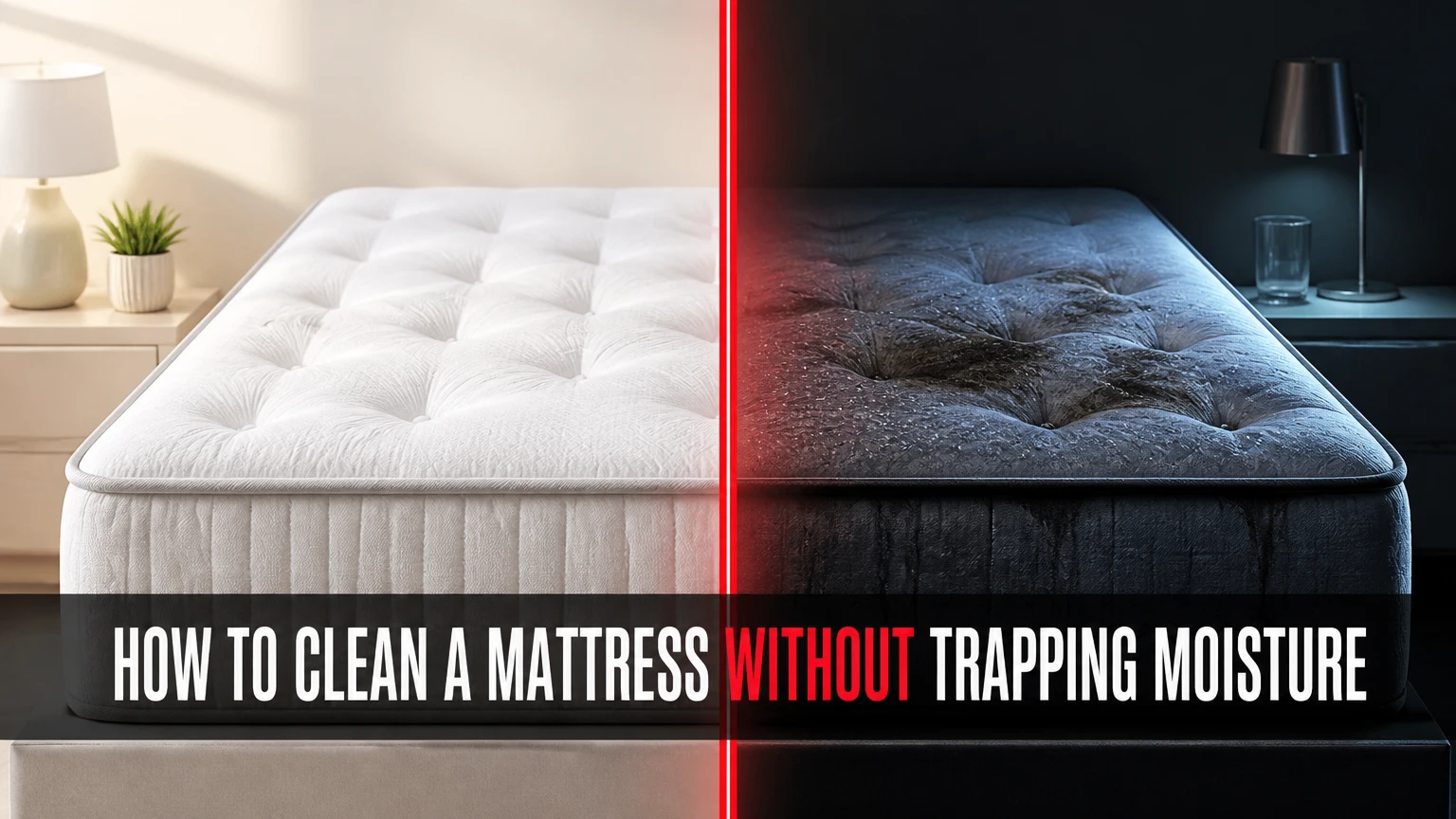
To clean a mattress safely, strip and wash the bedding, vacuum the entire surface, deodorize with a dry absorbent, treat stains with minimal liquid, and dry the mattress completely before remaking the bed. The mattress material and stain type determine which cleaner is safe, but controlling moisture is the main factor that prevents lingering odor and internal mildew.
Key Facts
A routine mattress clean takes about 45-90 minutes of active work, excluding drying time.
A mattress should be completely dry before sheets or a protector go back on.
Baking soda can reduce surface odor, but it does not disinfect a mattress or remove deep urine contamination.
Hydrogen peroxide can lighten blood and biological stains, but it may bleach colored ticking.
Memory foam, latex, and hybrid mattresses require less liquid than washable textile surfaces.
A waterproof, zippered protector prevents far more contamination than repeated deep cleaning.
Before You Start
The safest home method costs about $5-$25 and usually requires 6-12 hours of drying when liquid is used. The work is low difficulty, but a mattress must be moved or tilted enough to expose its sides, seams, and underside without straining the sleeper or damaging the bed frame.
| Requirement | Typical specification | Why it matters |
|---|---|---|
| Active cleaning time | 45-90 minutes | Covers bedding, vacuuming, powder, and spot treatment |
| Drying time | 6-12 hours | Allows moisture to leave foam and upholstery |
| Baking soda | 1-2 cups for queen size | Provides a dry deodorizing layer |
| Vacuum | Upholstery tool, preferably HEPA-filtered | Removes loose dust and skin debris |
| Cloths | 4-6 white microfiber towels | Prevents dye transfer and supports blotting |
| Air movement | 1-2 box fans or a room fan | Accelerates surface evaporation |
Check the mattress law tag, manufacturer care guide, and warranty before using water, peroxide, steam, or an extractor. Some covers are removable but not machine washable, while some foam warranties exclude damage caused by liquid, stains, or unauthorized cleaning chemicals.
Do not start a liquid treatment if the room is humid, the mattress cannot be ventilated, or the mattress already has a musty smell. Those conditions increase the chance that moisture will remain below the fabric.
How to Clean a Mattress: The Six-Step Method
Step 1: Strip and Wash All Bedding
Remove sheets, blankets, pillows, and the mattress protector before cleaning the mattress. Wash each item according to its care label, then dry it fully on the warmest permitted setting because damp bedding can return moisture and odor to a clean mattress.
For dust-mite control, the American Academy of Allergy, Asthma & Immunology recommends encasing mattresses and pillows and washing bedding regularly in hot water where the fabric permits. A 60°C wash can reduce dust mites, but temperature, detergent, wash duration, and dryer performance all affect the result, so 60°C is not a universal sterilization guarantee.
Inspect the protector separately. A protector with a torn membrane, open zipper, or absorbed odor needs replacement rather than repeated washing.
Success checkpoint: Bedding is clean, dry, and temporarily stored away from the mattress.
Common mistake: Leaving the protector underneath while vacuuming, which hides debris and prevents inspection.
Step 2: Vacuum the Mattress Surface and Seams
Vacuum the top, sides, piping, seams, handles, tufts, and exposed underside with a clean upholstery attachment. Work in overlapping horizontal and vertical passes, using slow strokes rather than pressing hard enough to compress foam or damage the ticking.
A HEPA vacuum can retain more fine particles in its exhaust than a conventional vacuum, but vacuuming does not reliably remove dust mites embedded below the cover or eliminate allergens already bonded to fabric. The National Institute of Environmental Health Sciences identifies bedding and mattresses as common dust-mite reservoirs, which is why a zippered encasement remains more effective for long-term exposure control.
Avoid a rotating brush on delicate knit covers and latex surfaces. Empty or seal the vacuum canister outdoors if possible, especially when cleaning a heavily dusty mattress.
Success checkpoint: No visible dust line remains along seams, and the vacuum nozzle collects little new debris after a second pass.
Common mistake: Using a dirty floor head, which can transfer grit, hair, and outdoor allergens to the sleeping surface.
Step 3: Deodorize With a Dry Absorbent
Sprinkle approximately 1 cup of plain baking soda over a queen mattress, using less on a twin and up to 2 cups on a king. Leave the powder for 2-4 hours, then vacuum it thoroughly; 12-24 hours may help with a strong surface odor, but additional time does not make baking soda a disinfectant.
Baking soda can absorb some moisture and reduce acidic or volatile odors near the surface. It cannot extract urine salts from foam, kill every microorganism, or restore a mattress with internal mold. Sunlight may warm and dry the cover, but ordinary household sunlight should not be treated as a dependable disinfection method.
Do not mix essential oils into the powder when a child, pet, or fragrance-sensitive sleeper uses the bed. Tea tree and other concentrated oils can irritate skin and may be toxic if pets ingest them.
Success checkpoint: The powder comes off as a dry residue, with no clumps or damp patches remaining.
Common mistake: Applying powder over a wet stain, which creates paste and pushes residue into the fabric.
Step 4: Treat Stains With Minimal Liquid
Identify the stain before choosing a product, and test every solution on a hidden seam. Apply the cleaner to a white cloth or a small amount to the stain, never by pouring a cup of liquid onto the mattress.
Blot from the outside toward the center with a clean towel. Do not scrub, because friction spreads pigment and drives proteins, fats, or urine salts deeper into foam. Use only enough liquid to dampen the affected fibers, then press with dry towels until transfer stops.
| Stain or odor | Safer first treatment | Contact time and removal |
|---|---|---|
| Fresh blood | Cold water on a white cloth, then a small amount of 3% peroxide if needed | Blot immediately; remove residue with cold water |
| Fresh urine | Enzyme cleaner labeled for upholstery or urine | Follow label time; blot and ventilate |
| Dried urine | Enzyme cleaner after a small patch test | Several applications may be needed; dry between treatments |
| Vomit | Remove solids, then mild detergent solution or labeled enzyme cleaner | Blot, rinse lightly, then dry |
| Sweat or body oil | A few drops of mild detergent in 1 cup water | Damp-blot, then towel-dry |
| Unknown brown mark | Manufacturer-approved upholstery cleaner | Patch test first; avoid heat until identified |
Success checkpoint: The treated area feels only slightly damp, transfers no color to a dry towel, and has no cleaner pooled around the seam.
Common mistake: Combining peroxide, vinegar, bleach, or ammonia. Chemical mixtures can create irritating fumes or damage fabric.
Step 5: Remove Powder and Cleaning Residue
Vacuum the entire mattress again after baking soda has finished sitting and after each treatment has dried. A second pass removes powder, loosened skin particles, dried cleaner, and residue that would otherwise remain under the protector.
Move the nozzle slowly over seams and tuft channels. If baking soda has formed a paste, do not force it into the upholstery with a brush; lift the residue with a dry towel, allow the area to dry, and then vacuum gently.
Success checkpoint: The fabric feels dry and powder-free, and the vacuum no longer leaves visible white trails.
Common mistake: Skipping this pass, which can leave alkaline residue that irritates sensitive skin.
Step 6: Dry and Ventilate Completely
Stand the mattress on its side only if the manufacturer permits it and the mattress can remain stable. Open windows when outdoor humidity is low, direct a fan across the surface, and run a dehumidifier when indoor humidity exceeds approximately 50-60%.
Press a dry towel into the treated area to test for transfer after several hours. The mattress is ready only when the surface and surrounding seams feel dry, no cool damp area remains, and no musty odor develops when the protector is withheld overnight.
Foam can hold moisture below a dry-feeling cover. For that reason, a liquid-treated memory-foam mattress may need 12-24 hours, while a lightly spot-treated innerspring mattress may dry in 4-8 hours under strong airflow.
Success checkpoint: A dry towel stays dry after firm pressure, and the mattress has normal rather than cool, clammy temperature.
Common mistake: Replacing sheets after two or three hours because the top fabric feels dry.
Which Cleaning Method Fits Your Mattress?
The best mattress cleaning method is the lowest-moisture method that can address the problem. Dry powder suits routine odor control, enzyme cleaner suits biological stains, and professional extraction suits severe contamination when the provider can prove that the mattress will be dried quickly.
| Method | Best use | Typical time | Main risk |
|---|---|---|---|
| Vacuum and baking soda | Surface dust and mild odor | 3-5 hours | Limited effect on deep stains |
| Upholstery spot cleaner | Small sweat or food marks | 4-12 hours drying | Overwetting foam |
| Enzyme treatment | Urine, vomit, pet accidents | 8-24 hours | Residue or discoloration |
| Low-moisture steam | Some spring or commercial mattresses | 4-8 hours | Heat and trapped moisture |
| Hot-water extraction | Severe textile contamination | 6-12 hours | Water entering the core |
| Mattress replacement | Mold, infestation, or saturation | Immediate once replaced | Cost and disposal |
Can You Steam-Clean a Mattress?
You can steam-clean some mattresses only when the care instructions allow heat and moisture, but steam is not automatically safer or more sanitary than low-moisture spot cleaning. Memory foam, latex, and thick pillow-top constructions can retain water or suffer heat-related damage.
A household steam iron is unsuitable because it delivers concentrated heat and wet droplets over a small area. A professional vapor steamer may reduce surface microbes, but claims such as “99.9% sanitized” apply to specific organisms, surfaces, exposure times, and equipment conditions, not every mattress interior.
Never steam a mattress with a suspected mold problem, active bedbug infestation, electrical component, cooling gel layer, or manufacturer prohibition. Steam can also set some protein stains or spread dissolved urine through adjacent fibers.
How Do You Clean Memory Foam, Latex, and Spring Mattresses?
Memory foam and latex mattresses need the least liquid, while innerspring mattresses tolerate somewhat more surface treatment because air gaps surround the coil unit. Hybrid mattresses still require foam-level caution because their comfort layers can retain water above the springs.
| Mattress type | Preferred method | Avoid | Typical drying expectation |
|---|---|---|---|
| Memory foam | Vacuum, baking soda, tiny spot applications | Soaking, steam, carpet extractor | 12-24 hours |
| Latex foam | Manufacturer-approved dry or damp cleaning | Peroxide, solvents, prolonged sun | 8-16 hours |
| Innerspring | Vacuum and controlled upholstery spot cleaning | Saturating quilted top | 4-8 hours |
| Hybrid | Foam-safe spot treatment and airflow | High-volume extraction at home | 8-16 hours |
| Pillow top | Gentle vacuum and minimal liquid | Aggressive brushing and heat | 8-16 hours |
Removable covers should be washed only when the care label explicitly permits machine washing. Never remove a non-removable mattress cover to expose internal foam, because the cover often protects the construction and may be required for warranty coverage.
How Do You Remove Urine From a Mattress?
An enzyme cleaner formulated for urine and upholstery is the first choice for fresh or dried urine because it targets organic residues that create persistent odor. Blot fresh liquid immediately, apply only the labeled amount, and repeat after drying rather than flooding the mattress in one attempt.
For a fresh accident, press towels into the area with body weight, replace them as they become wet, and continue until transfer is minimal. Apply enzyme cleaner to the remaining spot, obey the product’s dwell time, blot again, and ventilate for at least overnight.
A commonly circulated mixture uses 1 cup of 3% hydrogen peroxide, 3 tablespoons of baking soda, and 2 drops of dish soap. That formula can lighten odor and staining, but peroxide may bleach ticking, baking soda can leave residue, and neither ingredient reliably removes urine from deep foam. An enzyme product is the more targeted option.
Dried urine may require two or more applications. If the smell returns whenever humidity rises, contamination may extend below the cover, where home spot treatment cannot reach safely.
How Do You Remove Blood, Vomit, and Sweat Stains?
Cold water is the safest first treatment for blood because heat can set blood proteins into fabric. Vomit requires solid removal followed by enzyme or mild detergent treatment, while sweat and body oil respond better to diluted detergent than to strong oxidizers.
For blood, use a white cloth dampened with cold water and blot repeatedly. If discoloration remains, test 3% hydrogen peroxide on a hidden area, apply a small amount to the cloth, blot the stain, and remove residue with another cold damp cloth.
For vomit, wear gloves, lift solids with paper or a scraper, and bag the waste. Blot with a mild detergent solution or upholstery-safe enzyme cleaner, then use a barely damp cloth to remove residue before applying airflow.
For sweat, mix a few drops of mild detergent into 1 cup of water. Work in small areas, blot the surface, and towel-dry immediately. White vinegar can reduce some odors, but its acidity does not make it a disinfectant, and repeated use can affect dyes or coatings.
What Should You Do if the Mattress Gets Too Wet?
If a mattress becomes saturated, remove all bedding, press clean towels into the wet area, and start high-volume airflow immediately. A box fan, dehumidifier, and raised mattress position can reduce drying time, but a waterlogged foam core may remain unsafe even when the cover feels dry.
Do not use a hair dryer on high heat, place the mattress against a heater, or cover it with plastic. Heat can deform foam, while plastic traps evaporated water. Rotate the mattress only when safe and practical, keeping the wet side exposed to moving air.
If a mattress remains damp after 24-48 hours, develops a musty odor, or shows spreading discoloration, stop using it and contact the manufacturer or a remediation professional. Internal mold cannot be reliably diagnosed or removed through surface spraying.
Common Mistakes and How to Fix Them
Overwetting the Mattress
Failure: Liquid reaches foam, batting, or the underside.
Fix: Press with dry towels, expose the wet area, run fans and a dehumidifier, and delay use until the towel test passes.
Scrubbing a Biological Stain
Failure: Friction spreads the stain and embeds proteins.
Fix: Blot outward to inward, change cloth sections frequently, and use an enzyme product with the correct dwell time.
Treating Baking Soda as a Disinfectant
Failure: Odor is masked while contamination remains.
Fix: Use baking soda only for surface odor, then address urine, vomit, mold, or infestation with the appropriate method.
Using Bleach or Solvent Cleaners
Failure: Bleach can weaken textile fibers and discolor ticking; solvents may damage foam adhesives.
Fix: Follow the care label and use a product specifically labeled for mattresses or upholstery.
Replacing Bedding Too Soon
Failure: Sheets trap residual moisture against the mattress.
Fix: Extend drying overnight and confirm that seams, not only the center surface, are dry.
Ignoring the Underside
Failure: A damp foundation or contaminated underside reintroduces odor.
Fix: Inspect the bed base, rotate only according to manufacturer instructions, and clean the underside with a dry vacuum pass.
When Should You Hire a Professional or Replace the Mattress?
Professional cleaning is worthwhile for large urine contamination, repeated pet accidents, valuable specialty mattresses, or stains that remain after a careful spot treatment. Typical professional prices range from $80-$200 or more, with higher charges for king mattresses, travel, severe odor, and rapid-drying equipment.
Ask the provider which method will be used, how much water enters the mattress, whether the technician has experience with your material, and what drying time is guaranteed. A low price is not useful if the mattress remains wet overnight.
Replace rather than clean when the mattress contains visible internal mold, has been soaked by floodwater or sewage, has a persistent infestation, or remains malodorous after complete drying and professional assessment. A surface spray cannot make a contaminated foam core hygienic.
Bedbugs require a separate pest-control plan. Vacuuming can remove some visible insects, but it does not eliminate eggs hidden in seams. Do not rely on baking soda, vinegar, or an ordinary steam pass as a complete bedbug treatment.
How Often Should You Clean a Mattress?
Most households benefit from vacuuming every 2-3 months and deep cleaning every 6-12 months, with shorter intervals for allergies, pets, sweating, children, or frequent food and drink in bed. Rotate the mattress only when its manufacturer permits rotation, because many modern mattresses are one-sided.
| Situation | Vacuum | Spot clean | Deep-clean or inspect |
|---|---|---|---|
| Typical adult bedroom | Every 3 months | Immediately | Every 6-12 months |
| Allergy-sensitive sleeper | Every 1-2 months | Immediately | Every 6 months |
| Pet in the bedroom | Every 1-2 months | Same day | Every 3-6 months |
| Child or frequent accidents | Monthly | Immediately | After each significant accident |
| Waterproof protector used | Every 3 months | Protector first | Every 12 months |
| No protector or visible odor | Monthly | When noticed | Every 6 months |
Use a fitted waterproof protector under ordinary sheets, and wash the protector according to its care label. A protector is a prevention tool, not a substitute for cleaning spills promptly.
The Bottom Line
The safest way to clean a mattress is to vacuum first, use baking soda only for surface odor, apply targeted stain treatment sparingly, and create enough airflow for complete drying. Memory foam and latex need especially low-moisture care, while mold, bedbugs, floodwater, and deep urine contamination may require professional assessment or mattress replacement.
A clean mattress still needs protection. Use a washable encasement or waterproof protector, keep food and drinks away from the bed, and treat accidents before liquid reaches the core. These measures reduce both cleaning frequency and the risk that a small stain becomes a structural problem.
Frequently Asked Questions
Can I wash a mattress in a washing machine?
No, a complete mattress should not go into a washing machine. Machine washing can distort the cover, damage foam, and leave the interior saturated. Wash only a removable cover when its care label permits it, and clean the mattress core with a vacuum and carefully controlled spot treatment.
Can I use a carpet cleaner on a mattress?
A carpet extractor can overfill mattress foam with water, so home use is usually unsuitable unless the manufacturer specifically permits extraction. Professional technicians may use low-moisture equipment with powerful recovery and controlled drying. Never assume that an upholstery attachment makes a carpet machine safe for every mattress.
Does baking soda kill dust mites?
Baking soda does not reliably kill dust mites throughout a mattress. The powder may reduce surface odor and absorb limited moisture, while regular vacuuming, hot laundering where allowed, and a fully enclosed allergen-proof encasement reduce exposure more effectively.
Can I put a mattress in the sun?
Brief, indirect outdoor airing can reduce surface humidity and odor, but direct sun can fade fabric, heat foam, and expose the mattress to pollen or moisture. Sunlight is not a dependable replacement for cleaning, disinfection, or professional pest treatment.
How can I tell whether a mattress is dry?
Press a clean, dry towel firmly against seams and treated areas for 10-15 seconds. The mattress is not ready if the towel feels damp, the area feels cool or clammy, or a musty odor appears after the room is closed. Wait longer and continue ventilation.
How do I clean a mattress after a bedbug infestation?
Use a licensed pest-control treatment rather than relying on household cleaners. Vacuum seams and dispose of the vacuum contents securely, launder and dry bedding on permitted settings, encase the mattress, and follow the pest professional’s monitoring and retreatment plan. Cleaning alone does not eradicate bedbugs.