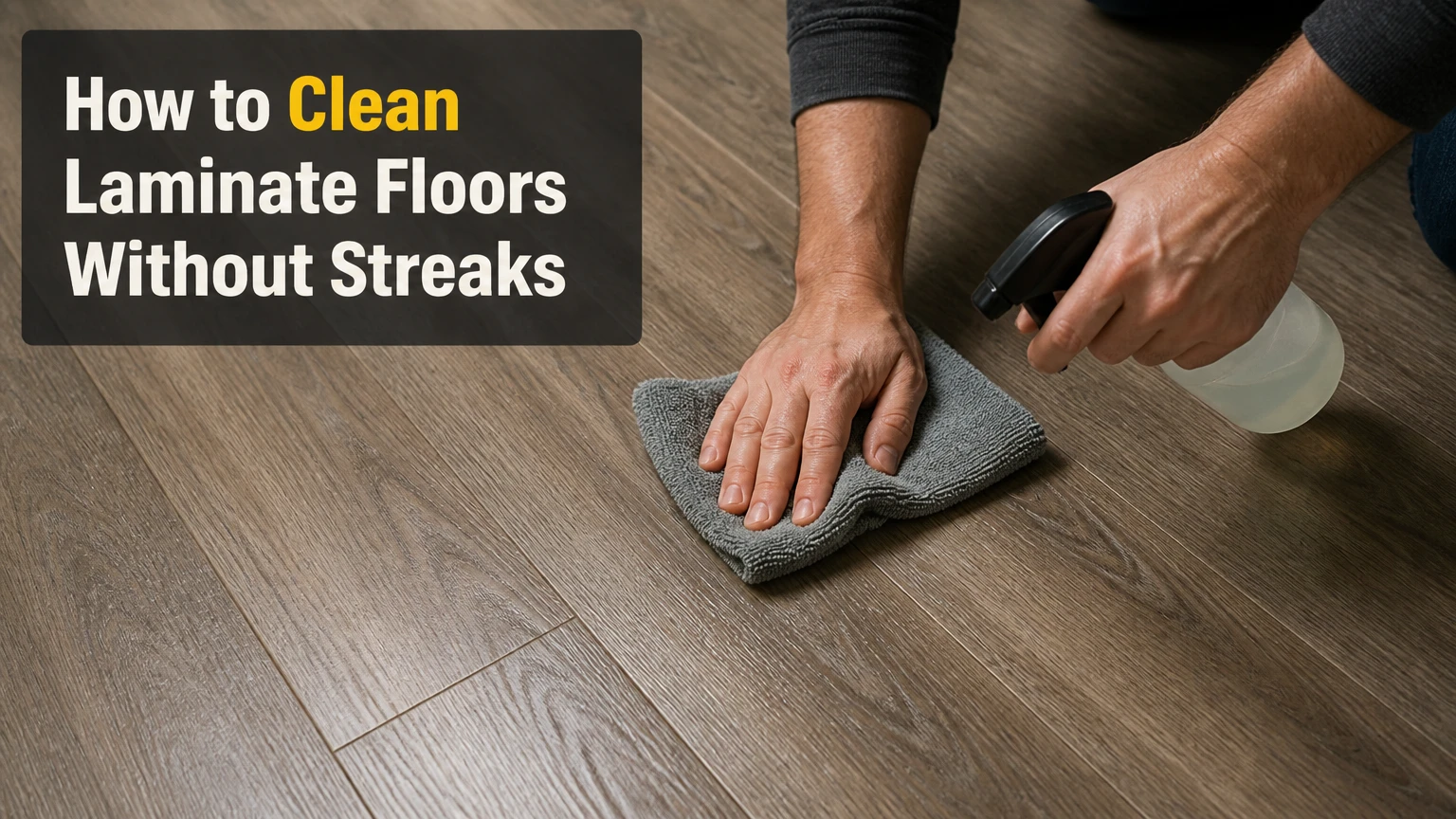
To clean laminate floors without streaks, remove dry grit first, use a manufacturer-approved pH-neutral cleaner on a barely damp microfiber pad, and work in small sections. Wipe with overlapping strokes, change the pad when it becomes dirty, and dry each section within a few minutes so cleaner residue and mineral water cannot form visible lines.
Key Facts at a Glance
- Laminate flooring should be damp-mopped, never saturated; standing water can swell the fiberboard core at open seams.
- Most streaks come from excess cleaner, hard-water minerals, oily residue, or a dirty mop pad rather than from a defective floor finish.
- A clean, tightly woven microfiber pad leaves fewer fibers and less residue than cotton string mops or disposable wet pads.
- Manufacturer-approved laminate cleaner is the safest default; vinegar and rubbing alcohol can conflict with some warranties or finishes.
- Typical spot cleaning takes 2-5 minutes, while a 500-square-foot room usually takes 15-25 minutes.
- Wax, acrylic polish, oil soap, abrasive powder, and steam mops should not be used on laminate flooring.
Why Do Laminate Floors Show Streaks?
Laminate floors show streaks when moisture dries unevenly on the clear wear layer, leaving cleaner solids, minerals, or oils behind. Laminate flooring has a decorative image layer beneath a transparent wear layer, usually over a high-density fiberboard core; the surface resists absorption, so residue remains visible instead of sinking into the material.
Four causes account for most streaks:
- Too much cleaning solution: A concentrated film dries as parallel mop lines or cloudy patches.
- Hard tap water: Calcium and magnesium minerals remain after water evaporates.
- Dirty or overloaded microfiber: Soil transfers across the floor instead of being collected.
- Oily contamination: Skin oils, cooking grease, pet residue, and furniture products create footprints after cleaning.
Laminate is more moisture-sensitive at its joints than across the center of each plank. The wear layer may tolerate a damp wipe, but repeated liquid exposure can enter the click-lock seams and swell the fiberboard below. That damage may appear hours or days after cleaning as raised edges, open joints, or buckled planks.
How much moisture is safe?
A laminate mop pad should feel damp and cool, not wet enough to release droplets. If squeezing the pad produces water, the pad contains too much moisture for routine laminate care.
Manufacturers vary in their instructions, so the product-care sheet for the exact floor takes priority over generic recipes. Pergo, for example, warns in its maintenance guidance, “Do not use excessive water when cleaning,” a practical rule that matters more than a claim that one homemade formula works for every laminate finish.
What Should You Prepare Before Cleaning?
Prepare a soft-bristle vacuum or dry microfiber mop, two or more clean microfiber pads, a small bucket or spray bottle, and a laminate-safe cleaner. Plan for 15-25 minutes for a typical 500-square-foot area, plus 2-5 minutes of drying time after each small section.
Before You Start
| Requirement | Typical specification | Why it matters |
|---|---|---|
| Cleaning time | 15-25 minutes per 500 sq. ft. | Prevents solution from drying before wiping |
| Drying time | 2-5 minutes per section | Limits mineral and detergent marks |
| Cleaner quantity | 1-2 teaspoons per 32 oz. water, only if label permits dilution | Reduces residue from over-concentration |
| Microfiber pads | 2-4 washable pads | Allows replacement before soil spreads |
| Section size | 3 x 3 ft. to 4 x 4 ft. | Keeps moisture and cleaner controllable |
| Floor condition | Loose grit removed; spills blotted | Prevents scratching and smearing |
Inspect the floor-care instructions before mixing anything. Some laminate manufacturers approve only their branded cleaner or a lightly damp cloth, while others permit a neutral cleaner diluted according to its label. A floor warranty is a better authority than an internet recipe.
For a first-time cleaning method, test a hidden area behind a door or beneath furniture. Let the test dry completely, then check for dullness, color change, tackiness, or a visible ring.
How to Clean Laminate Floors Without Streaks
Follow these seven steps: remove dry soil, identify the residue, prepare a compatible solution, dampen the pad rather than the floor, mop small sections, replace dirty pads, and dry the surface immediately. The leading success factor is moisture control, not the amount of cleaning chemical.
Step 1: Remove Dry Dirt and Grit
Vacuum the floor with the hard-floor setting and a soft brush, or use a clean microfiber dust mop. Move furniture pads and inspect along baseboards, under chairs, and near exterior doors because trapped grit can scratch the wear layer during wet cleaning.
Avoid a vacuum’s rotating beater bar if it can contact the floor aggressively. Fine sand, salt, and pet litter behave like abrasive particles under a mop. Removing them first also prevents muddy residue from creating the streaks you are trying to eliminate.
You will know it worked when: the floor has no loose grit under a dry microfiber cloth.
Common mistake: wet-mopping first. Water turns dust into a thin paste that spreads across several planks.
Step 2: Identify the Surface Problem
Rub a clean, dry white microfiber cloth over a streaked area. A greasy or tacky cloth indicates cleaner or oil buildup; a powdery white mark suggests mineral residue; a line that remains unchanged after gentle cleaning may be wear-layer damage, abrasion, or gloss variation.
This diagnosis prevents unnecessary chemical escalation. A floor with detergent buildup needs controlled residue removal, while a floor with a damaged finish will not become uniform through stronger mopping.
Step 3: Choose and Prepare the Cleaner
Use a ready-to-use laminate cleaner labeled pH-neutral or approved for laminate flooring. If the label requires dilution, measure the water and cleaner instead of pouring by guesswork. Distilled water can reduce mineral marks in hard-water regions, but it does not neutralize an excessive dose of detergent.
Do not automatically use a 1:1 mixture of rubbing alcohol and water. Isopropyl alcohol evaporates quickly and can remove oily marks, but alcohol compatibility depends on the floor finish and manufacturer instructions. Use it only for a small spot when the flooring documentation permits it, and never mix alcohol with bleach, ammonia, or other cleaners.
You will know it worked when: the solution dries without tackiness on the test area.
Common mistake: adding more cleaner because the floor looks dull. Extra product usually increases the film.
Step 4: Dampen the Microfiber Pad
Apply cleaner to the mop pad or lightly mist the pad, never flood the floor. The pad should be uniformly damp, with no dripping edge and no puddle left behind after one pass.
A spray mop can work well when its trigger dispenses a fine mist, but avoid holding the spray over one plank. For a bucket system, wring the pad thoroughly before it touches the laminate. Keep a second dry pad available for immediate finishing.
Step 5: Mop in Small, Overlapping Sections
Start at the far corner and move toward the exit. Clean a 3 x 3-foot or 4 x 4-foot section using overlapping S-shaped strokes, then lift the pad rather than dragging it through already collected grit.
Turn or replace the pad when one side becomes visibly gray, damp enough to leave a trail, or loaded with hair. A clean pad is more important than stronger agitation because laminate’s non-porous wear layer releases surface soil without aggressive scrubbing.
For textured laminate, follow the plank direction and use moderate pressure. Circular scrubbing can leave a different sheen in the recessed embossing, especially on matte surfaces.
You will know it worked when: the section looks uniformly damp for less than a minute and leaves no wet line behind the mop.
Common mistake: cleaning the whole room before rinsing or replacing the pad. Soil and cleaner then dry in repeated tracks.
Step 6: Dry and Buff Immediately
Pass a dry microfiber pad over the cleaned section within 30-60 seconds, especially when tap water is hard or indoor humidity is low. Buffing removes the thin moisture film before minerals and cleaner solids concentrate at its drying edge.
Do not polish aggressively. Two or three light passes are enough. Excess pressure can move residue into bevels and textured grooves rather than removing it.
Ventilate with normal room airflow, but avoid directing a powerful heater at the floor. Rapid, uneven heating can dry one area before another and exaggerate differences in gloss.
Step 7: Inspect Under Side Lighting
View the floor from a low angle near a window or lamp. Look for parallel mop tracks, dull rectangles, footprints, and residue along bevels. Correct one small area before continuing, because a successful test section reveals whether the cleaner, water, and pad combination is compatible.
A uniform matte appearance is not necessarily a cleaning failure. Many laminate floors have a low-sheen wear layer that will not become glossy without a coating, and adding a coating can void care recommendations.
Which Cleaner Is Safest for Laminate Floors?
A manufacturer-approved, pH-neutral laminate cleaner is the safest general choice, followed by plain water when the floor is lightly soiled. Vinegar and isopropyl alcohol may remove specific residues, but both should be treated as conditional spot-cleaning options rather than universal laminate solutions.
| Cleaning option | Typical use | Residue and drying behavior | Main limitation |
|---|---|---|---|
| Manufacturer-approved laminate cleaner | Routine damp mopping | Low residue when used at label dilution | Costs about $8-$20 per bottle |
| Plain distilled water | Dust, light footprints, small spills | Dries cleanest when minerals are low | Weak against grease |
| Diluted white vinegar | Old alkaline cleaner film, only if approved | Acidic solution can reduce some haze | May conflict with finish or warranty |
| Diluted isopropyl alcohol | Small oily footprint, only if approved | Evaporates quickly; can strip some coatings | Not a universal floor-safe solvent |
| Dish soap or oil soap | Heavy household soil | Leaves surfactant or oil film | Common cause of recurring streaks |
| Wax or acrylic polish | Attempted shine restoration | Forms a coating over the wear layer | Can become sticky and difficult to remove |
Plain water is often enough for a recently maintained floor. Cleaner adds value when there is grease, tracked soil, or a residue that water alone cannot lift, but its concentration must remain low.
Is vinegar safe on laminate flooring?
Vinegar is not automatically safe for every laminate floor. A mild vinegar solution can help dissolve alkaline cleaner residue, but acidic solutions may dull some finishes and can conflict with manufacturer warranties; use it only when the care instructions permit it and test first.
If approved, use no more than 1 cup of white vinegar per gallon of water for a one-time residue treatment, then wring the pad thoroughly and dry the area. Never pour the mixture directly onto seams, and do not use vinegar as a daily substitute for a laminate cleaner.
Which Tools Prevent Streaks Most Reliably?
A flat microfiber mop with removable pads offers the best control for most laminate floors because the pad absorbs soil, uses little liquid, and can be changed during cleaning. Spray mops improve convenience, but their fixed spray pattern can over-wet narrow areas if the trigger is held too long.
| Tool | Typical price | Moisture control | Best use | Limitation |
|---|---|---|---|---|
| Flat microfiber mop | $15-$45 | High, with hand-wrung pad | Whole-room cleaning | Requires separate solution |
| Spray mop | $20-$60 | Medium to high | Frequent light maintenance | Reservoir may encourage overuse |
| Cotton string mop | $10-$35 | Low | Tile or sealed concrete | Holds excessive water |
| Disposable wet pad | $8-$15 per pack | Medium | Small emergency spill | Can dry dirty and leave film |
| Soft-brush vacuum | $80-$350 | Not applicable | Daily dry soil removal | Motorized brush may scratch if unsuitable |
| Dry microfiber dust mop | $10-$30 | Not applicable | Hair, dust, and grit | Does not remove grease |
Use washable pads without fabric softener. Fabric softener coats microfiber fibers and reduces absorbency, which can cause the pad to push water and oils across the wear layer.
A practitioner rule of thumb is to assign one pad to approximately 100-200 square feet of normally soiled laminate, then adjust for pets, mud, and kitchen grease. The exact area depends on pad size and soil load, but the visual test is reliable: replace the pad when it leaves a gray or glossy trail.
How Often Should Laminate Floors Be Damp-Mopped?
Damp-mop laminate floors every one to two weeks in a typical household, while dry dusting or vacuuming handles daily grit. Entryways, kitchens, homes with pets, and rooms used by young children may need spot cleaning several times per week rather than more frequent full-floor wet mopping.
| Household condition | Dry cleaning | Damp cleaning | Immediate action |
|---|---|---|---|
| Low-traffic bedroom | 2-3 times weekly | Every 3-4 weeks | Blot spills |
| Typical living area | Daily or every other day | Every 1-2 weeks | Remove grit at entrances |
| Pet household | Daily | Weekly or as needed | Blot water and urine immediately |
| Busy kitchen | Daily | Every 5-7 days | Degrease spots with approved cleaner |
| Muddy entryway | Daily | 2-3 times weekly if needed | Remove grit before moisture |
| Commercial or very high traffic | Daily | Several times weekly | Change pads frequently |
More frequent cleaning is not automatically better. Repeated wetting raises the chance of liquid entering seams, while dry soil removal usually delivers most of the maintenance benefit.
What Should You Never Use on Laminate Floors?
Never use steam mops, soaking-wet mops, abrasive powders, wax, furniture polish, oil soap, or undiluted household chemicals on laminate flooring. These products either force heat and moisture into seams, leave a coating on the wear layer, scratch the surface, or create residue that attracts more dirt.
- Steam mops: Heat and vapor can enter joints and contribute to swelling or delamination.
- Wax and polish: Laminate already has a factory wear layer; a new coating can become cloudy, slippery, or sticky.
- Oil soap: Oils remain on the non-porous surface and create footprints.
- Dish soap: Surfactants can leave a film when over-dosed or inadequately removed.
- Abrasive scrubbers: Melamine foam and rough pads can alter the sheen.
- Bleach and ammonia: Strong chemicals may discolor or damage the finish.
- Soaking wet mops: Water can reach the fiberboard core through joints and edge damage.
The most counterintuitive mistake is chasing shine with more product. A glossy appearance created by polish is a coating effect, not proof that the laminate is cleaner, and the coating can make later streak removal harder.
How Do You Remove Existing Haze and Footprints?
Remove existing haze by first stopping the product that caused it, then cleaning a small test section with the least aggressive compatible method. Use a dry microfiber cloth for light oil, a barely damp pad with approved cleaner for ordinary residue, and a controlled vinegar treatment only when the manufacturer allows it.
Cloudy film after mopping
A cloudy film usually indicates dried cleaner, oil soap, or polish buildup. Vacuum first, then clean 3-4 square feet with plain distilled water or a label-approved laminate cleaner, immediately drying the area with a separate microfiber pad.
If the test remains tacky, repeat once with a fresh pad rather than increasing chemical strength. Persistent coating buildup may require a flooring professional because aggressive solvents can damage the decorative layer.
White lines after the floor dries
White lines often indicate hard-water minerals or concentrated cleaner at the edge of a drying section. Use distilled water for the test area, reduce solution quantity, and dry within one minute; if the mark remains, use a manufacturer-approved residue remover.
Footprints appear immediately
Footprints usually indicate an oily film, an incompletely dried cleaner, or a polish layer. Hand-buff the mark with a clean dry microfiber cloth first, then use a small amount of approved cleaner on the cloth if the oil remains.
Dull patches never disappear
A dull patch that remains after two gentle cleaning attempts may be abrasion, finish wear, chemical damage, or a manufacturing variation. Cleaning cannot restore a worn wear layer, and applying wax usually hides the problem temporarily while complicating repair.
What Changes for Pets, Children, and Hard Water?
Pet households need faster spill response and more frequent dry-soil removal, while hard-water homes need tighter control of water quantity and drying. Children’s food spills and pet accidents should be blotted immediately, then cleaned with a compatible product rather than repeatedly mopped with a strong disinfectant.
For pet urine, blot with absorbent towels, clean the affected area with a laminate-safe product, and dry the seams thoroughly. Avoid saturating the plank edges because odor treatment that penetrates the core can create swelling.
For muddy footprints, allow heavy mud to dry enough for easy removal, vacuum the grit, then wipe with a barely damp pad. Wet-mopping mud before removing its sand content spreads abrasive particles.
For kitchen grease, use a small amount of approved cleaner on the pad rather than adding concentrated detergent to the bucket. Change pads after the greasy zone so the residue does not spread into living areas.
How Much Does Streak-Free Laminate Cleaning Cost?
Typical DIY cleaning costs $10-$60 initially and $2-$8 per routine session after buying reusable tools. A flat microfiber mop usually costs $15-$45, washable replacement pads cost $5-$15 each, and laminate cleaner costs approximately $8-$20 per bottle in the United States.
| Cleaning setup | Initial cost | Routine cost | Typical time |
|---|---|---|---|
| Existing mop plus water | $0-$10 | Under $1 | 10-20 minutes |
| Flat microfiber system | $20-$60 | $1-$3 | 15-25 minutes |
| Spray mop system | $25-$80 | $2-$6 | 10-20 minutes |
| Vacuum plus microfiber mop | $100-$395 | $1-$4 | 15-30 minutes |
| Professional maintenance visit | $75-$200 | $75-$200 | 30-90 minutes |
Prices vary by country, floor area, and product brand. A reusable pad system usually costs less over a year than disposable wet pads, especially in homes that clean several times per week.
Expert Rules for a Consistent Finish
Three operating rules prevent most streaks:
- The clean-pad rule: A pad that looks only moderately dirty may already be transferring oil and detergent. Keep spare pads nearby and change them before a visible trail appears.
- The one-section rule: Never apply enough solution to wet an entire room. A section that can be dried within a minute is easier to control than a room left to air-dry.
- The warranty rule: Treat vinegar, alcohol, disinfectants, and steam as conditional products. The flooring manufacturer’s care document outranks a generic cleaning formula.
A fourth rule helps diagnose recurring marks: clean one plank across its width rather than one full-length strip. If the mark disappears only in the cleaned test area, residue is likely; if the sheen remains different, the finish itself may be affected.
FAQ
Can I use a Swiffer on laminate floors?
A Swiffer-style flat mop can be used if the pad is only damp and the product is approved for laminate. Avoid saturating disposable pads, leaving liquid in bevels, or using a fragranced solution that creates buildup. Dry the area after cleaning if the pad leaves a visible wet trail.
Should laminate floors be rinsed after cleaning?
Laminate floors usually should not be rinsed with a second wet pass when the cleaner is correctly diluted and labeled no-rinse. If an old soap film remains, use a barely damp pad with clean water in a small test section, then dry immediately rather than flooding the floor.
Can hot water clean laminate flooring better?
Hot water does not clean laminate better than a controlled amount of lukewarm water and an approved cleaner. Excess heat can soften residue temporarily while excessive moisture increases seam risk. Use room-temperature or lukewarm water unless the flooring manufacturer specifies another temperature.
Why are my laminate floors streaky after using a steam mop?
Steam-mop streaks can result from concentrated moisture, loosened residue, or heat-sensitive finish damage. Stop using steam, allow the floor to dry, and test a small area with a clean, barely damp microfiber pad. Permanent dullness or swollen seams require flooring assessment rather than stronger cleaning.
How can I make laminate floors shine without polish?
Make laminate floors look clean and uniform by removing grit, reducing cleaner quantity, using a clean microfiber pad, and drying each section. A factory wear layer determines the floor’s normal sheen. Polish may create temporary gloss, but it can leave a slippery film and complicate future maintenance.
Is tap water acceptable for cleaning laminate floors?
Tap water is acceptable when it is not highly mineralized and the floor dries without marks. In hard-water areas, distilled or demineralized water can reduce white deposits, but it will not prevent streaks caused by excess cleaner, dirty pads, or oily residue.
The Bottom Line
The most dependable way to clean laminate floors without streaks is simple: remove dry grit, use a small amount of compatible cleaner, dampen the microfiber pad instead of the floor, work in 3 x 3-foot or 4 x 4-foot sections, and dry immediately. Avoid steam, wax, oil soap, abrasive tools, and excess water. If streaks return, reduce the cleaner first, replace the pad sooner, and test distilled water before reaching for a stronger chemical.