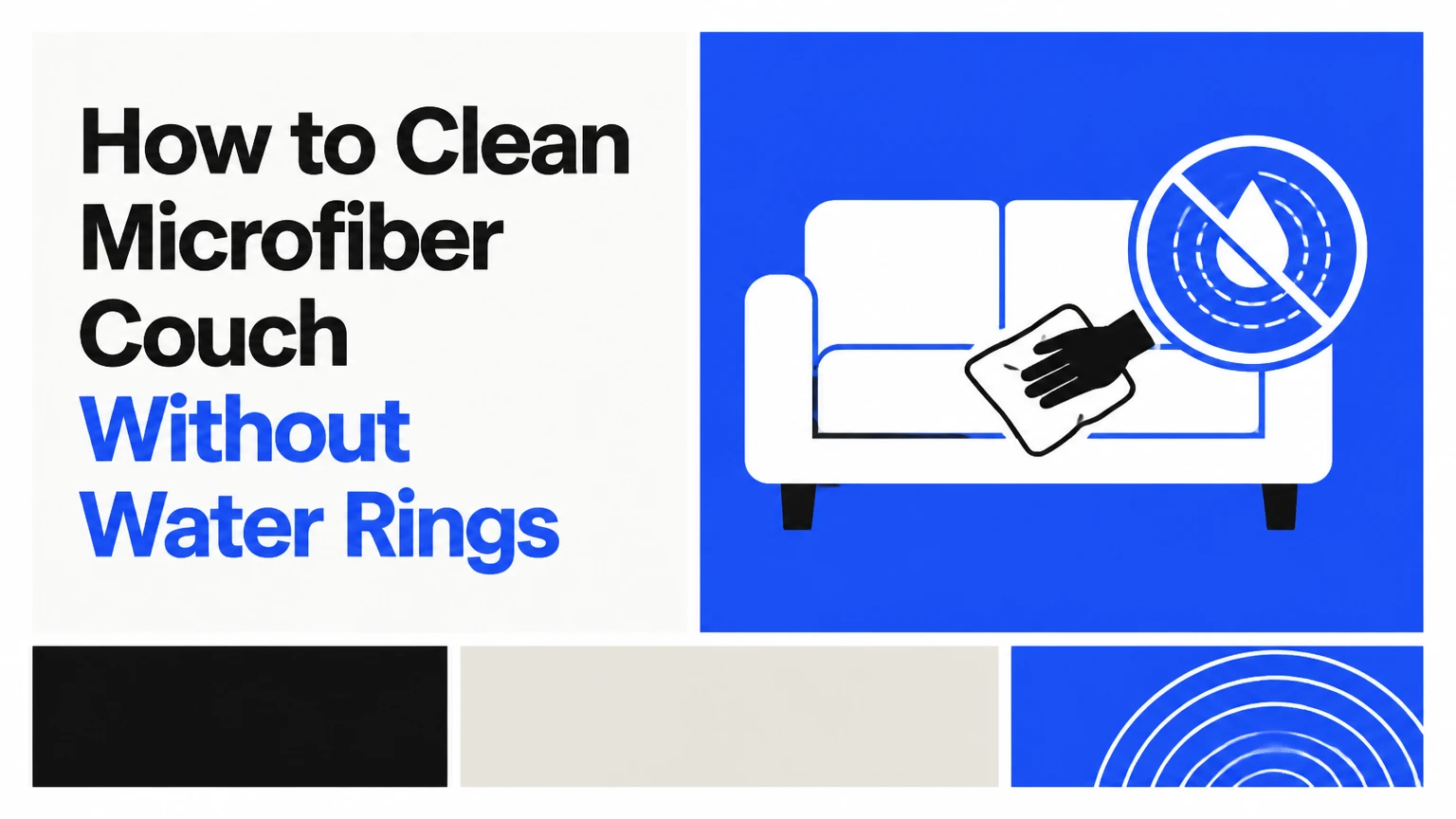
To clean a microfiber couch, first read its upholstery care code, then vacuum loose soil and spot-test the approved cleaner in a hidden area. Use low-moisture water-based foam on W or WS fabric, an approved solvent on S fabric, and vacuuming only on X fabric. Dry each section completely before brushing the nap.
Key Facts at a Glance
- A microfiber couch must be cleaned according to its care code: W, S, WS/S-W, or X.
- Water-based cleaning belongs on W and usually WS upholstery, while S upholstery requires a manufacturer-approved solvent.
- A typical three-seat couch takes 60-120 minutes of active work, plus 2-12 hours of water-based drying.
- Vacuuming before liquid or solvent cleaning prevents grit from becoming abrasive mud.
- A white cloth, small sections, light application, and complete drying reduce color transfer and water rings.
- A professional should assess X-coded fabric, unstable dye, wet foam, severe urine contamination, or unknown upholstery construction.
What Is Microfiber Upholstery?
Microfiber upholstery is a tightly woven synthetic textile made primarily from very fine polyester, polyamide, or a polyester-nylon blend. The fibers create a dense surface that resists rapid liquid penetration, traps dry soil, and produces a visible nap that can change direction after rubbing.
Microfiber is not one uniform material. A smooth, suede-like polyester microfiber and a brushed microfiber with a thicker nap can react differently to moisture, heat, pressure, and solvents. The care label therefore matters more than the word “microfiber” on the product listing.
The tight weave helps spills remain near the surface for a short time, but it does not make the couch stain-proof. Grease can bond to fibers, dyes can migrate, and dirty liquid can travel toward the edge of a damp spot. Microfiber cleaning succeeds when the operator removes soil without wetting the backing and controls the direction of abrasion.
Why does microfiber feel stiff after cleaning?
Microfiber feels stiff after cleaning because moisture, detergent residue, or solvent disturbance temporarily mats the raised fibers. Drying can also leave the nap lying in several directions, which creates a rough or crunchy hand even when the fabric is clean.
A clean, dry upholstery brush usually restores the texture. Brushing while the fabric is wet can spread soil, flatten the nap, and create visible shading.
How Do You Read the Care Code?
The care code is the manufacturer’s instruction for the safest cleaning chemistry, and the tag overrides generic microfiber advice. Look beneath removable cushions, along the platform, under the sofa frame, or inside a manufacturer’s care booklet; if no code exists, treat the couch as unverified rather than assuming that alcohol or water is safe.
| Code | Typical meaning | First-choice method | Main restriction |
|---|---|---|---|
| W | Water-based cleaner permitted | Low-moisture upholstery foam or diluted upholstery detergent | Avoid soaking foam and backing |
| S | Solvent-based cleaner permitted | Manufacturer-approved upholstery solvent | Do not assume every solvent is compatible |
| WS or SW | Water or solvent permitted | Use the lower-risk method confirmed by the label | Avoid saturation and high heat |
| X | Vacuum or light brushing only | Upholstery vacuum and dry brush | Do not apply water, soap, alcohol, or solvent |
Care symbols vary by manufacturer, and some labels include additional instructions such as “professional cleaning recommended,” “do not remove cover,” or a specific cleaning product. A removable cushion cover is not automatically machine-washable. The cover may shrink, the backing may delaminate, or the zipper may be decorative.
Is rubbing alcohol always safe on an S-coded couch?
Rubbing alcohol is not automatically safe on every S-coded couch. The S code means a solvent-based system is permitted, but the manufacturer may specify a particular solvent, concentration, application method, or professional service.
A small test with 70% or 91% isopropyl alcohol is a common field method for some polyester microfiber sofas, but it remains a general technique, not a universal warranty. Do not use alcohol near flames, heaters, pilot lights, or smoking materials, and do not mix it with bleach, ammonia, or other cleaners.
Choose the Cleaning Method
The best method depends on the care code, stain chemistry, fabric colorfastness, and condition of the cushion backing. Water-based foam is usually the practical choice for W upholstery, solvent cleaning can dry faster on compatible S upholstery, and X upholstery should remain dry unless the manufacturer authorizes professional treatment.
| Cleaning method | Compatible code | Typical drying time | Best use | Main risk |
|---|---|---|---|---|
| Upholstery foam | W, some WS | 4-12 hours | Food soil, mud, general grime | Water rings or wet foam |
| Diluted upholstery extractor | W, some WS | 6-24 hours | Heavy removable soil | Overwetting and residue |
| Isopropyl alcohol mist | Some S, some WS | 15-45 minutes | Body oil, ink transfer, surface grime | Fire hazard or finish damage |
| Professional solvent cleaning | S, delicate unknown fabrics | 1-4 hours typical | Large or unstable upholstery | Service cost |
| Steam extraction | Manufacturer-approved W or WS only | 6-24 hours | Deep embedded soil | Heat, shrinkage, wet backing |
| Dry vacuuming and brushing | X, all codes for maintenance | Immediate | Dust, crumbs, loose hair | Inadequate stain removal |
Commercial upholstery cleaners require label verification. A household carpet formula may contain optical brighteners, strong alkalines, fragrances, or excessive detergent that remains in microfiber and attracts new soil.
Before You Start
Prepare 60-120 minutes for a standard three-seat couch, excluding water-based drying. A basic DIY setup typically costs $5-$25 for distilled water, white cloths, a soft upholstery brush, a spray bottle, and a compatible cleaner; professional upholstery cleaning commonly costs about $100-$300, depending on location, size, access, fabric, and soil level.
Materials and prerequisites
| Item | Recommended amount or specification | Purpose | Substitute |
|---|---|---|---|
| Vacuum | Upholstery nozzle, crevice tool | Remove dry soil | Soft brush attachment |
| White cloths | 4-8 lint-free cloths | Prevent dye transfer | White cotton towels |
| Distilled water | 1-4 cups for W fabric | Reduce mineral deposits | Manufacturer-approved water |
| Clear mild detergent | 1 teaspoon per 2 cups water | Cut light soil | Upholstery shampoo |
| Isopropyl alcohol | 70% or 91%, only if approved | Solvent cleaning | Upholstery solvent |
| Brush | Soft or medium nylon upholstery brush | Restore nap | Clean, dry white sponge |
Open windows when using solvent. Remove pets and children from the area, and keep the couch away from ignition sources until alcohol vapors have dissipated. Photograph the care label before starting if the furniture may still be under warranty.
Step 1: Vacuum the Entire Couch
Remove pillows, throws, seat cushions, and back cushions when the design permits. Vacuum the frame, cushion faces, undersides, seams, welt cords, and crevices with overlapping passes, because dry grit can scratch the surface when a cloth later rubs across it.
Work from the top downward. Use the crevice tool around zippers and between the deck and arms, but avoid dragging a hard plastic edge across the nap.
You will know the step worked when the vacuum no longer collects visible crumbs or hair from each section. The common mistake is applying cleaner to dusty upholstery, which turns loose soil into a larger, darker smear.
Step 2: Inspect and Spot-Test
Choose a hidden area behind the back, beneath a cushion, or near the lower rear edge. Apply the planned cleaner to a white cloth or cotton swab, press it to the fabric for 10-15 seconds, and allow the area to dry completely before judging color and texture.
Check for dye on the cloth, a pale or dark halo, roughened fibers, sticky residue, or backing separation. A 15-minute test can reveal immediate bleeding, but water-based cleaning should ideally be observed until dry because rings often appear during evaporation.
You will know the test passed when the dried area matches the surrounding fabric in color, sheen, and hand. The common mistake is testing only for discoloration while ignoring stiffness or adhesive failure.
Step 3: Clean W and WS Upholstery with Low Moisture
For W or WS microfiber, mix approximately 2 cups of distilled water with 1 teaspoon of clear, mild dish detergent, or follow the upholstery cleaner’s dilution label. Whisk the mixture and use the foam rather than saturating the cloth or fabric.
Apply foam to a white cloth, not directly to the couch, unless the product label specifically permits spraying upholstery. Clean a complete cushion face or a small 1-by-1-foot section with light overlapping strokes, then use a second cloth barely dampened with distilled water to collect loosened residue.
Do not flood the fabric. Water that reaches the foam can carry dissolved soil back to the surface, extend drying, and encourage odor or microbial growth in persistently damp padding.
You will know the section worked when soil transfers to the cloth, the nap remains even, and no wet edge forms around the cleaned area. The common mistake is using a strong detergent mixture, which leaves a sticky film that attracts soil after drying.
Step 4: Clean S Upholstery with an Approved Solvent
For S upholstery, use the solvent named by the manufacturer. If the manufacturer permits isopropyl alcohol, place 70% or 91% alcohol in a clean, labeled spray bottle and lightly mist a 1-by-1-foot section, keeping the fabric damp rather than wet.
Immediately agitate with a clean white cloth or soft sponge. Use short circular passes for body oil and grime, changing to a dry part of the cloth as soil transfers. Maintain ventilation and keep the bottle closed between applications.
Alcohol evaporates quickly, but fast evaporation does not eliminate fire risk or guarantee color safety. Some coatings, printed fabrics, synthetic backings, and older adhesives can react badly to solvent.
You will know the section worked when the surface looks uniform after evaporation and feels dry rather than tacky. The common mistake is spraying a large area, which creates uneven overlap marks and increases vapor exposure.
Step 5: Dry and Restore the Nap
Allow water-cleaned upholstery to dry fully, usually 4-12 hours in ordinary indoor conditions, before replacing cushions. Improve airflow with open windows, a circulating fan, or a cool-setting hair dryer held well away from the fabric; never use concentrated high heat.
Once dry, brush the microfiber in one consistent direction, then lightly cross-brush only if the nap remains flattened. A clean, soft-to-medium nylon upholstery brush is safer than a rough abrasive pad.
You will know the finish worked when the fabric feels consistent and light changes no longer reveal random nap directions. The common mistake is brushing wet microfiber, which can redistribute moisture and create a larger textured patch.
How Do You Remove a Water Ring?
A water ring forms when moisture redistributes minerals, dissolved soil, or finishing residues toward the drying edge. The safest correction is usually to clean the entire affected panel or cushion face with the correct method, rather than repeatedly wetting only the dark outline.
For W fabric, work evenly from seam to seam with controlled foam and distilled water, keeping the whole panel at a similar moisture level. For compatible S fabric, use the approved solvent across the panel. Avoid treating an isolated ring with tap water, because a second mineral boundary may form.
If the ring follows a removable cushion’s edge, inspect the underside and zipper. The stain may originate in foam or batting rather than the surface fabric, in which case repeated surface cleaning cannot fully remove it.
Which Stain Method Fits the Situation?
Stain chemistry changes the cleaning decision. Remove solids first, blot liquids without rubbing, and test every treatment because a successful method for coffee may permanently spread an oil or dye stain.
| Stain or soil | First action | W or WS option | S option |
|---|---|---|---|
| Mud | Let dry, vacuum loose soil | Low-moisture foam | Approved solvent after vacuuming |
| Coffee or tea | Blot with white cloth | Distilled-water foam | Approved solvent if label permits |
| Grease or body oil | Blot, lift residue mechanically | Upholstery degreaser labeled for W | Solvent labeled for synthetic upholstery |
| Ink transfer | Do not spread with water | Manufacturer-approved spotter | Alcohol only if approved and tested |
| Pet urine | Blot and isolate cushion | Enzyme cleaner labeled for upholstery | Professional assessment often safer |
| Candle wax | Harden, lift gently | Treat remaining residue by label | Solvent only after compatibility test |
Do not pour enzyme cleaner into a cushion, add bleach to synthetic upholstery, or combine spotters. Enzyme products may require water and are therefore unsuitable for S or X fabric unless the manufacturer explicitly permits them.
Can You Steam-Clean Microfiber?
Steam cleaning is appropriate only when the upholstery manufacturer permits heat and moisture, usually for some W or WS fabrics. A W code allows a water-based cleaner, but it does not automatically approve every steam machine, extraction temperature, or dwell time.
If approved, use the upholstery tool, the lowest effective steam setting, and continuous movement. Make slow passes without holding the nozzle in one place, then extract as much moisture as the equipment allows and ventilate until the cushion is completely dry.
Steam is a poor choice for X fabric, unknown fabric, loose covers, heat-sensitive adhesives, and cushions with weak or deteriorated backing. The machine may clean the surface while forcing moisture into foam that cannot dry adequately.
What Maintenance Schedule Works?
Vacuum microfiber upholstery weekly, or twice weekly in homes with shedding pets, children, or respiratory sensitivity. Spot-clean fresh spills immediately after removing solids, rotate reversible cushions monthly, and inspect seams and cushion edges every three months.
A HEPA-filter vacuum can reduce airborne redistribution of fine dust during cleaning, but vacuuming does not disinfect upholstery or remove contamination inside foam. The American Cleaning Institute recommends following the product care label for upholstery because fiber content and construction determine chemical compatibility.
| Maintenance task | Typical frequency | Time required | Practical trigger |
|---|---|---|---|
| Surface vacuuming | Weekly | 10-20 minutes | Visible crumbs or pet hair |
| Crevice and seam vacuuming | Monthly | 15-25 minutes | Dust along cushion edges |
| Spill treatment | Immediately | 5-20 minutes | Any liquid or food spill |
| Nap brushing | After drying | 5-10 minutes | Flattened or shaded surface |
| Deep cleaning | Every 6-12 months | 60-120 minutes active | Persistent soil or odor |
| Professional inspection | As needed | 30-90 minutes | Unknown code, urine, dye bleed |
Common Mistakes and How to Fix Them
Using tap water
Hard-water minerals can remain at the evaporation boundary and make a ring more visible. Use distilled water for W upholstery, and clean an entire panel when correcting an existing halo.
Saturating the cushion
Overwetting can move soil into foam and prolong drying beyond 24 hours. Stop adding liquid, remove covers only if the manufacturer permits it, increase airflow, and seek professional help if the cushion develops a sour odor.
Scrubbing with a colored cloth
Red, blue, or dark towels can transfer dye to pale microfiber. Replace them with white, lint-free cloths and inspect the cloth after every pass.
Mixing cleaning chemicals
Bleach, ammonia, alcohol, enzyme products, and detergents can react or damage fibers when combined. Use one compatible product at a time, rinse or remove residue as directed, and allow the area to dry before changing methods.
Brushing too aggressively
Hard brushing can create a shiny patch or break fibers on delicate microfiber. Start with a soft brush, use light pressure, and stop when the nap becomes uniform.
Cleaning a removable cover in a washing machine
A zipper does not prove washability. Machine agitation, heat, and tumble drying can shrink the cover or prevent it from fitting over the foam again, so follow the sewn-in label exactly.
When Should You Stop DIY Cleaning?
Stop home cleaning when the care code is missing and the fabric is expensive, when dye transfers during the test, or when the cushion has absorbed urine, vomit, smoke odor, or floodwater. Surface methods cannot reliably sanitize contaminated foam or repair a failing backing.
Professional upholstery cleaners can identify fiber and backing behavior, select a lower-moisture system, and use extraction equipment that removes more water than a household cloth. Ask for the proposed chemistry, drying plan, insurance coverage, and an estimate before treatment.
Professional cleaning is also sensible for large uniform stains. A small spot can be blended across one cushion, but a broad couch-wide cleaning requires consistent application to prevent visible panels with different nap and color.
How Much Time and Money Does It Take?
A typical DIY microfiber couch cleaning costs $5-$25 and requires 60-120 minutes of active work for a three-seat sofa. Water-based upholstery usually needs 4-12 hours to dry, while compatible solvent cleaning often feels dry within 15-45 minutes, although ventilation should continue.
Professional upholstery cleaning typically costs $100-$300 for household furniture in the United States, with sectional size, travel, access, fabric testing, stain severity, and deodorizing treatment affecting the invoice. These figures are typical planning ranges, not fixed market prices.
Do not choose a solvent solely because it dries faster. A slower, approved water-based method is preferable to a fast treatment that changes color, damages backing, or leaves a permanent texture difference.
FAQ
Can I clean a microfiber couch with vinegar?
Vinegar is not a universal microfiber cleaner. Vinegar is water-based and acidic, so it may violate an S or X care code and can affect dyes, finishes, or backing. Use only a manufacturer-approved upholstery product, and do not combine vinegar with bleach or commercial chemicals.
Can I use baking soda on microfiber upholstery?
Baking soda can absorb some surface odor when sprinkled lightly on fully dry, code-compatible upholstery and vacuumed thoroughly after several hours. It does not remove urine from foam, dissolve grease, or disinfect the couch, and powder lodged in seams can irritate vacuum filters.
How do I clean a microfiber couch without a care tag?
Treat an unmarked microfiber couch as unverified. Vacuum first, inspect the fabric and backing, and test the least aggressive method in a hidden area. For costly, dark, heavily soiled, or suede-like upholstery, obtain the manufacturer’s instructions or use a professional rather than guessing.
Why does my microfiber couch look darker after cleaning?
A darker appearance can indicate wet fibers, nap reversal, soil migration, or a water ring. Let the section dry completely, then brush the nap consistently. If the color remains uneven after 24 hours, stop repeating spot treatments and have the fabric assessed.
How often should a microfiber couch be deep-cleaned?
Deep-clean microfiber upholstery every 6-12 months under typical household use, with weekly vacuuming between treatments. Homes with pets, children, smoking, or heavy daily use may need more frequent surface maintenance, but repeated wet cleaning is not automatically better because moisture stresses backing and foam.
Is microfiber easier to clean than cotton upholstery?
Microfiber often resists rapid liquid penetration and releases dry soil more readily than loosely woven cotton, but its care code can restrict cleaning chemistry. Microfiber is therefore easier for some spills, while cotton may tolerate a broader water-based process when its label permits it. The label, not the fiber name alone, determines the safe method.
The Bottom Line
To clean a microfiber couch safely, identify the care code, vacuum thoroughly, test the approved product, and clean in small low-moisture sections. Use foam and distilled water on compatible W fabric, use only a confirmed solvent on S fabric, avoid liquids on X fabric, and dry completely before brushing. The correct code and controlled moisture prevent most permanent rings, stiff texture, and backing damage.