Sofa upholstery is cleaned safely by checking the manufacturer’s care code, vacuuming loose soil, testing a compatible product, treating stains, applying minimal moisture, extracting residue, and drying the furniture rapidly. Most fabric sofas require 45-90 minutes of work and 6-12 hours of drying, while leather needs controlled wiping and conditioning rather than water extraction.
Key Facts at a Glance
W upholstery accepts a water-based upholstery cleaner, but the fabric still requires a small patch test.
S upholstery requires a solvent-based product and should not be saturated with water.
X upholstery should be vacuumed or brushed only unless the furniture maker gives different written instructions.
Upholstery foam should feel dry throughout before cushions return to the frame.
White microfiber towels reduce the risk of transferring dye onto pale fabric.
A professional cleaner is the safer choice for silk, rayon, vintage textiles, severe urine odor, and expensive furniture.
What Sofa Upholstery Cleaning Removes
Sofa upholstery cleaning removes surface dust, body oils, food residue, pet hair, loose soil, and some embedded stains from a couch covering. Cleaning improves appearance and odor when the contaminant remains in the fabric, but it cannot reverse fiber damage, sun fading, burned spots, peeling polyurethane, or permanently altered dye.
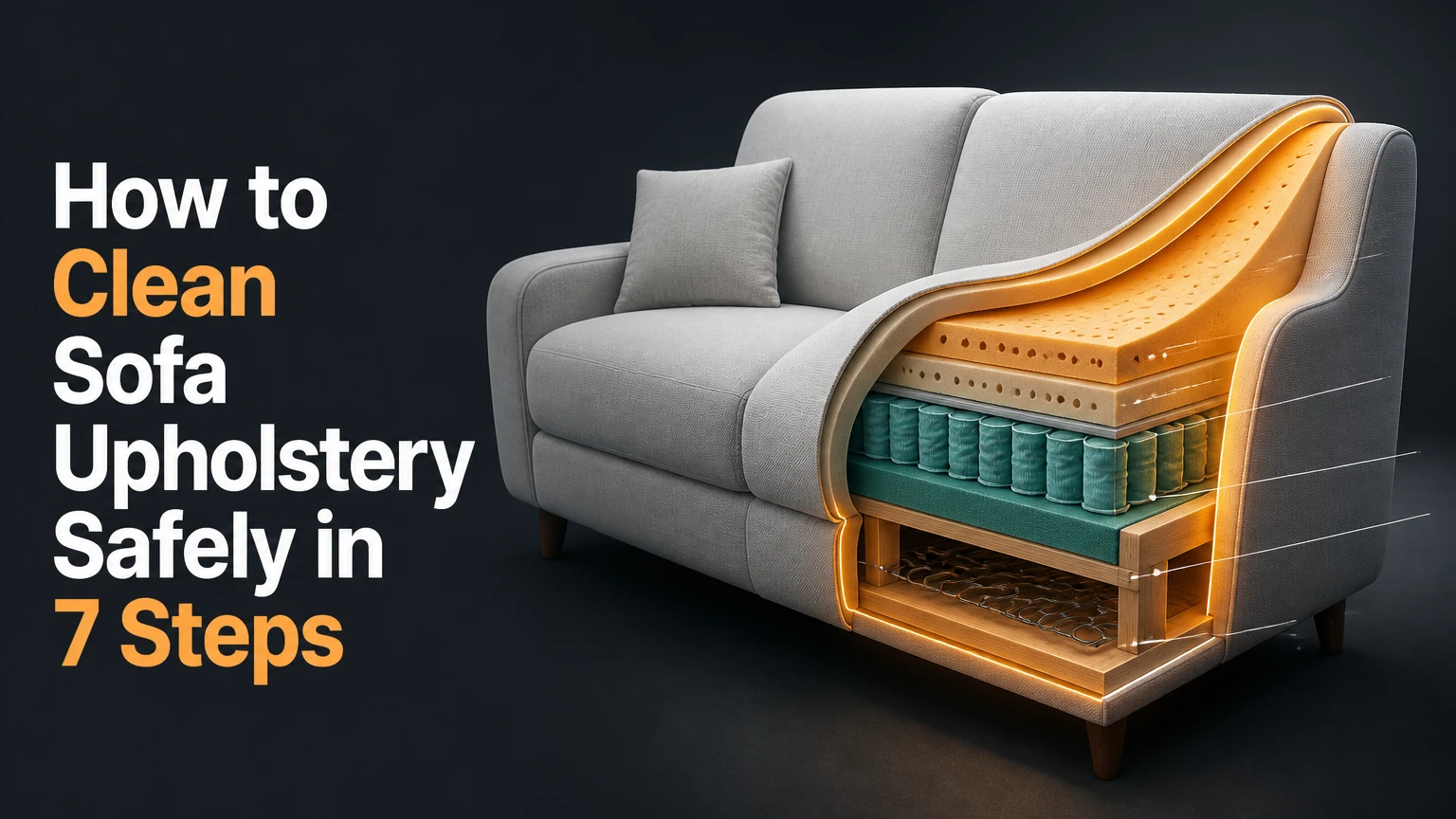
Fabric upholstery contains more than its visible cover. The construction may include a face fiber, backing, batting, adhesive, and polyurethane foam. Excess liquid can travel through those layers, carrying dissolved soil outward as a ring or leaving the foam damp long after the surface appears dry.
Cleaning also differs from disinfecting. Routine upholstery cleaning removes soil that can shield microorganisms, but a household cleaner should not be called a disinfectant unless its label authorizes that surface use and contact time. The U.S. Environmental Protection Agency requires registered disinfectants to follow label directions for use and dwell time.
Why soil returns after cleaning
Soil can return through wicking, a process in which dissolved dirt moves toward the surface while wet upholstery dries. Wicking is more likely when a stain reaches the cushion core, when the area is over-wet, or when extraction leaves dirty solution behind.
A second problem is residue attraction. Too much detergent leaves a sticky film that binds new dust. The professional rule is simple: use enough chemistry to suspend the soil, then remove as much dissolved product as possible.
Which Cleaner Is Safe for My Sofa?
The care label determines whether a sofa can receive water, solvent, either method, or only vacuuming. Upholstery codes are a starting point, not permission to ignore the furniture maker’s instructions, because some fabrics have coatings, backings, or finishes that react differently from the fiber itself.
| Code | Permitted approach | Typical examples | Main restriction |
|---|---|---|---|
| W | Water-based upholstery cleaner | Polyester, nylon, acrylic, performance fabric | Avoid soaking the cushion core |
| S | Water-free solvent | Some wool, rayon, silk, and delicate textiles | Ventilate and follow solvent label directions |
| WS | Water-based or solvent cleaner | Synthetic blends and mixed upholstery | Patch-test the selected chemistry |
| X | Vacuuming or brushing only | Specialty textiles, some natural fibers | Do not apply liquid without written approval |
| No code | Manufacturer guidance required | Vintage, imported, reupholstered furniture | Contact the maker or a professional |
Find the label beneath a seat cushion, under the sofa, or attached to the platform. A removable cover can have a separate care label, but a washable-looking zipper does not prove that the cover is safe for a washing machine. Shrinkage, backing distortion, and color loss can prevent the cover from fitting afterward.
What does the W code mean?
The W code means a water-based cleaner is an approved category, not that tap water alone is safe. Use a product labeled for upholstery, measure the dilution on its label, and test an inconspicuous area before treating a visible panel.
Can you clean S-code upholstery with water?
Do not use water on S-code upholstery unless the manufacturer specifically permits it. Water can create rings, move dyes, distort backing, or cause dimensional change, while a compatible upholstery solvent can dissolve oily soil with less fiber swelling.
What does X mean on a sofa?
The X code means routine care is limited to vacuuming and light brushing. A professional may be able to clean the textile after inspecting its fiber, backing, dye, and construction, but a home spray can permanently mark X-coded upholstery.
Before You Start: Time, Tools, and Cost
A standard three-seat fabric sofa usually takes 45-90 minutes to clean and 6-12 hours to dry under ordinary indoor conditions. The main cost is typically $10-$35 for a suitable cleaner and towels at home, or approximately $75-$250 for professional upholstery cleaning, with location, fabric, access, and sofa size causing large price differences.
| Requirement | Typical amount or setting | Purpose | Replacement option |
|---|---|---|---|
| Vacuum | 15-25 minutes | Remove dry soil before moisture | Upholstery nozzle and crevice tool |
| Upholstery cleaner | 250-500 mL ready-to-use solution | Treat a three-seat sofa | Manufacturer-approved concentrate |
| White towels | 6-12 towels | Blotting and towel extraction | White cotton cloths |
| Soft brush | 1 brush, 2-4 cm bristles | Controlled agitation | Clean soft toothbrush for seams |
| Air movement | 1-2 fans | Accelerate evaporation | Open windows when outdoor humidity is low |
| Patch test | 5-10 minutes | Check dye stability and texture | Hidden rear corner |
Prepare a vacuum with a brush or upholstery attachment, white microfiber towels, a bowl, the approved cleaner, a soft upholstery brush, nitrile gloves, and fans. Use distilled water only when the product or manufacturer recommends it, because hard-water minerals can leave visible deposits on dark fabric.
Do not mix bleach, ammonia, vinegar, peroxide, solvent, or enzyme products. Chemical mixtures can produce irritating vapors, damage dyes, or neutralize the active ingredients that make a product work.
How to Clean Sofa Upholstery in 7 Steps
The safest sofa-cleaning sequence is dry soil removal, inspection, patch testing, stain treatment, controlled cleaning, residue removal, and rapid drying. Work on one cushion or one manageable panel at a time, because a small wet section is easier to extract and compare than an entire sofa treated at once.
Step 1: Read the label and inspect the sofa
Remove cushions and inspect the care code, seams, piping, exposed backing, and previous repair areas. Photograph existing marks before cleaning, then identify whether the problem is loose soil, a fresh spill, an oily mark, dye transfer, odor, or physical damage.
Success checkpoint: You know the code, fiber information, and areas that need special treatment.
Common mistake: Starting with a popular spray before identifying whether the upholstery is W, S, WS, or X.
Step 2: Vacuum every dry surface
Vacuum the frame, both sides of removable cushions, seat platforms, crevices, underside edges, and the gap between the arm and seat. Use a brush attachment on delicate fabric and reduce suction on velvet, chenille, and loose-loop textiles so the pile does not pull or flatten.
For pet hair, vacuum slowly in two directions, then lift remaining hair with a rubber glove or upholstery-safe hair-removal tool. Do not wet pet hair first, because moisture turns loose hair into a mat that is harder to remove.
Success checkpoint: No crumbs, grit, loose hair, or visible dust remain in seams.
Common mistake: Skipping vacuuming, which turns dry soil into muddy residue during wet cleaning.
Step 3: Test the cleaner on a hidden patch
Apply the smallest practical amount of the approved cleaner to a hidden 2-5 cm area. Wait at least 10 minutes, blot with a white towel, and inspect the towel, fabric color, pile, backing, and dried appearance.
A failed test includes dye transfer, a darker halo, stiffness, gloss change, roughness, or color loss. If any appears, stop and contact the manufacturer or an upholstery professional. A successful test does not guarantee every panel will behave identically, especially when the sofa has uneven fading or repairs.
Success checkpoint: The test area dries without bleeding, rings, texture change, or odor.
Common mistake: Judging the result while the fabric is still wet.
Step 4: Treat stains according to their chemistry
Blot fresh liquid with folded white towels, working from the outer edge toward the center. Do not scrub. Scrubbing spreads liquid, abrades the face fibers, and can force the contaminant deeper into the backing.
| Stain type | First action | Suitable product category | Contact limit |
|---|---|---|---|
| Grease or body oil | Lift solids, blot excess oil | Upholstery degreaser for W or WS | 5-10 minutes |
| Milk or food protein | Blot, remove residue | Upholstery enzyme cleaner if label permits | Product label |
| Pet urine | Absorb deeply, avoid heat | Enzyme odor cleaner for compatible fabric | Product label |
| Mud | Let dry, vacuum particles | Water-based cleaner for W or WS | 5-10 minutes |
| Ink | Do not spread solvent | Manufacturer-approved solvent | Short test first |
| Red wine | Blot liquid immediately | Compatible upholstery spot cleaner | 3-5 minutes |
Grease requires a product that can emulsify oil, while protein stains may respond to an enzyme product. Enzyme cleaners need the contact time printed on the label and should not be combined with disinfectants or strong oxidizers.
Ink, dye transfer, lipstick, and old unknown stains are poor candidates for repeated home experimentation. Each additional chemical can create a larger, chemically altered mark that a professional cannot fully reverse.
Success checkpoint: The stain becomes lighter without a spreading edge or fabric damage.
Common mistake: Applying a large amount of stain remover and leaving a concentrated chemical ring.
Step 5: Clean one section with minimal moisture
For W or WS fabric, apply the upholstery solution to a white towel or controlled sprayer rather than flooding the sofa. Agitate gently with a soft brush, following the fabric’s direction where a visible pile exists.
A low-moisture method is safer than saturation when the sofa has thick cushions, weak airflow, humid indoor conditions, or uncertain foam construction. Foam cleaners can reduce wetting, but they are less effective when soil has migrated deep into the cushion.
Success checkpoint: Soil transfers to the towel or extraction tool, and the fabric feels damp rather than wet.
Common mistake: Cleaning the top surface repeatedly while leaving dirty solution inside the cushion.
Step 6: Extract dissolved soil and residue
Use an upholstery extraction machine only if the care code and product permit water. Make one slow vacuum-only pass after each short spray pass, then use dry white towels to absorb remaining moisture from seams and cushion edges.
Do not use carpet-machine pressure or solution volume designed for dense carpet on a sofa. Upholstery has thinner fabric, less drainage, and foam that can retain liquid. A rinse with clean water can reduce detergent residue, but it also adds moisture, so extraction must be thorough.
Success checkpoint: The towel picks up little additional soil, no foam remains, and seams are not pooling liquid.
Common mistake: Assuming a machine has removed all moisture because the surface looks clean.
Step 7: Dry, groom, and inspect
Stand removable cushions on their edges in a V-shaped arrangement, leaving space between each cushion and the frame. Direct one or two fans across the fabric, not close enough to blow dust into it, and use a dehumidifier when room humidity is high.
Avoid hairdryers, heaters, and direct hot sunlight. Heat can set some stains, shrink natural fibers, distort adhesives, and produce uneven drying. Brush the pile gently after the fabric is nearly dry, then inspect for rings, stiffness, odor, and remaining stains.
Success checkpoint: The upholstery and foam feel dry, smell neutral, and match the surrounding texture and color.
Common mistake: Reassembling damp cushions, which traps moisture against the frame and slows evaporation.
Which Upholstery Cleaning Method Fits the Material?
Hot-water extraction suits many W and WS synthetic sofas, low-moisture foam suits lightly soiled furniture where fast drying matters, solvent cleaning suits compatible S fabrics, and leather requires a separate cleaner-and-conditioner process. No method is universally safest because compatibility depends on the care code, finish, backing, stain, and cushion construction.
| Method | Suitable code or material | Typical drying time | Typical home cost | Main limitation |
|---|---|---|---|---|
| Hot-water extraction | W, WS polyester or nylon | 6-12 hours | $20-$60 | Over-wetting and wicking |
| Low-moisture foam | W, WS lightly soiled blends | 1-3 hours | $10-$30 | Limited deep-cushion cleaning |
| Upholstery solvent | S, only when labeled compatible | 1-4 hours | $15-$45 | Ventilation and chemical handling |
| Professional cleaning | Valuable, delicate, or heavily soiled furniture | 4-12 hours | $75-$250 | Higher price and appointment time |
| Leather cleaning | Protected or compatible finished leather | 30-120 minutes surface time | $15-$50 | Wrong product can damage finish |
Is steam cleaning safe for a sofa?
Steam or hot-water extraction can be safe for compatible W and WS upholstery when the machine is designed for furniture and the operator controls moisture. Steam cleaning is unsafe for S or X upholstery and risky for delicate velvet, silk, unstable dyes, and sofas with poorly ventilated foam.
The label “steam cleaning” can describe different processes. Some machines inject hot solution and recover it, while a handheld steam tool adds hot vapor with limited extraction. The second approach can leave moisture in the cushion and should not be treated as interchangeable with professional upholstery extraction.
How do you clean leather upholstery?
Leather upholstery should be vacuumed, wiped with a barely damp white cloth, cleaned with a pH-balanced leather product, and conditioned only when the leather maker recommends conditioning. Test the cleaner on a concealed area, keep liquid away from perforations and seams, and never use household dish soap, alcohol, abrasive cream, or furniture polish.
Protected leather tolerates more routine wiping than aniline leather. Aniline leather has a more exposed surface and can darken or stain when liquid penetrates. Peeling faux leather is not repaired by conditioner, because peeling usually indicates failure of the polyurethane coating rather than dryness in a natural hide.
How Should You Clean Specific Sofa Fabrics?
Microfiber and performance polyester usually tolerate controlled water-based cleaning when their labels show W or WS. Velvet, chenille, linen, wool, rayon, and vintage upholstery require more conservative testing because pile, dimensional stability, dye, or backing can change under moisture and friction.
| Material | Common risk | Safer home approach | Professional threshold |
|---|---|---|---|
| Microfiber | Water marks and flattened nap | Small sections, low moisture, groom nap | Rings remain after one controlled attempt |
| Polyester | Residue and oily soil | W or WS cleaner, thorough extraction | Heavy odor in foam |
| Chenille | Pulled loops and pile distortion | Vacuum brush, light blotting | Any dye bleed or loose yarn |
| Velvet | Crushed pile and water marks | Vacuum gently, avoid broad wetting | Most visible stains or vintage fabric |
| Linen | Shrinkage and browning | Label-approved low moisture | Large wet area or unlined fabric |
| Wool | Felting and dye bleed | S-approved method if labeled | Antique or hand-dyed upholstery |
| Rayon | Weakness when wet | Avoid DIY water cleaning | Any visible stain |
| Faux leather | Coating damage and peeling | Damp wipe with approved cleaner | Flaking, cracking, or exposed backing |
Microfiber often shows a dark patch after cleaning because the nap lies in a different direction, not because the fabric is permanently stained. Let it dry completely, then groom it in one direction with a clean soft brush. If the dark area remains, the mark may be soil wicking or finish damage.
How Do You Clean a Sofa Without a Machine?
Clean a compatible W or WS sofa without a machine by vacuuming, applying cleaner sparingly to a towel, brushing one small section, and pressing dry towels into the fabric to pull out dissolved soil. Repeat with fresh towels rather than increasing the amount of liquid.
A low-moisture foam method works best for light surface soil. Whip a label-approved upholstery detergent into foam, apply only the foam to a small section, blot until nearly dry, and vacuum the dry residue after the product’s stated drying period. A homemade mixture of mild dish detergent and water is not suitable for every fabric, and detergent residue can attract soil if the mixture is too concentrated.
Machine-free cleaning is not equivalent to deep extraction. It cannot reliably remove urine from foam, flood-related contamination, or heavy soil below the cover. Use it for maintenance and small marks, not as a substitute for professional treatment when odor or contamination is deep.
What Are the Common Cleaning Mistakes?
The most damaging upholstery mistakes are ignoring the care code, over-wetting the cushion, scrubbing aggressively, using incompatible household chemicals, and drying with high heat. These mistakes can create permanent rings, dye loss, texture change, foam odor, or finish failure even when the original stain was removable.
| Mistake | Visible symptom | Immediate correction | Escalation point |
|---|---|---|---|
| Excess water | Dark halo or slow-drying cushion | Towel-extract and increase airflow | Still damp after 24 hours |
| Hard scrubbing | Fuzzy or shiny patch | Stop friction and let dry | Texture remains altered |
| Wrong solvent | Bleeding or pale spot | Blot, do not add another chemical | Any color loss |
| Detergent excess | Crunchy or sticky fabric | Controlled water rinse if compatible | Residue persists after drying |
| Heat drying | Set stain or warped area | Stop heat and cool the fabric | Shrinkage or adhesive failure |
| Colored cloth | New blue, red, or yellow mark | Blot with clean white towel | Transfer does not lighten |
A counterintuitive practitioner rule is that more product rarely means more cleaning. Upholstery cleaning depends on a balance between chemistry, agitation, dwell time, and recovery; increasing detergent without improving extraction commonly produces faster resoiling.
Another rule is to clean the entire visual panel when a spot treatment leaves a boundary. A larger, evenly controlled panel can reduce contrast, but only after the fabric passes a patch test and the cleaner can be removed thoroughly.
How Do You Fix Rings, Odor, or Stiff Upholstery?
Water rings usually result from uneven wetting or soil wicking, stiff upholstery usually contains dried detergent residue, and sour odor usually indicates moisture retained in foam or backing. Let the sofa dry fully before diagnosing the result, then use only a compatible recovery method.
- Dark ring: Lightly re-treat the whole affected panel with the approved solution, blend outward, towel-extract evenly, and dry with airflow. Do not repeatedly wet only the center.
- Crunchy fabric: Vacuum loose residue, then use a manufacturer-approved rinse or very light clean-water treatment on W or WS fabric. Avoid vinegar unless the upholstery maker or product label specifically permits it.
- Sour smell: Separate cushions, expose all sides, run fans and a dehumidifier, and inspect after 24 hours. Persistent odor may require professional odor treatment or cushion replacement.
- Remaining stain: Stop after one or two controlled attempts. Old dye, oxidation, heat damage, and fiber discoloration cannot always be removed.
- Mildew concern: Do not seal, steam, or heavily wet suspected mold-contaminated foam. Remove the furniture from occupied space and obtain professional advice.
Do not use a 1:1 vinegar-and-water spray as a universal upholstery fix. Acidic solutions can affect dyes, finishes, and backing, and vinegar does not extract the soil that caused a ring.
When Should You Hire a Professional Cleaner?
Hire a professional when the sofa is S or X coded, made from silk, rayon, antique wool, velvet, or aniline leather, or has deep urine, smoke, flood, or mildew odor. Professional cleaning is also prudent when the furniture is expensive, irreplaceable, under warranty, or already showing dye instability.
Ask the cleaner for the planned method, product category, expected dry time, furniture-protection steps, and limitations. A credible technician should inspect the care label and perform testing rather than promise removal of every stain.
Typical professional pricing varies by country and market. In the United States, a three-seat sofa commonly falls around $75-$250; sectional size, access, fabric risk, stain treatment, and travel can move the quote outside that range. Compare the process, not only the lowest price.
How Often Should You Clean Sofa Upholstery?
Vacuum sofa upholstery weekly in homes with pets, children, allergies, or high use, and every two to four weeks in lower-use rooms. Spot-clean spills immediately, perform a deeper compatible cleaning every 6-18 months, and follow the furniture maker’s schedule when it differs.
| Situation | Vacuuming | Spot response | Deeper cleaning |
|---|---|---|---|
| One adult, low use | Every 2-4 weeks | Within 24 hours | Every 12-18 months |
| Children or daily use | Weekly | Within 15 minutes | Every 6-12 months |
| Dogs or cats | 2-3 times weekly | Immediately | Every 3-6 months |
| Allergy-sensitive room | 1-2 times weekly | Same day | Every 3-6 months |
| Vintage or delicate sofa | Weekly soft brushing | Professional advice | Inspection-led |
Use arm covers or washable throws in high-contact areas, rotate reversible cushions when the maker permits it, and keep food and liquids away from unprotected upholstery. Fabric protector can reduce wetting and staining, but it does not make an unsuitable fabric washable or eliminate the need for prompt blotting.
FAQ
Can I use baking soda on sofa upholstery?
Baking soda can absorb some surface odor when left dry and vacuumed thoroughly, but it does not remove oil, urine inside foam, or embedded soil. Avoid forcing powder into damp upholstery, because residue can remain in the backing and complicate later wet cleaning.
Can I wash sofa cushion covers in a washing machine?
Wash removable cushion covers only when the sewn care label explicitly permits machine washing. Use the stated water temperature, cycle, detergent, and drying method, and reinstall the cover while slightly damp only if the manufacturer allows it. Unapproved washing can cause shrinkage that prevents the cover from fitting.
How long should I wait before sitting on a cleaned sofa?
Wait until the fabric and cushion foam are dry, typically 6-12 hours after controlled wet cleaning. High humidity, thick cushions, weak airflow, and heavy application can extend drying beyond 24 hours. Sitting on damp upholstery compresses foam and transfers body oils into incompletely dried fabric.
Does upholstery cleaning remove dust mites?
Cleaning can remove dust, skin flakes, and some allergen-containing particles, but no home upholstery process guarantees complete dust-mite elimination. Vacuuming with suitable filtration, washable covers, humidity control, and regular laundering address the broader environment more reliably than a single sofa treatment.
Can I use carpet cleaner on a couch?
Use a carpet-cleaning machine on a couch only when its manual identifies an upholstery tool and the sofa care code permits the cleaning solution. Carpet formulas, attachments, and water volumes may be unsuitable for upholstery, so follow both the machine manual and the furniture manufacturer’s instructions.
How do I clean a sofa after a pet accident?
Blot urine immediately, remove as much liquid as possible without pressing it deeper, and apply a fabric-compatible enzyme odor product according to its label. Surface cleaning may not reach the foam, so persistent odor, repeated accidents, or saturated cushions require professional treatment or replacement of the affected insert.
The Bottom Line
To clean sofa upholstery safely, start with the care code, remove dry soil, patch-test the chemistry, treat the specific stain, use minimal compatible moisture, extract residue, and dry every layer quickly. The material and construction determine the method more than the stain-removal product does. For delicate, valuable, X-coded, or deeply odorous furniture, professional inspection is safer than repeated DIY experiments. A care-code-first process is the most reliable answer to how to clean sofa upholstery without trading a removable stain for permanent fabric or foam damage.