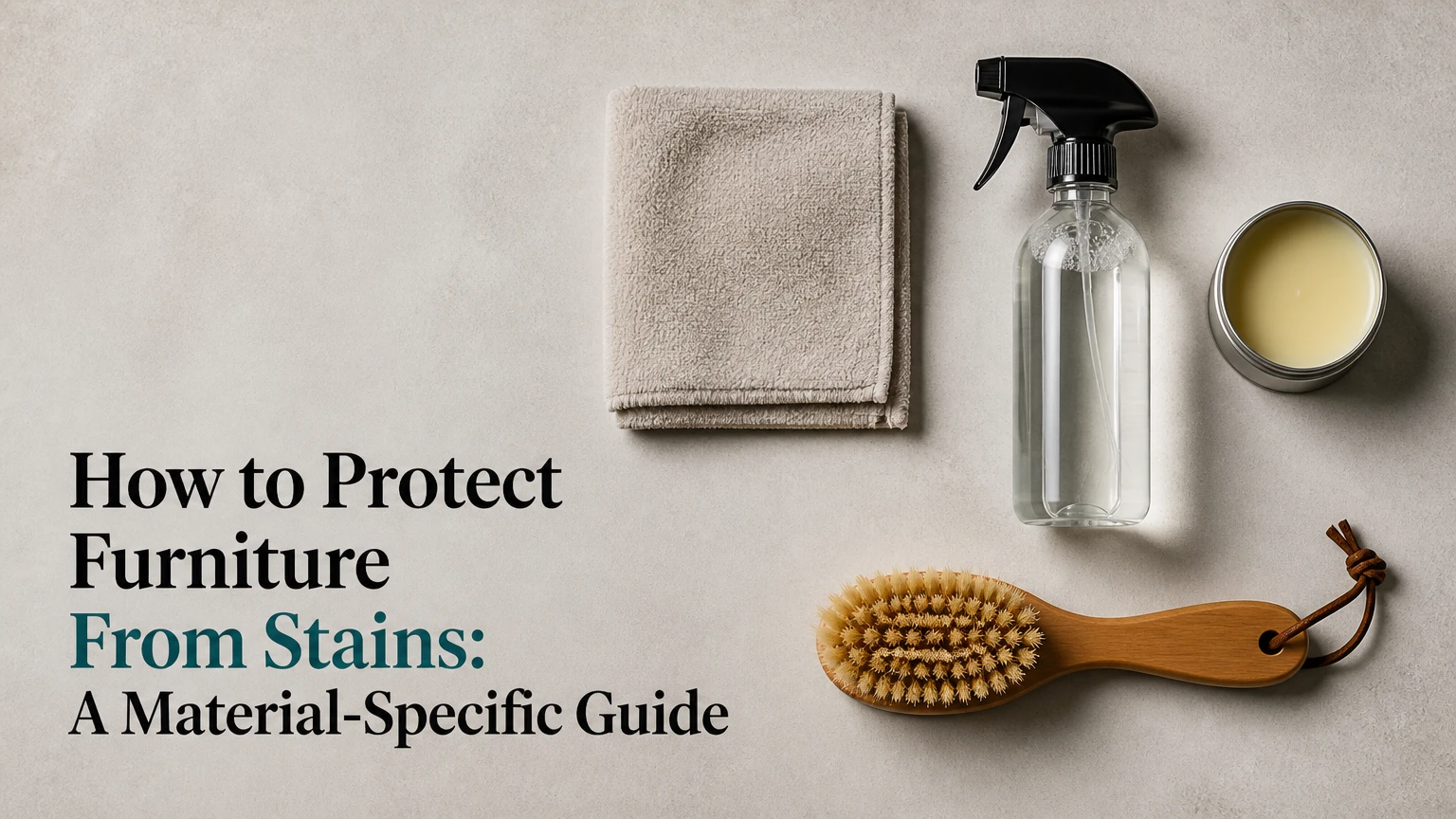
Furniture stain protection combines the correct material-safe treatment with physical barriers and fast spill response. For fabric, clean and test the upholstery before applying a compatible protector; for wood, maintain the finish; for leather, use a product approved for its finish. No treatment makes furniture permanently stain-proof, waterproof, or maintenance-free.
Key Facts at a Glance
- Fabric protector gives liquids more time to be blotted, but repeated friction gradually reduces repellency.
- Upholstery cleaning codes describe cleaning compatibility, not automatic approval for every stain-protection spray.
- Polyurethane protects wood better than wax, but the coating can still scratch, crack, or allow moisture through damaged areas.
- Aniline leather absorbs oils and dyes more readily than protected or pigment-coated leather.
- A washable slipcover provides a stronger physical barrier than a chemical spray when children, pets, or frequent spills are involved.
- Typical DIY protection costs range from $15-$80, while professional treatment commonly costs $100-$500 per furniture piece.
What Does Furniture Stain Protection Do?
Furniture stain protection creates a temporary or permanent barrier that slows liquid, oil, dye, and soil penetration. Fabric sprays coat fibers, wood finishes seal or cover pores, leather conditioners alter surface behavior, and slipcovers prevent contaminants from reaching the original upholstery.
The important distinction is repellency versus waterproofing. A repellent surface causes some liquids to bead, while waterproofing attempts to prevent liquid passage under defined conditions. Seams, worn areas, open weave, stitching holes, cracks, and prolonged contact can defeat either approach.
A treated cushion can still stain if red wine remains under a person’s weight for 20 minutes. A finished tabletop can still show a ring if hot moisture reaches a damaged or porous area. Protection buys response time; it does not remove the need for blotting, cleaning, and regular inspection.
How Does Stain Protection Work?
Fabric and leather protectors generally reduce wetting by changing surface interaction between the contaminant and the material. Liquids remain in larger droplets for longer, so a clean absorbent cloth can often remove them before they migrate into the fibers.
Performance depends on more than beading. Oil-based soil, colored dyes, alkaline pet urine, heat, abrasion, humidity, and the absorbency of the underlying material all affect results. A product that repels water may perform poorly against cooking oil or blue-jean dye.
The phrase “nano-coating” does not guarantee a particular lifespan. Silica-based products differ in chemistry, preparation, curing, and compatibility, while fluorinated treatments may offer stronger oil repellency but raise environmental and regulatory concerns. Read the manufacturer’s technical sheet instead of choosing from the label name alone.
Which Protection Method Fits Each Material?
The best method depends first on the furniture substrate, then on the contaminant and the household’s cleaning habits. Use a fabric protector for compatible upholstery, a finish or topcoat for unfinished wood, a leather-specific protector for absorbent hides, and a washable cover when physical protection matters most.
| Furniture material | Preferred protection | Typical reapplication or renewal | Main limitation |
|---|---|---|---|
| Polyester or microfiber upholstery | Water-based or manufacturer-approved fabric protector | 6-18 months | Abrasion wears the coating |
| Linen, cotton, or rayon upholstery | Professional or label-approved textile treatment | 6-12 months | Water and dye migration can occur |
| Aniline leather | Leather protector for aniline hides | 3-6 months | Oils and dyes can still darken leather |
| Finished oak or walnut | Existing finish maintenance, wax only if approved | Wax every 3-12 months | Wax does not repair damaged finish |
| Raw or lightly oiled wood | Tung oil, hardwax oil, or compatible sealer | 6-24 months | Uneven absorption can change color |
| Dining table used daily | Film finish such as polyurethane or lacquer | Inspect annually | Scratches require finish repair |
| Any high-spill sofa | Fitted washable slipcover | Wash every 1-4 weeks | Fit and appearance vary |
Fabric Upholstery
Fabric protector is most suitable for tightly woven, colorfast upholstery whose care instructions permit the proposed cleaner or treatment. Polyester, olefin, and many performance fabrics usually tolerate protection better than delicate velvet, viscose, silk blends, or unstable hand-dyed textiles.
Vacuum first, remove existing soil, and let the fabric dry fully. A protector cannot hide grease already present in the fibers, and spraying over residue can make an uneven dark area harder to clean later.
Leather Furniture
Leather protection should match the finish, not merely the color. Aniline and semi-aniline leather have exposed or lightly corrected surfaces that absorb oils and moisture, while pigmented or protected leather has a more substantial surface coating.
Avoid household furniture polish, saddle soap, cooking oils, and multipurpose silicone sprays unless the leather manufacturer specifically permits them. Those products can create gloss, change friction, soften the surface excessively, or interfere with later restoration.
Wood Furniture
Wood protection starts by identifying the current finish. Polyurethane and lacquer form surface films; oil and hardwax oil penetrate to varying degrees; paste wax adds a sacrificial layer but is not a standalone waterproof coating.
Polyurethane is water-resistant, not invulnerable. A scratch, open joint, chipped edge, or damaged seam can allow moisture to reach the wood, and trapped moisture can cause cloudy marks beneath some finishes.
Removable Covers and Surface Shields
A washable slipcover is usually the safest high-frequency solution for a family sofa because contamination can be removed without treating the original upholstery. Choose a cover with separate cushion panels, a washable label, and enough fabric to remain tucked during use.
Acrylic or glass protects a flat tabletop from spills, but trapped grit can scratch the finish and sealed edges can retain moisture. Use felt or silicone spacers where appropriate, and do not place hot cookware directly on acrylic.
How Should You Read the Upholstery Label?
Upholstery codes indicate which cleaning method the fabric can tolerate, but they do not certify every protector. Code W generally permits water-based cleaning, S permits specific solvent-based cleaning, WS permits both, and X limits care to vacuuming or professional advice.
| Code | Usual cleaning permission | DIY protector decision | Safer next action |
|---|---|---|---|
| W | Water-based products | Use only a water-compatible product after testing | Test hidden fabric first |
| S | Water-free solvent products | Use only solvent-approved treatment | Ventilate and follow label |
| WS or SW | Water or approved solvent | Choose based on product instructions | Patch-test both cleaner and protector |
| X | Vacuuming or specialist care | Do not apply a DIY spray | Ask the manufacturer or a professional |
The label may be beneath a cushion, attached to the platform, or printed in the care booklet. When the label is missing, identify the fiber and finish through the furniture maker or an upholstery professional before applying liquid.
How Do You Apply Fabric Protector?
Apply fabric protector in seven controlled steps after cleaning, drying, and patch-testing. For a typical three-seat sofa, allow 2-4 hours for cleaning and drying, 20-40 minutes for application, and at least 12-24 hours before normal use; humidity can extend every interval.
Before You Start
- Difficulty: Moderate
- DIY time: 30-60 minutes after the upholstery is clean
- Typical product quantity: 16-24 fluid ounces for one sofa, depending on fabric density
- Typical cost: $15-$40 for a consumer spray, or $100-$300 for professional treatment
- Tools: Vacuum, approved cleaner, white microfiber cloths, gloves, eye protection, masking film, and ventilation
- Prerequisites: Correct cleaning code, clean upholstery, complete dryness, and a successful hidden-area test
Step 1: Vacuum the Furniture
Remove cushions and vacuum both sides, seams, piping, crevices, and the area beneath the cushions. Use a soft upholstery attachment on velvet, chenille, and loose weaves to avoid pulling fibers.
Success checkpoint: The cloth shows little or no gray transfer when wiped across a hidden dry area.
Common mistake: Spraying over pet hair or grit, which can become embedded in the coating.
Step 2: Clean Existing Soil
Use the smallest amount of manufacturer-approved cleaner needed to remove grease, food, and old spots. Do not saturate cushion interiors, because foam and batting can remain damp after the surface feels dry.
Success checkpoint: No visible ring, sticky residue, or fragrance remains after drying.
Common mistake: Treating a fresh stain before removing the surrounding soil, which can create a visible clean patch.
Step 3: Let the Upholstery Dry Completely
Allow at least 6-12 hours after light water-based cleaning and longer after extraction or heavy washing. A fan improves air movement, but heat guns and hair dryers can set dyes, distort synthetic fibers, or damage adhesives.
Success checkpoint: The fabric feels the same temperature and weight across treated and untreated areas.
Common mistake: Applying protector to damp fabric, which dilutes the product and can trap odor.
Step 4: Patch-Test the Protector
Spray a hidden section, such as the rear underside of a cushion, using the same distance and coverage planned for the visible surface. Wait until the test area dries completely before checking color, texture, stiffness, odor, and ring formation.
Success checkpoint: The test area matches the surrounding fabric under daylight.
Common mistake: Testing only for color change while ignoring a crunchy feel or altered sheen.
Step 5: Mask Nearby Materials
Cover wood legs, painted trim, metal fittings, flooring, electronics, and nearby walls. Solvent overspray can soften some finishes, while water-based spray can leave marks on unfinished wood.
Success checkpoint: Only the intended textile remains exposed.
Common mistake: Assuming invisible spray cannot damage a polished or waxed surface.
Step 6: Apply a Light, Even Coat
Hold the nozzle at the distance stated on the label, commonly 6-12 inches, and use overlapping passes. Apply enough to cover the fibers without creating wet patches; a second light coat is safer than one saturated pass when the instructions allow it.
Success checkpoint: The fabric looks uniformly damp for a short period, without pooling or running.
Common mistake: Spraying until the surface appears glossy, which often indicates over-application.
Step 7: Cure Before Use
Keep people and animals away until the product is dry and the label’s ventilation period has ended. Typical surface drying takes 2-4 hours, while full curing can require 24-48 hours.
Success checkpoint: No tackiness, strong solvent odor, or transfer appears on a clean white cloth.
Common mistake: Testing with colored liquid immediately, which can create a stain before the film has cured.
What Do Furniture Protection Methods Cost?
Typical consumer prices range from $15-$80 for a DIY textile or leather product, while professional furniture treatment commonly costs $100-$500 per piece. Prices vary with furniture size, regional labor, fabric condition, product chemistry, and whether cleaning is included.
| Method | Typical DIY cost | Typical professional cost | Dry or wait time | Renewal interval |
|---|---|---|---|---|
| Fabric spray | $15-$40 | $100-$300 | 2-4 hours dry, 12-24 hours use | 6-18 months |
| Silica or ceramic textile treatment | $35-$80 | $200-$500 | 12-24 hours dry | 1-3 years, product dependent |
| Leather protector | $15-$45 | $100-$250 | 1-4 hours | 3-6 months |
| Water-based polyurethane | $20-$60 | $150-$500 | 4-8 hours between coats | 3-10 years, with care |
| Hardwax oil | $25-$70 | $150-$400 | 8-24 hours between coats | 6-24 months |
| Washable slipcover | $30-$250 | $150-$600 custom | Immediate after fitting | Replace when worn |
Professional treatment is more defensible for expensive upholstery, antiques, difficult fabrics, or furniture that requires controlled extraction first. DIY treatment is reasonable for a compatible, replaceable textile when the owner can ventilate the room and follow the product’s coverage instructions.
Are Sprays, Finishes, and Slipcovers Better?
No single method wins in every household. Chemical sprays preserve the original appearance, hard finishes protect flat wood effectively, and slipcovers provide the strongest removable barrier against repeated contamination.
| Option | Best resistance | Appearance change | Maintenance | Best household use |
|---|---|---|---|---|
| Fabric protector | Water and light oil exposure | Usually low | Reapply after wear or cleaning | Upholstered seating |
| Leather protector | Body oil and dye transfer | Low when compatible | Condition and inspect | Aniline or semi-aniline leather |
| Polyurethane | Liquid exposure and light abrasion | Medium to high | Repair damaged film | Dining and work surfaces |
| Wax or hardwax oil | Short spills and soil | Low to medium | Periodic renewal | Natural wood furniture |
| Slipcover | Food, mud, pet hair, and liquid | High | Machine wash or replace | Children, pets, frequent spills |
| Acrylic or glass top | Direct tabletop spills | Medium | Clean underside and spacers | Desks and dining tables |
What Is the Best Choice for Children and Pets?
A washable slipcover paired with performance upholstery is generally the most practical choice for children and pets. A spray can delay absorption, but it does not remove vomit, urine, muddy paws, scratching, or repeated laundering from the maintenance equation.
For existing furniture, use a fitted cover on high-risk cushions and protect only compatible exposed areas. Pet urine requires prompt extraction and odor treatment; a repellency coating cannot neutralize contamination that reaches foam or the frame.
What Is Best for Antique or High-Value Furniture?
Conservation-minded care is best for antique furniture because irreversible coatings can reduce originality and complicate future restoration. Use manufacturer or conservator guidance, soft barriers, coasters, stable humidity, and minimal compatible maintenance rather than applying polyurethane or an unknown nano-product.
Fine wood should be protected from standing water, sunlight, heat, and abrasive objects. A museum or furniture conservator should assess veneer, shellac, lacquer, and historic wax before any solvent or heat treatment is attempted.
What Prevents Stains Besides Chemical Treatment?
Daily behavior often prevents more damage than a protector. Use coasters, washable arm covers, trays, placemats, pet throws, and closed containers in the specific locations where contamination begins.
Keep furniture away from direct sun where practical, because ultraviolet exposure can fade fabric and leather even when the surface repels liquids. Maintain indoor humidity near 30%-50% when feasible for wood stability, while recognizing that local climate and building conditions change the appropriate range.
Protectors also do not prevent scratches, pilling, seam failure, color fading, cigarette odor, or pet damage. A stain barrier addresses absorption, not every cause of furniture deterioration.
What Should You Do When a Spill Happens?
Blot a fresh spill immediately with a clean, white, absorbent cloth, working from the outside toward the center without rubbing. Remove solids with a spoon or dull edge, then follow the material’s care instructions before using any cleaner.
| Spill type | Fabric response | Leather response | Wood response |
|---|---|---|---|
| Water or tea | Blot, then air-dry evenly | Blot immediately, avoid soaking | Wipe dry within minutes |
| Coffee | Blot, use approved cleaner | Blot, then follow leather guidance | Remove liquid and inspect finish |
| Red wine | Blot, do not add salt or bleach | Blot, avoid household detergent | Wipe immediately, check joints |
| Grease or oil | Lift solids, use approved solvent or cleaner | Blot, do not use cooking oil | Absorb surface oil, then clean finish |
| Pet urine | Blot, extract, use enzyme product if compatible | Professional advice for porous leather | Clean seams and inspect damage |
Rubbing drives contaminants deeper and can abrade fibers or spread dye. Bleach, vinegar, alcohol, steam, and dish soap are not universal solutions; use them only when the material and product manufacturer explicitly permit them.
What Are the Most Common Protection Mistakes?
The most damaging errors are applying an incompatible product, treating dirty or damp furniture, and assuming a successful water-bead test proves complete stain resistance. Correcting those errors requires stopping before the product cures and contacting the manufacturer when the surface changes.
- Ignoring the fiber and finish: Rayon, silk, velvet, shellac, aniline leather, and painted wood can react badly to ordinary sprays.
- Over-saturating upholstery: Excess liquid can cause rings, backing discoloration, adhesive failure, or slow-drying foam.
- Skipping the hidden test: A visible color shift may appear only after the carrier evaporates.
- Using rubbing alcohol as a universal fix: Alcohol can dissolve or haze some coatings; use it only when the product instructions authorize it.
- Applying wax over an incompatible finish: Wax can interfere with future refinishing and attract dust.
- Using heat on a water ring: An iron can blister lacquer, loosen veneer, or deepen damage even when a low-temperature method is sometimes recommended for specific finishes.
How Do You Fix Patchy or White Residue?
Stop using the furniture, photograph the affected area, and check the product instructions before attempting removal. A patchy appearance can result from excess product, incomplete mixing, high humidity, or interaction with an existing finish.
Do not automatically buff with water or alcohol. Water can enlarge a ring, and alcohol can dissolve a coating; the correct recovery method depends on whether the protector is water-based, solvent-based, wax-based, or a cured film. A professional cleaner is the safer option for visible upholstery or valuable leather.
Why Did Liquids Stop Beading?
Loss of beading usually indicates abrasion, detergent residue, repeated cleaning, ultraviolet exposure, or incomplete original coverage. High-contact areas such as seat fronts and arms commonly lose repellency before back panels do.
Clean according to the care code, allow complete drying, and reapply only if the original manufacturer permits it. A new coat over greasy residue usually produces uneven performance rather than restoring protection.
How Long Does Furniture Stain Protection Last?
Typical fabric protection lasts 6-18 months, leather protection lasts 3-6 months, and a properly maintained wood film finish can last 3-10 years before renewal or repair becomes necessary. Lifespan depends more on friction, cleaning frequency, sunlight, and contamination than on the calendar alone.
A rarely used accent chair may retain repellency beyond a year. A family sofa’s seat fronts may need attention after six months, especially when cleaned often or exposed to denim dye and pet contact.
Treat lifespan as an inspection schedule. Check high-contact areas after cleaning, when beading disappears, or when spills begin spreading faster than before.
Frequently Asked Questions
Can I protect furniture without changing its appearance?
Usually, yes, on compatible upholstery and finished leather. Clear textile and leather products generally preserve color and texture when correctly applied, but they can create stiffness, sheen, darkening, or odor on sensitive materials. A hidden test that dries fully is the only reliable household check.
Is Scotchgard safe for every sofa?
No. Scotchgard and similar sprays are not automatically suitable for every sofa, fiber, finish, or indoor environment. Check the sofa manufacturer’s care instructions and the product label, ventilate the room, keep people and pets away during drying, and avoid application to code X upholstery without professional approval.
Can baking soda prevent furniture stains?
Baking soda can absorb some odors and loosen certain dry residues, but it does not create a durable liquid- or oil-repellent barrier. Fine powder can also lodge in seams, foam, and textured upholstery. Vacuuming and a compatible protector provide more predictable prevention.
Should I protect outdoor furniture differently?
Yes. Outdoor furniture needs UV resistance, mildew management, drainage, and weather covers in addition to stain resistance. Use products labeled for the specific outdoor textile, wood, plastic, or metal, and never trap damp cushions under an impermeable cover.
Can I apply a protector after cleaning furniture?
Yes, after the furniture is completely clean and dry and the protector is compatible with the material. Extraction-cleaned cushions may require 12-24 hours or longer to dry internally. Applying treatment too early can trap moisture, create rings, and reduce uniform coverage.
Does stain protection prevent blue-jean dye transfer?
It can reduce transfer but cannot guarantee prevention. Dye transfer is more likely with dark denim, light leather or fabric, body heat, moisture, and repeated friction. Use a washable throw on pale seating and clean transfer promptly under the material’s care instructions.
The Bottom Line
To protect furniture from stains, identify the material and existing finish, follow the upholstery or leather care code, clean and dry the surface, patch-test a compatible product, and apply a light, even coat. Use slipcovers for repeated spills, durable wood finishes for flat surfaces, and immediate blotting for every accident. Furniture stain protection buys time, but routine care determines whether that time prevents permanent damage.