
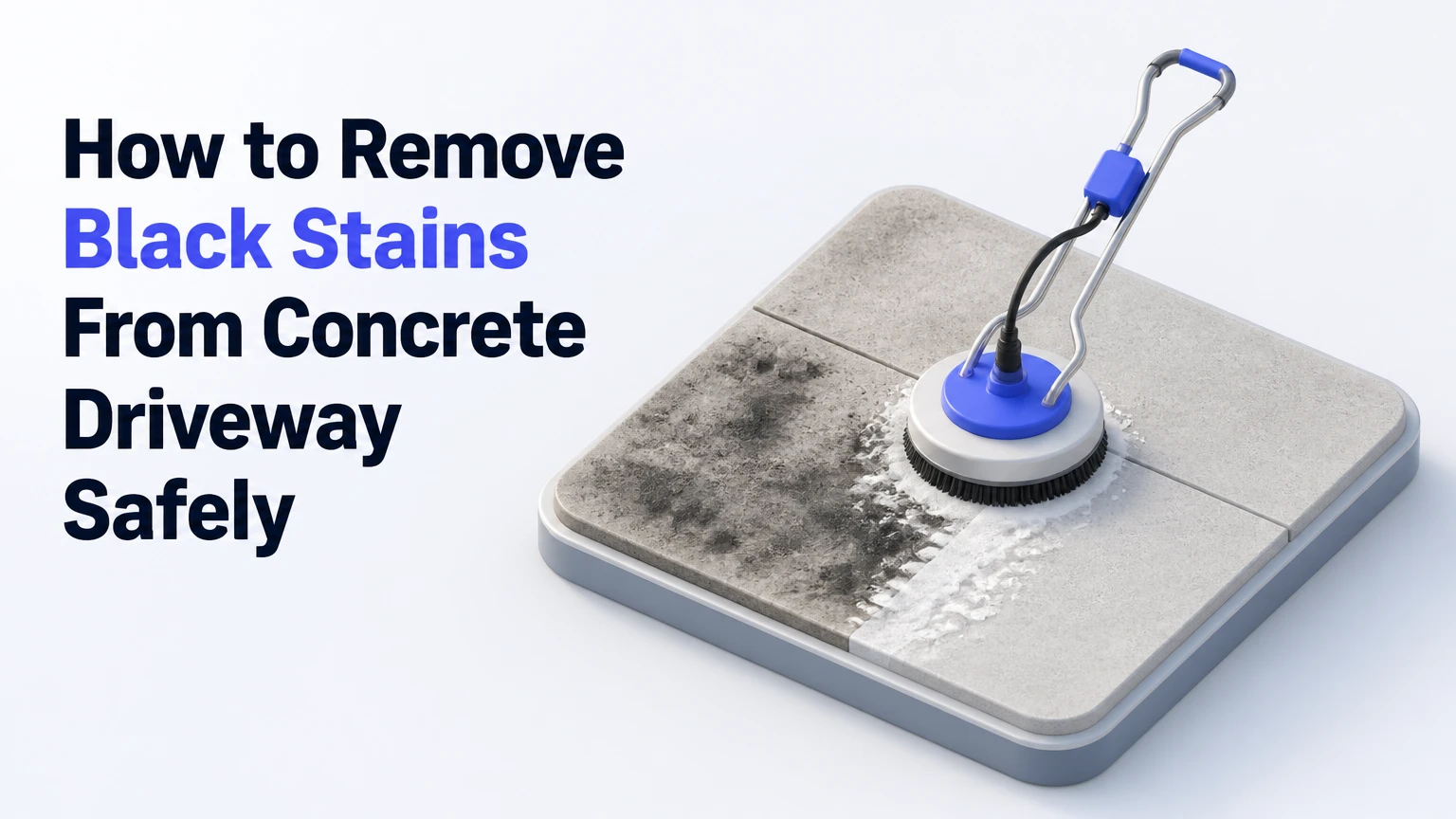
To remove black stains from a concrete driveway, first identify whether the discoloration is biological growth or petroleum residue. Use a labeled outdoor cleaner and nylon scrubbing for mold, mildew, or algae; use an absorbent poultice and concrete degreaser for oil or tire marks. Rinse carefully, contain runoff, and repeat treatment instead of escalating immediately to acid.
Key Facts at a Glance
- Black organic spots usually need an oxidizing or alkaline cleaner, agitation, and sufficient contact time.
- Black oil stains require degreasing and absorption because water-based rinsing alone rarely removes hydrocarbons from concrete pores.
- Muriatic acid is a poor first choice for driveway stains because it can etch the cement paste and alter the surface texture.
- A typical DIY cleaning session takes 1-3 hours, excluding overnight poultice dwell time.
- Pressure-washer damage comes from excessive pressure, a narrow nozzle, slow passes, or holding the tip too close.
- A stain that returns often indicates ongoing moisture, oil leakage, or residue left below the visible surface.
What Caused the Black Stain?
Black stains on concrete driveways most often come from mold, mildew, algae, decomposed organic debris, motor oil, transmission fluid, or rubber tire transfer. The stain’s shape and location provide useful clues before any chemical touches the concrete.
A spreading patch in shade, especially beneath trees or near a downspout, usually indicates biological growth. A sharply defined spot beneath an engine bay points toward oil or another petroleum product. Dark arcs or rectangular marks where tires rest may be rubber transfer, although tire marks can also trap oil and road grime.
Use these visual clues
| Appearance or location | Most likely contaminant | First treatment | Typical dwell time |
|---|---|---|---|
| Speckled black film in shade | Algae, mildew, or mold | Labeled outdoor oxidizer | 10-20 minutes |
| Irregular dark halo under a parked car | Motor oil or transmission fluid | Degreaser and absorbent powder | 30 minutes to 24 hours |
| Two dark arcs matching tire paths | Rubber and road residue | Alkaline degreaser | 10-30 minutes |
| Black-green growth near a drain | Algae, mold, and organic sediment | Oxygen-based cleaner | 15-30 minutes |
| White crust with gray shadow | Efflorescence or residue | Dry brushing, then mild cleaner | 5-15 minutes |
| Brown-black mark near metal | Rust mixed with organic dirt | Rust-specific treatment | Product label |
Concrete is porous, so liquids move through capillaries beneath the visible surface. That explains why a stain can lighten during the first wash and then reappear after the slab dries.
Try a small diagnostic test
Place a few drops of water on a clean edge near the stain. If the water darkens the concrete and absorbs within several minutes, the surface is relatively porous. If water beads for an extended period, the driveway may be sealed, and aggressive cleaners may damage the coating rather than improve the stain.
Do not rely on color alone. Test a 6-by-6-inch area with the intended cleaner, wait until it dries, and compare the result in natural light.
Which Cleaner Should You Use?
The best cleaner depends on the contaminant, not on how black the mark looks. Oxidizing cleaners target biological material, alkaline degreasers target oils, and enzymes can help with residual hydrocarbons when the surface remains damp long enough.
| Cleaner or method | Best target | Typical working time | Main limitation |
|---|---|---|---|
| Oxygen-based concrete cleaner | Mold, mildew, algae, organic grime | 10-30 minutes | May need two applications |
| Sodium hypochlorite product | Heavy biological growth | 5-15 minutes | Can injure plants and discolor materials |
| Alkaline concrete degreaser | Oil, grease, tire residue | 10-30 minutes | Does not kill mold roots or spores |
| Enzymatic oil remover | Residual hydrocarbons | 1-7 days | Requires warmth and moisture |
| Absorbent poultice | Fresh or deep oil deposits | 8-24 hours | Leaves cleanup material to collect |
| Pressure washing | Lifted dirt and chemical residue | 30-120 minutes | Can scar or erode concrete |
| Muriatic acid | Limited mineral or rust problems | Minutes, per label | Etches concrete and creates hazardous runoff |
Oxygen-based powders commonly contain sodium percarbonate, which releases hydrogen peroxide in water. These products are generally easier to control around a home than concentrated pool chemicals, but the product label remains the controlling dilution and contact-time instruction.
The Centers for Disease Control and Prevention gives a simple chemical rule: “Never mix household bleach or any disinfectant with other cleaners or disinfectants.” Never combine bleach with vinegar, ammonia, acids, toilet cleaner, or an unknown driveway product. Toxic gases or violent reactions can result.
Why is muriatic acid usually the wrong first step?
Muriatic acid is hydrochloric acid, and it removes material by reacting with cement compounds and etching the concrete surface. That action can expose fresh aggregate, create light and dark patches, weaken a finished surface, and make later staining easier.
Acid can have a legitimate role in controlled mineral or rust remediation, but a black organic or oil stain is not a good reason to start with acid. Concrete restoration professionals may choose a proprietary acid cleaner after identifying the surface, protecting adjacent materials, and planning neutralization. Most homeowners should use a labeled non-acid cleaner first.
Before You Start
A typical 10-by-20-foot driveway section requires 1-3 hours of active work, $15-$60 in materials, and a dry, mild day without forecast rain during the dwell period. Older oil stains may need an overnight poultice and two or more treatments.
| Requirement | Typical amount or specification | Why it matters |
|---|---|---|
| Nylon deck brush | 1 brush, 12-18 inches wide | Scrubs without steel fragments |
| Pump sprayer | 1, 1-2 gallon capacity | Applies dilute cleaner evenly |
| Cleaner | 0.5-2 gallons or label quantity | Covers one treatment area |
| Absorbent material | 1-5 pounds | Draws oil from pores |
| Pressure washer | 1,500-3,000 PSI adjustable | Provides controllable rinsing |
| Nozzle | 25-degree fan tip | Reduces concentrated impact |
| Protective equipment | Goggles, chemical gloves, boots, long sleeves | Protects eyes and skin |
| Plastic sheeting | Enough for nearby plants | Reduces chemical contact |
Remove vehicles, toys, furniture, and loose debris. Close nearby doors and windows, check the cleaner’s safety data sheet, and keep children and pets away until the surface has been thoroughly rinsed and dried.
Wet nearby vegetation with clean water before cleaning. Shield delicate plants from spray, but do not create a plastic tent that traps chemical runoff against foliage. Plan where the rinse water will go before applying product.
How to Remove Black Stains From Concrete Driveway
Use the following process for ordinary unsealed gray concrete. Adjust the chemical product to its label, and use the oil method instead of the organic method when the stain sits below a vehicle or has a greasy feel.
Step 1: Remove loose soil and protect the area
Sweep the driveway with a stiff broom, remove leaves, and scrape away gum or thick deposits with a plastic scraper. Wet nearby lawn and plants, move metal objects away, and block children and pets from the work zone.
Do not begin with a pressure washer on a heavily dirty surface. Loose grit can be driven into the slab, and a concentrated spray can create clean stripes around untouched soil.
Success checkpoint: The concrete surface is free of leaves, stones, and visible loose dirt.
Common mistake: Sweeping oil residue into a storm drain. Collect contaminated debris and dispose of it according to local waste rules.
Step 2: Test the cleaner on a hidden patch
Mix or dilute the selected product exactly as its label states. Apply it to a small inconspicuous area, keep the surface wet for the stated dwell time, rinse, and let the test area dry completely.
Concrete can show temporary darkening while wet, so judge the result only after drying. Test sealed, colored, stamped, or previously painted concrete with extra caution because the coating may react differently from bare cement.
Success checkpoint: The test patch shows no unusual whitening, gloss loss, color removal, or softening.
Common mistake: Assuming a stronger mixture is automatically more effective. Excess concentration often increases plant damage and surface discoloration without removing deeper oil.
Step 3: Treat mold, mildew, or algae
Apply a labeled oxygen-based concrete cleaner to dry or slightly damp concrete, according to the product instructions. Many organic-growth products work within 10-30 minutes, but hot sun may shorten the safe working period.
Keep the cleaner wet for the specified contact time without allowing a concentrated product to dry on the slab. Scrub with a nylon deck brush, working from the cleanest edge toward the darkest area so residue does not spread.
Rinse thoroughly with a garden nozzle or adjustable pressure washer. Direct water away from storm drains, ponds, edible gardens, and neighboring property.
Success checkpoint: The black film loosens, the brush produces gray or brown residue, and the concrete looks more uniform after drying.
Common mistake: Applying dish soap as a universal booster. Some soaps leave a film, and surfactant compatibility varies. Use only an additive named on the cleaner label.
Step 4: Treat oil, grease, or tire marks
For a fresh spill, cover the liquid immediately with clay-based cat litter, oil absorbent, or another labeled absorbent. Press the material gently into the spill, leave it for several hours, sweep it up, and repeat until the surface no longer feels slick.
For an older stain, apply a concrete degreaser at the label dilution. Scrub with nylon bristles, allow 10-30 minutes of contact time, and rinse. If a dark halo remains, make a poultice from a compatible degreaser and an absorbent such as powdered clay or diatomaceous earth.
Spread the paste about 1/8-1/4 inch thick. Covering it with plastic can slow evaporation, but follow the product instructions because some formulations require air exposure. Leave the poultice 8-24 hours, collect the dry material, scrub again, and rinse.
Success checkpoint: The surface no longer feels oily, and the stain lightens after the slab dries.
Common mistake: Using only hot water. Heat can spread oil through pores before a degreaser emulsifies it.
Step 5: Rinse with controlled pressure
Use a 25-degree fan tip, keep the nozzle moving, and begin around 12 inches above the surface. A typical residential machine in the 1,500-3,000 PSI range is sufficient for rinsing many driveways when paired with detergent and brushing.
Only reduce the distance or increase pressure after testing. A 3,000-4,000 PSI commercial machine can damage weak, old, or freeze-thawed concrete, especially with a zero-degree tip or a slow pass.
For a large uniformly dirty area, a surface-cleaner attachment usually produces fewer visible stripes than a handheld wand. Rinse chemical residue until no foam or slippery film remains.
Success checkpoint: Rinse water runs clear enough to show the concrete texture, and no sharp spray marks appear after drying.
Common mistake: Holding the nozzle closer than 6 inches for extended periods. The narrow impact can remove cement paste and leave permanent lines.
Step 6: Let the concrete dry before judging
Allow at least 24 hours of dry weather before deciding whether the stain is gone. Moisture temporarily darkens concrete and can conceal both residual oil and uneven cleaning.
Organic growth may require a second treatment after the first application kills the surface layer. Deep oil can also need repeated degreasing because each treatment removes only part of the material held in the pores.
Success checkpoint: The dry surface has an even color, no oily sheen, and no active black or green regrowth.
Common mistake: Sealing immediately after washing. Trapped moisture or oil can cause clouding, adhesion failure, and renewed discoloration.
How Do the Main Methods Compare?
Pressure washing works best as a rinsing and mechanical-lifting stage, not as a substitute for identifying the stain. Chemical treatment breaks the bond or biological structure, while controlled water pressure removes the loosened residue.
| Method | Best use | Typical cost | Typical time | Risk level |
|---|---|---|---|---|
| Oxygen-based cleaner and brush | Organic black growth | $10-$35 | 1-2 hours | Low to moderate |
| Degreaser and poultice | Oil or grease | $15-$60 | 2 hours plus 8-24 hours | Low to moderate |
| Enzymatic product | Residual hydrocarbons | $25-$75 | 1-7 days | Low if label followed |
| Pressure-washer rental | Large-area rinsing | $40-$100 per day | 2-5 hours | Moderate |
| Professional cleaning | Large, damaged, or sealed driveways | $150-$500 typical | 2-6 hours | Depends on contractor |
| Muriatic acid | Specialized mineral or rust work | $10-$30 | 1-2 hours | High |
Enzymatic cleaners are useful when residual oil remains after physical absorption and degreasing. They are not instant stain erasers, and cold temperatures, dryness, or disinfectants can reduce biological activity. Never use an enzyme product immediately after a disinfectant unless the labels confirm compatibility.
A professional can be the better choice when the driveway is decorative, coated, badly spalled, connected to sensitive drainage, or large enough that uniform cleaning matters more than minimizing cost.
What Should You Avoid?
Avoid four shortcuts: concentrated acid, uncontrolled bleach, wire brushes, and close-range pressure washing. Each shortcut can create a second problem that is harder to correct than the original stain.
- Do not use a steel wire brush. Broken bristles can rust in the concrete and leave orange marks. Choose nylon or polypropylene.
- Do not mix cleaners. Rinse one product away completely before considering another compatible treatment.
- Do not let concentrated chemicals dry. Dried residue can produce pale patches and increase plant injury.
- Do not wash oil into a storm drain. Use absorbent material first and contain contaminated rinse water where local rules require it.
- Do not use a zero-degree nozzle. Its concentrated jet can gouge the cement paste.
- Do not seal over a stain. Sealer can lock in oil and make future removal more difficult.
- Do not pre-wet for every product. Organic cleaners often work best on dry or slightly damp concrete, while acid products have different instructions and should not be improvised.
The most counterintuitive rule is that stronger pressure rarely compensates for the wrong chemistry. A mild degreaser with 20 minutes of contact and brushing can outperform a powerful washer used on untreated oil.
What If the Driveway Is Sealed, Colored, or Decorative?
Sealed, colored, stamped, and exposed-aggregate concrete require a test patch and a less aggressive process. Strong solvents, acids, stiff abrasion, and high pressure can remove color, dull sealer, or expose aggregate.
Use a pH-neutral or coating-approved cleaner first. Keep pressure moderate, avoid turbo nozzles unless the coating manufacturer allows them, and never use an untested bleach solution on decorative color.
Adapt the method to the surface
| Surface type | Preferred first cleaner | Pressure approach | Main concern |
|---|---|---|---|
| Unsealed gray concrete | Oxygen cleaner or degreaser | 1,500-3,000 PSI | Surface erosion |
| Acrylic-sealed concrete | Sealer-approved neutral cleaner | Low pressure, wide fan | Gloss and coating loss |
| Integral-colored concrete | Mild alkaline cleaner | Moderate, moving passes | Color lightening |
| Stamped concrete | Manufacturer-approved cleaner | Avoid concentrated spray | Pattern damage |
| Exposed aggregate | Mild cleaner and soft brush | Low to moderate pressure | Aggregate loosening |
| Painted concrete | Coating-compatible cleaner | Garden hose first | Paint peeling |
If the test patch changes sheen or color, stop. A contractor familiar with decorative concrete can identify the coating and recommend a compatible cleaner.
Why Do Black Stains Return?
Returning black stains usually indicate moisture, residual contamination, or a continuing source rather than a failure of every cleaning product. Biological spots return when shade, poor drainage, leaf debris, or a leaking downspout keeps the slab damp.
Oil marks return when a vehicle continues to leak or when oil remains below the visible surface. Place cardboard beneath the vehicle overnight to check for fresh drops, and repair the leak before repeating driveway treatment.
A white film after cleaning may be efflorescence, which consists of salts transported to the surface by moisture. Dry-brush it first. Acid should not be the automatic response because the white residue may be cleaner residue or a coating problem, not mineral scale.
Splotchy cleaning usually results from uneven chemical coverage, inconsistent dwell time, or wand overlap. Clean the entire visibly affected section with consistent passes rather than spot-blasting isolated marks.
How Can You Prevent New Black Spots?
Prevent black staining by controlling moisture, removing organic debris, and responding to oil spills before they penetrate. Clean leaves weekly in shaded areas, extend downspouts away from the driveway, and correct low spots that remain wet after rain.
Keep an absorbent product available for vehicle leaks. Fresh oil is much easier to collect than oxidized oil that has remained in concrete for weeks.
After the driveway is fully clean and dry, a compatible penetrating sealer can reduce absorption without creating a thick surface film. Follow the sealer manufacturer’s moisture and curing requirements, and understand that sealing reduces staining rather than making concrete stain-proof.
When Should You Hire a Professional?
Hire a professional when the slab is painted, sealed, decorative, structurally deteriorated, or connected to drainage that cannot safely receive runoff. Professional help is also sensible when a stain covers most of the driveway and uniform appearance matters.
Request the contractor’s planned pressure range, nozzle type, chemical product, runoff controls, and test-patch procedure. A responsible cleaner should explain how the method changes for oil, biological growth, and decorative coatings.
Cleaning cannot repair spalling, exposed reinforcement, deep cracks, or concrete discoloration caused by an integral material defect. If the black appearance remains after safe cleaning and the surface is physically damaged, repair or resurfacing may be necessary.
FAQ
Can baking soda remove black oil stains from concrete?
Baking soda can absorb some fresh surface oil, but it is rarely strong enough to remove an old driveway stain by itself. Apply it promptly, collect it as contaminated absorbent material, then use a labeled concrete degreaser for the remaining residue. Powder alone will not dissolve hydrocarbons embedded in deep pores.
Will vinegar remove black mold from a concrete driveway?
Vinegar is not a dependable primary treatment for extensive outdoor mold or algae, and its acidity can affect some nearby materials. Use a labeled outdoor biological-growth cleaner instead, keep runoff away from plants and drains, and never combine vinegar with bleach or another disinfectant.
How long should I wait before sealing cleaned concrete?
Wait until the concrete is visibly dry and the sealer’s moisture requirement is satisfied, commonly at least 24-72 hours after the final rinse. Older or porous slabs may need longer in humid weather. Test with plastic sheeting or the sealer manufacturer’s moisture procedure before application.
Can rain help remove the stain after applying cleaner?
Rain usually dilutes cleaner before it has completed its dwell time and can spread contaminated residue across the driveway. Apply products only when the label’s contact period can finish without rainfall. A light mist may prevent drying for some cleaners, but deliberate rainwater rinsing is uncontrolled.
Why is one clean patch darker than the rest of the driveway?
A darker patch may be wet, more porous, oil-saturated, or protected by sealer on adjacent concrete. Wait for complete drying, then compare water absorption and surface sheen. If the patch remains dark and oily, repeat degreasing; if texture or color differs, cleaning alone may not restore uniformity.
The Bottom Line
To remove black stains from concrete driveway surfaces, diagnose the contaminant first, then match the treatment: oxygen-based cleaner for mold and algae, degreaser plus absorbent poultice for oil, and controlled pressure washing for rinsing. Avoid improvised acid mixtures, contain runoff, let the slab dry before judging results, and correct moisture or vehicle leaks so the stain does not return.