
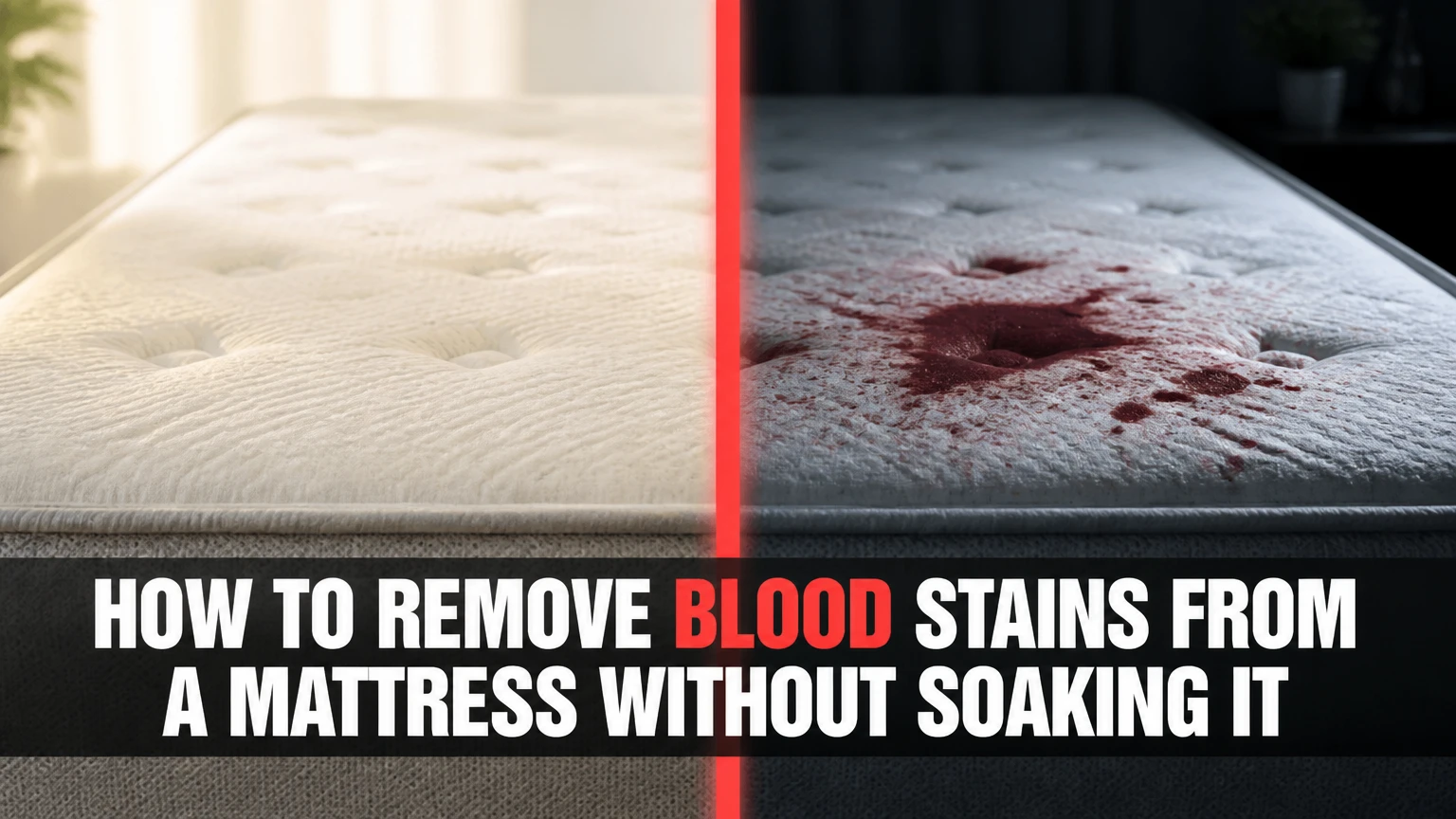
To remove blood stains from a mattress, use cold water, blotting, and a small amount of a suitable protein stain treatment, then dry the area completely. Fresh blood usually responds to repeated cold-water blotting, while dried blood may require a 3% hydrogen peroxide spot test or a protease enzyme cleaner applied sparingly.
Key Facts at a Glance
Cold water is safer than hot water because heat can make protein stains harder to remove.
A mattress should be dampened lightly, never soaked, because foam retains moisture below the surface.
A 3% hydrogen peroxide solution can lighten blood but may bleach dark or colored mattress fabric.
A protease enzyme cleaner is usually the better choice for dried blood and colored upholstery.
Blotting from the outside toward the center limits spreading and reduces a visible ring.
Complete drying matters as much as stain removal because trapped moisture can create odor and microbial growth.
Before You Start
Prepare the cleaning area before touching the stain. Remove all bedding, inspect the mattress care label, and place clean towels beside the bed so you can absorb moisture immediately rather than searching for supplies mid-treatment.
| Item | Typical amount | Purpose |
|---|---|---|
| White microfiber cloths | 4-6 cloths | Blotting without dye transfer |
| Cold water | 250-500 milliliters | Diluting and lifting blood |
| 3% hydrogen peroxide | 5-15 milliliters | Oxidative spot treatment |
| Enzyme stain cleaner | 10-30 milliliters | Breaking down dried protein |
| Baking soda | 100-250 grams | Absorbing residual odor |
| Fan | 1 unit | Accelerating evaporation |
Typical time: 25-45 minutes for active cleaning, followed by 4-12 hours of drying.
Typical cost: $0-$15 if household supplies are available.
Difficulty: Easy, but moisture control requires care.
Important prerequisite: Check the manufacturer’s care instructions before applying any chemical. The American Cleaning Institute’s basic rule is, “Always read and follow the care label instructions.”
Wear disposable gloves if the blood belongs to someone else, especially when the source is unknown. Put used towels in a sealed bag, wash your hands afterward, and avoid cleaning an open wound or heavily contaminated mattress without professional advice.
Why Blood Stains Need a Different Treatment
Blood stains are protein-based organic stains, so water temperature, drying time, and product chemistry affect the result. Blood contains hemoglobin, albumin, and other proteins that can bind to textile fibers as the liquid dries; rubbing and heat can drive those residues deeper into the mattress cover.
Cold water loosens and dilutes fresh blood. Enzymes such as protease break down protein residues, while hydrogen peroxide oxidizes colored compounds and can make the stain appear lighter. Hydrogen peroxide bubbling does not prove that every contaminant has been removed, and peroxide should not be described as a complete mattress disinfectant.
The heat warning is useful but needs precision. Hot water and steam can make protein residues more difficult to remove, particularly after the stain has begun drying, but cool or lukewarm water is appropriate for rinsing a treated area when the mattress manufacturer permits it.
How Do You Remove Fresh Blood From a Mattress?
Fresh blood should be removed with a cycle of dry blotting, minimal cold water, and repeated lifting. The most important factor is speed: remove liquid before it wicks through the cover and into foam, where it becomes harder to extract without excessive moisture.
Step 1: Remove Bedding and Expose the Stain
Take off sheets, mattress pads, and protectors without dragging them across the stain. Wash removable bedding separately in cold water, and do not place it in a dryer until the blood mark has disappeared because dryer heat can set remaining residue.
Inspect the stain under bright, neutral light. Photographing the area first can help you judge whether a later ring is new or was already present.
You’ll know this step worked when: the mattress cover is exposed and no wet bedding touches the affected area.
Common mistake: pulling a fitted sheet across the mattress and spreading the blood into a larger oval.
Step 2: Blot Blood Without Rubbing
Press a dry white cloth or folded paper towel straight down onto the stain for 5-10 seconds, then lift it vertically. Replace the cloth section as soon as it becomes red, because a saturated towel transfers blood back to the mattress.
Work from the outer edge toward the center only when the mark is spreading. For a small fresh spot, straight-down blotting is safer than circular motion. Continue until the towel absorbs little or no visible liquid.
You’ll know this step worked when: the surface feels barely damp and a clean towel shows only a faint pink transfer.
Common mistake: scrubbing with a brush, which spreads pigment and can roughen mattress ticking.
Step 3: Apply a Small Amount of Cold Water
Dampen a clean cloth with cold water and wring it until no drops fall. Dab the stain in small sections, then immediately press a dry towel over the same section to lift diluted blood.
Do not pour water directly onto a mattress. A practical limit is approximately 15-30 milliliters of liquid for a palm-sized stain, although dense foam, latex, and thick pillow tops may require even less.
You’ll know this step worked when: the stain becomes lighter without a wet perimeter forming around it.
Common mistake: using a spray bottle until the fabric is visibly saturated.
Step 4: Choose and Apply One Treatment
Select one treatment based on stain age and fabric color. Apply the product to a cloth first whenever possible, then press or dab it onto the stain; direct spraying makes it harder to control the amount entering the mattress.
Wait the recommended dwell time, but never allow a chemical to dry unchecked on delicate colored fabric. Keep the treated area small and use a timer.
You’ll know this step worked when: the stain softens or lightens without color loss in the surrounding fabric.
Common mistake: mixing peroxide, chlorine bleach, ammonia, vinegar, or other cleaners.
Step 5: Blot the Treatment Out
Use a second cloth dampened with cold water to dab away cleaner residue. Follow immediately with a dry towel and firm vertical pressure. Repeat the damp-blot and dry-blot cycle once or twice rather than adding a large amount of rinse water.
Keep the towel over the area and press with the flat palm. Do not kneel on the mattress, because compression can force moisture sideways and deeper into foam.
You’ll know this step worked when: the fabric feels only slightly cool and no slippery cleaner remains.
Common mistake: treating “rinse” as permission to flush the mattress with water.
Step 6: Dry the Mattress Completely
Place the mattress in a well-ventilated room, point a fan across the surface, and leave the bed uncovered. A hair dryer may be used only on a cool or low-warm setting held at least 30 centimeters away, with constant movement.
Press a dry towel into the area after 20-30 minutes. If the towel feels damp, continue drying. Do not replace bedding until the surface and surrounding padding are fully dry.
You’ll know this step worked when: the fabric feels dry, the area has no cool dampness, and no musty odor develops after several hours.
Common mistake: covering a damp mattress with a protector, which slows evaporation.
Which Cleaner Works Best for Blood on a Mattress?
The best cleaner depends on whether the blood is fresh or dried, whether the mattress is dark or light, and how much moisture the material can tolerate. For most colored mattresses, a protease enzyme cleaner is the safest first choice; 3% hydrogen peroxide is faster but carries a higher bleaching risk.
| Treatment | Best use | Amount for palm-sized stain | Dwell time | Main risk |
|---|---|---|---|---|
| Cold water | Fresh blood | 15-30 mL on cloth | 1-3 minutes | Spreading if overused |
| 3% hydrogen peroxide | White or colorfast fabric | 5-15 mL | 5-10 minutes | Bleaching or fiber damage |
| Protease enzyme cleaner | Dried blood | 10-30 mL on cloth | 15-30 minutes | Residue or lingering odor |
| Mild unscented detergent | Small fresh marks | 2-3 drops in 250 mL water | 5 minutes | Soap residue |
| Baking soda | Odor after cleaning | 100-250 g dry | 4-8 hours | Powder trapped in fabric |
| Meat tenderizer paste | Last-resort dried spot | 1 teaspoon powder | 15-30 minutes | Fragrance, residue, fabric damage |
3% Hydrogen Peroxide
Use ordinary 3% topical hydrogen peroxide, not concentrated salon or industrial peroxide. Test one hidden seam first, wait until the fabric dries, and inspect for lightening before treating the visible mark.
Apply a few drops to a white cloth or cotton swab, then dab the stain. Allow 5-10 minutes of contact, blot with a cold damp cloth, and dry immediately. Peroxide is most appropriate for white or demonstrably colorfast covers.
Peroxide is not a universal solution. It can lighten navy, gray, burgundy, patterned, or naturally dyed covers, and repeated applications may weaken some fibers. It also does not replace laundering, source control, or professional sanitation when biological contamination is extensive.
Protease Enzyme Cleaner
Choose a labeled upholstery or fabric enzyme cleaner that lists protease enzymes, or use a laundry product whose directions permit upholstery application. Pet stain products may contain enzymes, but some also contain fragrance, dyes, or surfactants that require a compatibility test.
Apply 10-30 milliliters to a cloth for a palm-sized mark, press it onto the stain, and leave it for 15-30 minutes. Blot with a cold damp cloth, then extract moisture with dry towels and airflow. Dried blood may need two or three separate applications, with complete drying between treatments.
Enzyme cleaners are generally better for dark fabric than peroxide. They are not automatically safe for every material, however, and high moisture can still damage memory foam, latex, wool, silk, or glued mattress layers.
Baking Soda and Salt Paste
A baking soda paste can absorb moisture and odor, but it is not the strongest chemical treatment for blood. Use it after the stain has been lifted, or use a very small amount when other products are unavailable.
A cautious recipe is 2 tablespoons of baking soda mixed with enough cold water to form a thin paste. Avoid the large peroxide-based paste recipes often repeated online because they introduce more liquid and oxidizer into foam, and dried paste can lodge in textured covers.
Spread a thin layer over the mark, leave it until fully dry, then vacuum gently with an upholstery attachment. Do not use baking soda as a substitute for blotting, and do not vacuum damp paste.
Meat Tenderizer Paste
Unseasoned meat tenderizer may contain papain or bromelain, enzymes that can break down proteins. It is a last-resort option, not a preferred mattress treatment, because spices, salt, fragrance, and prolonged enzyme contact can leave residue or alter fabric.
If the care label permits experimentation, mix 1 teaspoon of unseasoned tenderizer with a few drops of cold water. Patch-test first, apply for no more than 15-30 minutes, remove with a damp cloth, and dry completely.
How Should You Treat Dried Blood?
Dried blood needs rehydration before extraction, followed by an enzyme cleaner or a carefully tested peroxide treatment. Do not scrape aggressively, because a blade or stiff brush can damage the mattress cover while leaving the protein residue in the foam.
- Vacuum loose surface debris with an upholstery attachment.
- Place a cold, damp cloth over the mark for 2-3 minutes.
- Lift softened residue with a clean cloth, using short dabs.
- Apply enzyme cleaner for 15-30 minutes.
- Blot with minimal cold water.
- Dry completely before repeating.
A second pass is usually safer than a stronger first application. If a brown shadow remains after two careful treatments, stop increasing the chemical concentration and assess whether the discoloration is permanent oxidation, fabric dye change, or blood below the surface.
Does Mattress Material Change the Cleaning Method?
Mattress material determines how much liquid can be used and how aggressively the surface can be worked. Memory foam and latex require the strictest moisture control, while an innerspring mattress with a thin quilted cover may tolerate slightly more surface blotting without becoming saturated.
| Mattress material | Preferred treatment | Liquid limit | Drying requirement | Avoid |
|---|---|---|---|---|
| Memory foam | Cloth-applied enzyme cleaner | 15 mL per palm-sized spot | Fan for 8-12 hours | Pouring, steam, soaking |
| Latex foam | Cold water, mild enzyme spot test | 10-15 mL per spot | Airflow for 8-12 hours | Peroxide without testing |
| Innerspring | Cold water or tested peroxide | 20-30 mL per spot | Fan for 4-8 hours | Saturating quilted edges |
| Hybrid | Care-label-approved enzyme cleaner | 15-20 mL per spot | Fan for 6-10 hours | Compression while wet |
| Wool or natural fiber cover | Manufacturer-approved cleaner | Minimum possible | Air dry completely | Peroxide and hot water |
Memory Foam
Memory foam absorbs and retains water in its open cells, so treat the cover rather than the foam. Apply cleaner to a cloth, keep the affected area small, and use repeated dry-towel extraction.
Do not steam-clean memory foam unless the manufacturer specifically permits it. Heat and moisture can affect adhesives, foam structure, and drying time.
Latex
Latex may tolerate limited surface cleaning, but water and oxidizers can affect its cover or foam depending on construction. Use the care label as the deciding authority, and patch-test any peroxide product before visible treatment.
Never twist, fold, or compress a wet latex mattress. Mechanical stress can damage the foam while redistributing moisture.
Innerspring and Hybrid Mattresses
Innerspring mattresses often have more air space than solid foam, but their quilted covers and padding still hold water. Keep liquid away from tufting, seams, and edge supports, where it can migrate below the cover.
Hybrid mattresses combine foam and coils, so follow the more conservative foam protocol. A small surface mark does not justify a full mattress wash.
How Do You Remove Period Blood From a Mattress?
Period blood is treated the same way as other blood, but a larger or older mark may include moisture, skin oils, or other organic residue. Use cold-water blotting first, then a tested enzyme cleaner for dark fabric or 3% peroxide for a colorfast light cover.
Treat the stain in sections no larger than 10-15 centimeters across. Working in sections prevents a large wet halo and makes it easier to compare progress. Wash the bedding separately and inspect the mattress protector, because blood frequently passes through a loose or damaged protector at the edges.
If the bleeding resulted from an injury, illness, or repeated unexplained event, address the medical issue separately. Cleaning the mattress does not address the source of the blood.
What Mistakes Make the Stain Worse?
The most damaging mistakes involve heat, friction, chemical mixing, and excess moisture. Correcting the method usually matters more than buying a stronger product.
| Mistake | Result | Recovery |
|---|---|---|
| Hot water or steam | Protein residue becomes harder to lift | Rehydrate lightly with cold water |
| Scrubbing in circles | Larger stain and damaged ticking | Stop friction and blot outward to inward |
| Pouring cleaner directly | Moisture enters foam | Extract with dry towels and fan |
| Colored cleaning cloth | Dye transfers to fabric | Blot with white cloth and stop chemicals |
| Repeated peroxide use | Pale patch or brittle fibers | Switch to mild enzyme spot treatment |
| Covering mattress while damp | Musty odor and slow drying | Remove cover and ventilate for several hours |
A counterintuitive practitioner rule is that a stain can look worse immediately after treatment because wet fibers reflect light differently. Judge the final color only after the mattress is fully dry.
Another rule is to change cloth surfaces frequently. A clean section of one towel often lifts more blood than a larger amount of cleaner applied with a saturated towel.
Do not combine hydrogen peroxide with chlorine bleach, ammonia, vinegar, or commercial cleaners unless the product label explicitly confirms compatibility. Chemical mixtures can release irritating gases or create uncontrolled reactions.
How Do You Fix Rings, Odors, and Faded Shadows?
A ring usually results from uneven wetting or residue drying at the edge, while odor commonly results from blood left below the surface or a mattress that was covered before drying. Faded shadows may be permanent color changes rather than removable blood.
A Yellow or Brown Ring
Lightly dampen the entire immediate section, extending only 2-3 centimeters beyond the visible edge. Blot the perimeter first, then the center, and extract moisture with a dry towel under firm pressure.
Use a fan until dry. Do not keep adding peroxide, because the ring may be cleaner fabric around a permanently altered center rather than remaining blood.
A Chemical or Iron-Like Odor
Once the area is dry, scatter 100-250 grams of dry baking soda over the affected section. Leave it for 4-8 hours, vacuum gently, and repeat once if needed.
Baking soda absorbs some odor but does not sterilize a mattress. If odor persists after complete drying, residue may have entered the padding and professional extraction may be more appropriate.
A Faint Mark Remains
Repeat the enzyme treatment once after the first application has dried. If the stain remains after two or three controlled passes, further treatment may damage the cover more than it improves appearance.
Professional upholstery cleaners can assess whether extraction is safe for the mattress construction. They cannot always remove discoloration that has chemically altered the fabric.
How Much Time and Money Does Mattress Stain Removal Take?
A small fresh stain typically takes 25-45 minutes of active work and costs $0-$5, while a dried stain may require 1-2 hours of intermittent work across two sessions. Professional mattress cleaning commonly costs about $80-$200 in the United States, depending on size, location, travel, and contamination level.
| Situation | DIY active time | Drying time | Typical DIY cost |
|---|---|---|---|
| Fresh spot, cold water only | 15-25 minutes | 4-8 hours | $0-$3 |
| Fresh spot, peroxide test | 20-35 minutes | 4-8 hours | $2-$6 |
| Dried spot, enzyme cleaner | 30-60 minutes | 8-12 hours | $6-$15 |
| Large visible area | 60-120 minutes | 12-24 hours | $10-$25 |
| Professional extraction | 45-120 minutes onsite | 6-24 hours | $80-$200 |
These are typical planning ranges, not guaranteed prices. A local provider may charge more for king mattresses, stairs, emergency service, or biological-fluid cleanup.
When Should You Replace or Professionally Clean the Mattress?
Professional advice is warranted when blood covers a large area, has penetrated deeply, belongs to an unknown source, or remains accompanied by odor after thorough drying. Replacement becomes more reasonable when the mattress has extensive contamination, visible mold, structural damage, or an age and condition that no longer justify cleaning.
Do not attempt repeated DIY treatment when the cover is non-removable and the stain extends through several layers. Excess liquid can spread contamination farther than the original mark.
For a small surface stain on a sound mattress, careful home treatment is usually proportionate. For a heavily contaminated mattress, follow local public-health guidance and ask a certified upholstery or remediation provider what extraction method fits the material.
How Can You Prevent Future Mattress Blood Stains?
A waterproof, breathable mattress protector is the most effective preventive measure because it creates a washable barrier between bodily fluids and the mattress cover. Choose a protector with a fully enclosed or fitted waterproof layer, a washable care label, and dimensions that match the mattress depth.
Wash the protector according to its label after contamination. Inspect seams and elastic after each wash, because a small split can allow liquid to reach the mattress.
Keep spare sheets and one spare protector available. Immediate replacement reduces the temptation to sleep on a damply treated mattress, which is one of the most common causes of lingering odor.
Frequently Asked Questions
Can I use vinegar to remove blood from a mattress?
Vinegar is not the first choice for blood because its acidity does not specifically break down protein as effectively as a protease enzyme cleaner. Vinegar can also react unpredictably with other products and leave odor in foam. Use cold water first, then a compatible enzyme treatment or tested 3% peroxide.
Will rubbing alcohol remove a blood stain?
Rubbing alcohol is a poor first-line treatment for mattress blood stains because it can spread liquid, affect dyes, and dry the cover unevenly. Alcohol also does not provide the same protein-targeting action as enzymes. Use it only if the mattress manufacturer specifically permits it for the cover material.
Can I use a carpet cleaner on a mattress?
A carpet cleaner should be used on a mattress only when the mattress manufacturer and machine instructions permit it. Extraction equipment can leave foam excessively wet, especially when used with repeated passes. For a small stain, controlled cloth application and towel extraction provide better moisture control.
How long should I leave baking soda on a mattress?
Leave dry baking soda on a fully dry mattress surface for 4-8 hours, then vacuum it with an upholstery attachment. Baking soda absorbs some odor but does not remove deep blood or disinfect the mattress. Never cover wet cleaner residue with powder and assume the mattress is dry.
Can sunlight remove a blood stain from a mattress?
Sunlight may help dry a lightly damp cover, but direct ultraviolet exposure can fade mattress fabric and does not reliably remove blood. Use airflow first, and follow the manufacturer’s guidance before placing a mattress in strong sun. A fan provides more controllable drying with less discoloration risk.
Why does the blood stain return after cleaning?
A returning mark usually indicates wicking, where diluted blood or cleaner moves upward as the mattress dries. Lightly rework the immediate area, blot from the outer edge inward, extract with dry towels, and increase airflow. If the mark returns repeatedly, blood may be below the surface and require professional extraction.
The Bottom Line
To remove blood stains from a mattress, blot immediately, use cold water sparingly, apply one tested treatment, extract residue, and dry the mattress completely. Choose a protease enzyme cleaner for most dried or colored-fabric stains, reserve 3% hydrogen peroxide for tested colorfast covers, and never soak the foam. With that moisture-controlled process, how to remove blood stains from mattress becomes a manageable cleaning task rather than a reason to replace the bed.