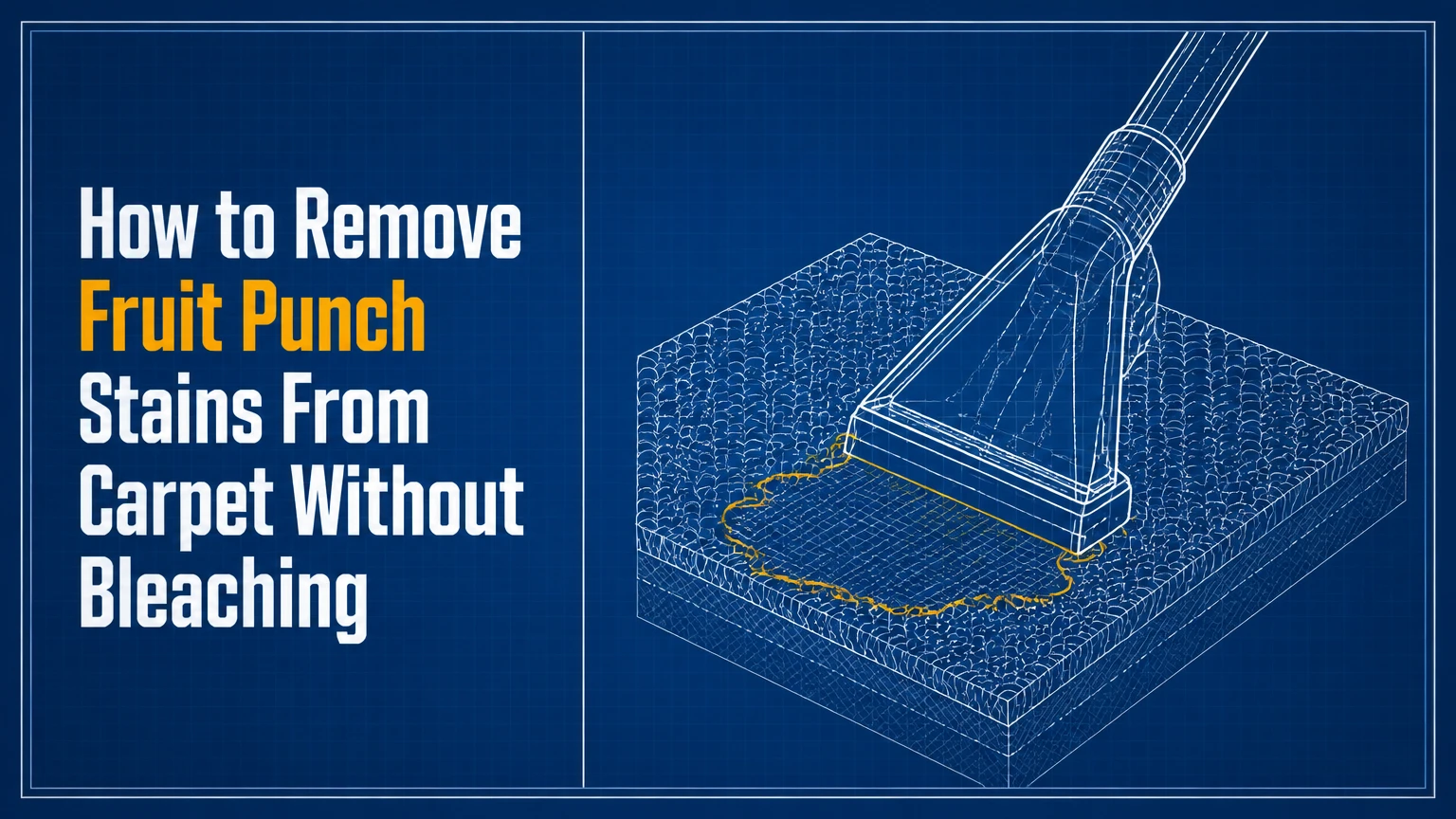
To remove fruit punch stains from carpet, blot the spill immediately, apply a small amount of diluted dishwashing detergent, and transfer the red dye into white towels without rubbing. Rinse with cool water, dry the area quickly, then use 3% hydrogen peroxide or a commercial red-dye remover only after testing carpet color.
Key Facts at a Glance
- Fresh fruit punch is usually easier to remove during the first 15 minutes because less dye has migrated into the carpet backing.
- White towels are safer than colored cloths because dyed fabric can transfer color into damp carpet.
- Nylon and polyester generally tolerate more spot-treatment options than wool, silk, rayon, or unknown natural fibers.
- Hydrogen peroxide can remove red color and original carpet color, so a hidden-area test is mandatory.
- Ammonia is unsuitable for wool, silk, many natural dyes, and mixed-fiber rugs.
- A stain that reappears after drying usually indicates wicking from carpet backing or padding, not a new spill.
Before You Start
Fruit punch stain removal usually takes 15-30 minutes of active work and 6-12 hours of drying. A fresh spill costs about $1-$5 to treat with household materials, while a specialized consumer remover typically costs $8-$25. Professional spot treatment commonly costs $75-$200, with larger or heavily saturated areas costing more.
Materials and preparation
| Item | Typical amount | Purpose | Important specification |
|---|---|---|---|
| White cotton or microfiber towels | 4-8 towels | Blotting and transfer | White, lint-free, colorfast |
| Cool or lukewarm water | 1-2 cups | Dilution and rinsing | Not hot; use distilled water for very light carpet if local water stains |
| Clear dishwashing liquid | 1 teaspoon | Surfactant cleaning | No bleach, dye, lotion, or heavy fragrance |
| White vinegar | 1 tablespoon | Optional mild acid rinse | Use only after detergent removal and fiber testing |
| 3% hydrogen peroxide | 1-4 tablespoons | Oxidizing residual red dye | Test first; avoid on dark or unstable color |
| Fan or air mover | 1 unit | Faster drying | Direct airflow across, not into, the backing |
First identify the carpet fiber if possible. A manufacturer label, installation invoice, or rug-care tag is more reliable than guessing by appearance. If the carpet is wool, silk, viscose, rayon, antique, hand-knotted, or valuable, stop after controlled blotting and call a qualified cleaner rather than experimenting with strong chemicals.
Why Is Fruit Punch So Difficult to Remove?
Fruit punch stains are persistent because red food colorants dissolve easily in liquid and can travel from the face fibers into the carpet backing. Sugars leave a sticky residue that attracts soil, while acids and flavor compounds can alter the appearance of some dyes. The red color does not automatically mean permanent chemical bonding.
Most commercial fruit punches contain water, sugar or sweeteners, flavor acids, and colorants such as Allura Red AC, also called Red 40, or other certified food dyes. Nylon, polyester, and polypropylene fibers differ in how strongly they retain those colorants. Carpet construction matters too: a shallow surface spot is easier than a cupful that reaches the pad.
The Carpet and Rug Institute recommends prompt blotting and testing cleaning products in an inconspicuous area before use. That guidance matters because stain removal can create a second problem, including color loss, pile distortion, sticky residue, or backing damage.
How to Remove Fruit Punch Stains From Carpet
Use a low-moisture, transfer-based process: extract the liquid, apply a measured cleaner, allow short contact, blot into clean towel sections, rinse lightly, and dry completely. The entire sequence takes about 15-30 minutes for a small fresh spill, but old or backing-saturated stains may require two or three controlled sessions.
Step 1: Extract the spill immediately
Place a folded white towel over the wet area and press straight down for 5-10 seconds. Lift the towel, rotate to a dry section, and repeat until little liquid transfers. Work from the outside edge toward the center so pressure does not spread the punch.
For a large spill, use a wet vacuum or carpet extractor if available. Make several slow extraction passes, then switch to dry towels. Do not drag the machine rapidly across the spot because lateral movement spreads colored liquid through adjacent pile.
You will know it worked when: the towel shows progressively less red liquid and the carpet no longer looks glossy with surface moisture.
Common mistake: rubbing in circles. Friction bends and abrades pile, pushes dye downward, and enlarges the affected area.
Step 2: Apply diluted dish soap
Mix 1 teaspoon of clear dishwashing liquid with 2 cups of cool or lukewarm water. Apply the solution to a white towel first, then press the damp towel onto the stain. This method limits oversaturation and gives the surfactant contact with the colored residue.
For a spot smaller than a dinner plate, begin with 2-4 tablespoons of solution. Do not pour the full mixture onto the carpet. The aim is to dampen the stained fibers, not flood the backing.
You will know it worked when: red color begins transferring to the towel after several firm presses.
Common mistake: choosing a blue, green, or heavily dyed detergent. Product color can transfer into light carpet, especially when the carpet remains wet for hours.
Step 3: Allow a short dwell period
Leave the diluted detergent in contact with the fibers for 3-5 minutes. Keep the area damp during that period, but do not allow the solution to dry. Longer dwell time is not automatically better because dried detergent can leave a sticky residue.
A professional spot-removal principle is controlled chemistry followed by extraction. More product does not compensate for inadequate towel transfer. Use fresh towel sections instead.
You will know it worked when: the stain appears lighter at the edges and the towel receives more color than the carpet surface.
Common mistake: skipping the dwell period entirely. Immediate blotting removes some liquid but may leave dye embedded in the pile.
Step 4: Transfer the loosened dye
Cover the treated area with a clean, folded white towel and press downward with both hands. For a small spot, hold pressure for 10-20 seconds; for a larger area, place a dry towel over it and stand on the towel briefly with clean socks.
Replace the towel as soon as its working section becomes pink or red. Continue until successive presses produce almost no color. Avoid scraping or brushing because mechanical agitation can spread softened dye.
You will know it worked when: the towel remains nearly white after repeated pressure and the carpet looks evenly colored when viewed from several angles.
Common mistake: reusing one saturated towel. A loaded towel can redeposit dye instead of removing it.
Step 5: Rinse away detergent residue
Dampen a clean white towel with cool water and press it onto the treated area. Use only enough water to pick up soap, then extract immediately with a dry towel or wet vacuum.
Residual detergent can attract soil and create a dark ring after drying. A vinegar rinse is optional for synthetic carpet: mix 1 tablespoon of white vinegar with 2 cups of water, apply sparingly, then rinse once with plain water. Vinegar is not a guaranteed red-dye remover.
You will know it worked when: the towel no longer feels slippery and no foam appears during the final press.
Common mistake: pouring rinse water directly over the stain. That can drive detergent and dye into the pad.
Step 6: Dry the carpet completely
Place several dry white towels over the area and weigh them with a flat, washable object for 30-60 minutes. Remove the weight, replace damp towels, and run a fan across the carpet for several hours.
Carpet should feel dry at the surface and at the base of the pile. A 6-12 hour drying period is typical for a small treated spot, while a saturated pad can take 24 hours or longer. Keep people and pets off the area until dry.
You will know it worked when: the carpet color remains stable after complete drying and no damp odor develops.
Common mistake: judging the result while the fibers are wet. Moisture changes how carpet color reflects light and can hide both residue and color loss.
Which Cleaning Solution Should You Use?
Diluted dish soap is the safest first treatment for most fresh synthetic-carpet spills. Hydrogen peroxide or a purpose-made red-dye remover is more appropriate for persistent color on bleach-stable synthetic carpet, while wool, silk, viscose, and valuable rugs need low-moisture professional treatment.
| Cleaning option | Best use | Typical concentration or amount | Main risk |
|---|---|---|---|
| Clear dish soap and water | Fresh spill on nylon, polyester, polypropylene | 1 teaspoon in 2 cups water | Residue if not rinsed |
| White vinegar rinse | Remaining soap film on tested synthetic carpet | 1 tablespoon in 2 cups water | Odor or fiber sensitivity |
| 3% hydrogen peroxide | Light, colorfast synthetic carpet | 3% solution, 1-4 tablespoons | Original dye bleaching |
| Commercial red-dye remover | Persistent Red 40 or similar color | Label-directed amount | Chemical incompatibility |
| Clear household ammonia | Rare professional use on compatible synthetic fiber | Product-label dilution only | Fiber damage, fumes, color loss |
When can hydrogen peroxide help?
3% hydrogen peroxide can oxidize some red food colorants, making the visible color less intense. Use it only on a tested, colorfast synthetic carpet, apply a few drops to a white cloth or cotton swab, and wait 5-10 minutes before inspecting the test area.
If the test remains unchanged, apply a small amount to the stain and monitor it for 2-5 minutes. Blot, rinse with cool water, and dry. Never assume that white-looking carpet is safe: optical brighteners and subtle beige dyes can still be affected.
Hydrogen peroxide is a poor choice for dark carpet, wool, silk, viscose, antique rugs, and carpets with uncertain dye stability. It may remove the punch while leaving a pale patch that cannot be cleaned away.
Should you use ammonia?
Ammonia should not be the default household treatment for fruit punch. Strong alkaline products can damage wool scales, natural dyes, silk, and some carpet backings, and ammonia fumes become dangerous when mixed with bleach or chlorine-containing products.
If a professional product specifically calls for an alkaline treatment, follow its label and ventilation requirements. Never combine ammonia with bleach, disinfectants, or unknown carpet chemicals. Rinse and extract before changing chemical categories.
Are commercial red-dye removers better?
Commercial red-dye removers can outperform household mixtures on old synthetic-carpet stains because their formulas target dye chemistry rather than only surface soil. Their results depend on the product category, dye type, carpet fiber, temperature, and whether the red color has already altered the original carpet dye.
Read the label for fiber restrictions and test first. Do not layer a commercial remover over vinegar, peroxide, ammonia, or another product without rinsing and extracting thoroughly. Chemical mixing creates unpredictable reactions and can lock residue into the pile.
Solution Choice by Carpet Fiber
Carpet fiber determines the acceptable chemical range more reliably than stain color alone. Nylon and polyester often tolerate carefully tested peroxide products, but wool and cellulose-based fibers can show texture or color damage after alkaline or oxidizing treatment.
| Carpet material | First response | Products to avoid without professional advice | Escalation point |
|---|---|---|---|
| Nylon | Dish soap solution, controlled rinse | Strong ammonia, untested peroxide | Red tint remains after 2 sessions |
| Polyester | Dish soap, labeled oxygen product | Aggressive solvents, excessive heat | Dye persists after complete drying |
| Polypropylene | Cool-water extraction, mild detergent | Hot tools, harsh oxidizers | Spill reaches backing or pad |
| Wool | Blot, cool water, wool-safe detergent | Ammonia, peroxide, alkaline cleaners | Any visible red shadow remains |
| Silk or viscose | Blot only, minimal moisture | Water saturation, peroxide, ammonia | Immediate professional referral |
| Hand-knotted or antique rug | Remove excess liquid, protect floor | Household experimentation | Professional rug cleaner promptly |
WoolSafe guidance for wool and specialty textiles emphasizes wool-approved products and controlled moisture. That restriction is practical: wool can felt, distort, or lose dye when exposed to friction, heat, or unsuitable alkalinity.
What If the Fruit Punch Stain Is Already Dry?
A dried fruit punch stain may still be removable, but the process usually requires two or three short treatments rather than one aggressive application. Vacuum loose soil, place a cool damp towel over the spot for 5 minutes, then repeat the dish-soap transfer process without saturating the backing.
Old sugar residue can make the fibers stiff and dark around the original stain. The first session may remove surface residue while leaving deeper red color. Allow the carpet to dry fully before deciding whether a second treatment is needed.
For stubborn red color on tested synthetic carpet, use a labeled red-dye remover or carefully tested 3% peroxide. Stop if the original carpet color begins transferring to the towel. That indicates dye loss, not successful stain removal.
How Do You Fix a Stain That Comes Back?
A returning fruit punch stain usually results from wicking, where dissolved residue in the backing or pad moves upward as moisture evaporates. Re-treat the surface lightly, extract more deeply, and dry the spot under weighted towels with airflow.
Place a barely damp white towel over the dry-looking spot, followed by several dry towels. Weigh the stack for 30-60 minutes, replace any damp towels, and continue fan drying. The slightly damp towel helps draw residue toward an absorbent surface rather than leaving it at the pile tips.
If the red mark returns again after 24 hours, the liquid probably reached the pad or subfloor. A carpet extractor or professional rinse may be necessary. Repeated surface spraying usually increases wicking because each attempt adds more moisture.
What If the Spill Was Large or Reached the Padding?
A spill larger than approximately 1 square foot, or any spill that soaked through to the pad, needs extraction rather than repeated surface blotting. Remove as much liquid as possible with a wet vacuum, keep furniture off the area, and dry both carpet and pad with strong airflow.
Do not lift glued carpet or pull up tack strips unless you know the installation method. Latex-backed carpet can delaminate when saturated, and excessive moisture may cause odor, microbial growth, or rippling. Professional cleaners can inspect moisture depth and flush residue with controlled recovery.
Milk-based or creamy fruit punch requires a different concern. Dish soap may remove the oily component, but lingering protein and sugar can create odor. Use a labeled upholstery or carpet product suitable for protein soils, and avoid heat until the residue is extracted.
Common Mistakes and How to Fix Them
| Mistake | What happens | Corrective action | Typical recovery time |
|---|---|---|---|
| Scrubbing the stain | Dye spreads and pile becomes fuzzy | Stop friction; blot from edge inward | 10-20 minutes |
| Using hot water | Dye migration and fiber stress increase | Switch to cool extraction | 15-30 minutes |
| Flooding the spot | Pad saturation and wicking occur | Wet-vacuum, towel-extract, fan-dry | 12-24 hours |
| Applying bleach | Original carpet dye may disappear | Rinse, stop chemistry, assess color loss | Immediate |
| Mixing cleaners | Irritating or toxic reactions can occur | Ventilate, leave area, rinse only when safe | Varies |
| Judging while wet | Temporary shading hides the final result | Wait until fully dry | 6-24 hours |
The most counterintuitive mistake is adding cleaner after the towel stops showing red. At that stage, the limiting factor may be extraction, not chemistry. More solution can dissolve deeper residue and cause the stain to reappear at the edges.
A second practitioner rule is to photograph the carpet before treatment. A damp spot can look darker or lighter than the surrounding area, and a before image helps distinguish remaining punch from a newly bleached patch.
Do not use a steam cleaner as the first response to a red-dye spill. Heat and moisture can spread the color through the backing, and a large machine may leave the pad wet longer than a small controlled extraction.
How Much Time and Money Does Removal Take?
Fresh DIY treatment commonly costs $1-$5 and takes 15-30 minutes of active work. Professional treatment typically costs $75-$200 for a spot, although local minimum charges, travel, rug value, furniture movement, and padding saturation can raise the total.
| Situation | DIY materials | Active treatment | Drying time | Typical professional cost |
|---|---|---|---|---|
| Fresh spot under 6 inches | $1-$5 | 15-20 minutes | 6-8 hours | $75-$125 minimum |
| Dried spot under 1 square foot | $3-$15 | 30-60 minutes | 8-12 hours | $100-$175 |
| Spill reaching carpet pad | $5-$25 | 45-90 minutes | 12-24 hours | $150-$300 |
| Wool or valuable rug | $2-$10 before referral | 10-15 minutes blotting | Variable | $100-$350 |
| Large room with multiple spots | $10-$30 | 1-3 hours | 12-24 hours | $150-$350 |
These are typical planning ranges, not guaranteed prices. Regional labor rates and minimum service fees have a larger effect than the cost of household ingredients.
When Should You Call a Professional?
Call a professional immediately for silk, viscose, antique, hand-knotted, or high-value rugs, and for any carpet where the fiber or dye stability is unknown. Professional help is also appropriate when the punch reached the pad, the stain covers more than about 1 square foot, or two controlled treatments fail.
Choose a cleaner who identifies the fiber, tests the dye, and explains the planned chemistry before applying it. A professional should use controlled extraction rather than simply spraying a stronger chemical over the mark.
Professional cleaning cannot always reverse color loss. If peroxide, bleach, sunlight, or an aggressive cleaner removed the original carpet dye, the remaining pale area is physical damage. Spot dyeing or fiber replacement may be required.
Frequently Asked Questions
Does baking soda remove red fruit punch from carpet?
Baking soda absorbs some moisture and odor, but it does not reliably dissolve or oxidize red food dye. Use extraction and a measured detergent solution first. Applying dry baking soda to a wet dye spill can make cleanup harder by creating paste-like residue in the pile.
Can club soda remove fruit punch stains?
Club soda is mostly carbonated water and does not contain a specialized red-dye remover. It may dilute a fresh spill, but plain cool water applied sparingly provides the same basic dilution without adding mineral residue. Blotting and extraction determine the result more than carbonation.
Will vinegar remove Red 40 from carpet?
White vinegar may help remove alkaline detergent residue, but vinegar alone is not a dependable treatment for Red 40. Use 1 tablespoon in 2 cups of water only as an optional rinse on tested synthetic carpet, then rinse lightly with plain water and extract.
Can I use OxiClean on fruit punch stains?
An oxygen-based carpet product may help on colorfast synthetic carpet when its label permits use on that fiber. Test an inconspicuous area first, follow the stated dilution, and do not mix it with vinegar, ammonia, bleach, or another remover. Avoid it on wool unless the product is explicitly wool-safe.
How do I remove fruit punch from a light-colored carpet?
Start with cool-water extraction and diluted clear dish soap. If a light synthetic carpet remains pink after drying, test 3% hydrogen peroxide in a hidden area, then apply a small amount only if the original color remains stable. White or beige carpet can still contain dyes that peroxide removes.
How do I remove fruit punch from carpet without making a ring?
Treat slightly beyond the visible edge, use minimal liquid, and blend the final rinse into the surrounding fibers with a damp white towel. Extract thoroughly and dry with airflow. Rings usually result from detergent residue, uneven wetting, or soil moving to the edge during drying.
The Bottom Line
To remove fruit punch stains from carpet, extract the liquid quickly, use 1 teaspoon of clear dish soap in 2 cups of cool water, blot with white towels, rinse lightly, and dry for 6-12 hours. Reserve peroxide or commercial red-dye removers for tested synthetic carpet, and refer wool, specialty rugs, saturated padding, and color-loss damage to a professional.