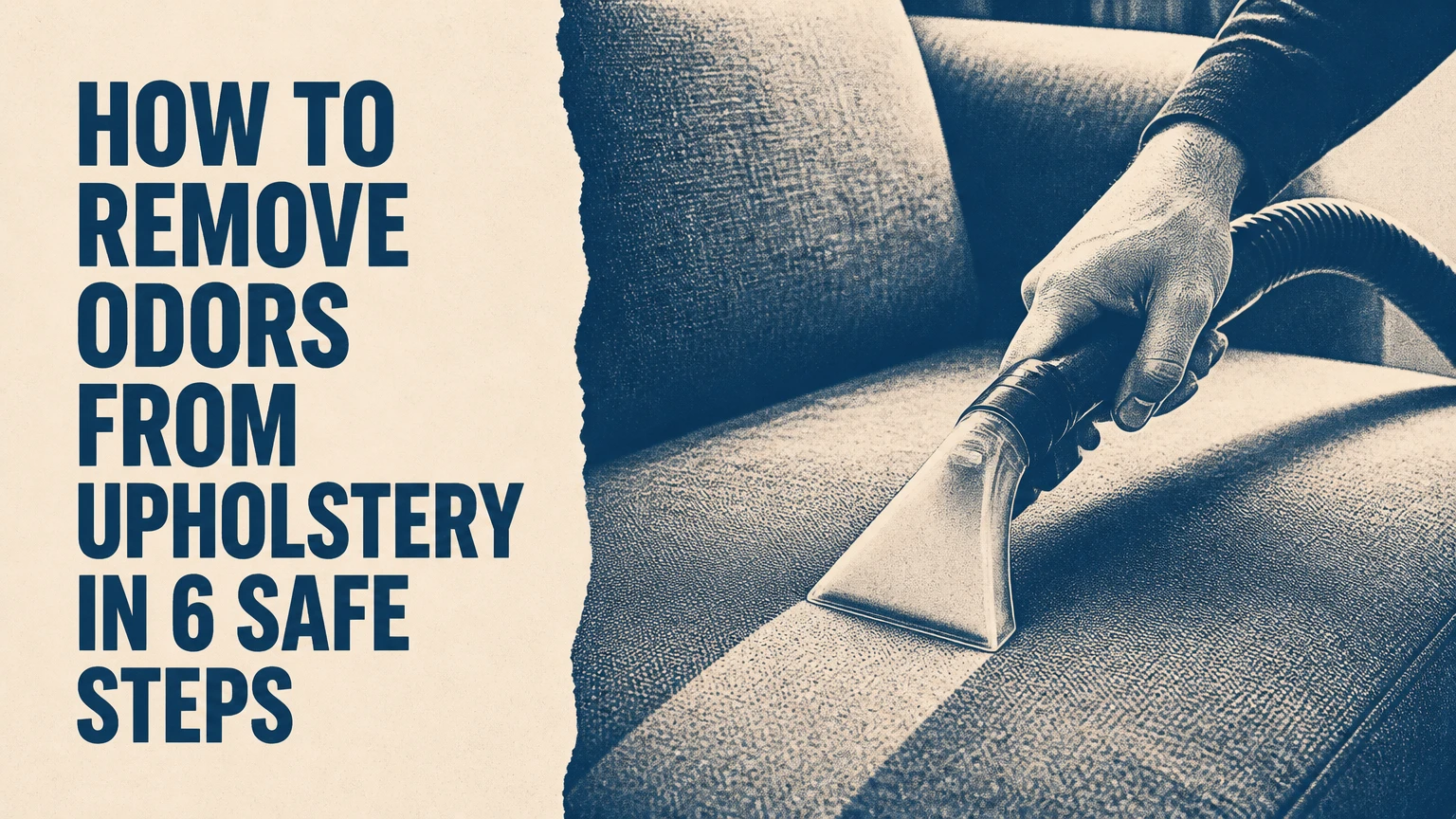
To remove odors from upholstery, identify the odor source, check the fabric-cleaning code, vacuum deeply, treat the contaminant with a compatible cleaner, extract residue, and dry the furniture rapidly. The most important factor is reaching the foam when liquid has penetrated the cushion, because surface deodorizing cannot remove a deep biological or smoke odor.
Key Facts at a Glance
Upholstery odors often reside in cushion foam, batting, seams, and the furniture deck, not only on the visible fabric.
Cleaning code W permits water-based products, S permits solvent-based products, WS permits either system, and X generally limits care to vacuuming or brushing.
Enzyme cleaners suit urine, vomit, milk, food, and other biological residues, but they do not remove fuel, paint, or cigarette-tar chemistry.
Baking soda can reduce light surface odor, but it rarely reaches contaminated foam and may leave abrasive residue.
Upholstery should be dried completely, usually within 6-24 hours, before normal use.
Never mix bleach, ammonia, vinegar, hydrogen peroxide, or commercial cleaners.
Why does upholstery keep smelling?
Upholstery keeps smelling when odor molecules remain in fibers, cushion foam, dust, body oils, pet residue, smoke film, or damp padding. A sofa behaves differently from a countertop because its textile cover, batting, foam, wood frame, and underside can hold separate portions of the same contamination.
Odor diagnosis should begin with location, not product selection. A smell concentrated around one cushion suggests a spill, urine, vomit, or food residue; a smell spread across the entire piece suggests smoke, body oil, environmental humidity, or an old cleaning solution. A sour smell that strengthens after damp weather often indicates moisture in foam or the deck beneath the cushions.
The odor may also come from an adjacent source. Check rugs, walls behind the sofa, pet bedding, floor vents, carpet padding, and the underside of removable cushions before treating the furniture. Otherwise, the upholstery may appear clean while the surrounding source recontaminates it.
Which cleaning code applies?
The upholstery cleaning code determines whether water, solvent, or vacuum-only care is appropriate, but the code is not a guarantee that every household product is safe. Manufacturer care instructions, fiber content, dye stability, backing material, and cushion construction can impose stricter limits.
| Code | Permitted starting method | Main risk | Suitable DIY action |
|---|---|---|---|
| W | Water-based foam, rinse, or extraction | Shrinkage, browning, water rings | Low-moisture test cleaning |
| S | Water-free solvent cleaner | Solvent marks, fumes, dye damage | Ventilated solvent spot test |
| WS | Water-based or solvent system | Water and solvent damage | Choose the lower-risk tested method |
| X | Vacuuming or brushing only | Permanent staining or shrinkage | Vacuum, brush, or consult a cleaner |
| No code | Manufacturer guidance required | Unknown fiber and backing response | Contact maker or professional |
An “S” label does not make steam cleaning safe. An “X” label does not mean that a professional can always wet-clean the furniture; a specialist must inspect the textile and construction first.
How do you remove odors from upholstery?
The safest upholstery odor-removal process has six steps: inspect the material, remove dry debris, identify the source, apply a compatible treatment, extract residue, and dry every layer. The process usually takes 30-90 minutes of active work and 6-24 hours of drying, with deep pet contamination requiring longer dwell time.
Before you start
| Requirement | Typical specification | Why it matters |
|---|---|---|
| Active work time | 30-90 minutes | Covers vacuuming, treatment, and extraction |
| Drying time | 6-24 hours | Depends on foam thickness, airflow, and humidity |
| Basic tools | Upholstery nozzle, crevice tool, white towels, fan | Removes debris and controls moisture |
| Water-safe cleaner | 250-500 milliliters per cushion section | Prevents unnecessary saturation |
| Enzyme product | Enough to wet the contaminated depth | Surface misting cannot reach urine in foam |
| Test area | 5 by 5 centimeters | Reveals dye bleed and texture change |
| Protective equipment | Nitrile gloves and ventilation | Reduces contact with biological residue |
Do not begin with a steam machine, fragrance spray, or large amount of water. Those choices can spread contamination before you know whether the fabric permits moisture.
Step 1: Check the fabric and test the cleaner
Read the sewn-in label, removable-cushion tag, warranty instructions, and care page from the furniture manufacturer. Apply a small amount of the intended cleaner to a hidden area, place a white towel over it for 30 seconds, and inspect the towel for color transfer.
Allow the test area to dry fully. A wet test can look acceptable while drying reveals a ring, darkening, stiffness, or dye migration. Test the actual combination of product, dilution, temperature, and tool because changing any one of those variables changes the result.
You will know it worked when: the dried test patch has the original color, nap, softness, and shape.
Common mistake: treating the visible stain before checking the label, then discovering that water has permanently marked an “S” or “X” fabric.
Step 2: Vacuum the entire piece
Vacuum both sides of removable cushions, the cushion platform, seams, folds, piping, button channels, arms, and the gap between the back and seat. Use a crevice tool for debris and an upholstery nozzle for fabric, keeping suction moderate on delicate weaves.
Remove pet hair before applying liquid. Hair and dander can retain odor, clog extraction tools, and prevent a cleaner from contacting the textile. For microfiber, vacuum in one direction first, then use a soft brush only if the manufacturer permits it.
You will know it worked when: the vacuum collects little additional dust after two slow overlapping passes and the odor is no longer strongest in loose debris.
Common mistake: vacuuming only the seating surface while leaving crumbs and hair compressed under the cushions.
Step 3: Locate and remove the odor source
Use sight, touch, and smell to map the affected area. A blacklight can help locate some old urine deposits, but it also reveals detergent residue, optical brighteners, and unrelated fluorescent materials, so confirm suspected areas by odor and history.
For a fresh spill, press folded white towels into the area without rubbing. Replace towels as they become wet. For a dry biological deposit, gently lift solids with a scraper, bag the waste, and vacuum the remaining particles before wet treatment.
If urine has reached foam, inspect the cushion insert and zipper area. If smoke film covers the entire frame, treat the fabric, underside, nearby walls, and hard surfaces because smoke residue is not confined to the upholstery.
You will know it worked when: the strongest odor location is identified and the treatment area includes the full contamination boundary, not merely the visible spot.
Common mistake: cleaning a small stain halo while leaving the cushion’s interior or furniture deck untreated.
Step 4: Apply the correct odor treatment
Choose the treatment from the contaminant and fabric code. Use an enzyme cleaner for biological residue, a low-moisture upholstery product for general soil, a solvent system for approved “S” fabrics, and dry absorbents only for light surface odor.
For pet urine, use a ready-to-use enzyme product according to its label. The liquid must contact approximately the same depth as the urine, which may require treating the cushion cover and foam separately. Keep the area damp for the label’s dwell time, commonly 15 minutes to 24 hours, then extract or blot as directed.
Enzyme products vary. Some contain enzymes only; others contain microorganisms, surfactants, or fragrance. Do not assume that a product containing “live bacteria” is inherently better, and do not use enzymes on fuel, paint, solvent, or smoke-tar contamination.
For fresh blood, vomit, or milk, begin with cool water and blotting. Heat can set protein residues, although the larger problem is usually incomplete removal rather than heat alone. Follow with a compatible detergent or enzyme cleaner after removing the bulk material.
You will know it worked when: the treated area smells neutral after the product’s dwell time, not merely strongly perfumed.
Common mistake: applying a fine mist to a urine-soaked cushion. A shallow application cannot reach a deep contamination layer.
Step 5: Extract cleaner and dissolved odor compounds
Use a clean, well-maintained upholstery extractor when the fabric code permits water. Make one controlled wet pass followed by two or three slow dry passes, emptying the recovery tank when suction declines. Hand-cleaned fabric should be blotted with white towels until the towel picks up little moisture or residue.
Extraction removes dissolved soil, surfactant, salts, and odor compounds. It does not sterilize furniture, and a household steam machine cannot guarantee mold-spore destruction because temperature, contact time, and penetration vary across the cushion.
Avoid flooding seams, zippers, cushion edges, and wooden rails. Excess water can migrate into batting, loosen adhesives, stain a wood frame, or dry slowly inside foam.
You will know it worked when: the recovered liquid is substantially clearer, the fabric does not feel slick, and no cleaner residue transfers to a dry white towel.
Common mistake: adding more detergent when odor remains. Residue can trap dust and create a new sour smell.
Step 6: Dry the upholstery completely
Blot the surface, separate cushions from the frame, open cushion zippers if permitted, and place air movement across rather than directly against the wet fabric. A fan, dehumidifier, and room temperature around 18-27°C usually dry low-moisture cleaning faster than warm, stagnant air.
Do not return cushions to the frame while their underside remains damp. Check seams, piping, foam edges, and the deck with a dry towel after 6 hours, then again before use. Dense foam may remain wet even when the cover feels dry.
You will know it worked when: the fabric and foam feel dry, the room no longer develops a damp smell after closing the windows, and the odor does not intensify when the cushion is compressed.
Common mistake: using the sofa after the surface dries while moisture remains in the foam.
Which upholstery odor-removal method is best?
The best method depends on the contaminant, fabric code, penetration depth, and drying capacity. Enzyme treatment is the leading choice for biological odors, dry absorbents suit mild surface smells, solvent cleaning suits approved “S” textiles, and professional extraction is safer for widespread or deep contamination.
| Method | Best use | Typical contact or work time | Main limitation |
|---|---|---|---|
| Baking soda | Light stale odor on dry, W or WS fabric | 8-24 hours | Does not remove deep urine or smoke film |
| Enzyme cleaner | Urine, vomit, milk, food residue | 15 minutes-24 hours | Requires correct depth and compatible fabric |
| Upholstery detergent | Body oil and ordinary soil | 20-45 minutes | Residue causes stiffness if overused |
| Solvent cleaner | Approved S-coded fabric | 15-30 minutes | Requires ventilation and solvent testing |
| Steam or hot-water extraction | Water-safe, heavily soiled upholstery | 1-3 hours | Overwetting, browning, and slow drying |
| Professional low-moisture cleaning | Delicate or high-value furniture | 1-2 hours | Typical service cost is $100-$350 |
Baking soda is an absorbent and mild pH buffer, not a deep extraction system. Leave it on dry fabric only, use a thin layer, and vacuum with a machine that can collect fine powder. Cornstarch may absorb surface oil, but it can clump in damp upholstery and should not replace source removal.
White vinegar can reduce some alkaline odors, but it is not a universal urine treatment. Vinegar may leave a temporary acetic smell, affect dyes, and create an ineffective mixture when combined with alkaline cleaners. Never combine vinegar with bleach.
Steam loosens oily soil and can improve odor when the upholstery is water-safe and extracted thoroughly. Steam does not automatically kill mold throughout foam, and heat cannot compensate for poor soil removal or inadequate drying.
How should you treat different upholstery odors?
Pet urine requires depth-matched enzyme treatment; smoke requires broad cleaning of residue-coated surfaces; mustiness requires moisture diagnosis; and sweat or food odors usually respond to vacuuming, detergent, extraction, and rapid drying. The source determines the chemistry.
| Odor source | First treatment | Typical drying or dwell | Escalation point |
|---|---|---|---|
| Dog or cat urine | Enzyme cleaner to cover and foam | 12-48 hours | Odor returns after two complete treatments |
| Vomit or milk | Cool blotting, then enzyme cleaner | 6-24 hours | Sour odor persists inside foam |
| Sweat and body oil | Vacuum, upholstery detergent, extraction | 6-12 hours | Whole sofa remains greasy |
| Cigarette smoke | HEPA vacuum, detergent or solvent by code | 12-48 hours | Tar odor remains after full cleaning |
| Mustiness | Find moisture source, dry, then clean | 24-72 hours | Visible mold or recurring dampness |
| Fuel or paint | Ventilate and isolate furniture | Product-specific | Any strong vapor or fire risk |
How do you remove pet urine odor from a couch?
Remove pet urine odor from a couch by treating the cover, batting, and foam with a compatible enzyme product at the original contamination depth, then extracting and drying the cushion completely. A fragrance spray or surface mist cannot reliably remove uric salts and residue embedded inside foam.
Remove the cover if the care label permits laundering. Treat the foam separately only when the product label allows it, and avoid injecting liquid into cushions that cannot be extracted. Use a plastic barrier beneath the cushion during treatment to protect flooring.
Repeated urine odor after cleaning often means the liquid reached the deck, underside fabric, or floor beneath the sofa. A professional may use ultraviolet inspection, moisture measurement, and controlled sub-surface extraction. Replace foam only after confirming that the frame and surrounding flooring are clean.
How do you remove smoke smell from upholstered furniture?
Remove smoke smell by vacuuming soot, cleaning the entire fabric surface with a code-compatible system, washing removable covers when allowed, and cleaning nearby hard surfaces. Smoke odor persists because nicotine and tar form a film that fragrance cannot dissolve.
HEPA vacuuming reduces loose particulate matter but does not remove bonded smoke residue. Ozone generators are not a casual household deodorizer: EPA guidance warns that ozone concentrations considered safe for people are generally ineffective against indoor contaminants, while higher concentrations can irritate the lungs and damage materials. Keep people, pets, and plants out of any professionally controlled treatment area.
How do you remove musty odors?
Remove musty odors by finding and correcting moisture before deodorizing. Inspect the underside, floor, wall behind the furniture, cushion foam, and nearby carpet; then dry the area and arrange professional evaluation if there is visible mold, persistent dampness, or a water-damage history.
Do not seal a damp cushion in plastic or cover mildew with baking soda. Cleaning may reduce odor while leaving the moisture source active. Porous foam with extensive mold growth may be difficult to restore safely and may require replacement.
What mistakes make upholstery odors worse?
The most damaging mistakes are overwetting, masking, mixing chemicals, treating only the visible fabric, and drying too slowly. Each mistake either drives contamination deeper, creates residue, damages fibers, or gives mold and bacteria more time to grow.
- Overwetting a cushion: use measured applications and extract rather than repeatedly soaking.
- Using perfume first: fragrance combines with smoke, urine, or sour residue and obscures diagnosis.
- Mixing cleaners: bleach with vinegar can release chlorine gas; bleach with ammonia can create toxic chloramines.
- Using alcohol on unknown fabric: isopropyl alcohol can affect dyes, finishes, adhesives, and coated textiles.
- Scrubbing aggressively: friction can spread liquid, distort pile, and abrade delicate fibers.
- Ignoring drying: stagnant, humid conditions prolong odor and increase microbial growth risk.
- Using ozone around occupants: ozone is a respiratory irritant and requires controlled professional use.
- Treating “X” fabric with steam: water damage can become permanent even when the odor improves temporarily.
A useful practitioner rule is to apply the least moisture that can solve the identified problem. More liquid is not more cleaning when the machine cannot recover it.
When should you hire a professional cleaner?
Hire a professional when odor has penetrated non-removable foam, the furniture is antique or expensive, the code is S or X, smoke affects multiple rooms, sewage or floodwater is involved, or the smell returns after two correct treatments. Professional upholstery cleaners can select low-moisture, solvent, or controlled extraction methods based on fiber and construction.
| Situation | DIY suitability | Typical professional price | Typical service time |
|---|---|---|---|
| One W-coded chair, light odor | High | $75-$150 | 45-90 minutes |
| Standard fabric sofa | Moderate | $100-$250 | 1-2 hours |
| Pet urine in removable cushions | Moderate | $150-$350 | 1-3 hours |
| Smoke odor across sofa and room | Low | $250-$700 | 3-8 hours |
| Antique silk, wool, or velvet | Low | $200-$600 | 1-4 hours |
| Flood or sewage contamination | None | Site-specific | Same-day assessment |
Prices are typical U.S. ranges, not fixed quotations; metropolitan labor rates, access, furniture size, contamination severity, and off-site cushion treatment can change the total.
A professional service is not automatically better. Ask which method matches the cleaning code, whether the technician will inspect foam, how wastewater is recovered, what drying equipment is used, and whether the quote includes deodorizing or only surface cleaning.
How do you fix upholstery odor that comes back?
Recurring upholstery odor usually means the contaminant remains in foam, batting, the deck, the underside, or nearby flooring. Reinspect the whole furniture assembly, use a moisture meter if available, and avoid repeating surface sprays until the deepest affected layer is identified.
Water rings usually result from uneven wetting, soil wicking, or mineral residue. On water-safe fabric, a professional can clean the entire panel seam to seam rather than creating another isolated spot. Do not attempt this on S or X fabric without product approval.
Crunchy fabric usually contains dried detergent, mineral, or baking-soda residue. Vacuum thoroughly, then use a compatible rinse or controlled extraction method; a vinegar solution is not a universal fix and may damage some fibers or finishes.
Foam replacement becomes reasonable when urine odor remains after professional extraction, the foam is visibly degraded, or the contamination is extensive and cannot be removed without saturating the furniture. Replace the cushion cover only after the insert, deck, and surrounding source have been addressed.
FAQ
Can baking soda remove a bad smell from a sofa?
Baking soda can reduce mild, dry surface odor on compatible upholstery, especially when the smell comes from loose soil or stale air. It cannot reliably remove urine, vomit, smoke tar, or mold odor inside foam. Apply a thin layer to dry fabric for 8-24 hours, then vacuum completely.
Can I use a carpet cleaner on upholstered furniture?
Use a carpet cleaner only when the upholstery is water-safe, the machine has an upholstery tool, and the manufacturer permits extraction. Carpet machines can deliver too much water, leave detergent residue, or damage foam and backing. Make a hidden test patch and use several dry passes after one controlled wet pass.
How long does upholstery smell after cleaning?
A cleaned cushion may have a temporary product odor for 6-24 hours, while enzyme-treated pet contamination can require 12-48 hours of dwell and drying. A sour or musty odor that becomes stronger as the cushion dries usually indicates residual contamination or trapped moisture rather than normal curing.
Does hydrogen peroxide remove upholstery odors?
Hydrogen peroxide can oxidize some organic stains and odors, but household concentrations may bleach dyes, weaken fibers, or alter finishes. Use it only when the upholstery manufacturer and product label permit it, never mix it with vinegar or bleach, and always test a hidden area until fully dry.
How do I remove odor from car upholstery?
Vacuum seats and crevices, identify whether the odor is in fabric or foam, check the vehicle upholstery material, apply a low-moisture compatible cleaner, and ventilate until fully dry. Avoid flooding seat cushions because wiring, seat sensors, adhesives, and dense foam can retain water.
Should I replace a cushion that still smells?
Replace cushion foam when a strong biological or chemical odor remains after correct source treatment and professional extraction, or when the foam is damaged or mold-contaminated. Do not replace only the cover while retaining contaminated foam, because the odor will usually return through the new textile.
The Bottom Line
To remove odors from upholstery, start with the cleaning code and the odor source, then vacuum, treat the full contamination depth, extract residue, and dry the furniture completely. Baking soda helps with mild surface smells, enzyme cleaners suit biological residue, and professional cleaning is the safer choice for delicate fabrics, smoke damage, mold, and odor trapped in foam. Use the least moisture that can solve the problem, because successful deodorization depends on source removal and complete drying, not perfume.