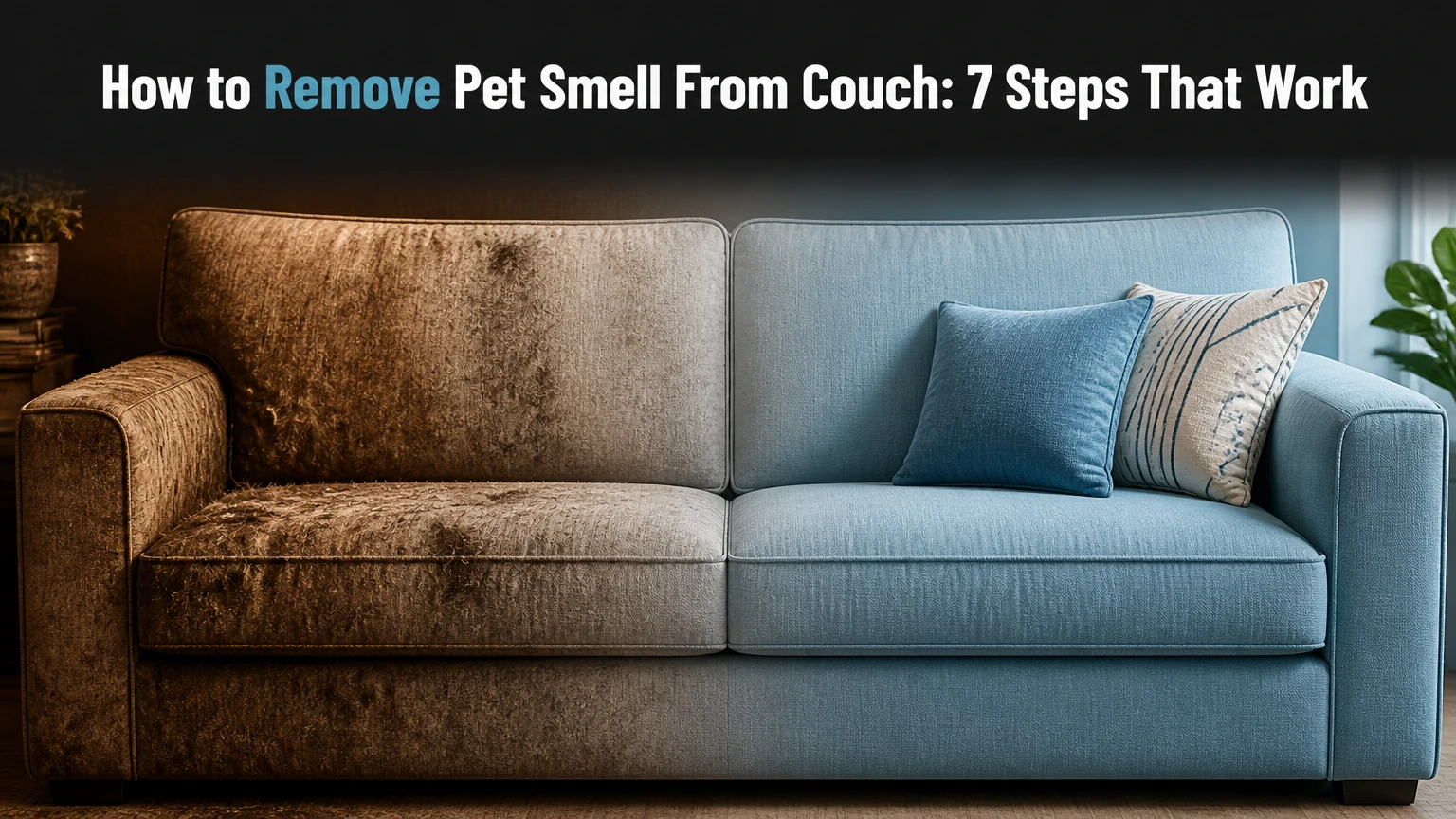
To remove pet smell from a couch, vacuum away hair and dander, follow the upholstery care code, treat urine or other organic residue with an upholstery-safe enzymatic cleaner, and dry every layer completely. The most important factor is reaching the odor source without oversaturating the cushion or applying heat before urine residue is removed.
Key Facts at a Glance
Upholstery code W permits water-based cleaning, while S requires a solvent-based product and X permits vacuuming only.
Enzymatic cleaners are the best first treatment for pet urine, feces, and vomit because they break down organic residues rather than perfume them.
Baking soda can reduce dry surface odor, but it cannot reliably remove urine trapped inside cushion foam.
A damp couch cushion commonly needs 12-48 hours to dry, depending on airflow, foam thickness, humidity, and cleaning volume.
Never combine bleach, ammonia, vinegar, peroxide, or commercial cleaners in the same treatment.
If odor returns during humid weather, the contamination may be inside the foam, batting, deck fabric, or underside of the sofa.
Why Pet Odor Stays in a Couch
Pet smell stays in a couch because upholstery is a layered material, not a single fabric surface. Hair and dander collect on the weave, body oils adhere to fibers, and urine can migrate through batting into foam, where slow evaporation releases odor again when humidity rises.
Fresh surface odor and embedded accident odor require different treatments. Vacuuming and dry deodorizing can address dander, but urine salts and proteins need liquid contact with the contaminated area. A scented spray changes the air temporarily without removing the residue.
The odor source may be farther from the visible stain than expected. Liquid spreads sideways through cushion batting and may reach the zipper seam, cushion underside, sofa deck, or hardwood frame. Cats can also leave small urine deposits that are difficult to see but easy to detect with a UV flashlight in a dark room.
What creates the smell?
| Odor source | Where it collects | Most suitable first action | Typical persistence |
|---|---|---|---|
| Dog hair and dander | Surface weave, seams, cushion gaps | Vacuum and rubber hair removal | 1-7 days without cleaning |
| Pet body oils | Fibers, armrests, headrests | Upholstery-safe detergent cleaning | Several weeks |
| Urine residue | Batting, foam, deck fabric | Enzymatic cleaner with controlled saturation | Months if untreated |
| Vomit or fecal residue | Surface and padding | Remove solids, enzyme treatment | Days to weeks |
| Damp or moldy cushion | Foam core and underside | Drying, inspection, professional assessment | Persistent until moisture ends |
A practitioner rule of thumb is simple: if the smell appears only when the cushion is warm or damp, surface deodorizing has probably not reached the source.
What to Check Before Cleaning
Check the manufacturer’s care label, identify the odor source, and test every product on a hidden area before treating the visible upholstery. A cleaning method that works on a cotton-blend cushion can cause water rings, dye bleeding, shrinkage, or texture change on velvet, linen, suede, or some microfiber fabrics.
Upholstery codes
| Code | Permitted method | Avoid | Practical implication |
|---|---|---|---|
| W | Water-based upholstery cleaner | Uncontrolled soaking | Spot-clean with low moisture |
| S | Water-free solvent cleaner | Water, steam, vinegar | Use a labeled upholstery solvent |
| WS or SW | Water or solvent | Unverified household mixtures | Test both methods before choosing |
| X | Vacuuming only | Water, solvent, steam | Use a professional upholstery cleaner |
| No label | Manufacturer guidance first | Assumptions based on appearance | Photograph the fabric and request advice |
Care codes are not stain-removal guarantees. A W label means the material tolerates an appropriate water-based method, not that a cushion can be saturated. Never remove a fixed upholstery cover by cutting stitches, and do not machine-wash a removable cover unless its sewn label allows it.
Before treatment, inspect dye stability with a white cloth dampened with the proposed cleaner. Press, do not rub, for 10 seconds. If color transfers, stop and use a professional service.
How to Remove Pet Smell From Couch
The safest general process uses seven steps: remove dry contamination, identify the source, wash permitted covers, treat the residue, extract carefully, dry completely, and reassess after 24 hours. A light odor may take 30-60 minutes of active work, while a urine-contaminated foam cushion can require 24-72 hours and repeated treatment.
Before You Start
| Requirement | Typical specification |
|---|---|
| Active cleaning time | 30-90 minutes for a sofa |
| Total elapsed time | 12-72 hours, including drying |
| DIY cost | $10-$35 for cleaner, towels, brush, and bags |
| Enzymatic cleaner | 16-32 fluid ounces for one localized accident |
| Baking soda | 1-2 cups for a standard three-seat sofa |
| Tools | Upholstery vacuum, white towels, gloves, fan, measuring cup |
| Prerequisite | Care code, hidden-area test, ventilation, absorbent towels |
Step 1: Remove Hair, Dander, and Dry Debris
Vacuum the entire couch before applying liquid. Remove cushions, vacuum both sides and every seam, then clean the deck, back, arms, skirt, and the floor beneath the sofa. A rubber pet-hair brush or silicone squeegee can gather hair that an upholstery nozzle leaves behind.
Use a crevice tool around piping and zippers. Empty the vacuum outside if dander aggravates allergies. Wear nitrile gloves when handling areas contaminated by urine, feces, or vomit.
You will know this step worked when: the vacuum collects little additional hair after two slow passes over each section.
Common mistake: spraying deodorizer before vacuuming, which turns loose hair and dander into damp clumps that are harder to remove.
Step 2: Locate and Classify the Odor
Smell each cushion, seam, and the sofa deck separately. Use a UV-A flashlight in a dark room to locate possible urine deposits, but treat fluorescent marks as leads rather than proof because detergent residue and some fibers also glow.
Record whether the odor is general, localized, sour, ammonia-like, musty, or greasy. A general dog smell usually comes from oils and dander; sharp ammonia odor suggests urine breakdown; mustiness suggests retained moisture or microbial growth.
If a cushion smells worse underneath, inspect the batting and foam through the zipper. Do not cut open a non-removable cushion. Photograph the location before applying cleaner.
You will know this step worked when: you can identify a treatment zone instead of wetting the entire sofa.
Common mistake: treating only the visible discoloration while ignoring the cushion underside and adjacent seams.
Step 3: Wash Removable Covers Only When Allowed
Remove washable covers and follow the sewn label, including water temperature, cycle, detergent type, and drying instructions. Use a fragrance-free or odor-neutralizing detergent at the label dose, because excess detergent can leave a film that attracts soil.
Do not automatically add vinegar to the wash. Vinegar can affect dyes, elastic, and some finishes, and it does not replace an enzymatic treatment for urine. Never mix vinegar with chlorine bleach or products containing bleach.
Air-dry covers until the seams and zipper area are fully dry. A cover that feels dry on the outside can still hold moisture in folded hems. Do not reinstall a damp cover over foam.
You will know this step worked when: the dry cover has no sour odor and fits without unusual shrinkage.
Common mistake: using high heat in a dryer before checking fit, which can shrink cotton, linen, and some blended fabrics.
Step 4: Apply an Enzymatic Cleaner to Organic Residue
For urine, feces, or vomit, apply an upholstery-labeled enzymatic cleaner according to its product instructions. Enzyme formulas vary: some use protease, amylase, or lipase; others also include bacterial cultures. Do not assume that every enzyme product contains live bacteria or that a longer dwell time is always safer for fabric.
Use enough product to contact the contaminated layer, but avoid flooding the cushion. For a surface accident on a W or WS fabric, begin with approximately 4-8 fluid ounces over a 12-inch zone, then increase only if the odor clearly extends into the padding. Blot fresh urine first with folded white towels, but old contamination may require controlled wetting to dissolve dried salts.
Allow the label-specified dwell time, commonly 10-30 minutes. Keep pets away during treatment, and do not apply heat, ammonia, bleach, or another cleaner over the enzyme product.
You will know this step worked when: the treated zone smells neutral after drying, rather than strongly perfumed or chemically sharp.
Common mistake: scrubbing aggressively, which drives residue sideways and damages the upholstery nap.
Step 5: Treat General Pet Odor With Dry Deodorizing
For dry dander and body odor on a water-safe couch, spread a thin layer of baking soda over the fabric. One cup is usually enough for a standard sofa, and a thicker layer does not create deeper cleaning.
Leave the powder for 6-12 hours, then vacuum slowly with an upholstery attachment. Sodium bicarbonate can reduce some surface odor by adsorption and chemical buffering, but it is not a substitute for extraction or enzyme treatment when urine has entered foam.
Do not sprinkle baking soda on wet enzyme cleaner. Damp powder can form residue in the weave and make vacuuming difficult. Avoid this method on delicate fabrics if the manufacturer prohibits powders or brushing.
You will know this step worked when: the fabric has less dry, stale odor and no visible powder remains in seams.
Common mistake: relying on baking soda for a cushion that smells worse in humid weather, which indicates a deeper source.
Step 6: Extract Excess Moisture
Use a portable upholstery extractor only on a compatible W or WS fabric and only after the organic residue has had time to react. Make one controlled spray pass followed by two or three slow suction passes. The suction passes matter more than adding more solution.
Use cool or lukewarm water unless the manufacturer specifies otherwise. Steam does not automatically sanitize upholstery, and high heat can set some urine residues, damage adhesives, shrink fibers, or distort foam. If a machine leaves the cushion visibly wet, stop and remove moisture with dry towels and a fan.
Professional hot-water extraction can be effective when the technician understands upholstery construction and uses low moisture where needed. A typical professional service costs $150-$300 for a sofa, while a portable rental or spot extractor commonly costs $30-$60 per day.
You will know this step worked when: the cushion feels evenly damp rather than saturated, and no water transfers to a dry white towel after repeated suction.
Common mistake: making repeated wet passes because the odor remains while the cushion is still damp. Reassess only after complete drying.
Step 7: Dry Every Layer and Recheck the Odor
Separate cushions from the sofa, stand them on edge, open removable covers, and place a fan so air crosses both faces. Ventilation removes moisture more reliably than direct heat. Typical drying times are 12-24 hours for light surface cleaning and 24-48 hours for a cushion treated through its padding.
High indoor humidity, dense memory foam, and a closed cushion cover can extend drying to 72 hours. Do not return cushions to normal use while the foam feels cool, heavy, or damp at the zipper seam.
After drying, smell the sofa in the morning and again after the room becomes humid. If the odor returns, identify whether it comes from the foam, deck, carpet beneath the sofa, wall, or pet bedding.
You will know this step worked when: the cushion has its normal weight and temperature, and the odor remains absent after several hours of closed-room exposure.
Common mistake: using a hair dryer to speed drying, which creates uneven heat and can damage fabric or set remaining urine residue.
Which Pet-Odor Method Should You Choose?
The best method depends on the residue and the upholstery code. Enzymatic treatment is the strongest choice for accidents, baking soda is a low-cost option for dry surface odor, and professional low-moisture cleaning is safer for delicate fabrics, widespread contamination, or cushions that cannot dry quickly.
| Method | Best use | Typical cost | Typical time | Main limitation |
|---|---|---|---|---|
| Vacuum and dry brushing | Hair, dander, loose debris | $0-$20 | 20-40 minutes | Does not remove liquid residue |
| Baking soda | Mild dry fabric odor | $2-$6 | 6-12 hours | Limited effect inside foam |
| Enzymatic cleaner | Urine, feces, vomit | $10-$25 | 12-48 hours | Requires correct fabric compatibility |
| Portable extraction | Water-safe embedded soil | $30-$60 rental | 6-24 hours drying | Overwetting can create musty odor |
| Professional upholstery cleaning | Delicate or deeply contaminated sofa | $150-$300 | 1-3 days total | Higher cost and appointment time |
A useful decision rule is to match the chemistry to the residue. Enzymes address organic contamination, detergent and extraction address oils and soil, and ventilation addresses moisture. No single spray reliably performs all three jobs.
Is vinegar better than an enzymatic cleaner?
Vinegar is not better than an enzymatic cleaner for pet urine. Diluted vinegar may reduce some alkaline odor on compatible water-safe fabric, but it does not reliably digest the proteins and uric compounds that keep urine odor returning, and its acidity can affect dyes or finishes.
Never pour vinegar over an enzyme product, bleach, hydrogen peroxide, or a proprietary cleaner unless the manufacturer explicitly confirms compatibility. Product residues can react unpredictably, and chemical mixing can create irritating vapors.
How to Handle Specific Couch Materials
Material changes the safe cleaning method more than the pet species does. A W-coded polyester sofa can tolerate a carefully controlled enzyme treatment, while an X-coded velvet sofa may require professional dry cleaning or vacuum-only care.
| Material or construction | Safe starting point | Avoid | Drying or inspection requirement |
|---|---|---|---|
| Polyester microfiber, W or WS | Hidden test, low-moisture enzyme | Heavy rubbing, excess water | Brush nap after fully drying |
| Cotton or linen blend | Label-approved spot cleaner | Hot water and high dryer heat | Check for shrinkage and rings |
| Velvet | Vacuum and professional advice | Baking soda brushing, steam | Preserve pile direction |
| Leather or faux leather | Wipe with leather cleaner, clean seams | Saturating, vinegar, enzyme spray | Condition only after dry |
| Suede or nubuck | Professional cleaner | Water-based sprays and powders | Keep liquid away from nap |
| Removable foam cushion | Label-approved enzyme and controlled extraction | Sealing while damp | Dry on edge with airflow |
For leather, remove hair with a soft vacuum brush, wipe the surface with a barely damp cloth, and use a leather-specific cleaner. Pet urine can enter perforations, seams, or unfinished underside material, so a surface wipe may not remove the odor. Faux leather can delaminate when soaked.
Common Mistakes and How to Fix Them
Using ammonia
Ammonia can resemble urine to pets and may encourage renewed marking. If ammonia has already been used, remove the residue with the fabric’s permitted cleaning method, ventilate the room, and wait until the couch is fully dry before applying a compatible enzyme product.
Applying heat before treating urine
Heat can accelerate drying while leaving urine salts and proteins behind, and it can set some stains or damage upholstery adhesives. Blot or extract first, apply a compatible enzyme cleaner, and use ambient airflow rather than direct heat.
Overwetting the foam
Excess liquid moves contamination deeper and creates prolonged drying conditions. A damp foam cushion can develop a musty odor that is difficult to distinguish from the original pet smell. Use measured product, slow suction passes, and a moisture check at the zipper and underside.
Scrubbing the stain
Hard scrubbing spreads liquid laterally and roughens fibers. Blot fresh liquid, press enzyme cleaner into the zone with a towel, and use gentle agitation only when the care label and fabric texture allow it.
Layering incompatible products
Bleach, ammonia, vinegar, peroxide, enzyme products, and fragrances should not be combined. Rinse or extract the previous product as appropriate, allow the fabric to dry, and consult the label before changing chemistry.
Masking the odor with fragrance
Air freshener can make a room smell cleaner while leaving the contamination untouched. Fragrance is acceptable only after removal and drying, and heavily perfumed products can irritate pets or people with respiratory sensitivity.
What to Do When the Smell Keeps Coming Back
Recurring odor usually means the source remains inside foam, batting, deck fabric, or an adjacent absorbent material. Humidity reactivates odor compounds and increases their volatility, so a couch may smell clean when dry and offensive during rain or warm weather.
Remove the cover if the design permits and inspect the foam block, seams, and cushion underside. For a W or WS construction, an upholstery professional may be able to apply enzyme treatment through the contaminated area and extract it without leaving the foam saturated. Drying can take 24-72 hours.
Do not place wet foam in direct, intense sunlight for days without checking the manufacturer’s guidance. Sunlight may fade fabric, degrade latex, heat adhesives, and warp some materials. Air movement, low indoor humidity, and access to both sides are more controllable.
Replace a cushion insert when urine odor remains after two properly executed treatments, the foam has visible discoloration or mildew, or the insert cannot dry within roughly 72 hours. Replacing the insert may cost less than repeated professional cleaning, especially for a removable standard-size cushion.
Variations for Common Situations
Fresh dog urine
Blot immediately with white towels until transfer decreases. Apply an upholstery-safe enzyme cleaner to the affected zone, maintain the labeled dwell time, extract excess liquid, and dry the cushion on edge. Avoid baking soda until the fabric is completely dry.
Old cat urine
Use a UV flashlight, inspect adjacent surfaces, and assume the odor may have reached the foam or sofa deck. A surface mist is rarely enough for old cat urine; use a measured, compatible treatment or hire a technician who handles urine-contaminated upholstery.
General dog smell without an accident
Vacuum hair and dander, wash permitted covers, clean pet bedding, and use baking soda only on dry compatible fabric. If odor returns within a week, clean the armrests, cushion undersides, carpet, and wall behind the couch because the sofa may not be the only reservoir.
A rented or delicate sofa
Photograph the care label and existing marks before cleaning. Use vacuuming and removable washable covers first, then ask the landlord, manufacturer, or professional cleaner about stains and solvents. A failed DIY treatment can create a larger charge than the original odor.
How Much Does Couch Pet-Odor Removal Cost?
DIY pet-odor removal typically costs $10-$35 for an enzymatic cleaner, towels, gloves, and a brush. Portable extraction adds approximately $30-$60 for a rental or machine purchase, while professional upholstery cleaning commonly costs $150-$300 for a standard sofa; severe foam contamination may cost more.
| Situation | DIY materials | Labor time | Professional alternative |
|---|---|---|---|
| Mild dander odor | $2-$10 | 30-60 minutes | $100-$200 |
| One fresh accident | $10-$25 | 45-90 minutes | $150-$250 |
| Multiple cushion accidents | $20-$60 | 2-4 hours | $200-$400 |
| Delicate S or X fabric | $5-$20 for vacuuming | 20-40 minutes | $150-$350 |
| Foam replacement | $40-$200 per insert | 1-2 hours fitting | Custom upholstery pricing |
Prices vary by region, fabric, access, stain age, and whether the technician must disassemble the sofa. Ask whether the quote includes odor treatment, extraction, travel, and drying guidance.
FAQ
Can I leave baking soda on my couch overnight?
Yes, baking soda can remain overnight on dry, compatible upholstery if the manufacturer does not prohibit powders. Use a thin layer for 6-12 hours, then vacuum slowly. Baking soda will not remove urine trapped in foam, and damp powder can leave residue in fabric seams.
How long does pet odor take to disappear?
Mild surface odor may improve after one cleaning session, while urine odor inside foam can require 24-72 hours of treatment and drying. Judge success only after the cushion is completely dry and the room has returned to normal humidity.
Can I use hydrogen peroxide on a couch?
Hydrogen peroxide can bleach or discolor upholstery and should not be used without confirming fabric compatibility. Peroxide also should not be mixed with vinegar, ammonia, bleach, or an enzyme product. A labeled upholstery cleaner is safer than a kitchen or bathroom formulation.
Should I use a steam cleaner on pet urine?
Do not steam-clean untreated pet urine. Heat and moisture can set residue, spread contamination, or force liquid into foam. On a compatible fabric after enzyme treatment, controlled extraction may help, but low-moisture professional cleaning is safer for dense or delicate upholstery.
How do I remove pet smell from a leather couch?
Vacuum seams, wipe leather with a barely damp cloth, and use a leather-specific cleaner approved by the manufacturer. Do not saturate leather, apply vinegar, or spray enzyme cleaner into perforations without professional guidance. Persistent odor may be inside seams, padding, or the unfinished underside.
When should I call a professional cleaner?
Call a professional when the couch is coded S or X, the smell returns after two correct treatments, urine reached non-removable foam, mildew is visible, or the cushion cannot dry within 48-72 hours. Provide the care code and identify every product already used.
The Bottom Line
The reliable way to remove pet smell from a couch is to remove dry debris, identify the contaminated layer, follow the upholstery code, use an enzymatic cleaner for organic accidents, control moisture, and dry the cushion completely. Baking soda helps with mild surface odor, but recurring humidity-activated smells usually require foam-level treatment or insert replacement. Use this process to remove pet smell from couch upholstery without trading a pet odor for water damage or mildew.