
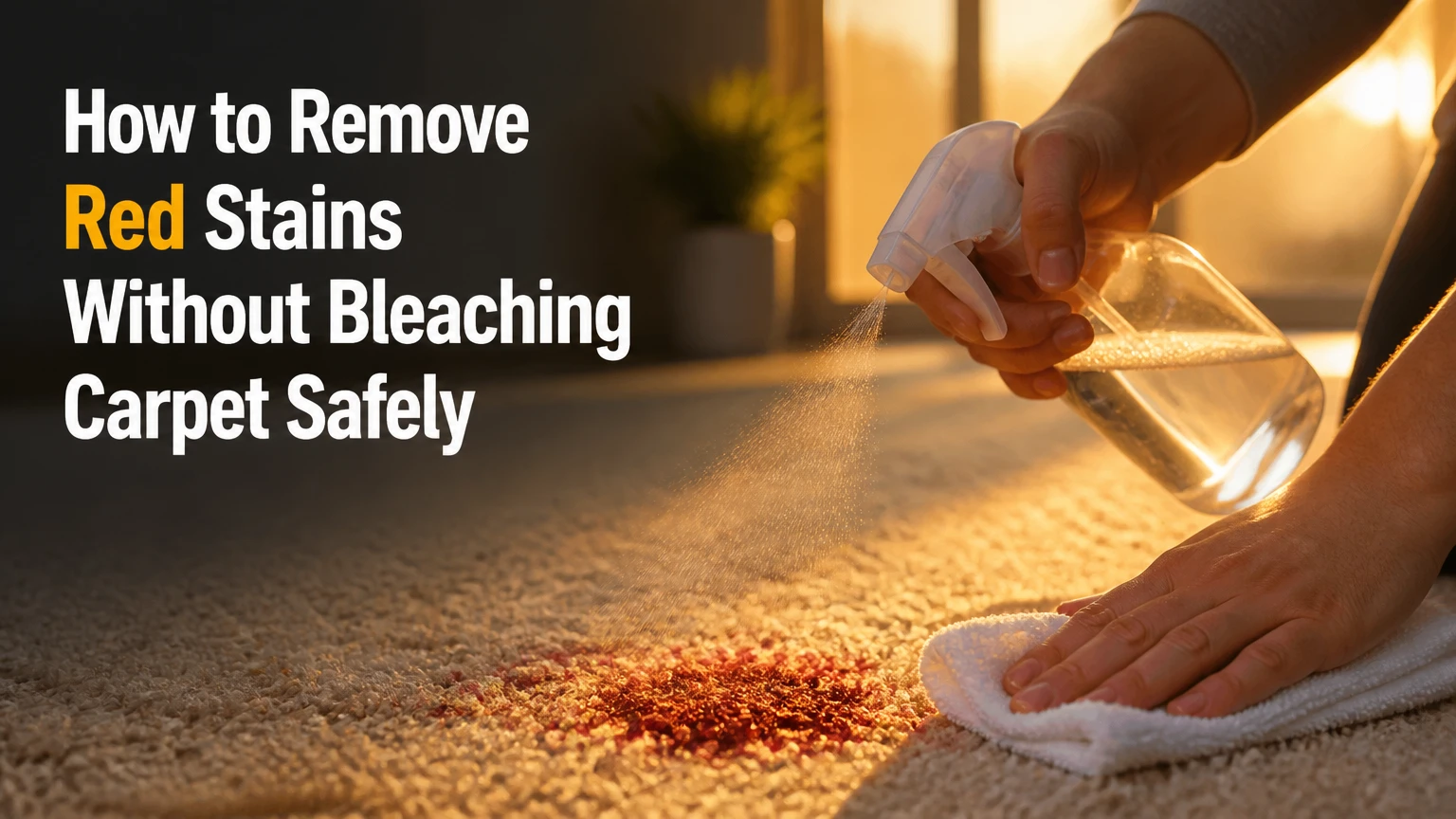
To remove red stains without bleaching carpet, first blot the spill, identify whether it is dye, protein, tannin, or grease, then use a tested neutral detergent or fiber-appropriate stain remover. Apply small amounts, blot from the outside inward, rinse the residue, and dry the carpet quickly. Never scrub or mix chemicals.
Key Facts at a Glance
- Red Kool-Aid, sports drinks, and food coloring usually require a reducing agent, not chlorine bleach.
- Blood is a protein stain, so cold water and an enzyme or neutral detergent are safer starting points than heat.
- Three-percent hydrogen peroxide can remove organic red stains, but peroxide is still an oxidizer and may lighten carpet dye.
- Wool, viscose, cotton, and unknown fibers require label-approved products and a hidden colorfastness test.
- A household iron can melt synthetic carpet, flatten pile, damage backing, or set an uneven color change.
- Most fresh spot treatments take 5-15 minutes, while drying commonly takes 6-24 hours.
Why Do Red Carpet Stains Need Different Treatments?
Red carpet stains are not one chemical category. Artificial beverage dyes can bond strongly to nylon or wool, while blood contains proteins, wine contains tannins and pigments, and tomato sauce may combine water-soluble color with oil.
The treatment must match the stain. A detergent can lift soil and food residue but may leave synthetic dye behind. An enzyme can digest protein in blood but has little value against Kool-Aid coloring. An oxidizer such as peroxide can break down some organic pigments, yet the same reaction can lighten the carpet’s original dye.
The Carpet and Rug Institute’s spot-removal guidance consistently emphasizes prompt action, blotting, and testing cleaning solutions in an inconspicuous area. Those instructions matter because carpet color is part of the fiber, not a separate washable surface.
Identify the Red Substance Before Applying Anything
Use the source, texture, and age of the mark as the initial diagnosis. A wet, sticky beverage stain behaves differently from a dry blood spot or lipstick transfer.
| Stain source | Likely components | First treatment | Avoid first |
|---|---|---|---|
| Kool-Aid or sports drink | Synthetic acid dyes, sugar, water | Cool water plus neutral detergent; professional reducing agent for residual dye | Heat, chlorine bleach, aggressive scrubbing |
| Red wine | Water, tannins, alcohol, natural pigments | Absorbent blotting, neutral detergent, controlled peroxide after testing | Salt piles, hot water, soaking the pad |
| Blood | Proteins, cells, water | Cold water, enzyme or neutral detergent | Hot water, steam, heated iron |
| Tomato sauce | Carotenoid pigments, oil, solids | Remove solids, detergent, rinse, then spot-test peroxide | Rubbing oil deeper into pile |
| Lipstick or makeup | Oils, waxes, synthetic pigments | Carpet-safe solvent or detergent selected for the fiber | Water alone, acetone, nail-polish remover |
| Unknown red mark | Undetermined dye, food, or transfer | Dry blot, water test, professional inspection if color changes | Combining several products |
How to Remove Red Stains Without Bleaching Carpet
A safe household workflow uses six stages: remove solids, blot liquid, test the fiber, apply a measured cleaner, rinse residue, and dry the area. Allow 5-15 minutes for a fresh small spot and stop if the carpet changes color, develops a halo, or releases fiber dye onto the towel.
Before You Start
| Requirement | Typical value | Why it matters |
|---|---|---|
| Treatment time | 5-15 minutes | Covers a fresh spot under 12 inches wide |
| Drying time | 6-24 hours | Prevents judging the result while carpet remains dark |
| DIY material cost | $2-$8 | Includes towels, detergent, and distilled water |
| Supplies | 4-6 white towels, spray bottle, spoon, vacuum | Limits dye transfer and controls liquid volume |
| Solution quantity | 1-2 teaspoons per application | Reduces saturation of pad and backing |
| Test location | 1 hidden area, 5 minutes | Checks colorfastness before visible treatment |
Use white cotton or white microfiber towels, cool distilled water, a teaspoon of clear dye-free dish detergent, and a vacuum. Add an enzyme carpet cleaner for blood or food protein, but follow the product label because enzyme formulas differ in pH and dwell time.
Do not begin with ammonia, chlorine bleach, oxygen bleach, rubbing alcohol, acetone, or a hot iron. “Without bleaching” should mean avoiding chlorine and uncontrolled color removal, not assuming every alternative is color-safe.
Step 1: Remove Solids and Absorb Excess Liquid
Lift dried or semi-solid material with a spoon, dull knife, or plastic card. Place a folded white towel over the wet area and press straight down for 10-20 seconds, then move to a dry section of the towel.
Work from the outside edge toward the center. Circular rubbing spreads liquid across adjacent tufts and can force pigment into the carpet backing.
Success checkpoint: The towel picks up moisture without creating a larger wet ring.
Common mistake: Vacuuming wet sauce or scrubbing dried blood, which spreads the stain and damages pile.
Step 2: Test Carpet Fiber and Colorfastness
Find the carpet fiber on the installation paperwork, manufacturer label, or flooring invoice. Apply one drop of the intended solution to a hidden corner, cover it with a white towel for 30-60 seconds, and inspect both towel and carpet.
A pink, yellow, or carpet-colored transfer means the solution is affecting the original dye. Wool, viscose, silk, cotton, and plant-fiber rugs deserve professional treatment because water and alkaline products can cause shrinkage, browning, texture change, or dye bleed.
Success checkpoint: No original carpet color transfers and the pile dries with its normal texture.
Common mistake: Testing only for visible bleaching while ignoring dye transfer onto the towel.
Step 3: Apply a Neutral Detergent Solution
Mix 1 teaspoon of clear, dye-free dish detergent with 2 cups of cool water. Lightly dampen a white towel or spray the solution onto the towel, then press it onto the stain for 10-15 seconds.
Use no more liquid than needed to dampen the upper fibers. Blot, rotate the towel, and repeat four to six times before reassessing. A neutral detergent is especially appropriate for fresh wine, tomato sauce, and sugary drinks after excess liquid has been removed.
Success checkpoint: The red color transfers to the towel and the stain becomes smaller rather than spreading outward.
Common mistake: Pouring a cup of solution onto the carpet, which wets the pad and increases wicking.
Step 4: Choose the Treatment for the Stain Type
Use cold water and enzyme cleaner for blood, detergent for fresh food and beverage residue, and a labeled reducing agent for persistent synthetic red dye. Use peroxide only after a colorfastness test confirms that the carpet tolerates it.
| Carpet situation | Recommended option | Typical dwell time | Risk level |
|---|---|---|---|
| Fresh wine on nylon | Neutral detergent, then tested 3% peroxide | 1-5 minutes | Moderate |
| Fresh blood on polyester | Cold water and enzyme cleaner | 5-10 minutes | Low to moderate |
| Old Kool-Aid on nylon | Professional reducing agent | Label-specific, often 1-5 minutes | Moderate |
| Red food coloring on polypropylene | Detergent, then labeled dye remover | 1-10 minutes | Moderate |
| Wool rug with unknown red stain | Wool-safe product or professional cleaner | Label-specific | High |
| Lipstick on synthetic carpet | Carpet-safe solvent followed by detergent | 30-120 seconds | Moderate |
For a tested peroxide treatment, use a fresh 3% pharmacy solution and apply only enough to dampen the mark. Let it work for 1-3 minutes while watching the color, then blot and rinse with cool water. The 20-30 minute dwell time often repeated online is unnecessarily aggressive for installed carpet and increases the chance of lightening.
Success checkpoint: The red pigment fades without a pale spot or fuzzy texture.
Common mistake: Treating peroxide as a harmless bleach substitute. Hydrogen peroxide can oxidize the carpet’s original dye.
Step 5: Rinse Cleaning Residue
Mist the treated area with a small amount of cool water, then press with a dry white towel. Repeat once or twice until the towel no longer feels soapy.
Residue attracts soil and can create a darker patch after drying. Professional carpet cleaners use extraction because rinsing removes dissolved stain material and cleaning agents more reliably than surface blotting alone.
Success checkpoint: The towel absorbs mostly clear moisture and the fibers do not feel slick.
Common mistake: Skipping the rinse because the visible stain appears gone.
Step 6: Dry the Carpet Completely
Fold a dry towel over the area and apply hand pressure for 30-60 seconds. Replace it when damp, then position a fan to move air across the carpet; do not use concentrated high heat.
Allow 6-24 hours for complete drying, depending on humidity, pile height, and how much water reached the backing. Keep children and pets away until the surface is dry and all product directions permit re-entry.
Success checkpoint: The carpet matches the surrounding area in color and texture after drying.
Common mistake: Evaluating the stain while wet, when moisture makes carpet look temporarily darker.
Which Red-Stain Method Is Safest?
The safest method is the least aggressive product that matches the stain and passes a hidden colorfastness test. Neutral detergent is the best first choice for fresh food and drink residue, while enzyme cleaner fits blood and protein-based stains; reducing agents are more suitable for persistent synthetic dye.
| Method | Best use | Typical cost | Main limitation |
|---|---|---|---|
| Cool water and blotting | Fresh blood or water-based spill | $0-$2 | Does not dissolve set dye |
| Neutral detergent | Wine, tomato, juice, fresh food | $2-$5 | May leave synthetic red dye |
| Enzyme carpet cleaner | Blood, milk, meat, pet food | $6-$15 | Ineffective on non-protein dye |
| Tested 3% peroxide | Organic pigments on colorfast synthetics | $2-$6 | Can lighten original carpet color |
| Professional reducing agent | Set-in Kool-Aid or beverage dye | $15-$30 retail | Requires label knowledge and rinsing |
| Professional extraction | Large, old, or wicking stains | $100-$300 typical visit | Higher cost and scheduling |
Should You Use Ammonia and an Iron?
Avoid the household ammonia-and-iron method on installed carpet unless a trained carpet technician specifies it for the exact fiber and dye. Ammonia can create irritating vapor, and an iron can melt or distort nylon, polyester, polypropylene, adhesive, and carpet backing; a damp towel does not eliminate those risks.
Heat-transfer methods can move some synthetic dye into a wet white towel, particularly on compatible nylon carpet. However, a clothing iron concentrates heat over a small area, and carpet pile can reach damage temperatures before the operator sees an obvious burn.
Never mix ammonia with chlorine bleach or acidic products. Ammonia fumes can become dangerous when combined with bleach. If a professional uses controlled heat, the technician should protect the backing, control temperature, ventilate the room, and verify the manufacturer’s care instructions.
Is Hydrogen Peroxide Safe for Carpet?
Three-percent hydrogen peroxide is conditionally safe on some colorfast synthetic carpets, but it is not universally safe and is not a truly non-bleaching chemical. Peroxide oxidizes organic color compounds, and the same mechanism can fade carpet dye, especially on wool, viscose, dark colors, and sun-exposed areas.
Use a drop test, short dwell time, minimal liquid, and immediate rinsing. Do not use beauty-supply peroxide such as 10-volume, 20-volume, or 40-volume developer on carpet. Those products can contain stronger peroxide concentrations, conditioners, alkalinity, or additives that increase fiber and color damage.
What Works for Specific Red Stains?
Different red stains require different first actions. Blood needs cold treatment, synthetic beverage dye may need reduction, and wine usually benefits from absorption followed by controlled detergent treatment.
Red Wine
Blot wine immediately with a white towel, then use 1 teaspoon of clear detergent in 2 cups of cool water. If a red shadow remains on a tested synthetic carpet, apply a small amount of 3% peroxide for 1-3 minutes, blot, rinse, and dry.
Do not cover the spill with salt. Salt can add moisture, leave residue, and does not reliably remove bonded carpet dye.
Blood
Use cold water, never hot water, because heat can set protein into carpet fibers. Apply a labeled enzyme cleaner for 5-10 minutes if the fiber permits, then blot and rinse.
Wear disposable gloves when handling blood and follow local public-health guidance for larger contamination. A professional should handle extensive blood loss, contamination through the backing, or areas that cannot be fully rinsed and dried.
Kool-Aid, Sports Drinks, and Food Coloring
Blot sugar and liquid first, then use neutral detergent. If the red color remains after rinsing, a professional-grade reducing agent designed for carpet dye is usually more appropriate than peroxide.
Synthetic acid dyes can be unusually persistent on nylon and wool. A stain that turns orange or yellow after treatment may be partially reduced rather than removed, so repeated chemical experiments can damage the original carpet while leaving the remaining dye.
Tomato Sauce and Berries
Remove solids, absorb oil, and treat with detergent before considering peroxide. Tomato sauce may require multiple small applications because oil can hold pigment in the pile.
Berries contain natural anthocyanin pigments that may respond to mild detergent and controlled oxidation, but the result depends on carpet color and fiber. Test first.
What Should You Avoid When Removing Red Carpet Stains?
Avoid scrubbing, colored towels, chlorine bleach, uncontrolled heat, chemical mixing, and excessive water. These mistakes either spread the stain, add a second dye, damage fibers, or move contamination into the pad.
- Scrubbing: Frays and distorts pile, then drives pigment toward the backing.
- Colored cloths: Cleaning solution can release towel dye into the carpet.
- Chlorine bleach: It removes or changes carpet color and can weaken fibers.
- Baking soda paste: It may leave powder in the backing and does not neutralize most synthetic red dyes.
- Vinegar: Dilute vinegar may help with odor or alkaline residue, but it is not a dependable red-dye remover and can react poorly with other products.
- Rubbing alcohol: Alcohol can dissolve some makeup components but may spread pigment and affect latex or backing adhesives.
- Steam or hot water on blood: Heat can set protein and worsen the mark.
- Mixing products: Never combine peroxide, ammonia, bleach, vinegar, or commercial chemicals unless the label explicitly permits it.
A practitioner rule is to use one chemistry at a time and rinse before changing chemistry. That rule prevents invisible residues from reacting with the next product.
Why Did the Red Stain Come Back?
A red stain that reappears after drying usually indicates wicking from the carpet backing or pad, not a failure of surface blotting alone. Dissolved dye and moisture travel downward, then return toward the tips as the carpet dries.
Blot the surface again with a small amount of cool water, place several layers of white towels over the area, and weight them with a flat, waterproof object for 2-4 hours. Replace saturated towels, then use airflow until the carpet is dry.
Brown or yellow discoloration may indicate cellulosic browning, especially in cotton-backed rugs or carpet containing jute. Additional peroxide can worsen that color change, so professional inspection is preferable when the stain returns with a brown halo.
How Do You Remove an Old Red Stain?
An old red stain requires diagnosis, controlled rehydration, and a maximum of two or three treatment cycles rather than repeated soaking. Vacuum loose soil, test the fiber, lightly apply the correct cleaner, blot, rinse, and dry fully between attempts.
Set-in synthetic dye often resists household detergent. A professional reducing product may alter the dye molecule without stripping the surrounding carpet color, but the technician must first determine whether the carpet is nylon, polyester, polypropylene, wool, or a blended construction.
Old stains also conceal texture damage. If the pile is crushed, the area may remain visibly different even after the color improves. Stop treatment when the white towel shows carpet color, the spot expands, or the carpet develops a pale edge.
When Should You Call a Professional?
Call a professional when the red stain covers more than 1 square foot, reaches the pad, persists after two controlled attempts, returns after drying, or appears on wool, viscose, silk, or an expensive area rug. Professional extraction and dye-reduction products reduce the risk of permanent color loss.
| Situation | DIY limit | Professional reason | Typical price |
|---|---|---|---|
| Fresh spot under 6 inches | 2 treatment cycles | Usually manageable at home | $2-$8 |
| Set-in synthetic dye | 1 gentle cycle | Requires reducing chemistry | $75-$200 spot service |
| Spill larger than 1 square foot | Blot only, then assess | Pad saturation and wicking risk | $100-$300 visit |
| Wool or viscose rug | Hidden test only | Fiber and dye instability | $100-$500 rug service |
| Returning brown or red stain | One extraction attempt | Backing, pad, or browning issue | $125-$350 visit |
| Blood contamination through backing | No deep DIY treatment | Hygiene and extraction requirements | Quote-based |
The most expensive mistake is not buying the wrong cleaner. It is repeatedly wetting a stain until the pad, backing, and surrounding dye become involved.
The Bottom Line
To remove red stains without bleaching carpet, blot first, identify the stain, test the fiber, and start with a measured neutral detergent solution. Use cold water for blood, a short tested 3% peroxide application only on compatible colorfast carpet, and a professional reducing agent for persistent synthetic beverage dyes. Rinse, dry, and stop before the original carpet color changes.
Frequently Asked Questions
Can vinegar remove red stains from carpet?
Vinegar is not a reliable remover for bonded red beverage dye, blood, or wine pigment. A diluted solution may neutralize alkaline residue or reduce odor, but vinegar should never be mixed with bleach, ammonia, peroxide, or an unknown commercial cleaner. Use a labeled carpet product or neutral detergent instead.
Does baking soda remove red wine from carpet?
Baking soda can absorb a small amount of surface moisture, but it does not reliably dissolve wine tannins or synthetic carpet dye. A paste can lodge powder in the pile and backing. Blot the wine, apply diluted neutral detergent, rinse lightly, and use tested peroxide only when the fiber and color permit it.
Can red stains be removed from polyester carpet?
Many red stains can be removed from polyester carpet because the fiber resists some water-based dyes, but polyester is not immune to permanent staining or color change. Treat fresh spills promptly, use a hidden test, and select a reducing agent only when its label specifically lists polyester carpet.
How long should a carpet stain remover sit?
Most household spotters should sit for 1-10 minutes, according to the product label and stain type. A short 1-3 minute peroxide dwell is more conservative than leaving peroxide for 20-30 minutes. Never allow a treatment to dry on the carpet unless the manufacturer explicitly instructs you to do so.
Will professional carpet cleaning remove every red stain?
Professional cleaning cannot guarantee removal of every red stain. Permanent dye change, fiber damage, sunlight fading, backing contamination, and previous bleach or peroxide exposure can remain after extraction. A qualified technician can improve many stains while identifying when color repair or partial carpet replacement is more realistic.