
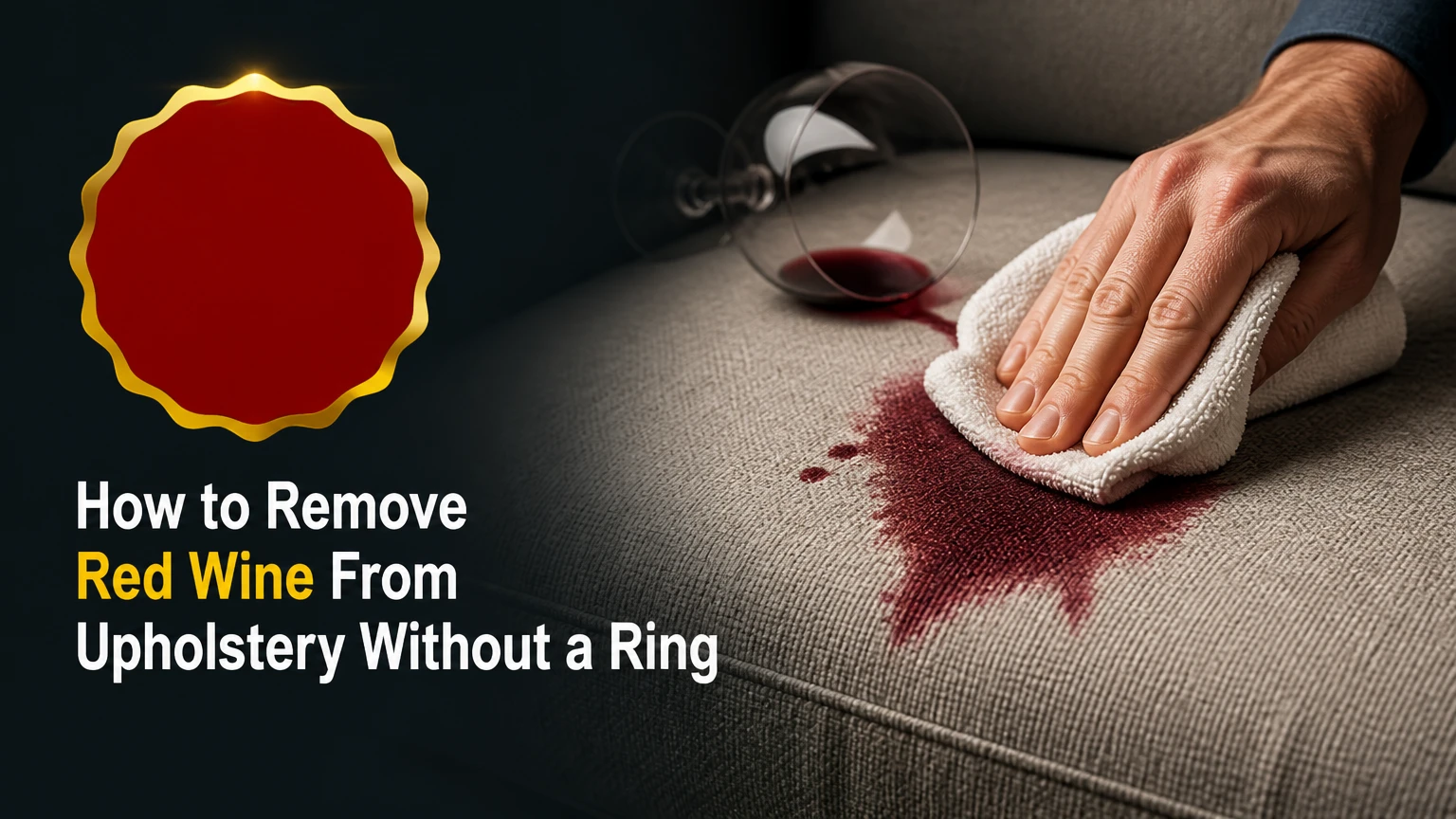
To remove red wine from upholstery, blot the spill immediately, identify the furniture’s cleaning code, then apply the smallest suitable amount of water-based cleaner or solvent. A fresh stain usually takes 5-15 minutes of active work, but the upholstery must dry fully before you judge the result or repeat treatment.
Key facts at a glance
White towels are safer because colored textiles can transfer dye to damp upholstery.
Upholstery code W permits water-based cleaning, S permits a solvent, S/W permits either, and X means vacuum-only or professional care.
Never rub red wine into upholstery; rubbing spreads pigment and pushes liquid into the cushion foam.
A 3% hydrogen peroxide solution can lighten upholstery dye as well as wine pigment, so patch-testing is mandatory.
Salt may absorb surface liquid, but it does not remove a set stain and can leave abrasive residue.
Drying speed matters: trapped moisture can cause odor, browning, mildew, or a visible water ring.
What should you do immediately after a red wine spill?
Immediately remove cushions if possible, place an absorbent towel beneath the affected area, and blot from the outside edge toward the center. Do not add water, soap, salt, or peroxide until the free wine has been removed and the care code has been checked.
Use a clean white microfiber cloth or several layers of plain white paper towel. Press vertically for 5-10 seconds, lift, rotate to a dry section, and repeat. Replace the towel when it becomes pink or saturated. The objective is extraction, not friction.
If the spill reached a cushion seam, inspect the underside and the foam cavity. A surface that looks nearly clean can still contain wine below the fabric, where it later wicks upward during drying. Keep the affected cushion separate from painted wood, untreated leather, and light-colored adjacent textiles.
The first five minutes
- Remove solids or glass fragments without dragging them.
- Blot pooled wine with a white towel.
- Work from the perimeter toward the center.
- Check the cleaning code under a cushion or on the platform.
- Test the chosen product on a hidden 2-inch area.
Success checkpoint: the towel picks up little or no red color after several presses, and the upholstery feels damp rather than soaked. Common mistake: scrubbing because the stain appears larger while wet. Wet fabric often shows a temporary halo that contracts as it dries.
How do upholstery cleaning codes change the method?
Upholstery cleaning codes determine whether water, solvent, or neither should contact the fabric. The code is a risk-control instruction, not a guarantee that every cleaner bearing the right chemistry is safe.
| Code | Permitted approach | Typical examples | Main risk |
|---|---|---|---|
| W | Water-based upholstery cleaner | Polyester, nylon, many acrylic blends | Water ring, browning, foam saturation |
| S | Water-free solvent | Some microfiber, velvet, wool blends | Dye bleed, fumes, flammability |
| S/W | Water-based or solvent cleaner | Mixed synthetic upholstery | Product-specific color loss |
| X | Vacuum only or professional cleaning | Delicate, antique, unknown fabrics | Permanent staining or fabric damage |
| No label | Manufacturer guidance first | Vintage or custom furniture | Incorrect chemistry or finish damage |
Labels vary by manufacturer, and a removable cover can have a different washing instruction from the fixed upholstery underneath. Follow the furniture maker’s manual when it conflicts with a generic online recipe.
A hidden-area test should check for dye transfer, lightening, texture change, stiffness, and a drying ring. Wait until the test patch is completely dry, because some color damage appears only after evaporation.
Which red wine removal method is safest?
The safest method is the least aggressive one that matches the care code and stain age. For most code W synthetic upholstery, begin with diluted dish detergent; reserve peroxide for light, colorfast fabric after a successful test. For code S upholstery, use a labeled upholstery solvent or 70% isopropyl alcohol only when the manufacturer permits it.
| Method | Quantity | Suitable code or material | Typical active time | Main limitation |
|---|---|---|---|---|
| Dish detergent rinse | 1/4 teaspoon detergent in 1 cup cold water | W, colorfast synthetics | 10-20 minutes | May leave residue if not rinsed |
| Vinegar detergent mix | 1 tablespoon detergent, 1 tablespoon vinegar, 2 cups water | W or some S/W synthetics | 15-25 minutes | Acid does not remove every dye |
| 3% peroxide mix | 2 parts peroxide, 1 part detergent | Light, tested W fabric | 10-20 minutes | Can bleach or yellow some fibers |
| 70% isopropyl alcohol | Apply lightly, do not dilute | Tested S microfiber | 10-20 minutes | Flammable and unsuitable for some finishes |
| Commercial wine remover | Manufacturer’s dose | Label-compatible upholstery | 5-30 minutes | Formula and dwell time vary |
| Professional extraction | Cleaner-selected chemistry | X, luxury, large, or old stains | 1-3 hours onsite | Typical cost of $100-$300 |
The table gives typical household ranges, not guaranteed success rates. Stain outcome depends on dye concentration, fabric construction, protective finish, backing, foam depth, and how long the wine remained wet.
How do you clean a code W sofa with detergent?
Mix 1/4 teaspoon of clear, dye-free dish detergent with 1 cup of cold distilled water. Dab the foam onto a white cloth, press the cloth onto the stain from edge to center, then rinse with a second cloth barely dampened with plain distilled water.
Do not pour the mixture directly onto the cushion. A folded towel placed beneath a removable cover can catch transferred liquid, but do not force liquid through the fabric into foam. Change cloth sections frequently so lifted wine does not return to the upholstery.
After rinsing, press dry towels over the area for 30-60 seconds. Aim a fan across the surface, not directly into a seam, and allow 4-8 hours before evaluating the color.
Success checkpoint: the stain becomes lighter on each blot and the fabric returns to its original texture when dry. Common mistake: using a tablespoon of detergent in a small bowl, which creates a sticky residue that attracts soil.
Can hydrogen peroxide remove red wine from upholstery?
A tested 3% hydrogen peroxide and dish-detergent mixture can oxidize red wine pigment on some light-colored, code W upholstery. It is not a universal upholstery cleaner because peroxide can remove the fabric’s dye, weaken some finishes, or create a pale patch.
Use two parts ordinary 3% hydrogen peroxide and one part clear dish detergent. Apply a small amount with a white cloth, allow 5 minutes of dwell time, then blot and rinse lightly with distilled water. Do not mix peroxide with vinegar, chlorine bleach, ammonia, or other cleaners.
Peroxide is a poor choice for dark navy, burgundy, black, printed, antique, silk, wool, and untested upholstery. Treat the hidden patch as a colorfastness test, not a formality. If the cloth picks up the upholstery’s own color, stop.
Expert rule: oxidation should be the second-line treatment, not the first response. Removing excess wine mechanically first reduces chemical exposure and lowers the amount of moisture entering the cushion.
How should you clean code S microfiber or velvet?
Use a compatible upholstery solvent, or 70% isopropyl alcohol only after a hidden-area test and adequate ventilation. Mist the cloth rather than flooding the furniture, blot the wine transfer, and allow the area to dry completely before restoring the nap with a soft brush.
Alcohol evaporates quickly, which reduces water-ring risk on some microfiber. It still can dissolve finishes, move dyes, or damage backing, and its vapor is flammable. Keep the area away from candles, gas flames, heaters, cigarettes, and electrical sparks.
Velvet requires special caution because the pile can flatten or change direction. Blot without twisting, never scrub across the nap, and brush only after the fabric is fully dry. Silk, rayon, antique velvet, and luxury wool should go to a professional cleaner rather than receive an improvised alcohol treatment.
Success checkpoint: the fabric dries without a hard edge, shiny patch, or nap reversal. Common mistake: spraying alcohol directly until the cushion is wet, which defeats the low-moisture advantage.
Is vinegar better than peroxide for upholstery?
Vinegar is generally less likely than peroxide to bleach a tested synthetic fabric, but it is not automatically more effective at removing red wine. Vinegar changes acidity and can help with odor or some discoloration, while detergent provides most of the lifting action.
For a tested code W or S/W fabric, mix 1 tablespoon of clear dish detergent, 1 tablespoon of distilled white vinegar, and 2 cups of cold distilled water. Apply the solution to a cloth, dab the stain, blot with dry sections, then lightly rinse with plain water.
Do not use vinegar on unsealed wood, some natural stone surfaces, or upholstery whose manufacturer prohibits acidic products. Never combine vinegar with bleach or peroxide. A persistent vinegar smell usually indicates excess solution, not a need for stronger fragrance.
How do you remove a dried red wine stain?
Rehydrate a dried red wine mark with a compatible cleaner before attempting extraction, but avoid improvised glycerin treatments unless a professional or manufacturer specifically recommends them. Glycerin can leave a difficult residue and may make later rinsing harder.
For tested code W fabric, place a cloth dampened with the detergent solution over the mark for 5 minutes. Lift loosened pigment with repeated dabs, rinse sparingly, and dry thoroughly. A commercial oxygen-based wine remover can be more predictable when its label explicitly permits upholstery.
Dried stains often require two or three controlled applications separated by complete drying. Repeated saturation is worse than a partially visible stain because the foam can retain moisture and produce a larger wick mark.
| Stain condition | Typical active work | Typical drying time | Sensible next step |
|---|---|---|---|
| Fresh, under 15 minutes | 5-15 minutes | 4-8 hours | Blot, then use mild compatible cleaner |
| Damp, 15 minutes-4 hours | 15-30 minutes | 6-12 hours | Detergent or labeled remover |
| Dry, 1-3 days | 30-60 minutes | 8-24 hours | Rehydrate, treat, reassess when dry |
| Large or foam-soaked | 45-90 minutes | 12-24 hours | Professional extraction |
| Unknown or X code | Do not improvise | Manufacturer-dependent | Professional inspection |
These are typical practitioner ranges, not a guaranteed stain-removal percentage. A dry stain on pale polyester can respond better than a fresh stain on unstable red upholstery dye.
What should you avoid when removing wine from upholstery?
Avoid rubbing, hot water, untested oxidizers, excessive liquid, colored towels, and aggressive brushing. These actions can spread pigment, create dye transfer, set a ring, damage pile, or move wine into the foam.
- Hot water: use cool or room-temperature water; heat is unnecessary and may accelerate dye migration.
- Salt: use it only as a short-term absorbent for a fresh surface spill, then remove it completely. Salt does not pull a set stain from upholstery fibers.
- Baking soda: dry powder can absorb surface moisture, but it is not a reliable treatment for red pigment and can leave alkaline residue.
- White wine: white wine may dilute red wine slightly, but it adds liquid and does not neutralize the stain.
- Bleach: household chlorine bleach can destroy upholstery color and should not be used as a general stain remover.
- Steam: heat and moisture can drive wine deeper or set a ring when the fabric is not designed for steam cleaning.
- Hair dryers: concentrated heat can dry an edge too quickly and produce uneven browning.
Practitioner insight: a smaller, controlled damp patch is usually easier to dry evenly than a visibly clean but saturated cushion. Upholstery cleaning is partly a moisture-management problem.
How can you fix a water ring or blue-gray stain?
A water ring usually results from uneven drying, while a blue-gray mark can result from a pH shift in wine pigment or from dye transfer. Stop adding chemicals, let the area dry, and diagnose the pattern before treating it again.
For a light ring on code W fabric, lightly mist distilled water across the entire cushion panel from seam to seam, not only inside the ring. Blot evenly with several dry towels and dry with moving air. This reduces the sharp moisture boundary that creates a tide mark.
If a red wine spot turns blue-gray after alkaline detergent, do not immediately add lemon juice or vinegar. First rinse away residue with a barely damp cloth, allow the fabric to dry, and then follow the care label. Acid can change the color again without removing the underlying pigment.
If the upholstery has a printed pattern, unstable dye, deep pile, or a ring larger than a dinner plate, stop home treatment. A professional can inspect the backing and use controlled extraction rather than layering unpredictable pH changes.
When should you call a professional upholstery cleaner?
Call a professional when the tag reads X, the upholstery is silk, rayon, antique velvet, unfinished leather, or wool, or the wine reached the foam, seams, or a large section. Professional help is also sensible when two careful applications have not improved the stain.
Typical professional upholstery cleaning costs range from $100-$300 for a sofa or sectional, with location, fabric testing, access, stain size, and specialty treatment affecting the quote. Ask whether the price includes stain treatment, deodorizing, drying advice, and protection reapplication.
Look for an IICRC-certified technician or a cleaner who documents fiber identification and performs a colorfastness test. A reputable technician should explain the likely limitation before applying strong chemistry. No cleaner can guarantee removal when wine has permanently dyed the fiber or altered the upholstery finish.
What information should you give the cleaner?
Provide the wine type, approximate spill time, previous products, care code, fabric content, and whether the cushion is removable. Photograph the stain before treatment if the furniture is rented, insured, or under a warranty.
Tell the technician if peroxide, vinegar, alcohol, bleach, carpet cleaner, or steam has already been used. Residues can alter the next product’s performance and change how the fabric reacts.
How much does DIY red wine removal cost?
A basic household treatment typically costs $0-$15 when white towels, distilled water, and dish detergent are already available. A dedicated wine-removal spray commonly costs about $8-$20, while professional treatment for a sofa typically falls within $100-$300.
| Approach | Typical supply cost | Active labor | Drying requirement | Best financial case |
|---|---|---|---|---|
| Detergent and water | $0-$5 | 10-20 minutes | 4-8 hours | Fresh W-code spill |
| Vinegar mixture | $2-$6 | 15-25 minutes | 4-8 hours | Odor plus light stain |
| Peroxide treatment | $4-$10 | 10-20 minutes | 4-8 hours | Tested pale W fabric |
| Commercial remover | $8-$20 | 10-30 minutes | 4-12 hours | Dried or recurring spills |
| Professional cleaning | $100-$300 | 1-3 hours onsite | 8-24 hours | X code, luxury, or deep spill |
DIY is not always cheaper if the furniture is expensive or irreplaceable. A failed peroxide test can create a permanent light patch that costs more to repair than an initial professional visit.
How do you prevent another upholstery wine stain?
Keep white microfiber towels, distilled water, a clear detergent, and a care-code-compatible spot cleaner together in a labeled container. Treat spills promptly, and avoid applying fabric protector unless the product is approved for the specific upholstery fiber and finish.
For party areas, use washable throws over fixed seating rather than plastic covers, which can trap condensation and alter the fabric’s appearance. Do not store peroxide in a mixture with detergent; make fresh diluted solution because peroxide loses strength after exposure to light and contamination.
Record the furniture manufacturer, fabric code, and cleaning instructions before a spill occurs. That small preparation removes the most consequential delay: deciding whether water is safe.
FAQ
Does club soda remove red wine from upholstery?
Club soda is mostly water with dissolved carbon dioxide, so it does not provide a special red-wine neutralizing reaction. It may dilute a fresh surface spill, but repeated pouring increases moisture and water-ring risk. Blot first, then use a small amount of the cleaner allowed by the upholstery code.
Can I use laundry detergent on a fabric sofa?
Laundry detergent is usually too concentrated for spot application and may contain optical brighteners, enzymes, fragrances, or dyes that leave residue. Use a clear, low-dose dish detergent or upholstery cleaner approved for the care code, then rinse sparingly and dry completely.
How do I remove red wine from a removable cushion cover?
Check the cover’s sewn-in washing label rather than assuming the underlying furniture code applies. If machine washing is permitted, rinse the stain from the reverse side with cool water, pre-treat according to the label, and do not tumble-dry until the stain has disappeared.
Will red wine permanently stain a white sofa?
Red wine can permanently discolor white upholstery when its pigment bonds to the fiber, the fabric dye is unstable, or earlier heat and friction set the mark. Prompt blotting followed by a tested code W treatment gives the best chance, but a professional may be needed for a large or dried stain.
How do I remove wine odor after the color is gone?
Remove odor by extracting cleaner and wine residue, then drying the upholstery thoroughly with moving air. Do not mask the smell with fragrance. If odor remains after 24-48 hours, wine may have entered the foam, requiring professional extraction or cushion-core treatment.
Can red wine damage leather upholstery?
Red wine can stain unfinished or absorbent leather and damage its finish if treated with vinegar, peroxide, alcohol, or excess water. Blot immediately, use the leather manufacturer’s cleaner only after testing, and contact a leather-restoration specialist when the surface becomes tacky, pale, cracked, or darkened.
The bottom line
To remove red wine from upholstery, blot first, identify the W, S, S/W, or X code, and apply a measured cleaner without soaking the cushion. Start with mild detergent on compatible water-cleanable fabric, use peroxide only after testing light colorfast upholstery, and use solvent methods only when the material permits them. Dry the area evenly, reassess when fully dry, and call a professional for luxury, unknown, X-code, large, or foam-soaked furniture.