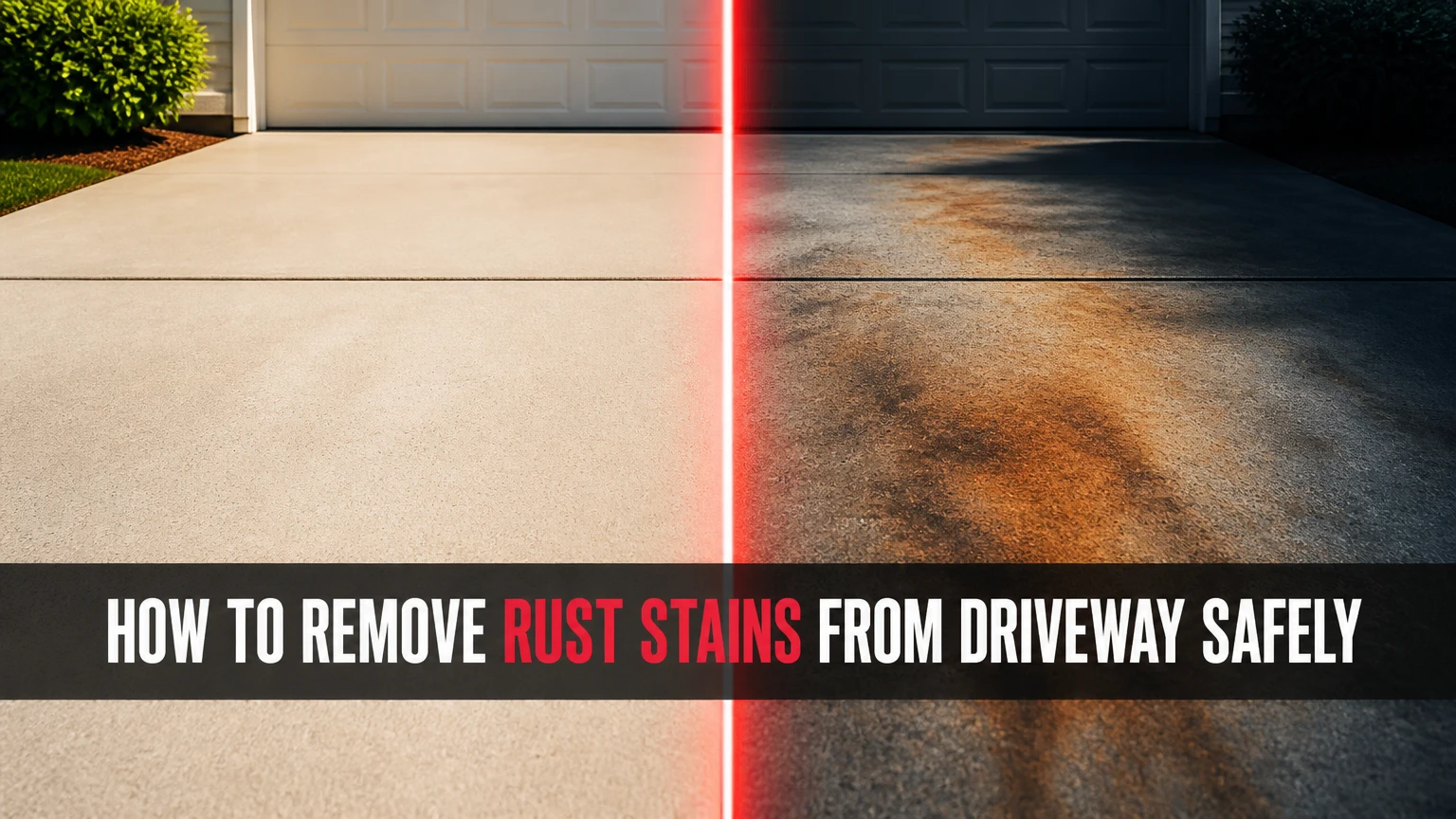
To remove rust stains from a driveway, identify the surface, apply a labeled rust remover containing oxalic, citric, or phosphoric acid, keep it wet for the stated dwell time, scrub with nylon, and rinse thoroughly. Light stains may respond to vinegar, while deep stains usually require a commercial product and source correction.
Key Facts at a Glance
- Oxalic-acid rust removers typically work on concrete in 15-30 minutes when they remain wet.
- Vinegar is suitable only for small, light rust marks and may require repeated applications.
- Muriatic acid can remove discoloration by etching concrete, but it can damage asphalt, plants, metal, colored concrete, and masonry joints.
- A pressure washer removes loosened residue; pressure alone often cannot dissolve rust embedded in concrete pores.
- A test patch is necessary on stamped, colored, sealed, natural-stone, or older deteriorated surfaces.
- Rust that returns usually has an active source, such as iron-rich irrigation water, fertilizer, metal furniture, or vehicle runoff.
What Causes Rust Stains on a Driveway?
Rust stains form when dissolved or suspended iron reaches a wet porous surface and oxidizes into red, orange, or brown iron compounds. Common sources include iron-rich well water, sprinkler overspray, steel furniture feet, fertilizer granules, brake dust, battery corrosion, and rusty vehicle parts.
Concrete absorbs water through capillaries and surface pores, so iron can move below the visible surface before oxidation occurs. The stain is therefore more than loose dirt sitting on top. Asphalt can also show orange-brown iron staining, although its petroleum binder and aggregate respond differently to acids.
Is the Mark Really Rust?
Confirm the stain before selecting a chemical. Rust usually appears orange, red-brown, or tea-colored and often follows sprinkler arcs, furniture legs, or vehicle parking positions. Red clay may look similar but generally leaves a more earthy, matte deposit; tannins from leaves create brown-black marks, while oil produces a dark translucent patch.
A small test with a rust remover on an inconspicuous area helps confirm the diagnosis. If the color does not lighten after the product’s stated dwell time, stop increasing the chemical strength and investigate another contaminant.
Which Rust Removal Method Works Best?
A labeled commercial rust remover is the best general choice for an ordinary concrete driveway because it provides stronger, more predictable chemistry than household vinegar without the severe etching and fume risk of muriatic acid. Surface material, stain depth, and the presence of a sealer determine the final choice.
| Method | Suitable surface | Typical dwell time | Typical material cost |
|---|---|---|---|
| White vinegar, 5% acetic acid | Unsealed concrete, light marks | 30-60 minutes | $2-$6 |
| Citric acid solution | Concrete, selected pavers after testing | 20-60 minutes | $4-$12 |
| Oxalic-acid cleaner | Unsealed or compatible concrete | 15-30 minutes | $12-$35 |
| Phosphoric-acid cleaner | Concrete and some masonry products | 10-30 minutes | $12-$35 |
| Muriatic acid | Bare concrete only, professional-level risk | 1-2 minutes | $15-$30 |
| Professional rust treatment | Large, old, sensitive, or widespread stains | 2-5 hours | $200-$600 |
The product label controls dilution, dwell time, compatible materials, and disposal instructions. Concentration figures vary substantially between brands, so mixing a powder or liquid from a generic internet ratio can produce unnecessary surface damage.
What Should You Use on Each Driveway Material?
Concrete generally tolerates a properly selected rust remover, but acid can dull the surface cream, expose aggregate, or alter decorative color. Asphalt should be treated with a product specifically labeled for asphalt or bituminous paving, because strong acids and aggressive pressure can soften binder, bleach the surface, or loosen aggregate.
| Driveway material | Preferred approach | Avoid | Main risk |
|---|---|---|---|
| Plain gray concrete | Oxalic or phosphoric cleaner, nylon agitation | Uncontrolled muriatic acid | Etching and uneven light patches |
| Stamped or colored concrete | Manufacturer-approved cleaner, test patch | Strong acids and wire brushes | Pigment or sealer discoloration |
| Asphalt | Asphalt-safe rust product, low-pressure rinse | Muriatic acid and hot high-pressure washing | Binder damage and aggregate loss |
| Concrete pavers | Product labeled for pavers, controlled rinse | Acid on unknown sealers | Joint-sand loss and color change |
| Limestone or marble | Specialist stone cleaner | Vinegar, oxalic acid, muriatic acid | Permanent acid etching |
| Sandstone or porous natural stone | Stone-specific rust treatment | Household acids without testing | Darkening, mineral damage, or spotting |
Natural stone needs separate treatment because calcium-carbonate stones react with acids. A cleaner that works on gray concrete can permanently roughen limestone, marble, travertine, or some cement-based decorative surfaces.
How Do You Remove Rust Stains from a Concrete Driveway?
Use the following process for a small or medium rust stain on plain concrete. The full treatment usually takes 30-90 minutes, excluding drying time, and success depends more on preventing the cleaner from drying than on using the strongest available acid.
Before You Start
| Requirement | Typical specification |
|---|---|
| Work time | 30-90 minutes |
| Difficulty | Moderate, with chemical handling |
| Cleaner | 1 quart to 1 gallon of labeled rust remover |
| Brush | 1 stiff nylon deck brush, 8-18 inches wide |
| Rinse | Garden hose or pressure washer at 1,500-2,500 PSI |
| PPE | Chemical-resistant gloves, goggles, long sleeves, closed shoes |
| Other supplies | Plastic sheeting, absorbent material, measuring cup, clean water |
| Weather | 50-85°F, calm, with no rain expected for 2-4 hours |
Choose a cool period without direct midday sun. Heat and wind accelerate evaporation, which shortens dwell time and can leave dissolved iron as a yellow or white residue.
Step 1: Remove the Rust Source
Move metal furniture, planters, tools, vehicles, or fertilizer away from the affected area before cleaning. Check whether a sprinkler sprays the driveway and inspect nearby metal for active corrosion.
You will know the source is controlled when the area stays dry between irrigation cycles and no rust-producing object contacts the pavement. A common mistake is cleaning the mark repeatedly while a steel furniture foot or irrigation stream recreates it.
Step 2: Protect Plants and Drains
Wet nearby grass and plants with clean water, then cover especially sensitive vegetation with plastic sheeting for the treatment period. Block or redirect runoff from storm drains, ponds, and streams with absorbent socks or temporary barriers.
You will know the setup is adequate when rinse water remains contained and does not flow toward a storm inlet. A common mistake is assuming dilution makes acidic runoff harmless; iron, low-pH water, and product ingredients can still injure plants or aquatic life.
Step 3: Clean and Test the Surface
Sweep away grit, leaves, and fertilizer. Remove oil or grease first because oily films prevent the rust product from contacting the concrete. Apply the cleaner to a 6-by-6-inch inconspicuous test patch and wait the label’s full dwell period.
You will know the product is compatible when the test area lightens without a glossy, chalky, rough, or noticeably different finish. A common mistake is testing only for stain removal and ignoring changes to sealer, pigment, or aggregate.
Step 4: Wet the Concrete
Mist the stain with clean water until the concrete is evenly damp, but do not leave puddles. Damp concrete slows uncontrolled absorption and helps the cleaner remain at the surface where the iron residue is concentrated.
You will know the surface is ready when it looks uniformly darkened without standing water. A common mistake is applying cleaner to bone-dry concrete, which can pull the solution deep into pores and increase the amount needed for rinsing.
Step 5: Apply the Rust Remover
Apply the labeled oxalic-, phosphoric-, or citric-acid cleaner evenly across the stain and extend 2-4 inches beyond its visible edge. Use enough product to maintain a wet film, usually about 1 quart per 10-25 square feet, depending on porosity and product instructions.
You will know the chemistry is active when the stain begins to fade or the product changes color without vigorous bubbling. A common mistake is interpreting bubbling as proof of superior cleaning; aggressive fizzing can indicate surface reaction rather than efficient rust removal.
Step 6: Maintain the Dwell Time
Allow 15-30 minutes for a commercial concrete cleaner, or 30-60 minutes for vinegar or a mild citric-acid treatment. Never let the product dry. Lightly mist the surface if evaporation begins before the label’s maximum dwell time.
You will know the dwell period is complete when most of the orange color has lifted and remaining marks look gray-brown rather than bright orange. A common mistake is leaving the product on longer than directed, which can create residue or etch the surface without improving the result.
Step 7: Agitate with Nylon
Scrub with a stiff nylon brush using overlapping strokes. Work from the outside toward the center so dissolved iron does not spread across clean concrete. Avoid wire brushes because steel fragments can embed in porous masonry and create new rust specks.
You will know agitation is sufficient when the remaining liquid appears orange-brown and the stain does not darken between brush passes. A common mistake is using excessive downward force; chemical contact time usually improves results more safely than harder scrubbing.
Step 8: Rinse Thoroughly
Rinse with a garden hose using a high-volume stream, or use a pressure washer with a wide fan nozzle at approximately 1,500-2,500 PSI. Keep the nozzle 12-18 inches from concrete, move continuously, and direct runoff away from plants and drainage inlets.
You will know rinsing is complete when the water runs clear, no slippery film remains, and the surface has no yellow crust after several minutes. A common mistake is using a narrow pressure-washer tip close to the surface, which can create stripes and expose aggregate.
Step 9: Inspect After Drying
Let the driveway dry fully, usually 2-24 hours depending on shade, humidity, and porosity. Wet concrete can conceal remaining discoloration and make a successful treatment appear incomplete.
You will know the job is finished when the dry surface has an even color and no orange halo remains around the original mark. If a faint shadow persists, repeat the mild commercial treatment once rather than immediately escalating to muriatic acid.
Can Vinegar or Lemon Juice Remove Driveway Rust?
White vinegar or lemon juice can reduce light, fresh rust stains on unsealed concrete, but household acids rarely remove deep deposits in one application. Standard white vinegar contains about 5% acetic acid, while lemon juice varies in acidity, so results are less predictable than with a labeled rust remover.
Pour undiluted vinegar over a small stain, keep it wet for 30-60 minutes, scrub with nylon, and rinse thoroughly. Do not combine vinegar with bleach, ammonia, or another cleaner. Vinegar is a poor choice for limestone, marble, travertine, many sealers, and asphalt.
Citric-acid powder can be more consistent than lemon juice when the product label provides a concrete-safe dilution. More concentrated does not automatically mean better; stronger acidity can alter the cement surface while leaving iron trapped below it.
Why Should You Avoid Muriatic Acid?
Muriatic acid, or hydrochloric acid, can remove rust by dissolving iron compounds and a thin layer of cement paste, but that same etching action can leave a permanently lighter, rougher, or patchy driveway. Muriatic acid is unsuitable for asphalt and carries serious splash, vapor, plant, metal, and runoff hazards.
Homeowners should normally choose a labeled rust remover before considering hydrochloric acid. Professional cleaners may use it in tightly controlled circumstances, but generic instructions such as mixing one part acid with four or ten parts water are not universally safe because the starting concentration, surface, temperature, and runoff route differ.
Never mix muriatic acid with bleach, chlorine products, ammonia, or other cleaners. If a qualified user handles it, the product label, current safety data sheet, ventilation requirements, chemical-resistant PPE, and local disposal rules control the procedure. Baking soda is not a substitute for protective equipment or controlled runoff.
The American Lung Association identifies chlorine and other irritating chemical fumes as respiratory hazards, and the Occupational Safety and Health Administration requires hazard communication and accessible safety information for workplace chemical use. Residential users should treat concentrated acid with the same seriousness.
What Mistakes Make Rust Stains Worse?
Rust removal fails most often because the cleaner dries, the source remains active, or the chemical damages the surface faster than it removes embedded discoloration. The following mistakes account for most avoidable callbacks and uneven-looking driveways.
- Using chlorine bleach: Bleach is an oxidizing agent, not a rust dissolver, and it can darken iron staining or leave a persistent yellow-brown mark.
- Using a wire brush: Steel bristles scratch concrete and can deposit iron particles into pores, producing small rust spots later.
- Leaving cleaner to dry: Dried acid can leave yellow, white, or orange residue that requires another controlled application and extensive rinsing.
- Pressure washing first: High pressure can spread loose iron across a wider area and does not replace chemical dissolution.
- Treating an oily surface: Oil blocks contact between the rust remover and concrete, so the stain appears unchanged after treatment.
- Ignoring the material: Acid-safe concrete guidance does not transfer automatically to asphalt, limestone, decorative concrete, or sealed pavers.
A practitioner rule of thumb is to increase dwell control before increasing chemical strength. A damp, shaded surface treated twice with a compatible product usually produces a more uniform result than one aggressive application.
How Do You Handle Old, Deep, or Returning Stains?
Old stains need staged treatment, source correction, and realistic expectations because iron may occupy deeper pores or be associated with surface wear. Begin with the mildest compatible commercial product, repeat after drying if necessary, and stop when additional chemistry changes the concrete more than the stain.
For a large stain, apply in manageable sections of 10-25 square feet. Sectioning prevents the cleaner from drying in one area while another is still being treated, and it makes runoff easier to contain. Historic staining may require professional extraction, light surface restoration, or color blending after cleaning.
Returning rust indicates an unresolved source rather than an inadequate final rinse. Inspect these locations:
| Symptom | Likely source | Corrective action |
|---|---|---|
| Orange arcs beside lawn | Iron-rich sprinkler water | Redirect heads and test irrigation water |
| Rectangular leg marks | Steel furniture or planters | Add nonmetal feet or move items |
| Fine orange dust near parking spot | Brake or undercarriage corrosion | Inspect vehicle and clean deposited dust |
| Scattered orange granules after lawn care | Iron fertilizer | Sweep granules immediately |
| Rust line beside house | Corroding gutter or flashing | Repair metal and redirect discharge |
| Ring around hose area | Iron-rich well water | Install or service iron filtration |
Well water with dissolved iron can create staining even when the water looks clear at the tap. A water-treatment professional can test iron, manganese, pH, and hardness before you spend money on repeated driveway cleaning.
How Do You Remove Rust from Asphalt, Pavers, or Stone?
Asphalt, pavers, and natural stone require material-specific products and lower mechanical force than plain concrete. Use the manufacturer’s compatibility statement and test a hidden area because color, binder, sealer, joint sand, and mineral composition determine whether cleaning improves or permanently changes the surface.
Asphalt
Select a rust remover labeled for asphalt or bituminous pavement. Apply only to the affected area, maintain the shortest stated dwell time, scrub gently with nylon, and rinse with moderate water pressure. Avoid muriatic acid, strong mineral acids, hot-water cleaning, and a concentrated pressure-washer stream.
The success checkpoint is a lighter stain without softening, gloss loss, or exposed aggregate. If the asphalt becomes tacky or the aggregate loosens, stop immediately and flush according to the product instructions.
Concrete Pavers
Sweep joints before treatment and prevent rinse water from removing joint sand. Use a paver-compatible product, especially when the blocks have a factory finish or topical sealer. Treat a spare paver when available, because replacing one block is easier than matching a chemically altered installation.
Natural Stone
Do not use vinegar, lemon juice, oxalic acid, or muriatic acid on limestone, marble, or travertine unless a stone-care professional confirms compatibility. Use a stone-specific rust poultice or cleaner, follow its extraction instructions, and expect several hours or multiple cycles for deep iron.
How Much Does Driveway Rust Removal Cost?
DIY rust removal typically costs $5-$35 for household or commercial materials, while professional treatment commonly costs $200-$600 for a large or difficult driveway. Actual pricing depends on square footage, stain age, surface sensitivity, travel, water recovery, and whether pressure washing or sealing is included.
| Service or approach | Typical area | Typical time | Typical cost |
|---|---|---|---|
| Vinegar or citric-acid DIY | 5-25 square feet | 1-3 hours | $5-$12 |
| Commercial rust remover DIY | 10-100 square feet | 30-120 minutes | $15-$35 |
| Professional chemical treatment | 100-600 square feet | 2-5 hours | $200-$600 |
| Treatment plus pressure washing | 400-1,000 square feet | 3-6 hours | $300-$800 |
| Rust removal plus penetrating sealer | 400-1,000 square feet | 1-2 days | $450-$1,200 |
These are typical consumer and contractor ranges, not guaranteed quotes. Request a written scope that identifies the chemical, material compatibility, runoff controls, expected result, and whether surface etching or color variation is excluded.
How Can You Prevent New Rust Stains?
Prevent rust stains by eliminating iron exposure and reducing water penetration into porous concrete. Repair the source first, then consider a breathable silane or siloxane penetrating sealer for compatible concrete after the surface is clean and fully dry.
Sweep or blow iron-containing fertilizer granules off the driveway before irrigation. Do not wash fertilizer toward a storm drain. Keep steel furniture feet on plastic, rubber, or sealed supports, and repair rusty gutters, downspouts, irrigation fittings, and vehicle leaks.
A penetrating sealer does not stop a rust source, and it cannot restore already discolored concrete. Typical resealing intervals range from two to five years, but traffic, climate, product chemistry, and water absorption determine the correct schedule. Follow the sealer manufacturer’s coverage and reapplication instructions.
When Should You Hire a Professional?
Hire a professional when rust covers most of the driveway, the surface is stamped or colored, natural stone is involved, runoff could reach a storm drain, or previous acid treatment has created patches. Professional cleaning is also sensible when the rust comes from a persistent well-water or vehicle problem that requires diagnosis.
Ask the contractor four specific questions:
- Which chemical is labeled for this driveway material?
- Will you perform and show a test patch?
- How will you contain or redirect chemical runoff?
- What surface change is possible if the stain is embedded?
A qualified contractor should describe limitations rather than promise perfect removal. Iron below a worn surface, pigment loss, aggregate exposure, or an active water source can prevent a uniform result even when the chemistry is correctly applied.
Frequently Asked Questions
Does WD-40 remove rust stains from concrete?
WD-40 is not a suitable concrete rust remover. Its oils can create a new dark, greasy stain and may interfere with later acid treatment. Use a labeled rust-removal product, and degrease any accidental overspray before treating the iron discoloration.
Will baking soda remove rust from a driveway?
Baking soda alone does not chemically dissolve established iron oxide. Baking soda is useful as a mild abrasive in limited cleaning situations and may help neutralize acidic residue when a product label permits it, but it is not a replacement for a rust remover or thorough rinsing.
Can cola remove rust from concrete?
Cola contains phosphoric acid, but its concentration, sugar, dyes, and additives make it an inconsistent driveway cleaner. Cola can leave a sticky organic film that attracts dirt. A labeled phosphoric-acid product provides clearer directions and surface-compatibility information.
Should I seal concrete immediately after rust removal?
Do not seal concrete immediately after treatment. Wait until the driveway is fully dry, free of chemical residue, and visually uniform, often 24-72 hours depending on weather and product instructions. Sealing damp or contaminated concrete can trap moisture and create uneven appearance.
Will a power washer remove a rust ring?
A pressure washer may remove loose residue from a rust ring, but pressure alone usually cannot dissolve iron oxide embedded in concrete pores. Use compatible rust chemistry first, then rinse with a wide fan pattern and controlled pressure to avoid etching stripes.
What removes rust stains from fertilizer?
A commercial concrete rust remover containing oxalic, citric, or phosphoric acid usually removes fertilizer-related iron staining more reliably than bleach or detergent. Sweep future fertilizer granules away before watering, because repeated iron exposure will recreate the stain after cleaning.
The Bottom Line
The safest answer to how to remove rust stains from driveway surfaces is to match a labeled rust remover to the material, test a small area, keep the product wet, scrub with nylon, and rinse until no residue remains. Use vinegar only for light marks, avoid muriatic acid for routine DIY work, and correct the iron source before sealing or repeating treatment.