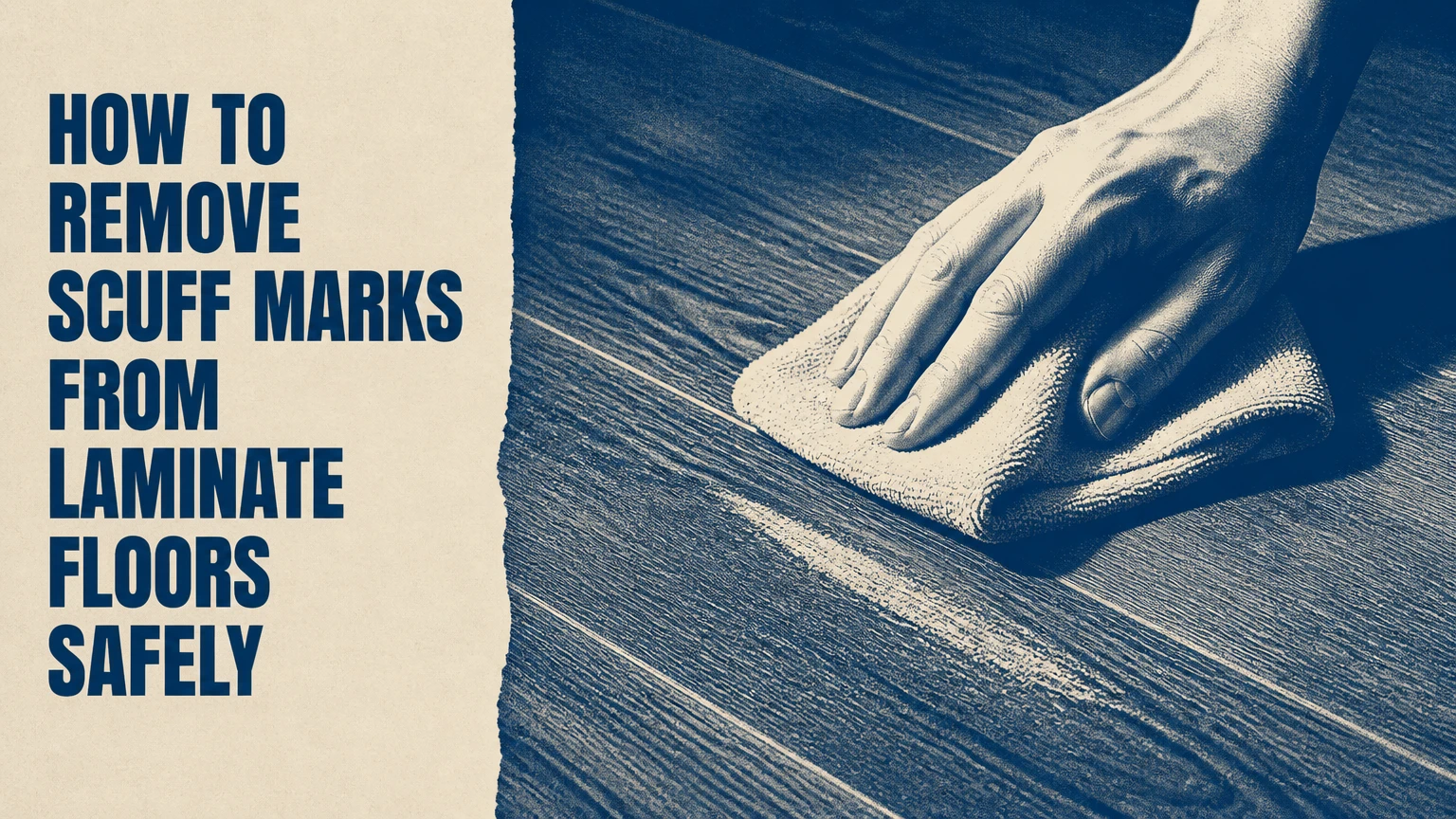
To remove scuff marks from laminate floors, vacuum loose grit, rub the mark with a clean white eraser or tennis ball, then use a barely damp microfiber cloth. If the residue remains, apply a small amount of 70% isopropyl alcohol to the cloth after a hidden-area test, and dry the floor immediately.
Key Facts
A scuff mark usually sits on top of laminate’s wear layer; a scratch cuts into the surface.
A clean white eraser is the safest first treatment for a small rubber or shoe mark.
Laminate flooring should never be left wet, especially across board joints.
Isopropyl alcohol can remove stubborn residue, but the flooring manufacturer’s care instructions take priority.
Melamine foam and baking soda can alter the sheen because both abrade the surface.
Acetone is a last-resort chemical, not a universally safe laminate-floor cleaner.
Before You Start
Prepare a vacuum or soft broom, one clean white polymer eraser, two lint-free microfiber cloths, a bowl of warm water, mild dish soap, and 70% isopropyl alcohol if needed. Allow 5-10 minutes for one mark, and expect a typical material cost of $0-$8 when ordinary household supplies are available.
| Item | Quantity or specification | Purpose | Typical cost |
|---|---|---|---|
| Vacuum or soft broom | 1 tool, brush attachment preferred | Remove grit before rubbing | $0-$40 |
| White polymer eraser | 1 clean, unused piece | Lift light rubber transfer | $1-$4 |
| Microfiber cloth | 2 cloths, lint-free | Damp cleaning and drying | $2-$8 |
| Dish soap | 2 drops in 250 mL water | Remove oily residue | Less than $1 per treatment |
| Isopropyl alcohol | 70%, 1 teaspoon or less | Treat persistent residue | $3-$8 per bottle |
| Cotton swab | 1, optional | Test a tiny solvent area | Less than $1 |
Read the laminate manufacturer’s maintenance sheet before using any chemical. Pergo, Quick-Step, Mohawk, and other manufacturers can specify different restrictions, and a product that is acceptable for one wear-layer finish may void care guidance for another.
Open a window when using alcohol. Keep alcohol and acetone away from flames, pilot lights, children, and pets. Do not pour any liquid directly onto the floor.
What Is a Scuff Mark?
A scuff mark is a shallow streak of transferred material caused by friction, commonly from shoe rubber, plastic wheels, rubber furniture feet, or a dragged object. The mark changes the floor’s appearance without removing the printed décor or cutting through the protective wear layer.
A scratch has a different structure. A scratch is a groove, chip, or cut in the surface, so cleaning cannot restore the missing material. Laminate floors typically use a printed decorative layer protected by a clear wear layer made from resin, often reinforced with aluminum oxide; the exact construction varies by product.
Is the Mark a Scuff or a Scratch?
A scuff is usually smooth to the touch and may disappear when viewed from a different angle, while a scratch catches a fingernail or remains visible after residue removal. Use three checks before choosing a stronger cleaner:
- Shine a phone flashlight across the floor at a low angle.
- Run a clean fingernail lightly across the mark.
- Wipe the spot with a barely damp microfiber cloth and inspect it dry.
If the fingernail catches, the area has a groove or raised chip. Stop rubbing. A laminate repair marker or color-matched wax filler may disguise a shallow scratch, while swollen boards, peeling edges, or deep damage usually require board replacement.
Which Method Is Safest?
A dry white eraser is the safest general first choice because it adds no moisture or chemical solvent. A tennis ball offers the same low-moisture approach for broad marks, while a barely damp microfiber cloth is the safest next step when loose residue remains.
| Method | Best mark type | Typical time | Surface risk | Recommended order |
|---|---|---|---|---|
| White polymer eraser | Light black shoe rubber | 30-90 seconds | Low when used gently | First |
| Clean tennis ball | Broad rubber transfer | 1-3 minutes | Low | First or second |
| Barely damp microfiber | Dust and light film | 30-60 seconds | Low if dried | Second |
| Diluted dish soap | Oily or dusty residue | 1-2 minutes | Low if not pooled | Third |
| 70% isopropyl alcohol | Persistent rubber or adhesive film | 10-20 seconds | Moderate, test first | Fourth |
| Melamine foam | Resistant surface transfer | 20-40 seconds | High, can dull gloss | Last cleaning option |
The safest process is progressive, not aggressive. More pressure does not compensate for choosing the wrong treatment, and a dull patch can be more permanent than the original black mark.
How to Remove Scuff Marks From Laminate Floors
Use a five-step progression: remove grit, dry-rub the mark, wipe with minimal moisture, use diluted soap if necessary, and spot-treat with isopropyl alcohol only after testing. One small scuff generally takes 2-5 minutes, and the most important success factor is keeping liquid away from seams.
Step 1: Remove Grit From the Area
Vacuum the scuff and a 15-centimeter area around it with a soft brush attachment, or sweep using a clean soft-bristled broom. Do not begin rubbing while sand, grit, or hard debris remains on the surface because abrasive particles can create fine scratches.
Inspect the floor under direct light. Loose dirt can make a black mark look larger than it is.
Success checkpoint: The surface feels clean and dry when you pass a microfiber cloth over it.
Common mistake: Using a rotating vacuum brush that drags trapped grit across a high-gloss finish.
Step 2: Rub With a Clean White Eraser
Hold a white polymer eraser at a shallow angle and rub the mark with short strokes or small circles. Apply light-to-moderate hand pressure for 10-15 seconds, then brush away the crumbs with a dry microfiber cloth.
A white eraser is preferable to a colored eraser because it reduces the chance of transferring dye. Work only on the mark, since repeated rubbing over a large clean area can change the sheen.
Success checkpoint: The black or gray transfer fades without a cloudy halo.
Common mistake: Using a pencil eraser with a metal holder or rubbing until the finish feels warmer and visibly different.
Step 3: Try a Clean Tennis Ball for Broad Marks
Use a clean, dry tennis ball on a wide rubber streak, especially when the mark came from a shoe or furniture foot. Rub the ball across the streak with controlled pressure, or cut a small cross in the ball and attach it to a broom handle for standing operation.
A tennis ball works through controlled friction and contact with the transferred rubber. It is useful in hallways and offices because the operator can treat several marks without kneeling.
Success checkpoint: The residue transfers or breaks into faint sections without a shiny rubbed patch.
Common mistake: Using a dirty tennis ball whose surface contains grit, clay, or outdoor soil.
Step 4: Wipe With Minimal Moisture
Dampen a microfiber cloth with plain water and wring it until no water drips when squeezed. Wipe the treated area once or twice, then dry it with the second cloth.
Laminate care guidance from major flooring manufacturers commonly emphasizes limited moisture because water can enter joints, swell the core, and cause edge lifting. The risk is highest where boards meet, around damaged edges, and beside bathrooms or exterior doors.
Success checkpoint: The floor is dry within 30 seconds and no moisture remains in the joint.
Common mistake: Spraying cleaner directly on the floor or using a wet mop to treat a two-inch mark.
Step 5: Use Diluted Soap, Then Test Alcohol
For oily residue, mix two drops of mild dish soap into 250 mL of warm water. Moisten a cloth, wring it thoroughly, rub the mark for 10-15 seconds, and remove the soap with a second barely damp cloth before drying.
If the mark remains, test 70% isopropyl alcohol in an inconspicuous location, such as beneath an appliance or inside a closet. If the test does not change color or gloss after drying, place a teaspoon or less on a cloth, never on the floor, and wipe the mark for 10 seconds.
Success checkpoint: The mark disappears while the printed pattern and surrounding gloss remain uniform.
Common mistake: Leaving alcohol to puddle, repeatedly scrubbing after the residue has dissolved, or skipping the manufacturer’s solvent warning.
What Should You Avoid on Laminate Flooring?
Avoid steel wool, scouring pads, razor blades, stiff brushes, floor wax, oil-based polish, and standing water. These materials can scratch the wear layer, leave a dirt-attracting film, gouge the surface, or force moisture into the fiberboard core.
Why Baking Soda Is a Backup Option
Baking soda can loosen some rubber transfer through mild abrasion, but it is not the preferred first-line treatment for laminate. A paste made with a small pinch of baking soda and a few drops of water may dull a high-gloss surface when rubbed repeatedly.
If you use it, test a hidden area, apply it for less than 20 seconds, remove every grain with a damp microfiber cloth, and dry immediately. Never use a dry mound of powder with heavy pressure.
Should You Use Melamine Foam?
Melamine foam can remove resistant marks, but its fine abrasive structure can reduce gloss. Treat it as a last cleaning option, use only the corner of a barely damp sponge, make two or three light passes, and stop as soon as the residue lifts.
Melamine foam is especially risky on dark, satin, and high-gloss laminate, where a permanently matte patch is easy to see. It is not suitable for routine maintenance.
Can Acetone Remove a Scuff?
Acetone can dissolve some plastics, adhesives, and finishes, but acetone is not universally safe for laminate floors. Nail-polish remover may contain water, fragrance, oils, or other solvents, and the mixture can affect the printed layer, coating, or edge seal.
Use acetone only when the flooring manufacturer permits it and a controlled hidden-area test passes. Apply a tiny amount to a cotton swab, touch the residue briefly, wipe with a clean cloth, and dry immediately. Do not use acetone on a broad area or allow it to sit.
Which Cleaner Fits Each Type of Mark?
The correct treatment depends on the transferred material, the floor’s sheen, and whether the mark is raised, sticky, or cut into the surface. Dry friction suits rubber, while adhesive requires short solvent contact and a scratch requires repair rather than cleaning.
| Mark source | First treatment | Escalation | Avoid |
|---|---|---|---|
| Black shoe rubber | White eraser | Tennis ball, then tested alcohol | Hard brush |
| Furniture foot | Tennis ball | Mild soap solution | Dragging the furniture again |
| Plastic toy wheel | Dry microfiber and eraser | Tested alcohol | Acetone without a test |
| Tape or label glue | Dry cloth | Manufacturer-approved adhesive remover | Spreading the sticky film |
| Melted plastic | Let it cool fully | Professional or approved solvent treatment | Knife or razor |
| Gray transfer on matte floor | Microfiber cloth | Short eraser pass | Melamine foam |
| Raised chip or groove | Stop cleaning | Repair kit or replacement board | More rubbing |
When Is the Mark Glue or Adhesive?
Sticky residue that catches dust is usually adhesive, not ordinary shoe scuff. Start by lifting loose material with a dry microfiber cloth, then use a small amount of a laminate-approved adhesive remover on the cloth after a hidden-area test.
Goo Gone and similar products can contain oils that leave a film, so follow the label and remove the residue completely. A final barely damp wipe and immediate drying prevent an oily patch from attracting dirt.
Never scrape adhesive with a knife. A plastic card may be safer for a softened, raised residue, but use almost no downward pressure and stop if the card catches an edge.
How Much Time and Money Does It Take?
A single light scuff usually costs nothing and takes 30-90 seconds with an eraser. A stubborn mark requiring alcohol generally takes 3-5 minutes and less than $1 of consumable material, while a repair kit for a true scratch typically costs $8-$25.
| Treatment | Typical duration | Typical consumable cost | Moisture level |
|---|---|---|---|
| White eraser | 30-90 seconds | $1-$4 | None |
| Tennis ball | 1-3 minutes | $2-$6 | None |
| Soap and microfiber | 1-2 minutes | Less than $1 | Low |
| Isopropyl alcohol | 10-20 seconds of contact | Less than $1 | Evaporating solvent |
| Adhesive remover | 1-3 minutes | $5-$10 | Low to moderate |
| Laminate repair kit | 10-30 minutes | $8-$25 | None |
These are typical household ranges in U.S. retail pricing, not guaranteed local prices. Commercial janitorial supply costs, regional taxes, and manufacturer-approved products can change the total.
Common Mistakes and How to Fix Them
Excessive Water Left the Joint Damp
Dry the area immediately with absorbent microfiber cloths and inspect the board edges for swelling. If a joint rises, separates, or develops a soft edge, stop cleaning and photograph the damage before contacting the flooring installer.
Abrasion Created a Dull Spot
Stop using baking soda, melamine foam, or an eraser. Compare the spot under daylight and low-angle light; if the sheen changed, a laminate restorer may not reproduce the factory finish, so test any repair product on a spare plank first.
Alcohol Left a Cloudy Film
Wipe once with a clean cloth barely dampened with water, then dry. Do not add wax or oil polish to conceal the haze, because polish can create a sticky layer that captures dust and makes future spot cleaning harder.
The Mark Did Not Move
Check whether the mark is a scratch, melted plastic, or dye transfer. A fingernail catch indicates physical damage, while a raised hard edge may require an approved plastic scraper or professional treatment rather than stronger rubbing.
The Eraser Made a Halo
Eraser friction can change gloss when applied beyond the mark. Clean the entire nearby plank gently with a dry microfiber cloth, then stop; do not enlarge the treatment area with more abrasive cleaning.
Situational Variations
Removing Scuffs After Moving Furniture
Lift furniture instead of dragging it, vacuum the complete path, and begin with a tennis ball or white eraser. Furniture marks often contain rubber mixed with dust, so a dry treatment followed by a single barely damp wipe usually works better than a wet floor cleaner.
Install felt pads or manufacturer-approved glides after cleaning. Replace compressed pads, because a flattened pad can expose a hard plastic edge that creates new transfer and scratches.
Treating Dark or High-Gloss Laminate
Use the least abrasive sequence on dark and high-gloss floors: vacuum, dry microfiber, white eraser, then a hidden-area solvent test. Avoid melamine foam and baking soda unless the manufacturer specifically approves them.
High-gloss finishes reveal halos from uneven abrasion. Stop as soon as the mark disappears instead of trying to make the treated zone brighter than the surrounding boards.
Cleaning a Large Office or Hallway
Divide the floor into 1-square-meter sections, remove dry marks with a white eraser or tennis ball, and use a flat microfiber mop with a controlled spray of pH-neutral laminate cleaner for general soil. Do not flood the floor or use an automatic scrubber with aggressive pads.
A practical maintenance rule is to spot-treat visible transfer daily and damp-clean high-traffic areas according to the flooring manufacturer’s schedule. Rubber chair casters should be replaced with hard-floor-rated polyurethane casters when compatible with the chair.
How to Prevent New Laminate Scuffs
Preventing scuffs is easier than repeatedly polishing the surface because transferred rubber usually comes from predictable contact points. Use non-marking footwear indoors, felt or polyurethane furniture glides, clean caster wheels, and entrance mats with a non-staining backing.
Keep abrasive grit outside the room. Vacuum entry zones more frequently during wet or sandy weather, because grit increases both visible transfer and permanent scratching.
Do not use rubber-backed mats unless the flooring manufacturer approves the backing material. Some rubber and latex products can discolor resilient and laminate surfaces over time, particularly under heat and prolonged pressure.
When Should You Repair or Replace the Plank?
Repair a laminate surface when the damage is a shallow scratch, small chip, or localized color loss with stable board edges. Replace or professionally assess the plank when the core has swollen, the top layer is peeling, a joint has separated, or moisture has caused bubbling.
A repair wax kit can fill a shallow groove, but it cannot restore a damaged wear layer’s original abrasion resistance. Match the repair color under daylight, clean the area first, and follow the kit’s curing time before walking on it.
The limitation matters: no household cleaner can reverse missing laminate material. Cleaning removes residue; repair fills or disguises damage; replacement restores the factory surface.
FAQ
Will vinegar remove scuff marks from laminate floors?
Vinegar may cut light mineral or greasy residue, but it is unnecessary for most rubber scuffs and can conflict with flooring-care instructions. Use a white eraser first, followed by a barely damp microfiber cloth. If you use a vinegar product, follow the manufacturer’s dilution guidance and never leave the floor wet.
Can toothpaste remove black marks from laminate flooring?
Toothpaste is a mild abrasive and can create a dull patch, especially on glossy laminate. It also contains humectants and additives that may leave residue. Choose a clean white eraser instead, because it provides localized friction without spreading a paste across the printed surface.
How do you remove rubber marks without chemicals?
Vacuum the area, then rub the mark with a clean white polymer eraser or a clean tennis ball. Use short passes and light pressure. These dry methods remove many shoe and furniture marks without adding water, alcohol, fragrance, or solvent to the laminate.
Can a steam mop remove laminate scuffs?
A steam mop is a poor choice for laminate scuffs because heat and moisture can enter board joints and damage the fiberboard core. Steam does not improve the dry-friction process. Follow the flooring manufacturer’s cleaning instructions instead, and use a barely damp microfiber cloth for the wet stage.
Why do scuff marks keep coming back?
Recurring scuffs usually come from the same rubber sole, caster, furniture glide, or gritty traffic path. Clean the contact item, replace damaged glides or wheels, and use a non-marking mat. Repeated marks in one location can also indicate that furniture is being dragged rather than lifted.
How soon can you walk on the floor after cleaning?
You can usually walk on the area once it is visibly dry, which typically takes less than one minute after a properly wrung cloth or a small alcohol application. Keep foot traffic away while the surface remains damp, and never cover a wet area with a mat.
The Bottom Line
To remove scuff marks from laminate floors, start with a dry white eraser or tennis ball, then use minimal moisture and mild soap only when needed. Reserve 70% isopropyl alcohol for a tested, persistent mark, avoid routine acetone and melamine foam, and stop cleaning when a fingernail detects a scratch. The correct method protects both the visible finish and the moisture-sensitive board joints.