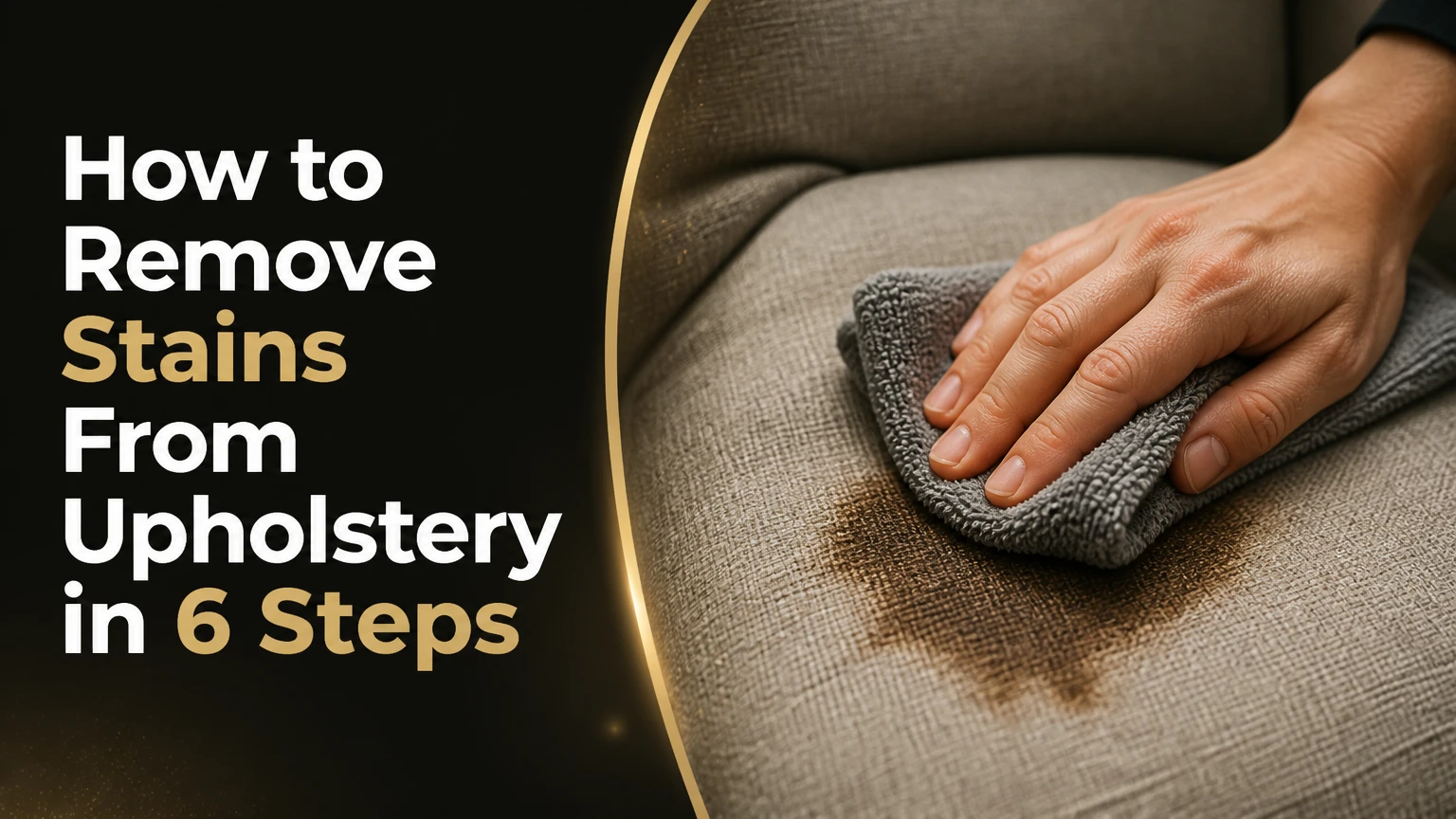
To remove stains from upholstery, identify the fabric-care code, remove excess material, apply a compatible cleaner sparingly, blot rather than scrub, rinse only when the code permits, and dry the fabric rapidly. The stain type determines the chemistry: enzymes suit protein soils, absorbent powders suit fresh grease, and solvent methods suit approved S fabrics.
Key facts at a glance
Upholstery code W permits water-based cleaning, S permits water-free solvent, W/S permits either, and X permits vacuuming or brushing only.
A white towel reveals dye transfer and prevents colored lint from entering the fabric.
Cold water is safer than hot water for blood, milk, egg, vomit, and other protein stains.
Cleaner quantity matters: excess liquid can reach cushion foam, cause wick-back, and create a larger ring.
A hidden test should be checked while wet and again after the tested area has dried, preferably for 24 hours.
Typical spot treatment takes 15-30 minutes of work and 2-6 hours to dry, depending on fabric, humidity, and moisture volume.
Why Upholstery Stain Removal Works
Upholstery stain removal works by separating a soil from the fiber and transferring the loosened material into a towel, powder, or extraction machine. Surfactants surround oily particles, solvents dissolve compatible non-water-soluble soils, enzymes break down some biological residues, and blotting provides the physical transfer.
A surfactant has a water-attracting end and an oil-attracting end. The molecule helps water carry loosened soil away, but detergent cannot make every stain disappear. A water-based cleaner may spread grease, while a solvent can damage a finish or dissolve dye.
“Blot, don’t rub” is the practical rule used by the American Cleaning Institute in its stain-care guidance because rubbing adds abrasion and pushes liquid sideways and downward. Capillary action then moves moisture from the upholstery into a dry towel, which is why changing towel sections improves removal.
Match the chemistry to the stain
| Stain family | Examples | Useful first approach | Main risk |
|---|---|---|---|
| Protein or biological | Blood, milk, urine, vomit | Cold water and an upholstery-safe enzyme product on W or W/S | Heat sets protein and moisture carries odor into foam |
| Oil or grease | Butter, makeup, body oil, chips | Dry blotting, absorbent powder, then approved detergent or solvent | Powder residue, spreading, or solvent discoloration |
| Tannin | Coffee, tea, red wine, fruit | Blotting and a carefully diluted water-based product on W or W/S | Brown edge, dye migration, over-wetting |
| Adhesive or wax | Gum, candle wax, glue, slime | Harden, lift mechanically, then spot-test a compatible solvent | Fiber distortion or finish removal |
| Dirt or mud | Soil, outdoor grime | Dry removal first, then mild water-based cleaning if permitted | Turning dry soil into a larger wet suspension |
What Do W, S, W/S, and X Mean?
The upholstery cleaning code tells you which liquid system the manufacturer permits, but the code does not prove that a fabric is colorfast or safe from shrinkage. Find the tag under a removable cushion, beneath the sofa, or attached to the platform, then follow the furniture maker’s instructions if they conflict with a general code chart.
| Code | Permitted method | Typical materials | Do not use |
|---|---|---|---|
| W | Water-based foam, detergent, or upholstery cleaner | Many polyester, olefin, and treated performance fabrics | Unapproved dry-cleaning solvent |
| S | Water-free upholstery solvent | Some microfiber, rayon, wool, and delicate blends | Water, steam, and wet extraction |
| W/S or WS | Water-based or solvent method | Mixed-fiber furniture with dual approval | Uncontrolled saturation or untested chemicals |
| X | Vacuuming and gentle brushing only | Highly delicate, coated, or manufacturer-restricted fabrics | Water, solvent, steam, and extraction |
Test before treating the visible stain
Use two drops or a small spray of the intended product on a hidden seam, underside, or rear skirt. Press a white cloth against the area for 10 seconds, let it dry completely, and inspect for bleeding, darkening, shrinking, stiffness, or nap change. A 24-hour check is prudent for expensive or delicate furniture.
Do not rely on a test performed only on an unseen portion. Different panels can have different wear, dye concentration, or finishing treatment. If the test transfers color, stop. If the tag says X, do not “upgrade” the furniture to W by trying a mild household mixture.
Before You Start
The following setup suits one small or medium stain on a code W or W/S fabric. Code S requires a compatible solvent, and code X requires non-liquid care or professional advice.
| Item | Recommended amount or specification | Purpose |
|---|---|---|
| White microfiber towels | 4-6, lint-free and colorfast | Blotting and final drying |
| Vacuum with upholstery tool | Low suction, clean attachment | Dry soil and powder removal |
| Distilled water | 250-500 milliliters | Controlled rinsing and reduced mineral residue |
| Clear dish detergent | 1 teaspoon per 250 milliliters water | Mild surfactant for approved W fabrics |
| Enzyme upholstery cleaner | Label-directed quantity | Protein and biological residues |
| Nitrile gloves | 1 pair | Contact protection for bodily fluids |
| Fan | One directional room fan | Faster, more even drying |
Work in good light. Remove nearby cushions when possible, protect wood and metal, and photograph the original stain before treatment if the furniture belongs to a landlord or client.
How to Remove Stains From Upholstery in Six Steps
Step 1: Identify the stain and care code
Classify the spill before adding liquid. Determine whether the material is water-based, oily, protein-rich, tannin-based, or sticky, and read the furniture label before choosing a product.
A fresh coffee spill needs a different first treatment from dried grease. If the substance is unknown, begin with dry removal and conservative blotting rather than combining chemicals.
Success checkpoint: You can state both the stain family and permitted cleaning system.
Common mistake: Treating the color instead of the substance, such as using bleach on a red stain without knowing whether the red is wine, dye, or the upholstery itself.
Step 2: Remove solids and excess liquid
Lift solids with a spoon or dull plastic edge. Hold a dry white towel over liquid for 10-20 seconds at a time, applying downward pressure without twisting the fabric.
For blood, vomit, milk, egg, or urine, wear gloves and use cold water only during the first response. Do not use a hair dryer, heated extractor, or hot towel at this stage.
Success checkpoint: No loose solid remains, and the towel absorbs liquid without a growing wet perimeter.
Common mistake: Scrubbing in circles. Circular rubbing spreads pigment, roughens the nap, and can force contamination into the cushion seam.
Step 3: Apply the smallest compatible amount of cleaner
For a code W fabric, mix 1 teaspoon of clear, dye-free dish detergent with 250 milliliters of distilled water, unless the product label specifies another dilution. Apply the solution to a towel rather than flooding the upholstery.
For an enzyme product, follow its label and keep the area damp for the stated dwell time, commonly 10-20 minutes. For code S, place the recommended solvent on a cloth and never pour it directly onto the furniture.
Success checkpoint: The stain boundary remains controlled, and the fabric is damp rather than saturated.
Common mistake: Adding more detergent because foam looks productive. Soap residue attracts soil and may leave a stiff, visibly darker patch.
Step 4: Blot from the outside toward the center
Press vertically with a clean section of towel, lift, rotate to a dry section, and repeat. Start at the outer edge to prevent the dissolved material from migrating into clean fabric.
The transfer mechanism matters more than force. A towel with unused absorbent surface removes more soil than a saturated towel pressed repeatedly into the same spot.
Success checkpoint: Color or soil transfers onto the towel while the visible boundary becomes smaller.
Common mistake: Returning a dirty towel to the center. That action re-deposits the stain.
Step 5: Rinse only when the code allows it
For W or W/S fabric, lightly mist or dab distilled water onto the treated area, then blot until the towel shows little or no cleaner residue. Do not rinse S fabric with water, and do not wet X fabric.
Rinsing should remove detergent, not create a second wet stain. Treating only a tiny circle can leave a ring, so feather the final moisture slightly beyond the original edge without saturating the cushion.
Success checkpoint: The fabric feels neither slippery nor heavily damp, and no cleaner foam remains.
Common mistake: Using tap water on a dark or absorbent textile. Minerals can remain at the drying boundary, although a ring can also result from uneven soil redistribution rather than water hardness alone.
Step 6: Dry evenly and inspect after drying
Press dry towels over the area, place a fan so air moves across the fabric, and leave the cushion uncovered. Avoid direct high heat, which can shrink fibers, distort finishes, or set remaining protein.
A small spot commonly dries in 2-6 hours; thick cushions, humid rooms, and heavy moisture can require 12-24 hours. Inspect only after complete drying because damp upholstery often appears darker than the surrounding material.
Success checkpoint: The area matches the surrounding color and texture, with no odor, stiffness, tackiness, or returning halo.
Common mistake: Repeating treatment while the fabric is still damp. Wait until dry before deciding whether the remaining mark is soil, dye damage, or a water ring.
How Should You Treat Specific Upholstery Stains?
Blood, urine, vomit, milk, and other protein stains
Use cold blotting followed by an upholstery-safe enzyme cleaner on code W or W/S fabric. Enzymes can digest protein residues, but they cannot restore dye that has already changed or safely treat every fiber.
Remove solids, blot liquid, apply the labeled enzyme quantity, and maintain the required damp dwell time. Blot afterward, lightly rinse with distilled water if permitted, and dry rapidly. For urine that has entered foam, surface treatment may remove the visible mark while leaving odor below the fabric.
Never mix enzyme cleaners with bleach, peroxide, ammonia, or disinfectants. Seek professional cleaning when urine affects a full cushion, the odor persists after complete drying, or contamination involves sewage or extensive bodily fluids.
Grease, butter, makeup, and body oil
Blot fresh oil with a dry towel, then cover the spot with cornstarch or an upholstery-approved absorbent powder for 30-60 minutes. Vacuum gently using a clean attachment, test the fabric, and use a small amount of detergent on W fabric or an approved solvent on S fabric.
Baking soda is a weak general deodorizer, not a reliable grease solvent. Avoid aggressive brushing because oily fibers can become shiny, and some solvent-sensitive finishes can develop a lighter patch.
Coffee, tea, red wine, berries, and colored drinks
Blot immediately, then use a compatible commercial upholstery cleaner or a very dilute detergent solution on W or W/S fabric. Vinegar is not a universal neutralizer: its acidity may alter dyes, finishes, or the appearance of natural fibers.
Hydrogen peroxide can lighten some organic colorants, but 3% peroxide can also bleach upholstery. Use it only when the manufacturer permits it, after a hidden test, and with professional advice for valuable or dark furniture. Ink and transfer dye often require a specialist because the colorant may be soluble in a way that causes rapid spreading.
Gum, wax, slime, and glue
Harden gum or slime with ice sealed in a plastic bag for 10-15 minutes, then lift fragments with a dull edge. For candle wax, remove the solid surface first and ask the manufacturer whether low-temperature heat and absorbent paper are permitted.
Do not apply a solvent such as isopropyl alcohol or an adhesive remover until the care code and spot test permit it. Put solvent on a cloth, not directly on the fabric, and ventilate the room. Acetone and nail-polish remover can dissolve acetate, some finishes, and synthetic fibers.
Which Cleaning Method Should You Choose?
The best method is the least aggressive method that matches the fabric code, stain chemistry, and depth of contamination. Household detergent is economical for a small fresh spill, while extraction is better for compatible synthetic upholstery with widespread soil, not for every sofa.
| Method | Typical cost | Typical drying time | Suitable use | Main limitation |
|---|---|---|---|---|
| DIY detergent spot clean | $0-$5 | 2-6 hours | Fresh food, drink, and light soil on W fabric | Limited reach into foam |
| Commercial enzyme or upholstery spray | $7-$22 | 4-12 hours | Protein residue and odor on W or W/S fabric | Requires label-directed dwell and rinsing |
| Solvent blotting | $8-$20 per container | 30 minutes-4 hours | Grease on approved S fabric | Flammable vapors and dye risk |
| Portable extractor rental | $30-$60 per day | 6-24 hours | Broad soil on extraction-approved upholstery | Over-wetting and wick-back |
| Professional upholstery cleaning | $120-$300 typical sofa service | 4-24 hours | Delicate, large, old, or deeply contaminated furniture | Minimum service charges and access fees |
Steam and hot-water extraction are not interchangeable. A machine can flush soil from durable, water-approved fabric, but heat and moisture can shrink rayon, affect silk, distort velvet pile, or drive liquid into foam. Follow the furniture maker’s instructions and the machine manufacturer’s upholstery-tool limits.
What Should You Do With Old, Unknown, or Large Stains?
Old stains need a diagnosis before repeated chemical treatment. A brown mark may be oxidized soil, tannin browning, foam wick-back, dye loss, or a ring left by an earlier cleaner, so applying a stronger product can make the original problem irreversible.
Professional cleaning is the safer choice when the stain covers more than one cushion, exceeds roughly 5-10 centimeters, has entered foam, involves a valuable antique, or remains unidentified after a spot test. Vintage upholstery often has unstable dyes, aged stitching, fragile padding, or conservation value that consumer equipment cannot assess.
Do not use a machine on code X. For code S, use only a solvent system specifically intended for upholstery and maintain ventilation away from flames, pilot lights, and smoking materials.
How Do You Fix a Returning Stain or Water Ring?
A returning stain usually indicates wick-back, where dissolved soil or moisture in the backing and foam travels toward the surface during drying. A water ring can also result from uneven wetting, soil at the wet boundary, or residue from a previous product.
For W or W/S fabric, lightly dampen the entire cushion panel from seam to seam with distilled water rather than creating another small circle. Blot evenly with multiple towels, place a dry towel over the area, and use a fan until the panel is fully dry. Do not repeat this method on S or X fabric.
If the mark returns twice, stop adding water. The source may be inside the cushion, and professional extraction or cushion-cover removal may be necessary.
How Do You Remove Persistent Pet Odor?
Pet odor requires removal of urine salts and organic residue, not fragrance cover-up. Use a labeled enzyme product only on a code W or W/S fabric, keep the area damp for the product’s stated contact time, blot excess liquid, and allow complete air drying.
A surface mist cannot reliably treat urine that has saturated foam. Removable covers can sometimes be laundered according to their label, while fixed cushions may require controlled professional extraction. Black light can help locate old urine on some surfaces, but it does not identify every contamination source and should not replace an inspection.
Do not combine enzyme products with disinfectants or strong oxidizers. Chemical incompatibility can reduce enzyme activity and create irritating vapors.
What Are the Most Common Damage-Causing Mistakes?
| Mistake | What happens | Safer correction |
|---|---|---|
| Scrubbing hard | Fibers fray, nap changes, and pigment spreads | Press and lift with clean towel sections |
| Flooding the cushion | Foam retains moisture and stain wicks upward | Apply product to a cloth and use a fan |
| Using heat on protein | Blood and dairy residues can set more firmly | Use cold water and enzyme treatment |
| Mixing cleaners | Chemistry becomes unpredictable and unsafe | Use one product at a time and rinse when permitted |
| Skipping the code | Water, solvent, or steam can damage the textile | Read the tag and manufacturer instructions |
| Using colored towels | Dye or lint transfers to pale upholstery | Use white, lint-free cloths |
| Treating only a tiny circle | Uneven drying creates a visible halo | Feather moisture or clean the panel evenly |
An important practitioner rule is to stop when the towel stops gaining soil. More chemistry is not evidence of better cleaning. Persistent discoloration may be dye loss, abrasion, or permanent oxidation rather than removable dirt.
Situational Variations for Safer Results
Pet owners and parents
Keep white towels, gloves, distilled water, and an enzyme upholstery product together. Treat liquid spills immediately, but reserve extraction machines for water-approved fabrics and use a professional when contamination reaches foam.
Renters
Photograph the condition, check the lease, and avoid experimental peroxide, bleach, or solvent mixtures before a move-out inspection. A $30-$60 machine rental can be reasonable for a compatible large synthetic sofa, but the renter remains responsible for shrinkage, rings, and excess moisture.
Vintage and antique furniture owners
Use the least intervention possible. Avoid steam, soaking, peroxide, vinegar experiments, and unverified solvent mixtures; consult an upholstery conservator or specialist when the fabric is silk, rayon, wool, hand-dyed, embroidered, or structurally fragile.
How Much Time and Money Does Upholstery Stain Removal Take?
A small DIY treatment typically costs $0-$22 and takes 15-30 minutes of active work, followed by 2-6 hours of drying. Machine cleaning commonly costs $30-$60 for a rental, while a typical professional sofa visit falls around $120-$300, with location, access, fabric type, and minimum charges affecting the final price.
Success declines with time, but no honest universal percentage applies to every stain. Fabric construction, dye stability, stain depth, previous chemicals, and drying conditions matter more than an arbitrary “24-hour success rate.” Fresh removal is still preferable because less material has penetrated the backing.
FAQ
Can I use dish soap on a fabric sofa?
Use clear, dye-free dish soap only on a code W or W/S fabric, diluted at about 1 teaspoon per 250 milliliters of distilled water. Apply the solution to a towel, blot sparingly, and remove residue with controlled distilled-water blotting. Dish soap is unsuitable for code S or X upholstery.
Is vinegar safe for every upholstery stain?
No. Vinegar is not safe for every fabric or stain. Dilute acetic acid can affect dyes, finishes, and natural fibers, while it does not dissolve grease or remove every ink. Use the furniture manufacturer’s approved cleaner first, and perform a hidden test before any vinegar treatment.
Can I use rubbing alcohol to remove stains from upholstery?
Rubbing alcohol may help dissolve some ink, grease, and adhesive on code S or manufacturer-approved W/S microfiber, but it can strip dye or damage finishes. Apply a small amount to a white cloth, test an unseen area, ventilate the room, and never use alcohol on code X upholstery.
How do I clean upholstery without leaving a ring?
Prevent rings by using minimal liquid, cleaning with distilled water when rinsing is allowed, feathering the damp edge, and drying the panel evenly. If a ring already exists on W or W/S fabric, lightly dampen the whole cushion panel from seam to seam and blot it uniformly rather than treating only the center.
Should I steam-clean a microfiber sofa?
Steam-clean microfiber only when the care label and furniture manufacturer approve water and heat. Code S microfiber should not receive steam or water. Even approved microfiber can develop pile changes or water marks if over-wet, so a controlled low-moisture method and a hidden test are safer.
When should I call a professional upholstery cleaner?
Call a professional for code X furniture, fragile or valuable upholstery, extensive urine contamination, stains larger than one cushion, unknown chemicals, repeated wick-back, or failed spot tests. Professional cleaning cannot guarantee removal of dye loss or fiber damage, but it reduces the risk of worsening a difficult stain.
The Bottom Line
The safest way to remove stains from upholstery is to identify the fabric code, match the cleaner to the stain chemistry, blot with white towels, control moisture, and dry the fabric evenly. Start with the least aggressive approved method, and stop escalating when the problem appears to be dye damage, foam contamination, or fabric deterioration rather than removable soil.