
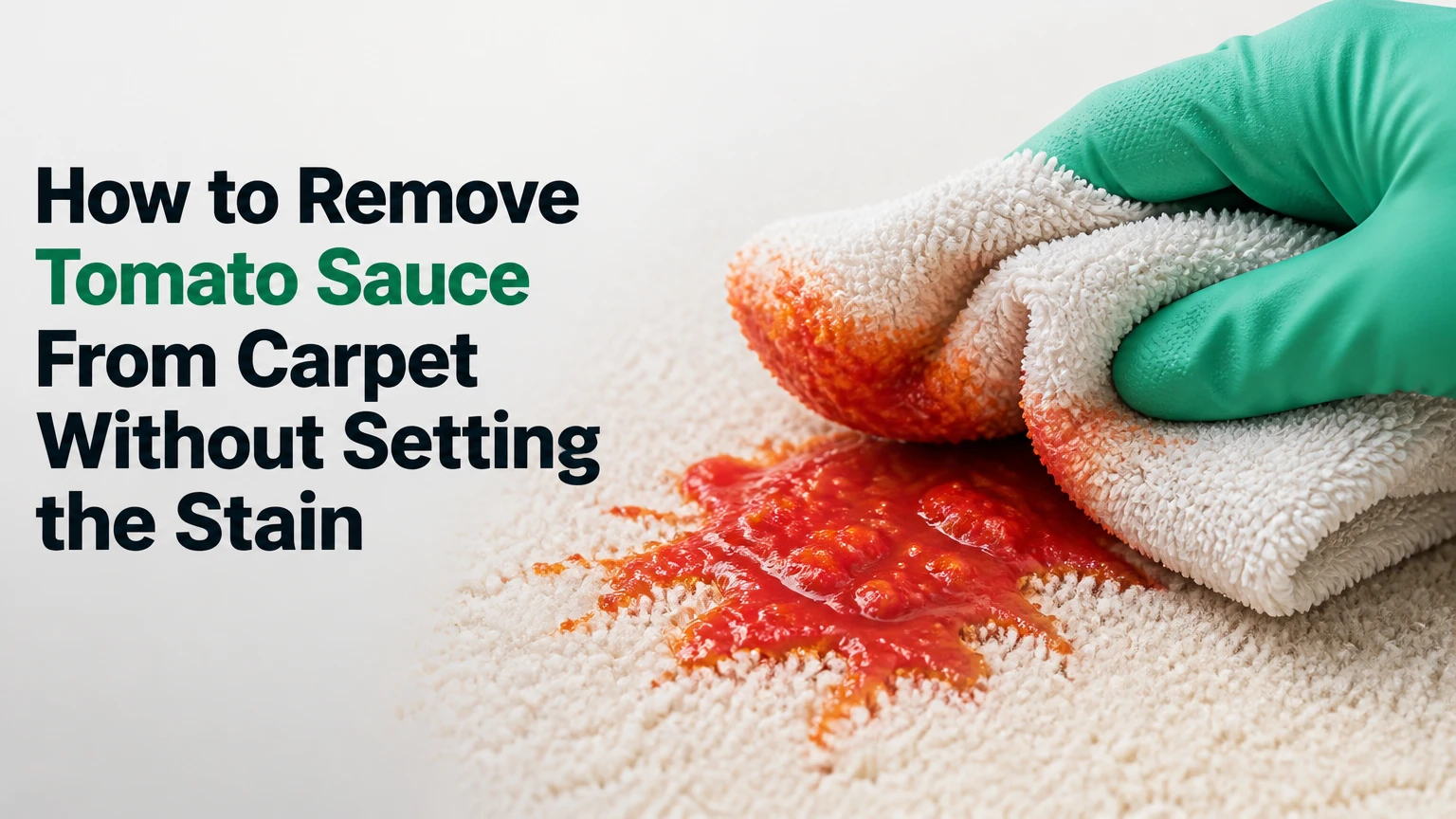
To remove tomato sauce from carpet, lift solids, blot excess liquid, apply 1 tablespoon of clear dish soap mixed with 2 cups of cool water, then rinse and dry the area thoroughly. Treat fresh spills within minutes, test every chemical on hidden fibers, and use peroxide only when the carpet’s dye and fiber can tolerate oxidation.
Key Facts at a Glance
Fresh tomato sauce usually responds best to cool water and a small amount of dish detergent.
Tomato sauce contains pigment, water, oil, and sometimes dairy, meat, sugar, garlic, or chili.
Scrubbing spreads the stain and can damage carpet pile; blotting transfers contamination into a clean towel.
Hydrogen peroxide can lighten carpet dye, so a hidden colorfastness test is mandatory.
Soap residue can attract soil and create a dark area after the carpet dries.
A stain that returns after drying usually indicates wicking from the carpet backing or pad.
What You Need Before Cleaning
Prepare the materials before touching the stain. The most important items are a spoon or dull knife, white absorbent towels, cool water, and a clear dishwashing liquid without added dye.
| Material | Amount or specification | Purpose |
|---|---|---|
| Spoon or dull butter knife | 1 | Lift solid sauce without cutting fibers |
| White microfiber cloths | 4-6 | Blotting and controlled application |
| White paper towels | 12-24 sheets | Initial absorption and overnight wicking |
| Clear liquid dish soap | 1 tablespoon | Emulsifies oil and loosens food residue |
| Cool water | 2 cups for solution, 1 cup for rinse | Dilutes detergent and removes residue |
| 3% hydrogen peroxide | Optional, 1-3 tablespoons | Oxidizes persistent red color on compatible carpet |
| White distilled vinegar | Optional, diluted 1:2 with water | Mild acidic rinse for limited situations |
| Vacuum cleaner | 1 | Removes dry baking soda or soil |
| Fan | 1, optional | Reduces drying time and wicking risk |
Typical treatment time is 15-30 minutes for a fresh spot, excluding drying. Household cost is usually under $3 when basic supplies are already available. A large spill, a saturated pad, or a valuable rug may require professional extraction rather than more home-applied liquid.
Check the carpet fiber and dye
Identify the carpet material if the manufacturer label or installation paperwork is available. Nylon and solution-dyed polyester generally tolerate careful spot cleaning better than wool, silk, viscose, or an antique Oriental rug, although dye stability varies within every fiber category.
Do not assume a dark carpet is safer than a light carpet. Dark dyes can bleed or fade, while a pale carpet makes a residual red shadow more visible. Test the cleaning solution on an inconspicuous edge, behind furniture, or a spare carpet offcut.
Why Tomato Sauce Leaves a Red, Greasy Carpet Stain
Tomato sauce is difficult because the visible mark may contain several different contaminants. Lycopene creates the red color, oil carries some of that pigment, and ingredients such as cheese, meat, sugar, or starch leave additional residue.
The acid in tomatoes does not reliably “open carpet pores” or chemically bind lycopene to every fiber. Carpet damage depends more on fiber chemistry, dye stability, drying, mechanical pressure, and how deeply the liquid reaches the backing. Cool water and detergent first address the removable food and oil; oxidation is reserved for color that remains afterward.
| Stain component | Typical source | Most useful treatment |
|---|---|---|
| Red pigment | Tomatoes, paprika, chili | Blotting followed by cautious oxidation |
| Oil or grease | Olive oil, meat fat, cheese | Clear dish detergent or carpet detergent |
| Water-soluble food residue | Salt, sugar, starch, broth | Cool-water dilution and extraction |
| Dairy or meat residue | Cream, cheese, sausage | Detergent, then thorough rinsing |
| Odor-producing residue | Garlic, onion, meat, bacteria | Complete extraction and controlled drying |
Baking soda does not reliably remove a fresh red pigment. Baking soda is more useful after the carpet has dried, when it can absorb some odor and loosen surface soil before vacuuming. It should not replace liquid extraction for a wet sauce spill.
How to Remove Tomato Sauce From Carpet
The safest general method has five stages: remove solids, absorb liquid, apply diluted detergent, rinse away residue, and dry quickly. Use only enough solution to dampen the affected pile; flooding the carpet can move sauce into the backing and pad.
Step 1: Lift the excess sauce
Use a spoon or dull knife to lift sauce from the carpet surface. Work from the outer edge toward the center, and wipe the utensil after each pass so sauce does not return to the fibers.
Do not press down while scraping. Pressing forces liquid through the pile and increases the area that needs treatment.
You will know this step worked when: no visible mound or thick layer remains, although a red or orange mark may still be present.
Common mistake: dragging the utensil outward from the center. That spreads the stain and can smear oil across clean carpet.
Step 2: Blot the liquid without rubbing
Place a clean white towel or folded white paper towel over the spot and press straight down for several seconds. Lift, move to a dry section, and repeat until the towel picks up little or no liquid.
Use pressure from your hand rather than twisting or scrubbing. Replace saturated towels promptly; a wet towel can redistribute sauce instead of extracting it.
You will know this step worked when: the towel shows progressively less red transfer and the carpet feels damp rather than wet.
Common mistake: rubbing in circles. Friction can flatten or fuzz the pile and pushes pigment toward the backing.
Step 3: Apply diluted dish soap
Mix 1 tablespoon of clear dish soap with 2 cups of cool water. Dip a white cloth into the mixture, wring it until damp, and dab the solution onto the stain from the perimeter inward.
Apply small amounts rather than pouring the mixture onto the carpet. Let the detergent remain for 5 minutes, then blot with a dry section of the cloth. Dish detergent works by surrounding oil and food residue so the towel and rinse water can remove them.
You will know this step worked when: red or orange residue transfers to the towel and the greasy feel decreases.
Common mistake: adding extra soap because the stain is large. More detergent creates more residue and makes rinsing harder; repeat controlled applications instead.
Step 4: Rinse out the detergent
Dampen a separate white cloth with plain cool water and press it over the treated area. Follow with a dry towel, alternating damp rinsing and dry blotting until the carpet no longer feels slippery.
Residual surfactant can collect soil after cleaning. For a small spot, one or two tablespoons of rinse water at a time is usually enough; a broad spill may require repeated extraction with a wet-dry vacuum.
You will know this step worked when: the cloth lifts little foam and the fibers feel clean rather than slick.
Common mistake: skipping the rinse because the red color has disappeared. Soap residue can leave a new dark ring several days later.
Step 5: Dry and inspect the carpet
Press a dry white towel over the area for 30-60 seconds, then place a fan nearby. Keep people and pets off the spot until the pile is fully dry.
Inspect the carpet in strong daylight after drying. A damp carpet can temporarily conceal a remaining shadow, and a stain can appear lighter before moisture has evaporated.
You will know this step worked when: the fibers are dry, the pile has recovered, and no red transfer appears on a clean white towel.
Common mistake: judging success while the carpet is still wet. Wait at least 4-8 hours for a small spot, or up to 24 hours when the backing became damp.
Which Treatment Works Best for Each Sauce Stain?
Dish soap is the best first choice for most fresh tomato sauce because it addresses both water-soluble food residue and the oil that carries pigment. Hydrogen peroxide is a second-stage option for a persistent red shadow on a compatible, light-colored synthetic carpet.
| Method | Best use | Typical dwell time | Main risk |
|---|---|---|---|
| Dish soap and cool water | Fresh, small, greasy food spills | 5 minutes | Soap residue if poorly rinsed |
| Carpet stain remover | Dried or broad synthetic-carpet stains | 5-15 minutes | Product residue or dye change |
| 3% hydrogen peroxide | Red shadow on pale, colorfast carpet | 5-10 minutes initially | Bleaching or fiber damage |
| Diluted white vinegar | Limited odor or residue situations | 5-15 minutes | Odor, dye instability, weak grease removal |
| Professional extraction | Saturated pad, valuable rug, large stain | 1-3 hours onsite | Cost and scheduling |
When is hydrogen peroxide appropriate?
Use 3% hydrogen peroxide only after detergent has removed the sauce’s oil and surface residue. Test one drop in a hidden area, wait 10 minutes, blot it, and compare the color with an untreated section.
For a confirmed colorfast carpet, dab a small amount of 3% peroxide onto the remaining red shadow. Leave it for 5 minutes initially, blot with a dry white towel, rinse with cool water, and dry. A second short application is safer than leaving peroxide wet for 30 minutes.
Hydrogen peroxide is not appropriate for wool, silk, viscose, antique rugs, unstable dyes, or dark carpet unless a qualified cleaner approves it. Peroxide is an oxidizer, so it may remove the red stain and part of the carpet’s original color.
Is vinegar a safe alternative?
Diluted white vinegar can help with limited residue or odor, but vinegar is not a strong grease remover and should not be the primary treatment for oily pasta sauce. Mix 1 part white distilled vinegar with 2 parts cool water, test it, dab lightly, then rinse with plain water.
Vinegar and hydrogen peroxide should never be mixed. The combination can create irritating peracetic acid. Vinegar also should not be applied to wool, silk, or delicate dyed rugs without fiber-specific guidance.
What should a commercial cleaner contain?
Choose a product labeled for carpet and compatible with the carpet fiber. A detergent-based spotter is usually the first choice; an oxygen-based product can address residual color, while an enzyme product may help with organic residue and odor but is not a guaranteed lycopene remover.
| Product feature | Useful when | Avoid or limit when |
|---|---|---|
| Carpet-specific detergent | Fresh food and oil | The label requires extraction you cannot perform |
| Oxygen color remover | Pale, synthetic carpet | Dark, wool, silk, or unstable dye |
| Enzyme formula | Meat, dairy, garlic, onion, odor | Expecting enzymes alone to erase red pigment |
| Low-residue formula | Rental or high-traffic carpet | A heavily saturated pad needs extraction |
| Built-in colorfastness directions | Unknown synthetic carpet | Antique or high-value textile |
Follow the label’s application volume and dwell time. Commercial products vary considerably in pH, solvent content, oxidizer strength, and residue load, so substituting one product’s instructions for another can damage the carpet.
How Do You Remove a Dried Tomato Sauce Stain?
A dried tomato sauce stain needs softening and staged extraction, not aggressive scraping. Place a cool, damp white cloth over the mark for 5-10 minutes, lift softened residue with a spoon, and then repeat the detergent method in small sections.
Do not soak a dried stain immediately. Excess water can dissolve surface residue and carry it into the backing before the detergent has emulsified the oil.
For an old mark, perform no more than two complete detergent treatments before reassessing. If a red shadow remains on a light, colorfast synthetic carpet, conduct a peroxide spot test. A stain older than 24 hours may need two or three controlled treatments, but repeated wetting becomes counterproductive when the carpet cannot dry fully.
A dried stain that covers more than 1 square foot, reaches a seam, or has penetrated the pad is a candidate for professional hot-water extraction. Professional cleaning uses stronger controlled extraction, not simply more household cleaner.
What If the Sauce Contains Oil, Cheese, or Meat?
Greasy tomato sauce needs detergent before any pigment treatment. Oil can shield the red color from water-based cleaning, so peroxide applied first may leave a greasy ring even if the pigment lightens.
For creamy or cheesy sauce, remove solids, blot, use the measured dish-soap solution, and rinse carefully. For meat sauce, extract visible particles and use a carpet-safe enzyme product only if its label permits carpet use; enzymes can help with organic residue and odor, but they do not replace detergent or rinsing.
For a chili or paprika-heavy sauce, expect a stronger color shadow. Keep peroxide exposure short and never assume that a product safe on white cotton is safe on colored carpet.
What If the Stain Comes Back After Drying?
A tomato sauce stain that reappears after drying is usually wicking, meaning dissolved residue in the backing or pad moves upward as moisture evaporates. Repeatedly spraying the surface can worsen the cycle by adding more moisture.
Lightly dampen the spot with a small amount of cool water, place several layers of white paper towel over it, and weigh the stack with a waterproof object for 6-12 hours. Replace the towels if they become damp, then allow the carpet to dry completely under a fan.
| Symptom after treatment | Likely cause | Corrective action |
|---|---|---|
| Red mark returns centrally | Pigment in backing or pad | Controlled extraction and weighted towels |
| Dark ring around perimeter | Soap or moisture edge | Rinse the boundary and blot outward |
| Carpet feels stiff | Dried detergent residue | Cool-water rinse and extraction |
| Sour or meaty odor | Organic residue in damp pad | Extract, dry fully, then use odor treatment |
| Fuzzy pile | Mechanical abrasion | Stop scrubbing; groom gently after drying |
If wicking returns after two drying cycles, surface treatment is unlikely to solve the problem. A technician may need to flush and extract the backing or replace contaminated pad material.
How Do Carpet Fibers Change the Safe Method?
Synthetic carpet permits the widest range of cautious home treatment, but wool and delicate rugs require a lower-risk approach. Fiber type, dye method, backing, and rug value matter more than the stain’s color alone.
| Carpet or rug type | Home approach | Chemicals to avoid without testing | Escalation point |
|---|---|---|---|
| Nylon | Cool water, mild detergent, careful rinse | Strong oxidizers, excess solvent | Color change or recurring wicking |
| Polyester | Cool water, mild detergent, low moisture | Aggressive brushing, strong peroxide | Large oily spill |
| Olefin/polypropylene | Low-moisture detergent cleaning | Heat and oily solvents | Grease reaches backing |
| Wool | Blot, minimal wool-safe cleaner | Peroxide, vinegar, alkaline dish soap | Any visible dye bleed |
| Silk or viscose | Keep dry, professional assessment | Water, peroxide, vinegar, scrubbing | Immediately for valuable rugs |
| Antique Oriental rug | Blot surface and stop | Household chemicals and soaking | Certified rug cleaner |
Wool fibers can felt or distort under friction and excess moisture. Silk and viscose can develop permanent water marks, texture changes, or dye migration from a small treatment area.
For a valuable Oriental rug, place absorbent towels under and over the affected area if possible, blot without adding chemicals, and contact a rug specialist. A low-cost home remedy is not a sensible trade-off against irreversible dye or texture damage.
Common Mistakes and How to Fix Them
Scrubbing the stain
Scrubbing creates friction, spreads the sauce, and can distort the pile. Stop immediately, let the area settle, and resume with vertical blotting using clean towel sections.
Using hot or boiling water
Hot water is unnecessary and can increase dye migration or backing damage. Tomato sauce is not primarily a protein stain that requires heat; use cool or room-temperature water instead.
Pouring cleaner directly onto the carpet
Direct pouring increases moisture penetration and wicking. Apply solution to a cloth, or use a controlled spray that follows the product label.
Using a colored towel
Colored textiles can transfer dye when wet. Replace them with white towels or unprinted white paper towels.
Applying peroxide before removing grease
Peroxide can lighten the visible pigment while leaving an oily residue behind. Degrease and rinse first, then test the oxidizer.
Mixing cleaning chemicals
Never combine vinegar with hydrogen peroxide, chlorine bleach, ammonia, or an unknown commercial product. Rinse the carpet with plain water and dry it before changing products.
Leaving the spot damp overnight
A damp pad can develop odor and encourage wicking. Use towels and airflow, and avoid sealing the area under furniture or plastic.
How Long Does Treatment Take, and When Should You Pay for Cleaning?
A fresh spot usually takes 15-30 minutes to treat, followed by 4-8 hours of drying. Typical retail spot cleaners cost $7-$20, while a professional visit commonly costs about $120-$250 as a minimum service range, depending on region, access, room size, and extraction scope.
| Situation | Home-treatment time | Typical material cost | Recommended decision |
|---|---|---|---|
| Fresh spot under 6 inches | 15-30 minutes | $0-$3 | Treat immediately |
| Dried spot under 1 square foot | 30-90 minutes plus drying | $2-$20 | Use staged treatment |
| Spill over 1 square foot | 1-3 hours plus drying | $5-$25 | Consider extraction |
| Pad feels wet | 12-24 hours drying risk | $10-$30 supplies | Call a professional if odor begins |
| Wool or silk rug | 10 minutes for blotting | $0-$10 | Stop chemicals and seek specialist |
| Reappearing stain after two cycles | 1-2 days of repeated drying | $5-$25 | Arrange professional extraction |
Escalate sooner when the stain is on a rental’s light carpet, lies along a seam, covers a large area, or involves a valuable rug. Photograph the stain before treatment if a security deposit or insurance claim may matter, and keep the product label if you use a commercial cleaner.
What Is the Best Final Check?
The correct final check is a dry, white-towel transfer test in daylight. Press a clean white towel onto the fully dry spot for 5 seconds; no red, orange, greasy, or foamy transfer should appear.
Check the pile from multiple directions because carpet shading can resemble a stain. Run a vacuum over the dry area only after all residue has been removed, then compare the spot with adjacent fibers.
If the carpet is clean but the red color remains, the problem is pigment rather than loose food residue. Use one carefully tested second-stage treatment or stop and call a professional rather than escalating to bleach, repeated vinegar, or undiluted peroxide.
FAQ
Can baking soda remove tomato sauce from carpet?
Baking soda is not a dependable remover of tomato pigment or oily sauce. Use it only on completely dry carpet for residual odor, leave it for 2-4 hours, and vacuum thoroughly. Liquid sauce requires physical extraction and a detergent that can emulsify grease.
Can I use a carpet steam cleaner on tomato sauce?
A carpet extractor can help with a large or deeply penetrated spill, but pre-treat the sauce with a carpet-safe detergent and follow the machine’s dilution instructions. Do not use a steam setting on delicate fibers without manufacturer approval, and remove as much surface sauce as possible first.
Will rubbing alcohol remove the red stain?
Rubbing alcohol is not a first-line treatment for tomato sauce and may affect carpet dye, backing, or latex adhesives. Alcohol can also spread dissolved color. Use cool water and diluted carpet detergent, then select a tested oxidizing product only when the carpet manufacturer permits it.
How do I remove tomato sauce from a carpeted car?
Treat a car carpet with minimal moisture because the backing and underlay dry slowly. Lift solids, blot, apply a damp cloth with diluted dish soap, rinse with a second damp cloth, and use ventilation until completely dry. Persistent odor often indicates sauce below the removable carpet layer.
How do I remove tomato sauce from white carpet?
Use the dish-soap method first, rinse thoroughly, and inspect after drying. If a red shadow remains, test 3% hydrogen peroxide in a hidden location, then apply a small amount for 5 minutes and blot. Stop if the test area becomes lighter or yellow.
Can tomato sauce permanently stain carpet?
Tomato sauce can permanently alter carpet when unstable dye bleeds, peroxide removes original color, friction damages the pile, or pigment penetrates a porous backing and is not extracted. Prompt blotting improves the outcome, but no home method can guarantee removal from every fiber or construction.
The Bottom Line
To remove tomato sauce from carpet, scrape away solids, blot without rubbing, use 1 tablespoon of clear dish soap in 2 cups of cool water, rinse away all detergent, and dry the area rapidly. Treat the red shadow only after removing grease, test peroxide before use, and stop home cleaning when the carpet is wool, silk, valuable, saturated, or repeatedly wicking.