
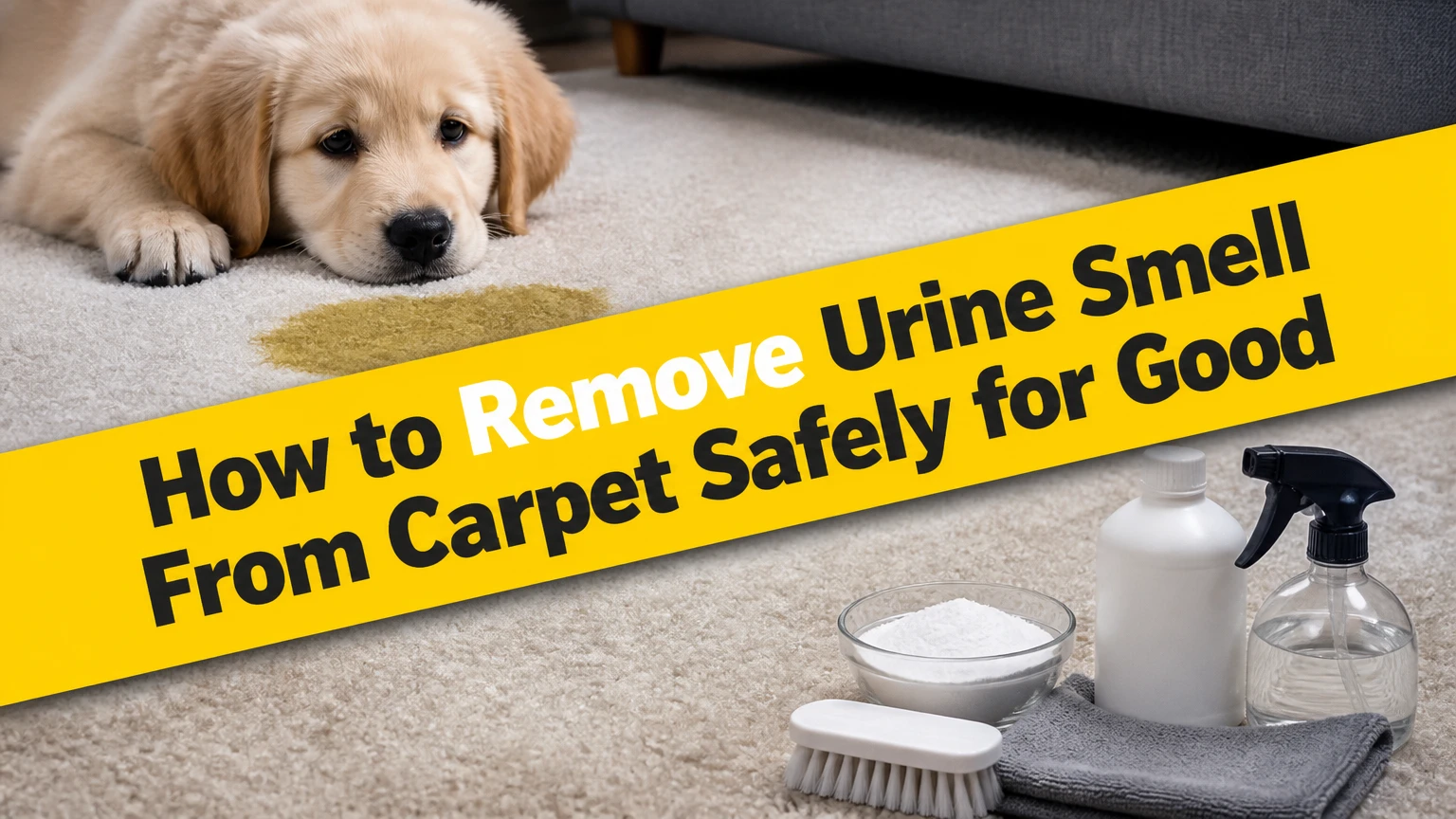
To remove urine smell from carpet, extract as much liquid as possible, then apply a compatible enzymatic urine cleaner deeply enough to reach the backing and padding. Keep the treatment wet for the product’s stated dwell time, extract the residue, and dry the carpet completely. Surface fragrance alone will not remove the source.
Key Facts at a Glance
- Enzymatic urine cleaners work on biological residue, but they must contact the contaminated fibers, backing, and accessible padding.
- Vinegar can reduce alkaline odor temporarily, while baking soda absorbs some moisture and odor; neither reliably removes deeply dried urate residue.
- A urine spot often extends beyond the visible stain because carpet spreads liquid sideways through its backing and pad.
- Never mix enzyme cleaners with bleach, peroxide, ammonia, vinegar, or other chemicals unless the product label specifically permits it.
- Complete drying commonly takes 24-48 hours after a deep treatment, depending on humidity, airflow, carpet density, and pad thickness.
- Repeated odor after two correctly performed treatments usually indicates contamination in the pad, tack strip, subfloor, or an adjacent hidden area.
Before You Start
A fresh spot can take 20-40 minutes of active work and 12-48 hours to dry. An old or repeated urine area may require several hours, carpet lifting, or professional extraction. The largest predictor of success is not the brand name of the cleaner; it is whether the treatment reaches every contaminated layer.
Materials and Safety Checklist
| Item | Typical quantity or specification | Purpose |
|---|---|---|
| White paper towels or absorbent cloths | 1-2 rolls or 8-12 cloths | Initial liquid removal |
| Enzymatic urine cleaner | 250-500 mL for a small spot; more for pad contamination | Biological residue treatment |
| Wet-dry vacuum or portable extractor | 1 machine with a clean recovery tank | Liquid and residue removal |
| Nitrile gloves | 1 pair per treatment session | Skin protection |
| Plastic sheet or washable barrier | 1 piece larger than the spot | Protect furniture or flooring |
| Fan | 1-2 units | Air movement during drying |
| UV-A blacklight | 365-395 nm, preferably with a dark-room test | Locating possible dried spots |
| White cloth | 1 clean cloth | Color-transfer and cleaner testing |
Open windows when practical, keep children and pets away from wet carpet, and follow the cleaner’s safety data sheet. Wear gloves when cleaning human or animal urine, especially if the source is unknown or the area contains fecal contamination.
How Does Urine Create a Persistent Carpet Odor?
Urine odor persists because soluble waste is joined by less-soluble urate residues that remain in carpet fibers, backing, padding, and sometimes wood beneath the carpet. As moisture rises, those residues dissolve or become chemically active again, releasing an ammonia-like smell.
Fresh urine contains water, urea, salts, pigments, proteins, and other metabolic compounds. Microbial activity breaks down urea and can produce ammonia, while dried mineral and urate residues remain after the visible wetness disappears. Cat urine is often especially persistent because concentrated deposits can reach the pad and subfloor.
The contamination path matters. A 100 mL accident does not necessarily create a 100 mL, coin-sized problem. Carpet backing can spread liquid laterally, and the pad can hold substantially more moisture than the carpet face. A treatment that wets only the tufts may leave the odor reservoir untouched.
Humidity explains many “returning” odors. A room can smell clean after drying, then develop odor during humid weather because moisture reactivates residue. Fragrance changes perception but does not remove the chemical source.
What Actually Removes the Odor?
Enzymatic cleaners use proteases, ureases, and related enzymes to break down specific organic components. Product formulas differ, so a label that lists enzymes or identifies urine odor treatment is more useful than a generic “pet-safe” claim. Enzymes do not magically remove every salt or repair urine-damaged backing.
Oxidizing cleaners, commonly based on hydrogen peroxide or peroxygen compounds, chemically alter some odor and stain compounds. Oxidizers can work faster than biological products, but they may lighten dyed fibers, damage wool, or react unpredictably with a previous cleaner.
Professional hot-water extraction removes dissolved residue and moisture through physical recovery. Extraction improves results, but it cannot compensate for a treatment that never reached the pad or a subfloor that remains contaminated.
Step 1: Blot Fresh Urine Immediately
Press clean towels into fresh urine until transfer becomes minimal, replacing saturated towels rather than rubbing the carpet. Firm downward pressure removes liquid from the pile, while rubbing spreads the accident across a larger area and pushes it toward the backing.
For a small accident, place folded towels over the area and press with your hands for 30-60 seconds per position. Standing on a towel-covered spot can increase pressure, but use a clean plastic barrier between shoes and towels. Continue until a fresh towel shows only slight dampness.
Do not begin with a deodorizing powder. Powder cannot extract a liquid puddle, and a wet mixture can become harder to remove from dense carpet.
Success checkpoint: the carpet feels damp rather than wet, and a new white towel picks up little liquid.
Common mistake: rubbing from the outside toward the center, which spreads contamination and enlarges the treatment area.
Step 2: Map the Full Contaminated Area
Identify the visible stain, the odor boundary, and any likely path beneath furniture before applying cleaner. Treat the odor boundary rather than only the darkest section, because urine commonly travels beyond the visible mark.
A UV-A blacklight can help locate old animal urine in a dark room. Clean the floor first, turn off visible lights, and inspect at several angles. Fluorescence is not proof of urine, because detergents, food, fibers, and other substances can also glow. Use odor, stain shape, pet behavior, and a small test area together.
For a fresh spot, estimate the perimeter by pressing dry towels outward from the center. For an old smell, inspect carpet edges, room corners, areas beside litter boxes, and locations where pets repeatedly sniff or circle.
Success checkpoint: you can outline the treatment area with removable tape or a mental boundary at least 5-10 cm beyond the visible stain.
Common mistake: pouring cleaner onto a single dark patch while leaving the surrounding odor zone dry.
Step 3: Apply a Compatible Enzymatic Cleaner
Apply enough enzyme cleaner to wet the affected carpet face and reach the contaminated backing, but do not flood a large area without an extraction plan. Use the product label as the primary quantity and dwell-time authority, because formulas vary from light sprays to deep-treatment solutions.
For a fresh, isolated spot where urine has not reached the pad, a typical starting volume is 250-500 mL for an area about 30 by 30 cm. A pad-soaked accident may need substantially more, but controlled application is safer than assuming a universal “twice the puddle” rule. Lift a carpet edge only if you can resecure it properly.
Apply from the outside edge inward, then gently press with a clean cloth to distribute the product through the pile. Do not mix enzyme cleaner with peroxide, bleach, ammonia, vinegar, baking soda, or detergent. A previous chemical can deactivate enzymes or create an irritating reaction.
Success checkpoint: the affected fibers are evenly wet, with no dry center or dry perimeter, and liquid has not reached baseboards or electrical outlets.
Common mistake: using a fine mist that perfumes the surface while leaving the backing dry.
Step 4: Respect Dwell Time, Then Extract
Keep the enzyme treatment wet for the label’s stated dwell period, which commonly ranges from 10 minutes to 24 hours. Enzyme products often need longer contact than ordinary carpet sprays, especially when dried residue is present.
Covering a treated spot with plastic can slow evaporation, but it also increases the risk of prolonged dampness, color migration, and microbial growth if the carpet remains wet too long. Use plastic only when the label allows it and the area can be monitored. Keep pets and children away throughout the dwell period.
After dwell time, remove dissolved liquid with a wet-dry vacuum or carpet extractor. Make several slow passes, then make additional extraction passes without spraying. Do not use a household vacuum cleaner on wet carpet.
Success checkpoint: the carpet is damp, not saturated, and the recovery tank contains visibly extracted liquid.
Common mistake: extracting immediately after application and removing the cleaner before the reaction has had time to work.
Step 5: Dry the Carpet Completely
Dry the carpet within 24-48 hours whenever possible by using fans, ventilation, and moderate room temperature. Replace wet towels, lift furniture legs onto foil or plastic blocks, and keep foot traffic low until the fibers and pad are dry.
A carpet can feel dry on top while the pad remains wet. Press a folded dry towel firmly into the spot for 30 seconds; dampness indicates incomplete drying. A moisture meter can provide a better comparison by checking the treated area against an unaffected section of the same room.
Do not use a high-temperature hair dryer or heater directly on the stain. Excessive heat can damage fibers, set some discoloration, accelerate dye migration, and create a false sense of completion while moisture remains below.
Success checkpoint: a dry towel remains dry after firm pressure, the carpet has no cool damp feel, and the odor does not intensify when the room becomes slightly humid.
Common mistake: judging success while the carpet is still wet, when cleaner fragrance temporarily masks the urine.
Step 6: Reassess After Drying
Smell the area after complete drying, then reassess during normal room humidity. Enzymatic treatment can produce a stronger odor while the area is wet because dissolved residues and cleaner ingredients become airborne; that temporary change is different from persistent odor after drying.
If odor is faint and limited to one section, repeat the compatible enzyme treatment once, using the same controlled saturation and extraction process. If the smell is strong after two properly dried treatments, stop adding chemicals and inspect below the carpet.
Mark the treated area and compare it with nearby carpet. A clean-looking surface is not proof of clean backing. Pet urine can leave yellowing, stiff fibers, delamination, or degraded pad even after the color has faded.
Success checkpoint: odor remains absent after drying and during a humid period, and the pet no longer shows repeated interest in the location.
Common mistake: layering different products after one unsuccessful attempt, which makes the chemistry and fiber risk harder to control.
Step 7: Treat the Padding or Subfloor When Necessary
Lift the carpet edge and inspect the pad or subfloor when the smell returns after drying, spreads across a broad area, or becomes strongest near a seam or wall. Deep contamination cannot be permanently removed from the carpet face if the pad or wood beneath continues releasing odor.
A professional can use subsurface extraction, a controlled pad treatment, or carpet lifting to expose the affected layers. Severely contaminated pad is often replaced rather than repeatedly soaked. Wood subfloors may require cleaning, complete drying, and an odor-blocking primer compatible with the flooring system.
Do not seal a damp subfloor. Trapping moisture under primer or replacement carpet can promote structural damage and microbial growth. Check the entire area, including tack strips and the underside of the carpet, before reinstalling materials.
Success checkpoint: the subfloor is dry, the replacement or treated pad has no odor, and the room remains neutral after several days.
Common mistake: applying primer over visible residue or wet wood, which can trap the problem rather than remove it.
Which Urine-Odor Treatment Works Best?
Enzymatic cleaner is the best first choice for most fresh or dried pet-urine contamination on synthetic carpet, provided the product is compatible and reaches the source. Oxidizer is a faster but riskier option for some synthetic carpets, while vinegar and baking soda are emergency measures that provide limited source removal.
| Treatment | Typical active window | Best use | Main limitation |
|---|---|---|---|
| Enzymatic urine cleaner | 10 minutes-24 hours | Pet urine on nylon or polyester | Slow; incompatible mixtures can deactivate it |
| Hydrogen-peroxide oxidizer | 15-60 minutes | Some old stains on colorfast synthetic carpet | Can bleach or alter dyes |
| Hot-water extraction | 1-4 hours including drying setup | Removing dissolved residue and cleaner | Cannot remove untreated subfloor contamination |
| Vinegar and water | 5-15 minutes | Temporary odor reduction on compatible synthetic carpet | Does not reliably destroy deep urate residue |
| Baking soda | 8-24 hours before vacuuming | Surface moisture and mild odor absorption | Ineffective against saturated padding |
Enzyme Cleaner Versus Oxidizer
Choose an enzyme cleaner when the source is pet urine, the carpet is synthetic, and you can allow a long dwell and drying period. Choose an oxidizer only after a colorfastness test and only when the label identifies the carpet fiber as compatible.
A 3% household hydrogen peroxide solution is not automatically equivalent to a commercial oxidizer. Commercial products may contain stabilizers, surfactants, or higher effective concentrations, while unknown mixtures can cause bleaching. Never combine peroxide with vinegar, chlorine bleach, ammonia, or another cleaner.
For wool, silk, viscose, antique rugs, and plant-fiber carpets, avoid improvised oxidizers and strong alkaline products. Contact a rug specialist who can test dye stability and identify the fiber before wet treatment.
Do Vinegar and Baking Soda Remove Urine Smell?
Vinegar and baking soda can reduce the apparent odor of a small, fresh surface accident, but the combination is not a dependable permanent treatment for urine in carpet padding. The acid and alkaline ingredients neutralize each other, producing carbon dioxide, water, and sodium acetate rather than a specialized urate-removal reaction.
If no enzyme product is available, dilute equal parts white vinegar and cool water, test an inconspicuous area, apply a small amount to compatible synthetic carpet, and extract after 5-15 minutes. Do not use vinegar on wool, silk, limestone, or other acid-sensitive materials without professional advice.
Apply baking soda only after the carpet is nearly dry, leave it for 8-24 hours, and vacuum thoroughly with a machine designed for fine powder. Baking soda added to a saturated spot can form paste in the backing and leave alkaline residue.
This method is a temporary household response, not the preferred answer for cat urine, repeated marking, or a smell that returns in humid conditions.
What Changes for Cat, Dog, and Human Urine?
Cat urine usually requires the deepest inspection because concentrated deposits often penetrate pad and subfloor, while dog urine commonly creates larger surface areas that spread through backing. Human urine can also contaminate carpet deeply, and hygiene precautions matter more when illness, medication, or fecal material may be involved.
| Source | Common pattern | Preferred first response | Extra concern |
|---|---|---|---|
| Cat | Small, concentrated deposits; repeated marking | Enzyme cleaner with deep inspection | Pad, tack strip, and subfloor contamination |
| Dog | Larger puddles; broad backing spread | Blot, map perimeter, then enzyme treatment | Treatment area often exceeds visible stain |
| Human | Variable volume and concentration | Gloves, extraction, compatible enzyme cleaner | Hygiene and possible medical-source contamination |
| Unknown | Odor without confirmed source | UV inspection and controlled testing | Avoid mixing chemicals before identification |
For repeated pet accidents, remove access to the location and address the behavioral or medical cause. Cleaning alone does not prevent re-soiling when a cat has urinary disease, a dog has separation anxiety, or a litter box is inaccessible.
What Are the Most Common Failure Modes?
Most failed treatments leave contamination below the carpet surface or introduce a second problem through incompatible chemistry. The following recovery rules prevent repeated saturation without diagnosis.
| Failure mode | Likely cause | Recovery action | Typical timeframe |
|---|---|---|---|
| Odor returns when humid | Dried residue remains below surface | Repeat deep treatment or inspect pad | 24-72 hours |
| Carpet smells like cleaner and urine | Product was not extracted | Rinse and extract with clean water if label permits | 1-2 days |
| Yellow halo appears | Liquid spread or dye migration | Stop chemicals; test fiber and extraction method | 1-3 days |
| Pet revisits the area | Odor remains detectable to the animal | Deep-clean, block access, improve toilet routine | 1-4 weeks |
| Carpet feels stiff | Cleaner or baking soda residue | Thorough dry extraction or professional rinse | 1-2 days |
| Smell is strongest at the wall | Pad, tack strip, or subfloor contamination | Lift edge and inspect layers | 1-3 days to diagnose |
Practitioner rule: a stronger odor immediately after wetting does not prove the cleaner failed. Judge the result only after complete drying and a later humidity check.
Practitioner rule: a product that removes color is not necessarily removing odor. Stain disappearance and source removal are separate outcomes.
Practitioner rule: repeated wetting increases risk when the pad cannot dry. After two controlled attempts, diagnose depth instead of adding more liquid.
How Much Does Professional Urine Removal Cost?
Typical professional treatment costs range from about $100-$300 for one localized area and $300-$800 or more for several rooms, subsurface extraction, pad replacement, or subfloor sealing. Local labor, minimum service charges, carpet construction, furniture, and contamination depth create large price differences.
| Service | Typical price range | Typical duration | Appropriate situation |
|---|---|---|---|
| Single-spot treatment | $100-$200 | 1-2 hours | One accessible synthetic-carpet area |
| One-room deep extraction | $150-$350 | 2-4 hours | Several related accidents |
| Pad replacement | $100-$400 per area | 2-5 hours | Saturated or degraded padding |
| Subfloor cleaning and sealing | $250-$800+ | 1-3 days | Persistent odor after carpet treatment |
| Specialty wool-rug treatment | $150-$600+ | Several days | Valuable or dye-sensitive rug |
Request an itemized quote that identifies whether the price includes inspection, subsurface treatment, extraction, pad replacement, odor-blocking primer, and drying equipment. A low surface-cleaning quote may not address contamination below the pile.
Situation-Specific Guidance
For Renters
Document the stain, notify the landlord when the pad or subfloor may be affected, and avoid applying a bleaching oxidizer before the move-out inspection. A renter should prioritize a reversible, label-compliant enzyme treatment and professional documentation rather than hiding the odor with fragrance.
For Homes With Toddlers
Block access to wet carpet, store products in a locked location, and keep the room unavailable until the carpet and pad are fully dry. Use fragrance-free products when possible, because perfume can irritate sensitive occupants and does not improve source removal.
For Wool or Valuable Rugs
Stop after blotting and consult a rug professional. Wool, silk, viscose, antique rugs, and unstable dyes can shrink, bleed, brown, or become permanently distorted after uncontrolled saturation.
For Large or Repeated Contamination
Professional service is appropriate when urine covers more than roughly 0.5-1 square metre, reaches seams or walls, has soaked through multiple times, or remains after two complete treatments. Carpet lifting may be more economical than repeated unsuccessful chemical applications.
How Can You Prevent the Smell From Returning?
Prevent recurrence by removing the odor from the full contamination path, restricting access during drying, and correcting the reason for repeated urination. For pets, clean bowls and litter areas, provide frequent toilet opportunities, and consult a veterinarian when accidents begin suddenly.
Use a washable waterproof pad beneath litter boxes, puppy pads, or vulnerable furniture. Move food and water away from a repeatedly marked location only after cleaning, because changing the location alone does not erase odor cues.
Vacuum dry baking soda thoroughly if used, because residue can attract moisture and stiffen fibers. Do not use ammonia-based cleaners on pet urine areas, since ammonia-like odor can encourage some animals to investigate and mark again.
FAQ
Can I use a steam cleaner on urine-stained carpet?
A steam cleaner can help extract dissolved residue after compatible treatment, but high heat and added moisture are poor first responses to a fresh urine accident. Blot and treat first, then follow the carpet and machine manufacturer’s instructions. Avoid steam on wool, unstable dyes, or a pad that cannot dry promptly.
How long should an enzyme cleaner sit on carpet?
The correct dwell time is the product label’s stated period, commonly 10 minutes to 24 hours. Fresh surface spots may need less time than dried cat urine in padding. The area must remain appropriately wet during the reaction, but prolonged saturation without extraction can damage backing and delay drying.
Why does carpet still smell after cleaning?
Persistent odor usually means urine remains in the backing, padding, tack strip, subfloor, or an adjacent hidden area. Other causes include incomplete extraction, cleaner residue, humidity reactivation, or a second accident. Stop mixing products, let the carpet dry, then inspect the contamination depth.
Will sunlight remove urine odor?
Sunlight can help dry removable rugs and may reduce some odor through ventilation and limited ultraviolet exposure, but sunlight does not reliably remove urate residue in carpet padding or subfloor. Direct sun can also fade dyes. Use airflow and appropriate extraction instead of treating sunlight as a chemical solution.
Is dried urine on carpet a health hazard?
A small, fully dried household urine spot is generally a lower-risk exposure than fresh urine, but contaminated carpet can carry bacteria, irritate sensitive occupants, and create persistent ammonia-like odor. Wear gloves, ventilate the room, prevent children and pets from contacting wet cleaner, and seek professional advice for extensive contamination.
Should I replace carpet after a urine accident?
Replacement is usually unnecessary for one fresh, accessible accident treated before it reaches the pad. Consider replacing padding, or the carpet assembly, when repeated accidents have saturated multiple layers, the backing is damaged, odor persists after professional treatment, or subfloor contamination cannot be isolated.
The Bottom Line
To remove urine smell from carpet, blot immediately, map the entire affected area, apply a compatible enzyme cleaner deeply enough to reach the source, follow the label dwell time, extract excess liquid, and dry for 24-48 hours. If odor returns after two complete treatments, inspect the padding and subfloor instead of adding more chemicals. That is the reliable path for removing urine smell from carpet rather than masking it.