
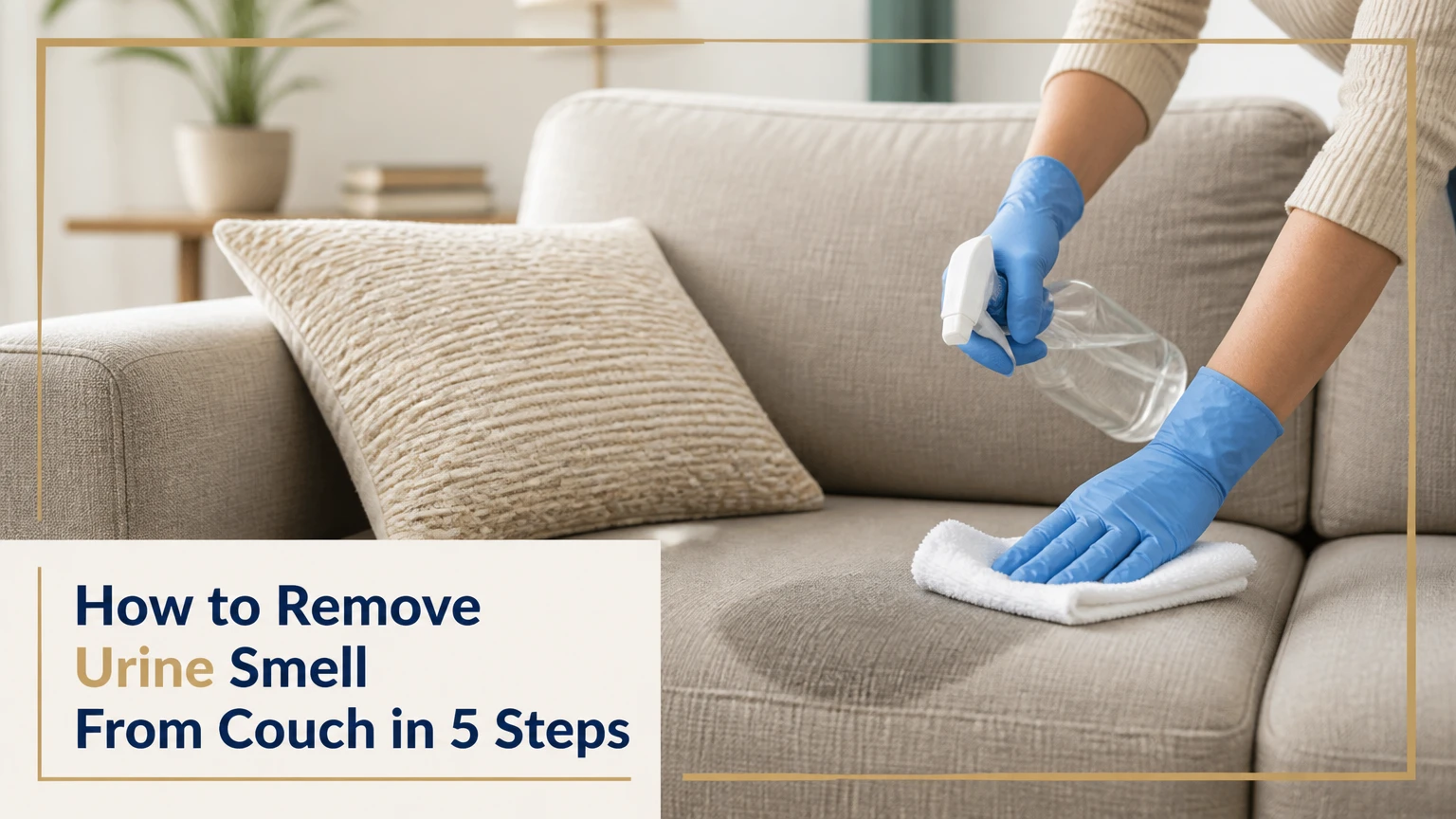
To remove urine smell from a couch, blot the liquid, identify the upholstery cleaning code, and apply a fabric-safe enzymatic urine cleaner deeply enough to reach the padding. Keep the treatment wet for the label-specified dwell time, extract excess moisture, and dry the cushion completely before judging the odor.
Key Facts
Enzymatic urine cleaners work best when they reach every layer contacted by urine.
Baking soda absorbs some surface moisture, but it does not replace a urine-specific treatment.
Mixing vinegar and baking soda creates fizz, then largely neutralizes both ingredients.
Upholstery marked W or WS is generally more suitable for water-based DIY cleaning than S, X, silk, or untreated leather.
A recurring smell usually means urine remains in foam, batting, the underside, or the couch frame.
Most treated cushions need 12-48 hours to dry, depending on saturation, ventilation, humidity, and foam density.
Why Urine Odor Returns After the Couch Dries
Urine odor returns when dissolved waste products remain in upholstery or foam and become noticeable again under warm, humid conditions. Fresh urine has a different odor profile from aged urine: bacterial activity can convert urea into ammonia, while less-volatile organic residues remain in fibers, batting, and cushion foam.
The phrase “uric acid crystals” is useful shorthand for dried urine residue, but it should not be treated as a complete chemical explanation. Residue composition varies with the person or animal, hydration, age of the spot, surface, and microbial activity. Enzymatic products target organic components of urine residue; they do not magically dissolve every contaminant after a light surface spray.
Odor location matters more than odor intensity. A small visible patch can represent a larger wetting pattern because upholstery distributes liquid sideways along fabric and batting. Cat urine often creates a stronger, more persistent odor because cats produce concentrated urine, but dog and human urine can also penetrate deeply enough to require repeated treatment.
What moisture and heat do
Humidity can make residual odor easier to detect, so a couch that seems clean in dry weather may smell again during summer or after steam exposure. Heat does not universally “bake” urine permanently into fabric, but high heat can accelerate odor release, damage dyes, shrink fibers, and set some stains.
Low, indirect airflow is safer than a hairdryer held against the fabric. Never use a heated appliance until the cleaner label and upholstery manufacturer permit it.
Which Cleaner Works Best for Couch Urine?
A urine-specific enzymatic cleaner is usually the best first choice for water-cleanable fabric, especially when urine reached the cushion filling. Hydrogen peroxide can help with some light, colorfast upholstery, while vinegar and baking soda are limited household options for fresh, shallow contamination.
| Method | Best use | Typical cost | Typical time | Main limitation |
|---|---|---|---|---|
| Enzymatic urine cleaner | Fresh or dried urine in W or WS fabric | $10-$30 | 12-48 hours | Requires deep contact and complete drying |
| Distilled white vinegar solution | Fresh, shallow odor on durable fabric | $2-$6 | 6-24 hours | Does not reliably remove deep urine residue |
| Baking soda alone | Surface odor and residual dampness | $1-$5 | 8-24 hours | Absorbs rather than chemically treats urine |
| 3% hydrogen peroxide mixture | Light, colorfast synthetic fabric | $3-$8 | 2-12 hours | May bleach, yellow, or weaken some materials |
| Portable extractor | Removable, water-cleanable cushions | $30-$70 rental | 4-24 hours | Extraction without pretreatment may leave odor |
| Professional upholstery service | Deep foam, antique, delicate, or severe contamination | $150-$400 typical | 1-3 days | Higher cost and variable treatment quality |
Why enzyme cleaner is usually the first choice
Enzymatic formulas contain enzymes and, depending on the product, microorganisms or other biological components that break down organic soil. Product formulations differ, so follow the label rather than assuming every “pet odor” spray has the same dwell time or is suitable for upholstery.
Enzymes cannot work where they cannot reach. A mist applied to the visible face of a cushion may remove surface odor while leaving the foam saturated underneath. The treatment should wet the affected zone to approximately the same depth as the urine, without flooding an unapproved material.
Do not combine an enzyme product with bleach, disinfectant, ammonia, peroxide, vinegar, or another cleaner unless the manufacturer specifically permits that sequence. Residual chemicals can reduce biological activity or create hazardous vapors.
Can vinegar and baking soda remove the smell?
Vinegar and baking soda can reduce a fresh, shallow odor when used carefully, but mixing them together is not a superior urine treatment. Acetic acid in vinegar reacts with sodium bicarbonate, producing carbon dioxide, water, and sodium acetate; the visible fizz does not mean that urine residue has been destroyed.
For a limited household approach, use one method at a time. Lightly apply a 1:1 mixture of distilled white vinegar and cool water to approved water-cleanable fabric, blot after several minutes, then allow ventilation. After the fabric is nearly dry, sprinkle baking soda, leave it for 8-12 hours, and vacuum thoroughly.
Vinegar is unsuitable for some natural fibers, dyes, finishes, and leather. Baking soda can lodge in textured upholstery and foam, where ordinary vacuuming may not remove it.
When is hydrogen peroxide appropriate?
A 3% hydrogen peroxide solution is appropriate only for upholstery that passes a hidden-area colorfastness test and has a manufacturer-approved water-cleaning code. Peroxide oxidizes some organic staining, but it can lighten dark dyes, create pale spots, yellow natural fibers, or affect protective finishes.
Use a small amount rather than saturating the cushion. A commonly used spot mixture contains 3% peroxide with a small quantity of unscented dish detergent, but a commercial upholstery product with explicit fabric directions is easier to control. Never mix peroxide with chlorine bleach, ammonia, or acidic cleaners.
| Upholstery code or material | DIY water treatment | Safer first action | Avoid |
|---|---|---|---|
| W, synthetic fabric | Usually permitted | Enzyme product after testing | Excessive flooding |
| WS, blended fabric | Often permitted | Label-approved enzyme or upholstery cleaner | Assuming every solvent is safe |
| S, solvent-clean only | Usually unsuitable | Professional solvent-based service | Water, vinegar, peroxide |
| X, vacuum only | No liquid spot treatment | Vacuum and professional assessment | Sprays and extraction |
| Wool or silk | High risk | Specialist upholstery cleaner | Enzymes, peroxide, soaking |
| Finished leather | Use leather-specific product | Blot, then manufacturer-approved cleaner | Vinegar, peroxide, saturation |
| Suede or nubuck | Specialist treatment | Blot and isolate the area | Water-based DIY cleaning |
How to Remove Urine Smell From a Couch Safely
The following five-step process works for most removable, water-cleanable fabric cushions. Total hands-on time is usually 30-60 minutes, while drying requires 12-48 hours; success depends primarily on reaching the deepest contaminated layer without damaging the cover.
Before you start
| Requirement | Typical specification |
|---|---|
| Hands-on time | 30-60 minutes |
| Drying time | 12-48 hours |
| Difficulty | Moderate for covers, high for fixed foam |
| Cleaner | 250-1,000 mL urine-specific enzyme product |
| Absorbent material | 10-20 clean white towels or paper towels |
| Tools | Gloves, vacuum, spray bottle if permitted, fan, UV flashlight |
| First check | Upholstery code, care label, hidden patch test |
Remove children and pets from the work area. Wear disposable gloves, wash hands afterward, and use ventilation. For human urine involving blood, feces, or a known infectious illness, follow public-health or professional cleaning guidance rather than treating the spill as an ordinary household stain.
Step 1: Find and blot the urine
Remove the cushion cover if possible and inspect the cover, foam, batting, zipper edge, underside, and couch deck. Press white towels firmly into fresh urine for 30-60 seconds at a time, replacing them as soon as they become damp.
Do not scrub. Scrubbing spreads liquid across fibers and can drive it farther into foam. A UV flashlight can help locate dried pet urine in a dark room, but optical brighteners, detergent residue, and some dyes also fluoresce, so confirm suspected areas by odor, texture, and inspection rather than UV light alone.
You will know Step 1 worked when: towels no longer pick up visible liquid and the suspected wet boundary has been mapped.
Common mistake: treating only the darkest visible mark while ignoring the cushion seam or underside.
Step 2: Test the upholstery and prepare the area
Check the care tag or manufacturer instructions for W, WS, S, or X. Apply one teaspoon of the chosen product to a concealed area, such as the rear lower edge, then blot with a white towel and inspect after the label’s stated test period.
Look for dye transfer, rings, tackiness, texture change, swelling, or color loss. Remove loose dirt with a vacuum fitted with an upholstery attachment, because soil can interfere with cleaner contact and make blotting less effective.
You will know Step 2 worked when: the test area has no visible dye transfer or texture change after drying.
Common mistake: testing only whether color fades, not whether the fabric develops a permanent water ring.
Step 3: Apply the enzyme cleaner deeply enough
Apply a urine-specific enzyme cleaner to the entire suspected zone, extending 2-3 inches beyond the visible edge. Use enough liquid to contact the contaminated layer, but do not exceed the quantity allowed by the upholstery manufacturer or product label.
For a removable cushion, inspect the foam after opening the cover. If the foam smells strongly, surface spraying is unlikely to be sufficient. Treat the affected face and, where the label permits, the corresponding foam area, then use towels or an extractor to control runoff.
Enzyme dwell time varies by product. Many products need several hours, and severe dried contamination may require an overnight contact period. A plastic cover can slow evaporation only when the product label permits it and the area remains safely contained; trapped moisture can encourage mildew.
You will know Step 3 worked when: the product has reached the same general depth as the urine without soaking the frame or leaving uncontrolled runoff.
Common mistake: applying a fine mist because the fabric looks wet, even though the foam underneath remains dry.
Step 4: Extract excess liquid and dry the cushion
After the required dwell time, press clean towels into the area or use a water-extraction machine approved for the upholstery. Do not add detergent to the extractor unless the machine and fabric instructions allow it.
Stand removable cushions on their edge with space around both sides. Open windows when outdoor humidity is low, run a fan across the room rather than directly against a wet seam, and use a dehumidifier if the room is humid. Avoid returning the cushion to the couch until the foam is dry through its center.
You will know Step 4 worked when: the fabric feels dry, the foam does not feel cool or heavy, and the odor remains absent after several hours of normal room humidity.
Common mistake: covering or stacking a damp cushion, which slows evaporation and can create a musty odor.
Step 5: Reassess after complete drying
Evaluate the couch only after 24 hours, or after the foam has dried fully. Smelling wet fabric gives unreliable results because moisture temporarily changes how odor compounds evaporate.
If odor remains, identify whether it is strongest in the cover, foam, batting, underside, wood frame, or floor beneath the couch. Repeat the enzyme treatment once if the material permits it and the first application reached only part of the contaminated depth.
You will know Step 5 worked when: the odor stays absent after the room warms and humidity rises modestly.
Common mistake: adding fragrance immediately. Fragrance masks odor and makes it harder to locate the remaining source.
What Changes for Fresh, Dried, Pet, and Human Urine?
Fresh urine requires rapid blotting, while dried urine requires source mapping and deeper treatment. Pet urine often needs a dedicated enzyme formula, whereas human urine may respond to the same product when it has penetrated fabric, batting, or foam.
| Situation | First action | Cleaner choice | Typical repeat pattern |
|---|---|---|---|
| Fresh human urine | Blot within 5-10 minutes | Approved enzyme product or mild upholstery cleaner | One treatment if shallow |
| Fresh dog urine | Blot and remove cover | Pet urine enzyme cleaner | One or two treatments |
| Dried cat urine | UV inspection and disassembly | Cat urine enzyme product | Two or more treatments possible |
| Unknown old odor | Inspect underside and foam | Enzyme product after patch test | Repeat after full drying |
| Urine on removable cover | Wash only if label permits | Pre-treat, then laundering | Recheck foam separately |
| Urine on fixed cushion | Protect frame and floor | Controlled enzyme application | Professional extraction if deep |
Removable covers
Wash a removable cover only according to its care label. Cold or warm water is usually safer for unknown fabrics than hot water, and the cover should not go into a hot dryer until both stain and odor have disappeared.
A clean cover cannot solve contaminated foam. Treat the insert separately when the urine crossed the cover.
Microfiber upholstery
Microfiber may show water marks even when the cleaner is chemically safe. Use a minimal, controlled amount on a tested area, avoid aggressive rubbing, and restore the nap with a soft brush only after the fabric is fully dry and the manufacturer permits brushing.
Leather, suede, silk, and wool
Liquid urine can damage leather finishes and natural fibers before odor removal begins. Blot without saturating, retain the care label, and contact a specialist when the material is marked S, X, silk, wool, suede, or nubuck.
When Should You Call a Professional?
Professional upholstery cleaning is appropriate when urine has saturated fixed foam, reached the couch frame, affected antique or delicate fabric, or returned after two properly executed treatments. Typical professional upholstery service costs range from $150-$400 for a couch, with higher prices for sectional size, travel, severe contamination, or specialty materials.
Ask the cleaner four specific questions:
- Will the technician inspect and treat the cushion foam, not only the fabric surface?
- Which cleaning method matches the upholstery code?
- How will the technician control urine odor rather than cover it with fragrance?
- What drying time and ventilation conditions are required?
Hot-water extraction can remove dissolved soil, but extraction alone may leave odor in dense foam. Conversely, excessive water can spread urine into the frame or floor. The best process combines inspection, a compatible odor treatment, controlled extraction, and documented drying.
Health and chemical safety
The Centers for Disease Control and Prevention warns, “Never mix bleach with ammonia or any other cleaner.” Urine can release ammonia as it ages, so chlorine bleach is a poor choice for a urine-soiled couch even before fabric damage is considered.
Keep peroxide, bleach, ammonia, acids, and biological cleaners in separate treatment sequences. Rinse or remove residues only when the product and fabric directions permit it.
Common Mistakes and How to Fix Them
Using ammonia-based cleaner
Ammonia can intensify the ammonia-like odor and may encourage a pet to revisit a marked location. Stop using the product, ventilate the room, and follow the upholstery manufacturer’s rinsing guidance before applying an enzyme treatment.
Spraying fragrance over the couch
Air freshener changes perceived odor without removing urine residue. Vacuum loose powder, inspect the deep layers, and treat the source rather than repeating fragrance applications.
Steam cleaning first
Steam can spread moisture through foam and release a stronger odor temporarily. If steam has already been used, dry the cushion completely, inspect the foam, and use a compatible urine treatment only after confirming that no incompatible chemical residue remains.
Over-wetting the frame
A saturated couch deck can swell wood, loosen adhesive, stain flooring, or develop mildew. Protect the floor with plastic and towels, use measured applications, and stop DIY treatment when liquid reaches inaccessible structural components.
Applying baking soda before extracting liquid
Powder on wet upholstery forms a paste that can lodge in the weave and foam. Blot or extract liquid first, let the fabric become nearly dry, then vacuum dry baking soda thoroughly if the material permits it.
Judging the result too soon
Wet upholstery often smells different from dry upholstery. Wait until the fabric and foam are fully dry, then reassess under ordinary room conditions rather than immediately after treatment.
How Much Does Treatment Cost and Take?
DIY treatment typically costs $10-$40 and takes 30-60 minutes of active work, followed by 12-48 hours of drying. Professional treatment commonly costs $150-$400 for a couch, although sectional size, access, fabric type, and deep foam contamination can raise the price.
| Treatment level | Materials or service | Active time | Drying or waiting time | Typical total cost |
|---|---|---|---|---|
| Fresh surface spot | Towels and enzyme spray | 20-30 minutes | 12-24 hours | $10-$20 |
| Dried cushion stain | Enzyme product and repeated blotting | 45-90 minutes | 24-48 hours | $15-$35 |
| Removable foam insert | Enzyme product and extractor | 60-120 minutes | 24-48 hours | $30-$70 |
| Fixed deep cushion | Professional inspection and extraction | 1-3 hours | 24-72 hours | $150-$400 |
| Delicate or antique upholstery | Specialist service | 1-4 hours | 24-72 hours | $200-$600 typical |
These are typical consumer ranges, not guaranteed prices. Product labels, local labor rates, and furniture construction determine the actual requirement.
FAQ
Will the urine smell disappear on its own?
A fresh surface odor may weaken as volatile compounds evaporate, but urine residue inside foam usually remains. Humidity can make the smell return later, so natural drying is not a reliable odor-removal method. Blot promptly, treat the contaminated depth, and dry the cushion completely.
Can I use a carpet cleaner on my couch?
Use a carpet-cleaning machine only when the upholstery manufacturer permits water extraction and the machine has an upholstery tool. Carpet formulas and brush agitation can damage couch fabric, leave detergent residue, or over-wet foam. Check the care code before using any machine.
How do I remove urine smell from a couch without vinegar?
Use a tested upholstery-safe enzymatic cleaner, blotting towels, controlled extraction, and moving air. Enzyme treatment is generally more suitable than vinegar for dried or pet urine because it targets organic residue rather than relying on acidity and odor masking.
Why does my couch smell worse after enzyme cleaner?
An enzyme treatment can make odor seem stronger while damp because moisture increases evaporation from the contaminated area. Wait until the fabric and foam are completely dry before deciding whether treatment failed. If the odor remains, the cleaner may not have reached the full depth.
How do I stop my cat from urinating on the couch again?
Remove the odor source completely, block access while the couch dries, and clean nearby flooring or blankets that may also carry urine odor. Repeated urination can indicate litter-box stress or a medical problem, so a veterinarian should assess a cat with a sudden change in toileting behavior.
Should I throw away a couch that smells like urine?
Replace the couch only when contamination has reached inaccessible foam or framing, repeated professional treatment has failed, or the material is unsafe to clean. A removable cover and replaceable cushion insert can often be treated separately, making repair less expensive than replacing the entire couch.
The Bottom Line
The most reliable answer to how to remove urine smell from couch is controlled, depth-appropriate enzyme treatment followed by extraction and complete drying. Blot fresh urine immediately, test the upholstery code, treat the foam when necessary, and reassess only after 12-48 hours. For silk, wool, leather, S or X upholstery, fixed deep cushions, and recurring odor, use a qualified upholstery professional rather than adding stronger household chemicals.