
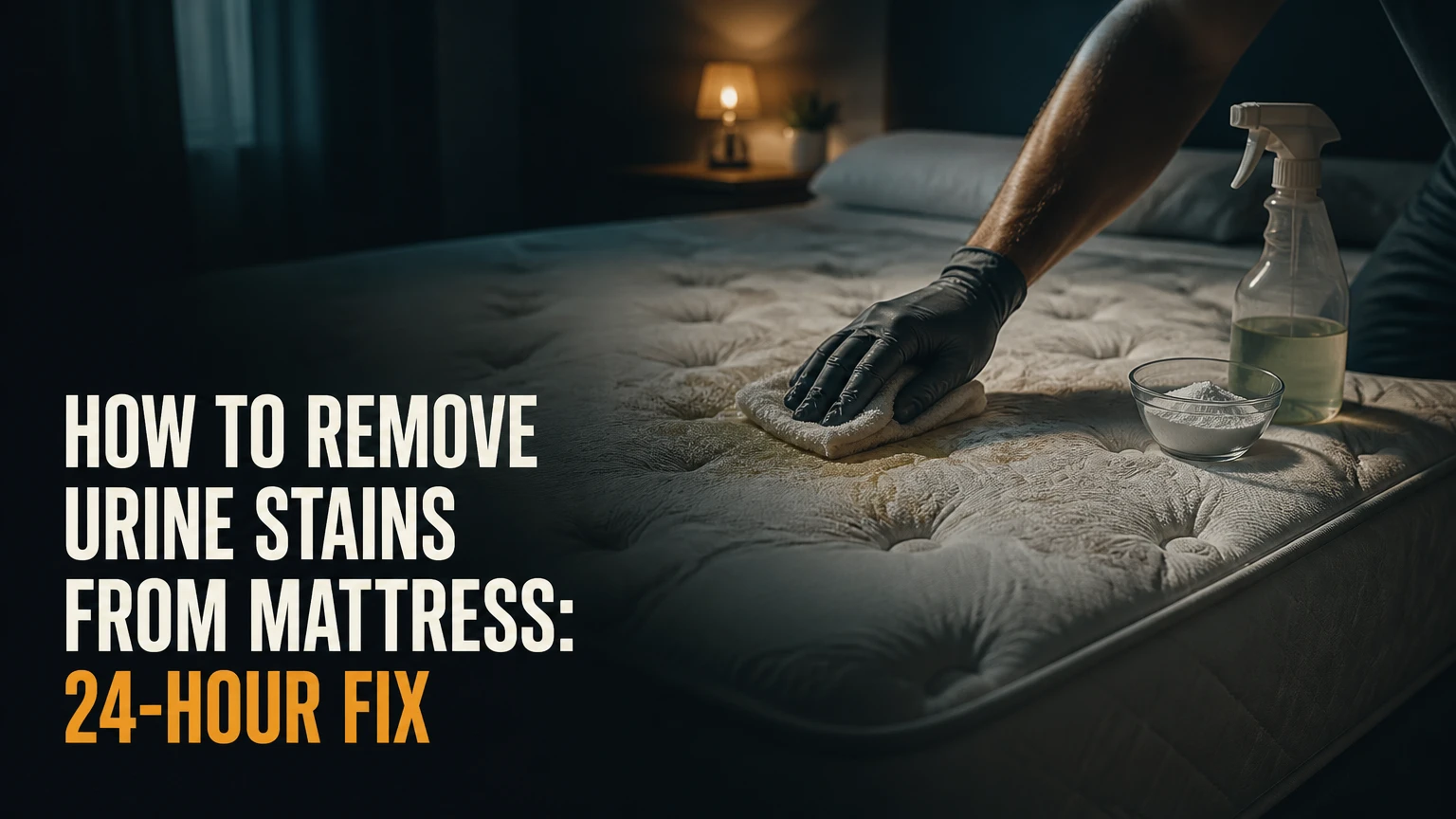
To remove urine stains from a mattress, blot fresh liquid, apply an enzyme-based urine cleaner deeply enough to match the spill, then dry the mattress completely with strong airflow. For a fresh stain, treatment usually takes 20-30 minutes of work and 12-24 hours of drying; dried or pet urine may require two or more applications.
Key Facts
An enzymatic urine cleaner is usually the best first choice for persistent odor, especially pet urine.
Vinegar and baking soda can reduce surface odor, but they do not reliably digest dried uric-acid residue.
Hydrogen peroxide can lighten yellow discoloration, but it may bleach mattress fabric and should be patch-tested.
Never soak memory foam, use chlorine bleach, or combine vinegar with hydrogen peroxide.
A mattress is ready for bedding only when the surface and interior feel dry and no cool, damp area remains.
The cleaning method must follow the mattress manufacturer’s care label, particularly for removable covers and foam layers.
How to Remove Urine Stains From Mattress Safely
The safest general method uses cool-water blotting, a compatible enzyme cleaner, limited moisture, and continuous ventilation. Remove bedding immediately, inspect the care label, and treat the stained area plus a narrow surrounding margin without flooding the mattress.
Urine treatment has two separate goals: removing the visible yellow or brown mark and removing the odor source. A peroxide solution may improve appearance, while an enzyme product is generally more useful when odor persists below the ticking.
Do not begin by pouring water onto the mattress. A mattress absorbs liquid differently from a washable sheet, and trapped moisture inside polyurethane foam can take much longer to evaporate than the surface suggests.
Before You Start
| Requirement | Typical specification | Why it matters |
|---|---|---|
| Working time | 20-30 minutes | Covers blotting, spraying, and setup |
| Drying time | 12-48 hours | Depends on foam, humidity, and airflow |
| Enzyme cleaner | 500-1,000 mL | Enough for one moderate treatment |
| Absorbent towels | 8-12 towels | Fresh urine can require repeated replacement |
| Fan or air mover | 1-2 units | Moves moisture away from foam |
| Gloves | 1 pair, nitrile | Protects skin during contaminated cleanup |
| Vacuum | Upholstery attachment | Removes dry baking soda and surface debris |
Open windows when outdoor humidity is reasonable, place a fan to move air across the mattress, and keep the mattress off a solid floor if possible. A dehumidifier helps in humid rooms, but do not direct high heat from a hair dryer onto foam.
Why Does Urine Smell After the Mattress Dries?
A dried urine odor returns because concentrated urine residue remains in fibers or foam and releases volatile ammonia-related compounds when humidity rises. Water and urea are relatively easy to remove, but uric-acid salts can remain attached to porous material after the visible wetness disappears.
The commonly repeated claim that vinegar and baking soda “break chemical bonds” in uric-acid crystals is too strong. Vinegar can alter pH and reduce some odors, while baking soda can absorb limited moisture and odor, but the fizzing reaction mainly neutralizes the two ingredients rather than reliably digesting embedded urine residue.
Enzyme cleaners are designed to break down organic components of urine, but performance depends on product formulation, contact time, temperature, and whether the product reaches the contaminated depth. They are not magic disinfectants, and a completely dry, heavily saturated foam core may need extraction or replacement.
Which Urine Cleaner Should You Use?
Choose an enzymatic urine cleaner for recurring odor, pet urine, or a stain that has penetrated below the surface. Choose a diluted vinegar treatment only for a small, fresh, lightly contaminated area when an enzyme product is unavailable; use peroxide primarily for stubborn discoloration after testing the fabric.
| Method | Best use | Typical active time | Main limitation |
|---|---|---|---|
| Enzyme cleaner | Pet urine and deep odor | 15 minutes to several hours | Must reach the contaminated depth |
| White vinegar solution | Fresh surface residue | 10-15 minutes | Does not reliably digest uric-acid salts |
| Baking soda | Surface moisture and mild odor | 4-12 hours | Cannot remove deep liquid from foam |
| 3% hydrogen peroxide | Yellow discoloration | 4-6 hours drying | Can lighten or damage dyed fabric |
| Professional extraction | Large or repeated saturation | 1-3 hours onsite | Requires controlled drying afterward |
Read the label before applying any product. Some enzyme products require the area to remain wet for a specified dwell time, while others warn against use on wool, silk, leather, or certain treated fabrics.
What Products Should Never Be Combined?
Never combine chlorine bleach with urine, ammonia products, vinegar, or other acidic cleaners. Chlorine-based products can react with ammonia compounds and release irritating or dangerous chloramine gases; bleach also damages many mattress coverings.
Do not combine hydrogen peroxide and vinegar in the same bottle or treatment step. Apply one product, remove its residue as directed, and allow the area to dry before considering another compatible method.
Step 1: Remove Bedding and Blot Fresh Urine
Strip sheets, mattress pads, and protectors immediately, then press clean towels firmly into the wet mattress. Replace saturated towels repeatedly until they lift little or no liquid, and avoid rubbing because friction spreads urine through the ticking and into adjacent foam.
Wash removable bedding according to its care label. A waterproof protector can usually go into a washing machine, but inspect its polyurethane backing for cracking before reusing it.
Success checkpoint: the towel feels damp rather than wet after firm pressure.
Common mistake: scrubbing the stain outward, which enlarges the treated area and increases the volume of material that must dry.
If the mattress has been compressed by body weight, lift the corner or change the pressure point while blotting. Do not kneel directly on memory foam because compression can force liquid sideways into clean areas.
Step 2: Locate the Full Contaminated Area
Mark the visible stain and inspect the underside of the sheet, protector, and mattress. Urine often spreads beyond the obvious ring, especially near the hips or center of a mattress where pressure drives liquid downward.
A black-light inspection can reveal some dried urine residue, but it is not definitive. Detergent residue, optical brighteners, and certain fibers can fluoresce, while weak or old urine may not show clearly.
Estimate depth from the incident. A small damp patch from a child may affect only the ticking, whereas a pet accident that soaked through a protector can reach several centimeters into foam.
Step 3: Apply an Enzyme Cleaner
Apply a labeled enzyme urine cleaner to the stained area and its immediate margin, using enough product to match the original contamination without creating a large wet zone. For a surface stain, start with approximately 100-250 mL; for deeper pet urine, follow the label’s saturation instructions rather than guessing.
Do not dilute a ready-to-use formula unless the manufacturer specifies dilution. Spray from a short distance to control overspray, and work around seams because liquid can travel through stitching.
Covering the area loosely with plastic for part of the labeled dwell period can slow evaporation, but this approach is unsuitable when the mattress is already saturated or the room cannot be ventilated. The product must remain damp long enough to work, then the mattress must dry promptly.
Success checkpoint: the cleaner has contacted every visibly affected fiber, with no puddling at the edge.
Common mistake: misting only the surface when the original urine reached deeper layers.
Allow the product to dwell according to its label. Fifteen minutes is common, but some formulas specify 30 minutes or several hours. Blot excess liquid afterward with clean towels.
Step 4: Blot and Dry the Mattress Completely
Press towels into the treated area to remove free liquid, then position one fan across the surface and another near the side or underside if available. Rotate or stand the mattress on its edge only when its construction and weight make that safe.
Typical drying times range from 12-24 hours for a lightly treated innerspring mattress to 24-48 hours for memory foam. A cool room, high humidity, thick foam, and deep urine contamination can extend the period beyond 48 hours.
Success checkpoint: the treated area feels the same temperature and firmness as surrounding material, and a dry towel pressed firmly against it remains dry.
Common mistake: replacing the sheets when the ticking feels dry while the foam core remains cool and damp.
Never sleep on a damp mattress. Body heat, pressure, and restricted airflow can prolong internal moisture and create conditions for mildew or material breakdown.
Step 5: Treat a Yellow or Brown Discoloration
Use 3% hydrogen peroxide only after a hidden-area patch test confirms that the fabric does not lighten. A commonly used fresh mixture contains 240 mL of 3% peroxide, 3 tablespoons of baking soda, and two drops of mild dish soap, but the mixture should be made in a ventilated container and discarded after use.
Apply a small amount to the discoloration rather than saturating the mattress. Peroxide oxidizes some pigments and may improve a yellow ring, but it cannot guarantee removal of a deep stain and can create a lighter patch on colored ticking.
Do not use peroxide on a cover labeled dry-clean-only or on materials the manufacturer excludes. Never store the mixed solution in a sealed bottle because gas pressure can build.
Success checkpoint: the stain lightens without a sharp fabric-color boundary.
Common mistake: treating a large dark ring before testing, then creating a permanent pale patch.
After four to six hours, vacuum loose baking soda only when the area is completely dry. Keep a vacuum’s motor and filter away from wet powder.
Can Vinegar and Baking Soda Remove Urine From a Mattress?
A 1:1 mixture of white vinegar and cool or lukewarm water can reduce surface odor from a fresh, small accident, but vinegar and baking soda are not a dependable substitute for enzyme treatment. Use the vinegar solution sparingly, blot it after 10-15 minutes, then apply dry baking soda for four to 12 hours.
The baking soda should be vacuumed only after it has dried completely. The method is most appropriate when the urine did not penetrate the protector or foam and when the mattress manufacturer permits limited water-based spot cleaning.
| Situation | Preferred method | Typical quantity | Expected result |
|---|---|---|---|
| Fresh surface spot | Enzyme cleaner | 100-250 mL | Odor reduction after one treatment |
| Fresh spot without enzyme product | Vinegar-water | 100-200 mL | Surface odor reduction |
| Dried pet urine | Enzyme cleaner | Label-directed saturation | May require 2-3 treatments |
| Yellow fabric ring | 3% peroxide mix | 30-60 mL test area | Possible pigment lightening |
| Large soaked area | Professional assessment | Site quotation | Extraction or replacement decision |
A vinegar smell can remain for about 24 hours, depending on ventilation. Never assume the disappearance of vinegar odor proves urine odor has been removed.
How Do You Clean Dried Urine From a Mattress?
Dried urine requires vacuuming loose debris, controlled rehydration with an enzyme cleaner, a full label-directed dwell period, and extended airflow. Do not begin with hot water, steam, or heavy scrubbing because those actions can spread residue and add moisture without addressing the contaminated depth.
For a dried mark, treat a small test area first. If odor returns after the mattress appears dry, the cleaner probably did not reach the same depth as the urine, or the original contamination extends beyond the visible stain.
A second enzyme application may help when the mattress remains structurally sound and dries quickly. If the foam is compressed, sour-smelling, visibly moldy, or wet far below the surface, home treatment has a poor risk-to-benefit ratio.
What Changes for Memory Foam, Hybrid, and Innerspring Mattresses?
Memory foam needs the least liquid because its closed or semi-closed cellular structure can retain moisture deep below the cover. Innerspring mattresses generally allow more airflow, but their padding, border foam, and fabric can still hold contaminated liquid.
| Mattress construction | Liquid tolerance | Typical drying range | Special instruction |
|---|---|---|---|
| Memory foam | Low | 24-48 hours | Use controlled application and strong airflow |
| Latex foam | Low to moderate | 24-48 hours | Check manufacturer’s cleaner restrictions |
| Hybrid | Moderate | 18-36 hours | Treat top foam without flooding coils |
| Innerspring | Moderate | 12-24 hours | Dry edges, seams, and border padding |
| Removable washable cover | Label-dependent | 2-8 hours | Remove only if the care label permits it |
Never remove a mattress cover that the manufacturer says must remain in place. A cover may contain fire-barrier material, and removing it can affect warranty, safety, or the mattress’s legal compliance.
What If the Urine Is From a Pet?
Pet urine usually deserves an enzymatic cleaner rather than vinegar and baking soda because cats and dogs can produce concentrated deposits that leave a persistent odor cue. Treat the mattress, protector, bed frame, and nearby floor if the odor extends beyond the mattress.
A pet may revisit a location when odor remains below the human detection threshold. Restrict access until the area is dry, and clean the surrounding hard surface with a compatible product.
For cat urine, inspect the mattress underside and platform because gravity can carry liquid through seams. If the smell returns after two properly dried enzyme applications, professional extraction or mattress replacement may be more practical than repeated wetting.
What If a Dark Water Ring Appears?
A dark ring usually indicates soil or dissolved residue migrated toward the wet area’s edge during drying. Lightly dampen the ring’s outer boundary with the approved cleaner or a small amount of water, then blot from the outside toward the center without expanding the wet zone.
Do not chase the ring with repeated large applications. Each new wet perimeter can create another ring, particularly on cotton ticking or quilted covers.
For valuable mattresses or broad discoloration, a professional upholstery cleaner can sometimes perform a controlled low-moisture treatment. Color loss, however, cannot be cleaned back into the original shade.
Common Mistakes and How to Fix Them
| Mistake | Why it fails | Recovery action |
|---|---|---|
| Hot water or steam | Adds heat and moisture without controlled extraction | Blot, ventilate, and use a compatible enzyme product |
| Chlorine bleach | Can damage fabric and react with ammonia compounds | Stop, ventilate, and avoid mixing chemicals |
| Heavy saturation | Traps moisture in foam | Use towels, fans, and a dehumidifier |
| Scrubbing outward | Spreads residue and enlarges the stain | Blot from the edge inward |
| Baking soda on wet foam | Creates paste and complicates drying | Remove excess, blot, and vacuum only when dry |
| Covering too soon | Restricts evaporation and hides dampness | Leave uncovered until interior dryness is confirmed |
One practitioner rule matters more than the recipe: match the cleaner’s wetness and depth to the original spill, then remove excess moisture aggressively. A surface mist cannot reach a deep accident, while a large pour can damage foam even when the cleaner is chemically appropriate.
Another counterintuitive point is that a faint odor after drying does not always mean the cleaner failed. Humidity can temporarily make residual salts smell stronger, so evaluate the mattress after 24 hours in normal room conditions rather than immediately after treatment.
When Should You Replace the Mattress?
Replace or professionally assess a mattress when urine has soaked through multiple layers, the foam remains damp beyond 48 hours, mold is visible, the odor persists after two correctly executed enzyme treatments, or the mattress has repeated contamination that cannot be isolated.
Professional cleaning is more sensible when the mattress is expensive, lightly contaminated but salvageable, or too large to dry safely at home. Typical professional costs range from $100-$250 in many markets, while local pricing can be substantially higher; request a written estimate and ask how the provider will dry internal foam.
| Condition | Home treatment | Professional cleaning | Replacement consideration |
|---|---|---|---|
| Fresh surface spot | Appropriate | Usually unnecessary | No |
| One dried pet spot | Try enzyme cleaner | Useful if deep | Only if odor persists |
| Multiple soaked areas | High moisture risk | Recommended | Possible |
| Visible mold | Not recommended | Assessment required | Often likely |
| Odor after 2 treatments | Limited benefit | Recommended | Consider age and core damage |
A mattress protector prevents most future liquid from reaching the mattress, but it must fit tightly and have intact waterproof backing. Replace a protector when cracks, peeling, or seam leaks appear.
How Much Time and Money Does Mattress Urine Removal Take?
A small fresh stain typically costs $5-$20 with household supplies or $10-$30 with a commercial enzyme cleaner and requires 12-24 hours of drying. Deep pet contamination, repeated bedwetting, and professional extraction can raise the typical total to $100-$250 or make replacement the more rational choice.
| Approach | Typical material cost | Hands-on time | Full elapsed time |
|---|---|---|---|
| Vinegar and baking soda | $3-$10 | 20-30 minutes | 8-24 hours |
| Enzyme cleaner | $10-$30 | 20-40 minutes | 12-48 hours |
| Peroxide spot treatment | $5-$12 | 10-20 minutes | 4-24 hours |
| Professional cleaning | $100-$250 | 15-30 minutes | 1-3 days |
| Replacement mattress | $200-$2,000+ | 1-2 hours | Same day to several days |
These are typical consumer ranges, not universal prices. Mattress size, location, product concentration, labor minimums, and contamination depth change the final cost.
FAQ
Will urine odor disappear on its own?
Urine odor may weaken as moisture evaporates, but concentrated residue can reactivate when room humidity rises. If the smell returns after drying, use a compatible enzyme cleaner at the contamination depth, then improve airflow and reassess after 24 hours.
Can I use rubbing alcohol on a urine stain?
Rubbing alcohol is not a preferred urine cleaner because it does not digest uric-acid residue and may damage adhesives, dyes, or foam coatings. It is also flammable and evaporates quickly, so it provides little benefit for a porous mattress stain.
Can I wash a mattress cover in a washing machine?
Wash a removable mattress cover only when its care label permits machine washing. Some covers contain fire-barrier layers, waterproof membranes, or bonded materials that shrink, delaminate, or lose their fit when washed incorrectly.
Does sunlight remove urine odor?
Sunlight can help dry a damp removable cover and may reduce some surface odor through ventilation and ultraviolet exposure, but sunlight cannot reliably remove urine embedded in mattress foam. Never leave memory foam in intense heat or direct sun if the manufacturer warns against it.
How do I prevent future bedwetting stains?
Use a fitted waterproof polyurethane protector beneath the sheet, keep a spare protector available, and treat accidents before liquid reaches the mattress. For recurring bedwetting, protect the mattress and wash bedding promptly rather than repeatedly wet-cleaning the foam.
Is a professional mattress cleaner worth the cost?
Professional cleaning is worth considering when contamination is deep, the mattress is expensive, or home drying is unreliable. Ask whether the service uses low-moisture or controlled extraction methods and how long the mattress must remain unused afterward.
The Bottom Line
To remove urine stains from mattress surfaces safely, blot first, use a label-approved enzyme cleaner for odor, reserve 3% hydrogen peroxide for tested discoloration, and dry the mattress completely before covering it. Vinegar and baking soda may help with a fresh surface spot, but deep or recurring odor requires depth-matched treatment, professional extraction, or replacement.